REVIEW · EPIDAURUS
From Athens: Full-Day Tour of Peloponnese
Book on GetYourGuide →Operated by Cretanholidays · Bookable on GetYourGuide
The most striking part of this 11-hour Peloponnese tour is how much ancient Greece it packs into one long day. You travel from Athens along the Saronic Gulf, cross the narrow Isthmus of Corinth, and reach two major archaeological sites in Argolis: Mycenae and Epidauros.
I like the clear progression from engineering spectacle at the Corinth Canal to the older ruins of Mycenae, then the graceful theater at Epidauros. I also like that transportation and a live English or French-speaking guide are included, which saves you from dealing with the long distances yourself. The drawback is the day’s length. Eleven hours on the road, with several stops, will feel demanding if you prefer a slow pace or want time for a relaxed lunch.
In This Review
- Key points to know before you book
- Why this Peloponnese day trip works from Athens
- The Corinth Canal makes a sharp opening stop
- Mycenae and the world of Homer
- Epidauros Theater rewards careful listening
- What the 11-hour schedule feels like
- Guide language, transport, and lunch choices
- Who should book this Argolis tour
- Cancellation and booking flexibility
- FAQ
- How long is the Peloponnese tour from Athens?
- What places does the tour visit?
- Is transportation included?
- Is lunch included?
- What languages does the guide speak?
- What should I bring?
- Are pets allowed?
- Is the tour suitable for wheelchair users?
- Should you book this Athens to Peloponnese tour?
Key points to know before you book
- The Corinth Canal makes a dramatic first stop: Take a short break beside the narrow waterway linking the Aegean Sea with the Ionian Sea.
- Mycenae brings Homeric Greece to life: See the Lion Gate, Cyclopean Walls, and Royal Tombs at one of Greece’s major ancient centers.
- Epidauros ends the sightseeing on a high note: The 4th-century BCE theater is still used and is famous for its remarkable acoustics.
- The coastal road adds variety: The route follows the Saronic Gulf before turning inland toward Argolis.
- Lunch depends on the option you choose: Food is included only if you select the lunch package, and extra drinks and food are not covered.
- Plan for a full day outside Athens: The tour lasts 11 hours and is not suitable for wheelchair users.
Why this Peloponnese day trip works from Athens
Athens gives you the Acropolis and the city’s ancient center, but the Peloponnese shows you a different side of Greek history. Here, the important sites are spread across the countryside, and reaching them independently means arranging transport between places that are not close together.
This tour handles that practical problem. You leave Athens, follow the coast of the Saronic Gulf, cross toward the Peloponnese, and return by the national road connecting Epidauros with Corinth. The result is a broad look at Argolis without renting a car or trying to piece together several bus journeys.
The $124 price needs to be judged against what is included. Transportation and a guide are part of the package, and lunch is included if you select that version. You still pay for extra food and drinks, so check the exact booking option before you commit. For a full day covering three major stops outside Athens, the price can make sense, especially if you value having the route and site visits organized for you.
The tradeoff is time. This is not a leisurely village day with long café breaks. It is a sightseeing circuit built around distance, ruins, and a return to Athens on the same day. I would choose it for efficient coverage, not for lingering.
You can also read our reviews of more tours and experiences in Epidaurus.

The Corinth Canal makes a sharp opening stop
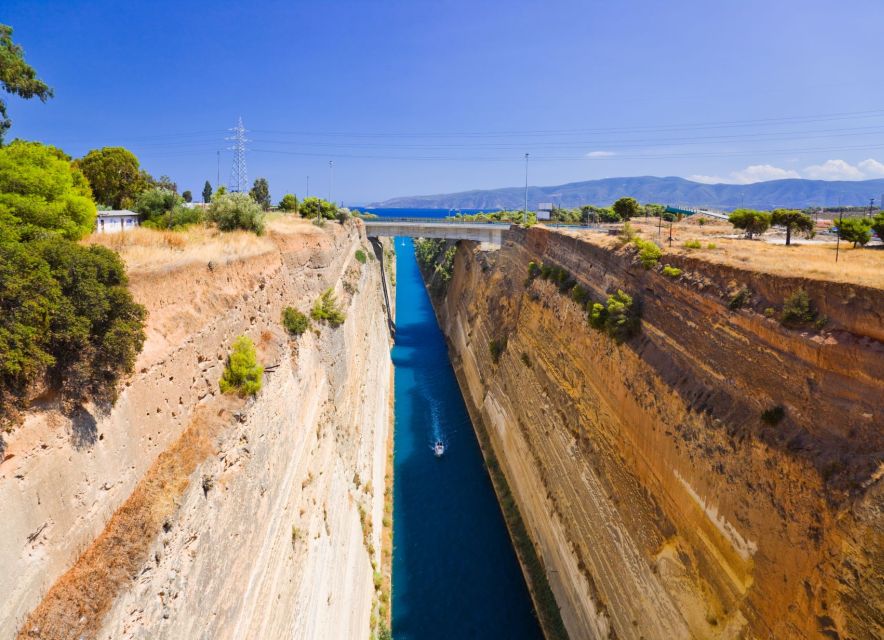
The first major sight is the Corinth Canal, cut through the narrow Isthmus of Corinth. It connects the Aegean Sea with the Ionian Sea, turning a strip of land into one of the most recognizable transport routes in Greece.
You stop briefly to take in the channel and the surrounding scenery. The canal is valuable as a first pause because it gives you a clear sense of geography. You are leaving the Athens area, crossing into the Peloponnese, and moving between two bodies of water through a remarkably narrow passage.
Do not expect a long visit here. The program describes a quick break rather than an extended exploration. That suits the stop: the canal is a visual landmark, best appreciated from the viewpoints available during the pause, before you continue toward Mycenae.
The drive along the Saronic Gulf is part of the pleasure of the route. You get changing coastal views before the tour turns toward the archaeological sites. Since the day includes substantial road time, it helps to treat the journey itself as part of the experience rather than as dead time between attractions.
Mycenae and the world of Homer
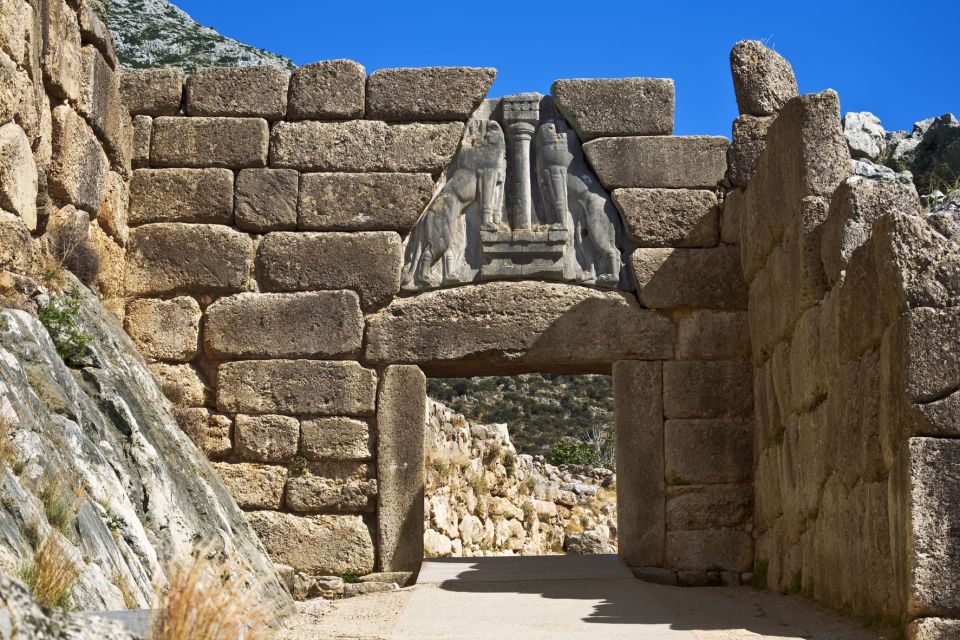
Mycenae is the tour’s most atmospheric archaeological stop. The site was a major center of Greek civilization and is tied to the classical stories preserved through Homer. The ruins give you a physical setting for those old accounts, with gates, walls, and tombs spread across an ancient site.
The Lion Gate is the signature feature. Its name comes from the carved lions above the entrance, and it provides a memorable focal point as you begin exploring the ruins. The structure is not just a photo stop. It helps you see how the entrance was designed to make an impression before you even move farther into the site.
The Cyclopean Walls add a sense of scale. Their massive stones are linked with the old belief that only the Cyclopes could have built them. The tour places you in the middle of the remains rather than presenting Mycenae only as a name from a textbook.
The Royal Tombs are another key part of the visit. They broaden the experience beyond fortifications and gateways, showing that Mycenae was also a place of burial and ceremony. Together, the Lion Gate, walls, and tombs give you three different ways to read the site.
Your guide matters here. A live guide in English or French can connect the physical remains with the poets and philosophers associated with classical Greece. The information provided does not name the individual guides, so do not book this expecting a particular person. Instead, choose your preferred language when availability is shown.
Mycenae is also where the day’s lunch break fits into the schedule. Lunch is included only if you select that option. If you do not, you need to cover your own meal and drinks. Since the tour continues to Epidauros and then returns to Athens, confirm the lunch arrangement before departure so you know what the $124 price includes for your booking.
Epidauros Theater rewards careful listening
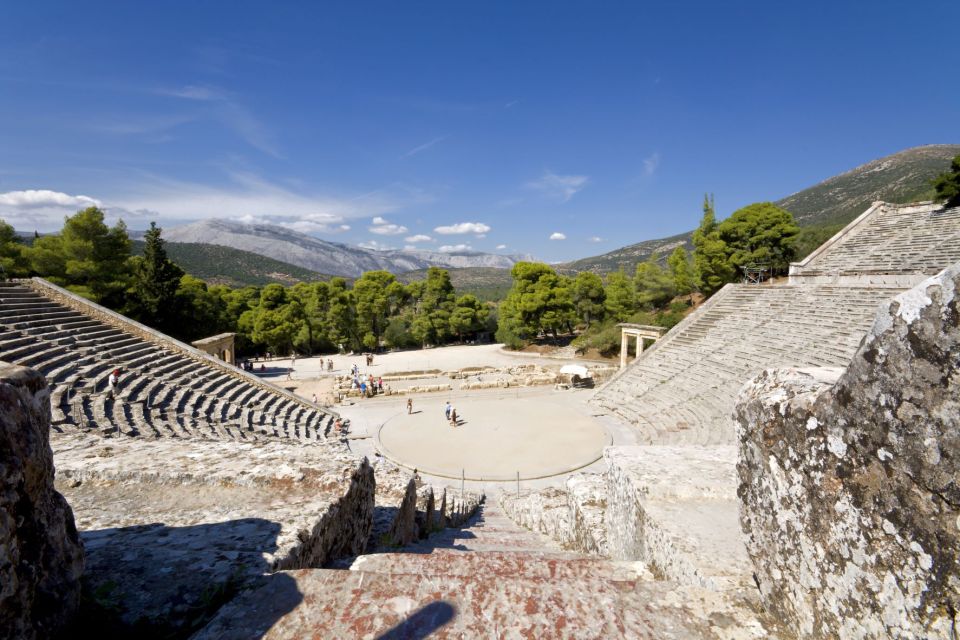
After Mycenae, the route continues to Epidauros. The main attraction is the 4th-century BCE theater, a landmark still used today and known for its astonishing acoustics.
This is a different kind of ancient site from Mycenae. Mycenae asks you to look at walls, gates, and tombs. Epidauros asks you to notice design, shape, and sound. The theater’s reputation for acoustics is not a minor detail. It is the reason the visit feels interactive even when you are simply standing in the seating area and listening.
The theater is described as breathtaking, but the useful point for you is its condition and continuing role. It is not only a ruin viewed from a distance. It remains a working performance space, which gives the stop a direct link between ancient construction and modern use.
The tour does not list a performance as part of the day, so plan to see the theater itself rather than expect a scheduled show. Even without one, the visit offers a strong final stop because it brings architecture and sound together after the more rugged remains at Mycenae.
The return route follows the national road from Epidauros to Corinth before continuing to Athens. By this stage, you will have spent much of the day on your feet and on the road. Comfortable shoes are specifically recommended, and that advice is worth taking seriously. The sites require walking around archaeological ground, and the full schedule leaves little room for recovering from poor footwear.
What the 11-hour schedule feels like
An 11-hour tour is a serious commitment, not a quick add-on to an Athens holiday. You leave the city, visit the canal, continue to Mycenae, stop for lunch, visit Epidauros, and return to Athens. The structure is efficient, but it will not feel unhurried.
I would book this early in your Athens stay if you want the Peloponnese but do not have time for an overnight trip. That gives you flexibility later if the long day leaves you ready for a quieter evening. If you already have several demanding excursions planned, compare the total walking and driving time before adding this one.
The main benefit of the schedule is reach. You see places that are difficult to combine without private transport, and you do not have to navigate the roads yourself. The main cost is attention and energy. You should be comfortable with a packed program and a late return to your Athens hotel.
The exact starting time depends on availability, so check it carefully when booking. The tour includes drop-off back at your hotel, which is useful after a day that ends with a drive from Epidauros through Corinth.
Guide language, transport, and lunch choices
The experience offers a live guide in English or French. That matters most at Mycenae, where the ruins can otherwise feel like a collection of stones and names. At Epidauros, a guide can also help place the theater in its wider setting, though the acoustics remain the central feature you can appreciate directly.
Transportation is included, making this a practical choice for anyone who does not want to rent a car. The information provided does not specify the vehicle type, group size, or exact pickup time, so check those details during the availability step if they affect your decision.
Lunch is an option, not an automatic part of every booking. If selected, it is included. Extra food and beverages are not included, so keep that distinction in mind when comparing the package price with other day trips.
The tour does not allow pets. It is also not suitable for wheelchair users, which is an important limitation for anyone who needs step-free access or specialized transport. Comfortable shoes are the main item to bring, and you should also be ready for a long day of movement between outdoor archaeological sites and the vehicle.
Who should book this Argolis tour
I would recommend this tour to you if you want to see beyond Athens in one day and care about ancient sites more than free time. It suits first-time visitors who want a guided introduction to the Corinth Canal, Mycenae, and Epidauros without building their own transport plan.
It is especially useful if you want context in English or French. Mycenae has several major features to understand, and the connection to Homer gives the visit a stronger sense of place. Epidauros then provides a change of mood, with a theater that remains connected to performance.
Families with older children may also find the variety helpful. The canal offers a quick visual stop, Mycenae has recognizable gates and walls, and Epidauros gives you a simple sound-based point of interest. Still, the 11-hour duration can be tiring for anyone who struggles with long road journeys.
I would think twice if you use a wheelchair, dislike organized schedules, or want to spend a lot of time at one site. This is also not the right pick if you want a full meal and drinks automatically included, since lunch depends on the selected option and extras are separate.
Cancellation and booking flexibility
You can cancel up to 24 hours in advance for a full refund. The reserve-now, pay-later option lets you hold a place without paying immediately, which can help while you are still arranging your Athens plans.
Check the starting time and lunch selection before finalizing the booking. The tour is offered in English and French, and the price is listed at $124 per person, with the exact inclusions depending on the option you select.
FAQ
How long is the Peloponnese tour from Athens?
The tour lasts 11 hours. Check availability for the specific starting times.
What places does the tour visit?
The itinerary includes the Corinth Canal, the archaeological site of Mycenae, and the theater at Epidauros.
Is transportation included?
Yes. Transportation from Athens and the return drop-off at your hotel are included.
Is lunch included?
Lunch is included if you select the lunch option. Extra food and beverages are not included.
What languages does the guide speak?
The live tour guide is available in English or French.
What should I bring?
Bring comfortable shoes, since the tour includes visits to archaeological sites.
Are pets allowed?
No. Pets are not allowed on the tour.
Is the tour suitable for wheelchair users?
No. The activity is not suitable for wheelchair users.
Should you book this Athens to Peloponnese tour?
Book it if you want an efficient, guided day covering three very different sights: the Corinth Canal, Homer-linked Mycenae, and the acoustically famous theater at Epidauros. The $124 cost is reasonable for a full day with transportation and a guide, especially if you select the lunch-inclusive option and want to avoid renting a car.
Skip it if an 11-hour schedule sounds exhausting or if you need wheelchair access. For everyone else, this is a strong choice when your Athens plans allow only one day for Argolis and you want the major sights handled in one organized route.