REVIEW · PYRGOS KALLISTIS
Santorini: Traditional Villages and Akrotiri Private Tour
Book on GetYourGuide →Operated by Santorini i-Land Tours · Bookable on GetYourGuide
Santorini’s famous views are only part of the story. This private tour takes you away from the postcard cliffs and into Pyrgos, Megalochori, and Emporio, where narrow lanes, castle walls, cave homes, and old churches show how island life worked before the crowds arrived. You’ll then connect that living history with the 4,000-year-old ruins at Akrotiri and the rust-colored cliffs of Red Beach.
I like the private vehicle and flexible feel, especially if you are visiting Santorini from a cruise ship and want to cover several far-flung sights in half a day. I also like the mix of villages and archaeology. The main drawback is time: 4.5 hours moves quickly, and the tour includes hills and walking, so it is not a good fit if you need easy, level access.
In This Review
- Key points at a glance
- Why this tour makes sense for a first Santorini visit
- Pyrgos and its hilltop Venetian castle
- Megalochori for old houses and a slower pace
- Emporio and its medieval passageways
- Akrotiri, Santorini’s buried Bronze Age town
- Red Beach closes the route with volcanic color
- What the private vehicle and guide add
- The $259 price and what you receive
- Walking, timing, and who should book
- Should you book this Santorini tour?
- FAQ
- How long does the Santorini tour last?
- What places does the tour visit?
- Is pickup and drop-off included?
- Can cruise ship passengers book this tour?
- Is transportation included?
- Is the Akrotiri entrance fee included?
- Is a licensed guide at Akrotiri included?
- What languages are available?
- Is this a private group tour?
- Is the tour suitable for people with mobility impairments?
Key points at a glance
- Pyrgos begins the tour with a Venetian castle and hilltop village lanes, giving you an early look at Santorini beyond the caldera.
- Megalochori offers a quieter village stop, with volcanic-rock homes, cave dwellings, bell towers, and a traditional square.
- Emporio preserves a medieval defensive layout, built with tight passageways to guard against pirate attacks.
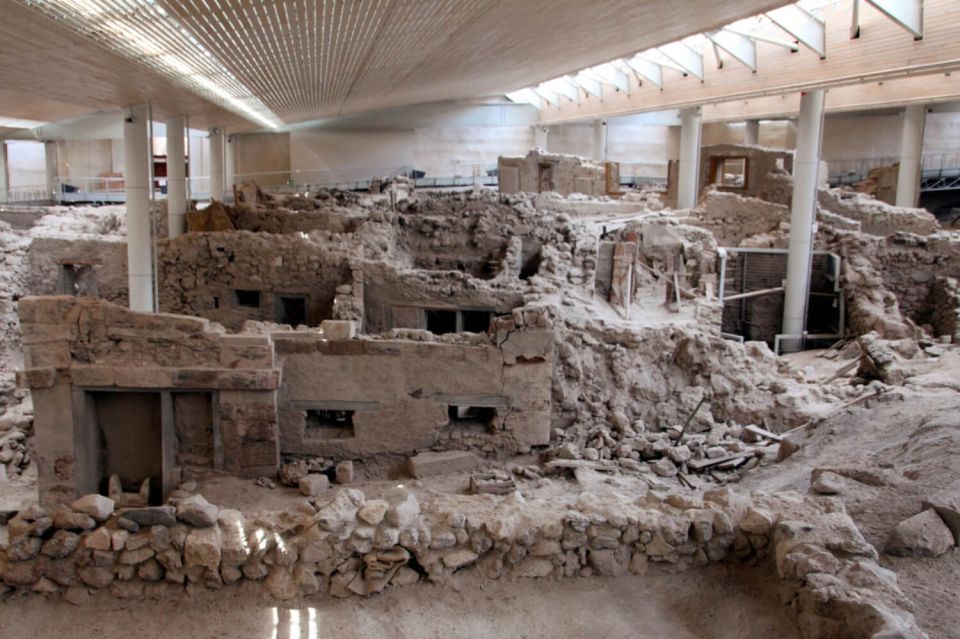
- Akrotiri admission is included, and the covered archaeological site reveals multi-story buildings, wall paintings, and an advanced drainage system.
- Red Beach provides a dramatic final stop, with red volcanic cliffs and views that feel very different from Santorini’s white-and-blue towns.
- Private pickup and drop-off simplify a short visit, with collection from most hotels or the top of the cable car for cruise passengers.
Why this tour makes sense for a first Santorini visit
Santorini can be awkward to explore on your own in a short window. The island’s best-known sights are spread out, roads can be busy, and many hotels sit on lanes too narrow for a vehicle. This tour solves much of that problem with a private, air-conditioned vehicle and a local driver-guide.
You do not spend the day simply staring at the caldera. Instead, you see the southern part of the island, where Santorini’s old villages and volcanic past come into sharper focus. That makes this a useful introduction if you want more than cliffside photographs.
The private format matters. You are not tied to a large group moving at one fixed pace, though the 4.5-hour schedule still has limits. Your pickup is arranged from your hotel, the nearest accessible point, the port, or the airport. Cruise passengers are collected at the top of the cable car, since vehicles do not reach the ship area directly.
For a cruise visit, this setup is especially practical. You will need to pay for the cable car separately, at €6 per person per ride, but the tour removes the need to arrange transport across the island once you reach the top.
You can also read our reviews of more tours and experiences in Pyrgos Kallistis.

Pyrgos and its hilltop Venetian castle
Pyrgos is a strong opening stop because it gives you a sense of how Santorini villages were built for protection. The settlement rises around a 16th-century Venetian castle, with lanes that curve and narrow as they climb.
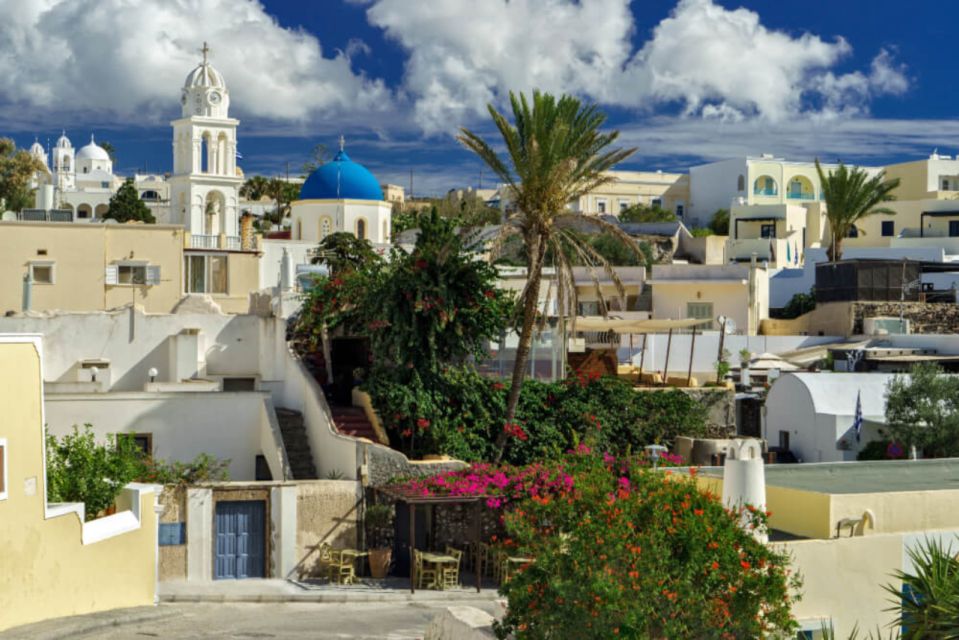
This is not a place designed for quick, straight walking. The circular streets and tight alleys were part of the defense, making the village harder to enter and easier to protect. As you walk, look for the details that make Santorini’s inland towns different from the polished viewpoints near Oia and Fira: small cave homes, balconies, blue-domed churches, vineyards, and pebbled paths.
The hilltop setting also gives Pyrgos a visual advantage. You get views across the island while standing among buildings that feel rooted in daily life rather than arranged for a photograph. The tradeoff is physical effort. Some paths are steep, and the castle area is reached on foot, so comfortable shoes matter.
Pyrgos is best treated as an orientation stop. It introduces the island’s Venetian past, defensive village design, and agricultural side without using up the entire morning.
Megalochori for old houses and a slower pace
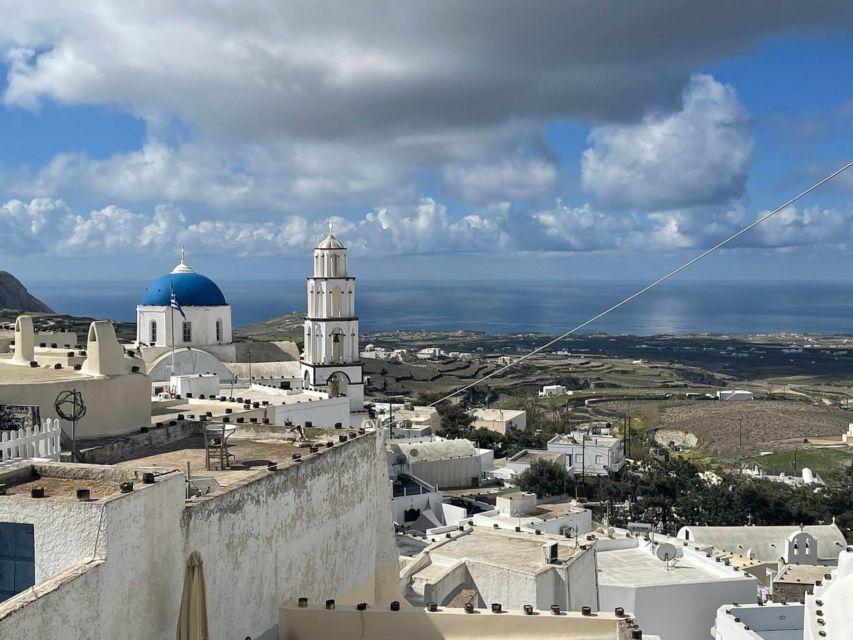
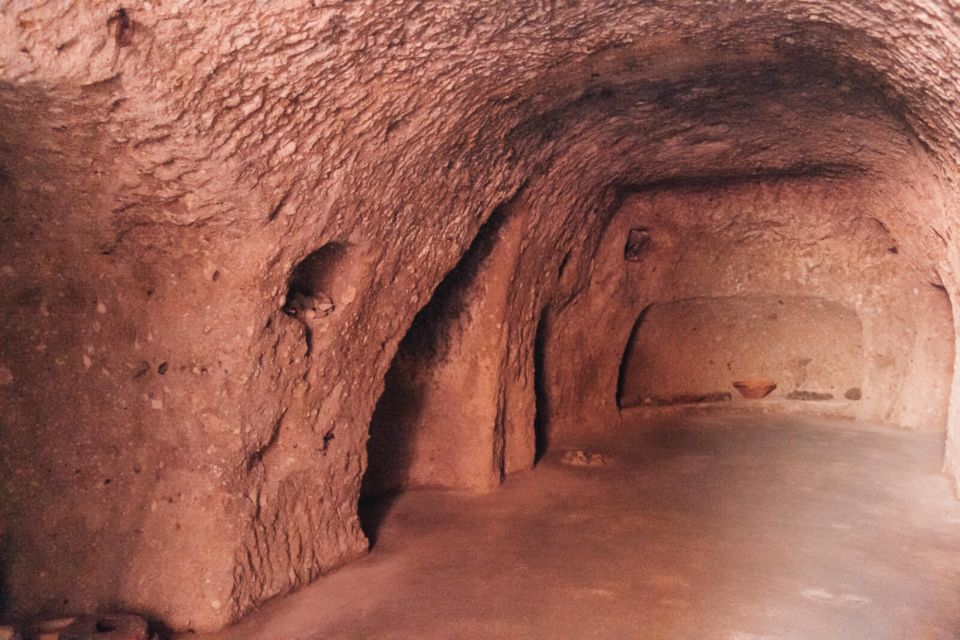
Megalochori is described as one of Santorini’s most charming villages, but the useful point is what you do there. Its traditional Cycladic buildings were shaped from volcanic rock, and the village includes underground caves, whitewashed structures, blue-domed churches, and tower bells.
The narrow streets lead to a pebbled square where you can stop for Greek coffee if time allows. That small detail helps separate Megalochori from a standard sightseeing circuit. You are not only looking at architecture. You get a chance to sit in a village setting and watch local life pass through the square.
I would not expect a long café break on a tightly timed 4.5-hour tour. The coffee stop is an option, not a promise of an extended meal. Still, Megalochori gives the itinerary a needed pause between the castle village and the archaeological site.
The village is also a good place to notice how Santorini’s homes adapted to the island. Cave dwellings and volcanic-rock construction were practical responses to the climate, terrain, and available materials. Your guide can connect those features to the way people lived, rather than leaving you with a row of pretty white buildings and no context.
Emporio and its medieval passageways
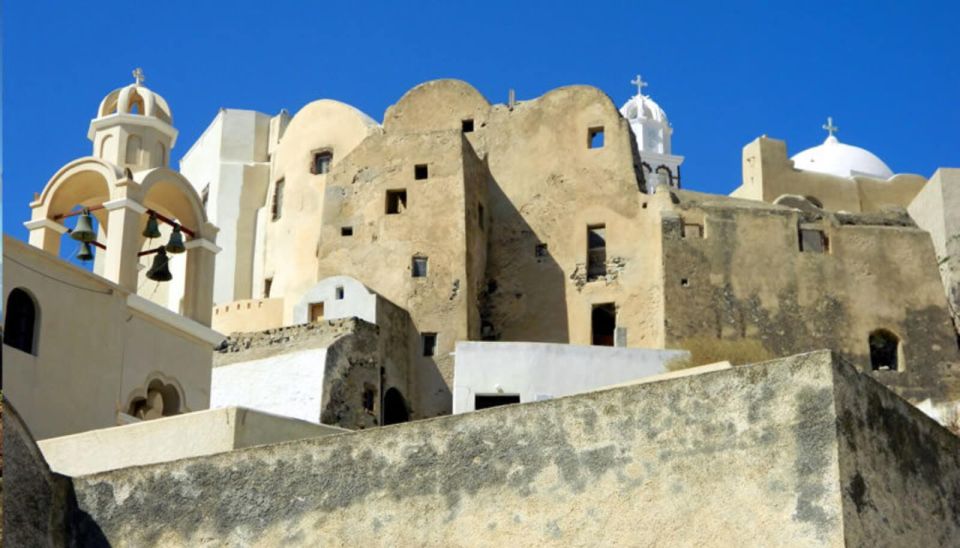
Emporio was Santorini’s commercial center during the Middle Ages and served as another fortified settlement. Its homes were built close together, with narrow lanes that helped protect residents from pirates.
The old castle area is the main reason to stop. Walking through its carefully maintained paths, you can see how a village could function as both a neighborhood and a defensive structure. The experience is more about layout and atmosphere than about one grand monument.
This stop rewards curiosity. Look at the way doorways, walls, and passageways fit together. The tight design makes more sense once you understand the threat it was meant to address. It also gives you a different view of Santorini’s past than the better-known volcanic eruption story.
Emporio can feel less immediately spectacular than Red Beach or Akrotiri. That is part of its value, but it may not satisfy you if you want a tour made entirely of big visual moments. The guide’s explanations are important here. Without context, you may simply see a pretty maze of lanes. With context, the village becomes a practical record of life under pressure.
Akrotiri, Santorini’s buried Bronze Age town
Akrotiri is the centerpiece for anyone interested in archaeology. This Bronze Age settlement flourished for thousands of years before a volcanic eruption covered it in ash. The ash helped preserve much of the town, leaving behind walls, multi-story buildings, paintings, and an intricate drainage system.
You walk through a protected archaeological area rather than across exposed ruins. The preserved remains show that this was not a simple cluster of huts. The three-story structures and drainage works point to a settled urban community with planning, trade, and skilled construction.
Admission to the excavations is included, and the tour includes skip-the-ticket-line access. That is useful during a short visit, since waiting at the entrance would take time away from the site itself.
An optional licensed guide at Akrotiri is not included. The local driver-guide will accompany the wider tour in English or Greek, but you should confirm what level of explanation you want at the excavation before booking. If Akrotiri is your main reason for coming, paying extra for a specialist guide could make the ruins easier to understand. If you mainly want to see the site and hear an overview, the included arrangement may be enough.
Give this stop your full attention. The walls and drainage channels can seem abstract at first, but the basic idea is striking: a whole town was sealed beneath volcanic ash and preserved for modern eyes. The site is also where the tour’s village architecture starts to feel connected to a much older Santorini.
Red Beach closes the route with volcanic color
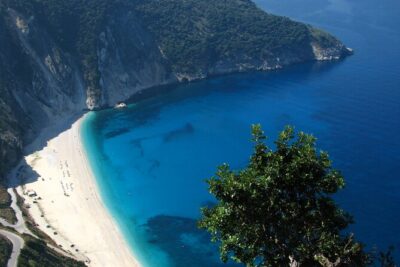
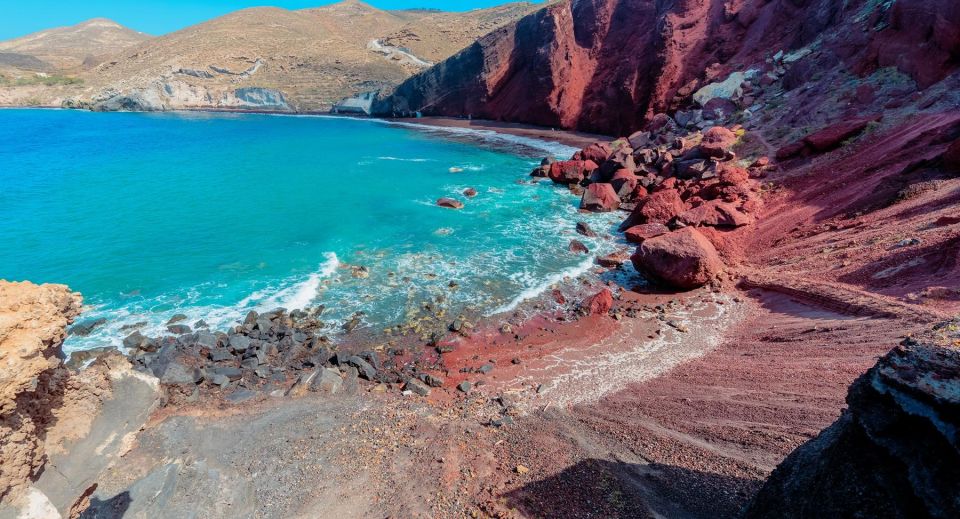
Red Beach is a short drive from Akrotiri and provides the tour’s final visual change. Its cliffs are formed from volcanic material, producing the deep red and rust-colored tones that give the beach its name.
You stop to take in the natural setting and views. The visit is brief, so think of it as a scenic finish rather than a beach day. The tour does not promise swimming time, a long walk along the shore, or a full beach stay.
That distinction is useful. Santorini has many places where the best experience comes from simply looking, and Red Beach is one of them. After the built environment of the villages and the carefully protected ruins at Akrotiri, the red cliffs bring you back to the island’s volcanic character.
Walking is still part of the stop, and some hills or uneven areas may be involved. If your mobility is limited, ask for precise conditions before booking. The tour is specifically not suited to people with mobility impairments.
What the private vehicle and guide add
The tour uses a luxury air-conditioned vehicle, with bottled water included. That matters in Santorini, where a half-day spent moving between villages can mean heat, hills, and exposure to the sun.
A private group also gives you more control over questions and attention. You can ask why a village is shaped the way it is, how the castle worked, or what you are seeing at Akrotiri without competing with a large crowd. The driver-guide speaks English or Greek.
One guide named in the available information is Dora, who was praised for being very good and for making the experience interesting, informative, and beautiful. You should not assume Dora will lead every departure, but her name is useful if you are able to request a guide when booking.
Pickup planning requires a little care. Many Santorini hotels are not accessible by vehicle, so you may be directed to the closest practical pickup point. The exact location is confirmed at least one day before the activity. Cruise passengers meet at the top of the cable car rather than at the ship.
The $259 price and what you receive
At $259 per person, this is not a budget sightseeing outing. The value depends heavily on your group size and your priorities.
You are paying for a private experience, hotel or port pickup and drop-off, an air-conditioned vehicle, an English or Greek-speaking local guide, bottled water, taxes, and admission to Akrotiri. The route also covers five major stops in 4.5 hours, which would be difficult to manage independently in a cruise port window.
The price makes more sense for couples, families, or small groups who would otherwise need several taxis or a private car. It is less compelling if you are comfortable using public transport, have a full day on the island, or mainly want to visit one site.
Remember the extras. Cruise passengers pay €6 per person per cable car ride. A licensed specialist guide at Akrotiri is also optional and costs extra. Food, drinks beyond the included water, and personal purchases are not listed as part of the package.
The short duration keeps the cost from becoming an all-day commitment, but it also means you should not expect long stops at every place. This is a broad introduction, not an unhurried village study.
Walking, timing, and who should book
You should expect walking in all the historic villages. Some spots can only be reached on foot, and the route includes hills and inclines. Wear shoes with a firm grip and avoid planning this tour if level access is essential.
The tour suits a first-time visitor who wants to understand Santorini’s inland villages and ancient past in one outing. It also suits cruise passengers who need reliable transport and a clear return to the original pickup area.
I would especially consider it if you have only one day or part of a day on the island. The private arrangement helps you use that limited time well, and the route includes sights that are easy to miss if you stay only around the caldera.
You may want something else if your main goal is swimming, winery visits, a long meal, or sunset views. None of those is the focus here. The emphasis is villages, history, archaeology, and volcanic scenery.
Free cancellation is available up to 24 hours before the start, and you can reserve now and pay later. Those terms are useful when cruise schedules or island plans remain uncertain, but confirm the start time and pickup location once they are provided.
Should you book this Santorini tour?
Book it if you want a private half-day history route that reaches several southern Santorini sights without forcing you to arrange every transfer yourself. Pyrgos, Megalochori, and Emporio give you a more grounded view of island life, while Akrotiri supplies the major archaeological experience and Red Beach finishes with strong scenery.
The best fit is an active first-time visitor, a small group, or a cruise passenger with limited time. Skip it if you need an accessible route, want long stays at each stop, or prefer to spend the day around the caldera.
If Akrotiri matters most to you, ask about adding the licensed archaeological guide. If you want a broad, efficient introduction with a local escort, the included arrangement offers a sensible way to see much of Santorini in 4.5 hours.
FAQ
How long does the Santorini tour last?
The tour lasts 4.5 hours.
What places does the tour visit?
The route includes Pyrgos, Megalochori, Emporio, the Akrotiri archaeological excavations, and Red Beach.
Is pickup and drop-off included?
Yes. Pickup and drop-off are included from most hotels, the nearest accessible point, the port, or the airport. Cruise passengers are picked up at the top of the cable car.
Can cruise ship passengers book this tour?
Yes. Cruise passengers can meet the tour at the top of the cable car. Cable car tickets are not included and cost €6 per person per ride.
Is transportation included?
Yes. Transportation is provided in a luxury air-conditioned vehicle.
Is the Akrotiri entrance fee included?
Yes. Admission to the Akrotiri excavation site is included, with skip-the-ticket-line access.
Is a licensed guide at Akrotiri included?
No. A guided visit by a licensed guide at Akrotiri is optional and is not included in the listed price.
What languages are available?
The tour is available with a live guide who speaks English or Greek.
Is this a private group tour?
Yes. The tour is operated as a private group experience.
Is the tour suitable for people with mobility impairments?
No. The tour includes walking, hills, inclines, and places that can only be reached on foot. It is not suitable for people with mobility impairments.