REVIEW · SANTORINI
Traditional Villages & Akrotiri Excavations: Private Tour
Book on Viator →Operated by Santorini i-Land Tours · Bookable on Viator
Akrotiri is the star here: a 4,000-year-old town preserved under volcanic ash, with three-story buildings, wall paintings, and an advanced drainage system. You then see Santorini beyond the postcard views, in Pyrgos, Megalochori, and Emporio, where narrow lanes were built for safety, not Instagram.
I like the private format and the flexible pickup. I also like the mix of village life, archaeology, and Red Beach in one outing. The main catch is that your driver-guide cannot lead you inside Akrotiri, so you will explore the excavation on your own unless you pay for a separate licensed guide.
In This Review
- Key points
- Why this half-day tour works well
- Pyrgos and its Venetian hilltop castle
- Megalochori, volcanic homes, and a quiet village square
- Emporio and the island’s medieval defenses
- Akrotiri: the reason to make room in your schedule
- Red Beach and the final scenic stop
- Private transport, pickup, and cruise ship timing
- Is $240.32 per person a fair price?
- Who will enjoy this tour most?
- Booking advice and cancellation details
- Should you book it?
- FAQ
- How long does the tour last?
- Is this a private tour?
- Is hotel pickup included?
- Where do cruise ship passengers meet?
- Is the cable car ticket included?
- Is Akrotiri admission included?
- Does the tour guide enter Akrotiri with the group?
- Is the tour offered in English?
- Does the tour require much walking?
- Can I cancel for a full refund?
Key points
- Akrotiri admission is included: See the preserved Bronze Age town beneath its protective volcanic roof.
- Three old villages offer different views of Santorini: Pyrgos has its hilltop castle, Megalochori its quiet square, and Emporio its medieval lanes.
- A private vehicle keeps the day flexible: Only your group participates, with hotel, port, or airport pickup.
- Dimitris is one named guide: He is noted for being attentive, informative, and helpful when cruise delays caused a late meeting.
- The 4.5-hour schedule includes driving: You get a useful island overview, but each stop is fairly short.
- Budget for extras: The optional licensed guide at Akrotiri and the cruise ship cable car are not included.
Why this half-day tour works well

Santorini is easy to reduce to white buildings and blue domes. This tour gives you a better sense of the island’s older, quieter side. You move through fortified villages, walk among homes cut into volcanic rock, and finish with one of the Aegean’s most important archaeological sites.
The private setup matters. You are not sharing the vehicle with a large group, so your guide can speak directly with you and adjust the pace within the fixed 4.5-hour window. Pickup and drop-off are included from most hotels, or from the nearest practical point when roads are too narrow. Cruise ship passengers meet at the top of the cable car rather than at the ship.
At $240.32 per person, this is not a budget sightseeing bus. The value improves if you are traveling with people who appreciate a private ride and direct attention from an English-speaking guide. You are paying for transport, pickup, bottled water, an air-conditioned vehicle, village stops, and entry to Akrotiri. If you are a solo visitor or a couple watching every euro, public transport and separate tickets may cost less, but they will not give you the same door-to-door ease.
The schedule is also worth reading carefully. The advertised duration includes travel between sites, pickup, and drop-off. That leaves roughly three hours and forty minutes at the listed stops, before allowing for traffic or delays. You will see a lot, but this is a sampler, not a slow village walk.
You can also read our reviews of more private tours in Santorini


Pyrgos and its Venetian hilltop castle

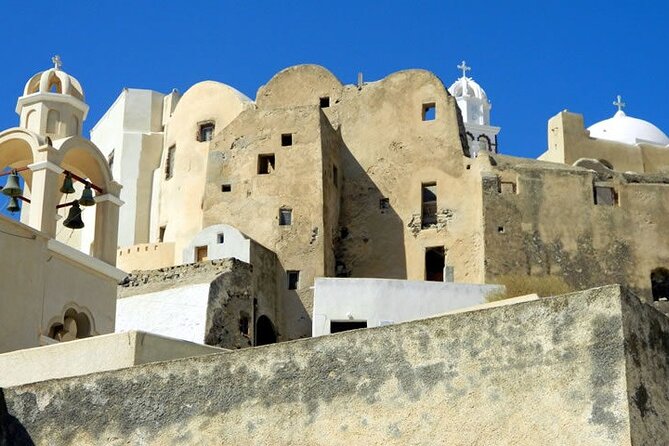
Pyrgos is the first stop, with about 45 minutes to explore. The village climbs toward a Venetian castle from the 16th century, and its layout tells you something about Santorini’s past. Circular streets and narrow lanes made the settlement easier to defend, while homes pressed close together for protection.
This is a good place to start because it gives you a feel for the island’s traditional form before the tour turns to archaeology. Look for small cave homes, balconies, pebbled paths, vineyards, and blue-domed churches tucked into the dense village fabric.
The climb is part of the experience, but it is also a practical concern. Pyrgos is hilly, and the lanes can be uneven. You do not need extreme fitness, but you should be comfortable walking uphill for short stretches. Wear shoes with a firm sole rather than smooth sandals.
Forty-five minutes is enough to see the main lanes and take in the castle area. It is not enough for every side street, a long café stop, or a detailed visit to every church. I would keep your first walk focused and save questions for the guide as you go.
Megalochori, volcanic homes, and a quiet village square
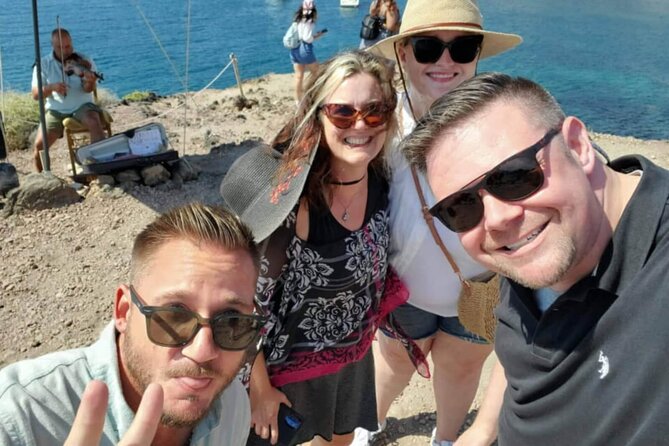
Megalochori gets about 50 minutes, making it the longest of the three village stops. It is a particularly useful contrast with the more famous cliffside parts of Santorini. Here, traditional Cycladic buildings are built into volcanic rock, and the streets remain more residential in character.
You will see blue-domed churches, underground cave homes, whitewashed bell towers, and winding lanes. The central pebble-stone square is a natural place to pause. The tour description suggests Greek coffee there, but your time and any purchase are your own responsibility.
I like this stop because it gives you room to notice details instead of simply taking a quick photo and returning to the vehicle. Look at how the buildings relate to one another. Many homes were shaped by the island’s volcanic material and by the need to stay cool and secure.
The village is described as less tourist-focused than Santorini’s headline sights, but you should still keep the visit modest in expectation. This is not a staged cultural show. You are passing through a working community, so the pleasure comes from observing its streets, homes, and everyday rhythm. Be respectful around churches and private doorways.
Emporio and the island’s medieval defenses

Emporio occupies about 45 minutes of the tour. During the Middle Ages, it served as an important commercial center, and its old settlement was arranged with defense in mind. Homes were built tightly together, with narrow passages that helped protect residents from pirate attacks.
The fortified section is the main draw. As you walk through the lanes, notice how little space there is between buildings. This compact design can feel maze-like, but that is exactly the point. The village was built for security and community, not for broad streets or grand viewpoints.
Emporio adds historical depth to the day. Pyrgos shows a hilltop defensive village, while Emporio gives you a closer look at an old commercial center and its castle paths. You will not get a full museum-style lesson at either place, but an effective guide can connect the layout to Santorini’s wider story.
Again, the walk includes slopes and uneven surfaces. If you have limited mobility, ask about the route before booking. The tour requires moderate physical fitness, and the private format lets you discuss the pace, but it does not remove the hills.
Akrotiri: the reason to make room in your schedule

Akrotiri receives about one hour, and admission is included. This is the most significant stop on the tour, especially if you enjoy ancient sites rather than only scenic viewpoints.
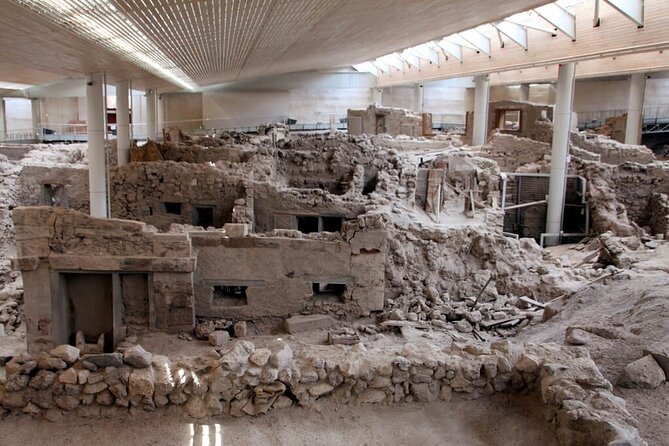
The settlement dates back about 4,000 years and flourished during the Bronze Age. A volcanic eruption buried it beneath ash, which helped preserve parts of the town. You can walk around the excavated remains and see walls, multi-story structures, paintings, drainage works, and other features linked to Minoan-era life.
The protective roof over the site makes the visit more manageable in strong sun, though you should still carry water. Bottled water is provided during the tour. The scale of the town is easier to understand when you take time to look at the building plans rather than rushing from one preserved section to the next.
One important limitation affects your experience: the local guide or driver is not allowed to enter and explain the excavation with you. You receive admission, but you explore the interior independently unless you arrange the optional guided tour with a licensed archaeological guide. That extra cost is not included.
This is the clearest decision point in the booking. If you mainly want to see Akrotiri and learn detailed archaeological facts, pay for the licensed guide or arrange a separate guided visit. If you are happy to read the site information and absorb the remains at your own pace, the included entry is still useful.
An hour gives you a solid introduction, but it is not generous for a major archaeological site. Keep an eye on the meeting time, especially if you enjoy reading every panel. Your vehicle still has to reach Red Beach and return you to your drop-off point.






Red Beach and the final scenic stop
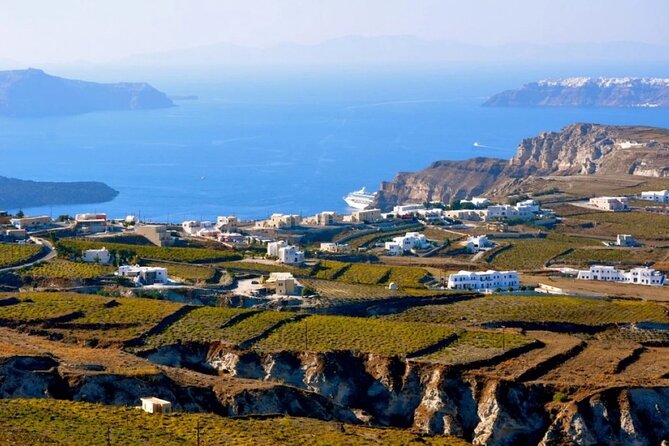
The final stop takes about 20 minutes. You travel a short distance toward Red Beach to see the contrast between dark volcanic ground and the red-toned cliffs.
This is a brief viewpoint stop rather than a beach day. The tour information promises views of the natural formation, but it does not include swimming time or a long walk along the shore. Treat it as a chance to take photos, breathe in the setting, and see another result of Santorini’s volcanic past.
One account of the outing also included a black sand beach and a monastery high on the mountain. Those places are not part of the stated standard schedule, so do not book this tour expecting them. Routes can sometimes vary, but Pyrgos, Megalochori, Emporio, Akrotiri, and Red Beach are the core stops.
Private transport, pickup, and cruise ship timing
Transport is by luxury air-conditioned vehicle, with hotel, port, and airport pickup and drop-off included. From many hotels, the vehicle can collect you directly. At some locations, especially narrow roads, you may need to walk to the closest accessible meeting point.
Cruise passengers meet at the top of the cable car. The cable car ticket is separate and costs €6 per person, per ride. You should include both the outbound and return rides in your cruise-day budget unless your port arrangements say otherwise.
The private format is helpful for cruise passengers because tendering can create real delays. Dimitris, one of the guides associated with this experience, is specifically praised for locating a late-arriving party at a changed meeting point and adding the lost hour to the outing. That is encouraging, but you should still contact the operator as soon as your ship schedule changes. Do not assume every delay can be absorbed.
The tour is offered in English. An English-speaking local guide accompanies your group, explains the villages and island sights, and handles the driving. The guide can enter the villages with you, but not the Akrotiri excavation itself.
Is $240.32 per person a fair price?
The price makes the most sense for a small group that values convenience. You get a private vehicle, direct pickup, an English-speaking guide, bottled water, taxes, and Akrotiri admission. You also avoid arranging several separate rides across the island.
If two people book, the per-person price can feel steep for a 4.5-hour outing. If several people share the private vehicle, the value becomes easier to justify, particularly with group discounts available. The best comparison is not against a basic bus ticket. Compare it with the cost and effort of arranging transport to three villages, Akrotiri, and Red Beach on your own.
The experience also saves planning time. You do not need to study island bus connections, find parking, or work out how to link inland villages with the archaeological site. That convenience is especially useful for a short stay or a port day.
Still, the price does not cover everything. Personal expenses and tips are optional. Cruise passengers pay separately for the cable car, and the licensed Akrotiri guide is an extra if you want guided interpretation inside the excavation.
Who will enjoy this tour most?

I would recommend this outing to you if you want more than Santorini’s famous caldera towns. It suits first-time visitors who want a compact introduction to village architecture, medieval defenses, volcanic scenery, and ancient history.
It is also a good fit for families or friends who prefer a private vehicle. You can ask questions directly, keep your party together, and avoid a large shared group. The flexible format helped one delayed cruise party recover lost time, which is a real advantage on a port visit.
The tour is less suitable if you want long café breaks, extensive shopping, a beach afternoon, or a slow archaeological study. The schedule moves steadily, and the 20-minute Red Beach stop is short.
You should also think about walking ability. The villages include hills, inclines, narrow lanes, and pebbled paths. Moderate fitness is required. The vehicle reduces the strain between sites, but it cannot turn the old village streets into flat pavement.
Booking advice and cancellation details
The tour is often reserved well ahead, with an average booking lead time of 47 days. That suggests you should plan early if your Santorini visit falls during a busy period, especially if you need a particular pickup time.
Confirmation is issued when you book. Free cancellation is available when you cancel at least 24 hours before the local start time. Cancellations or changes made inside that 24-hour window are not refunded or accepted.
Before paying, decide if you want the optional licensed guide at Akrotiri. The answer depends on your priorities. If the excavation is your main reason for booking, add that service if available. If the villages and private transport matter just as much, the included admission may be enough.
Should you book it?
Book this tour if you want a private, well-rounded Santorini day that reaches inland villages and Akrotiri without forcing you to manage transport. The combination is strong: Pyrgos for its hilltop defenses, Megalochori for traditional homes and village life, Emporio for medieval lanes, Akrotiri for ancient remains, and Red Beach for volcanic scenery.
I would hesitate only if you want a slow pace or detailed guidance inside Akrotiri. In that case, ask about the licensed archaeological guide before booking, or choose a tour built around a longer site visit. For most visitors with limited time, though, this is a practical way to see a side of Santorini that the caldera viewpoints do not show.
FAQ
How long does the tour last?
The tour lasts approximately 4 hours and 30 minutes. Pickup, drop-off, and driving time between attractions are included.
Is this a private tour?
Yes. Only your group participates in the activity.
Is hotel pickup included?
Yes. Pickup and drop-off are offered from most hotels in Santorini, or from the closest accessible point.
Where do cruise ship passengers meet?
Cruise ship passengers are picked up at the top of the cable car.
Is the cable car ticket included?
No. Cruise ship passengers must pay €6 per person for each cable car ride.
Is Akrotiri admission included?
Yes. Admission to the Akrotiri excavation site is included.
Does the tour guide enter Akrotiri with the group?
No. The local tour guide or driver is not permitted to enter and guide visitors inside the excavation. An optional tour with a licensed guide is available at an additional cost.
Is the tour offered in English?
Yes. An English-speaking local guide is included.
Does the tour require much walking?
The tour includes walking on hills, inclines, narrow village lanes, and pebbled paths. A moderate level of physical fitness is recommended.
Can I cancel for a full refund?
Yes, if you cancel at least 24 hours before the experience start time. Cancellations or changes made less than 24 hours before the start are not refunded or accepted.