REVIEW · ATHENS
6 Day Religious & Classical Tour of Thermopylae, Meteora, Delphi, Olympia, Mycenae, Nafplio, Epidaurus, ancient Corinth From Athens
Book on Viator →Operated by Ancient Greece Tours & Transfers · Bookable on Viator
Thermopylae, Meteora’s cliff monasteries, Delphi’s oracle and the stadium at Olympia give this six-day private circuit a powerful sense of place. You move from Spartan legend to Orthodox monasteries, then through the great sanctuaries and citadels of the ancient Greek world.
I like the freedom of a private car, especially when a long road day calls for a coffee stop, a village lunch or a small change of plan. I also like the human scale of the route: evenings in Kalambaka, Delphi, Olympia, Nafplio and Ancient Corinth let you eat and stroll after the archaeological sites close.
The tradeoff is pace. You cover a large part of Greece in six days, and several days combine major ruins with long drives. The $2,358.13 per-person price also excludes five nights of accommodation, entrance fees, meals and a licensed guide inside the sites, so your final cost will be higher.
In This Review
- Key points to know before you book
- From Athens to Thermopylae and the Gates of Fire
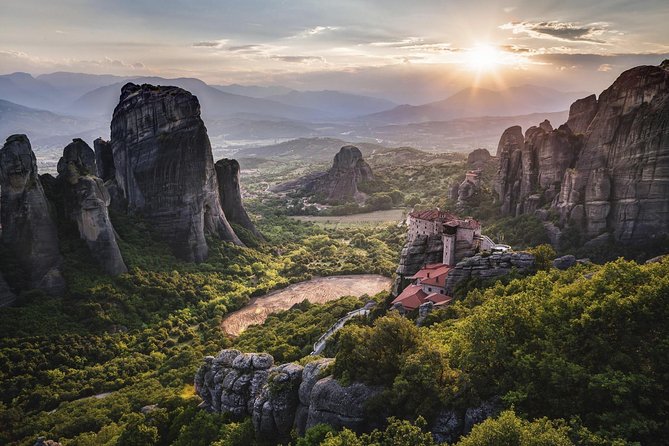
- Sunset beneath Meteora’s hanging monasteries
- Delphi, where Apollo’s oracle shaped Greek decisions
- Olympia and the birthplace of the Olympic Games
- Nafplio brings the best evening on the route
- Epidaurus and Mycenae, two very different ancient worlds
- Acrocorinth, Ancient Corinth and the canal
- What the $2,358.13 price really covers
- Who should book this Greek circuit?
- Should you book it?
- FAQ
- Where does the tour begin and end?
- What time does pickup begin?
- Is the tour private?
- Is a licensed guide included?
- Are hotels included in the price?
- Are entrance fees included?
- What should I wear at the monasteries and religious sites?
- Can I cancel for a full refund?
Key points to know before you book
- Thermopylae begins the journey with Spartan history, a battle museum and hot springs.
- Meteora gives you one sunset and two monastery visits, but dress rules and uphill walks matter.
- Delphi and Olympia reward readers of Greek mythology, ancient religion and Olympic history.
- Nafplio is the tour’s best evening base, with a waterfront, fortress views, sweets and old streets.
- Mycenae, Epidaurus and Corinth bring the Peloponnese’s strongest ancient sites into one route.
- A private driver adds flexibility, but a licensed guide and admission tickets are extra.
From Athens to Thermopylae and the Gates of Fire
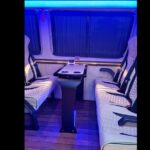
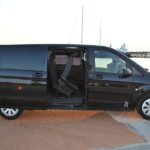
Your driver collects you from your Athens hotel, Airbnb or apartment at about 10:00 a.m. The vehicle is private, with WiFi, bottled water, refreshing wipes and handmade Greek biscuits. Airport and port pickup can be arranged for an additional cost.
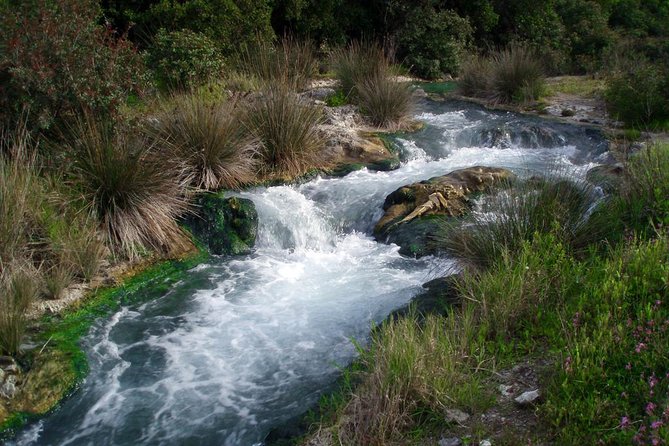
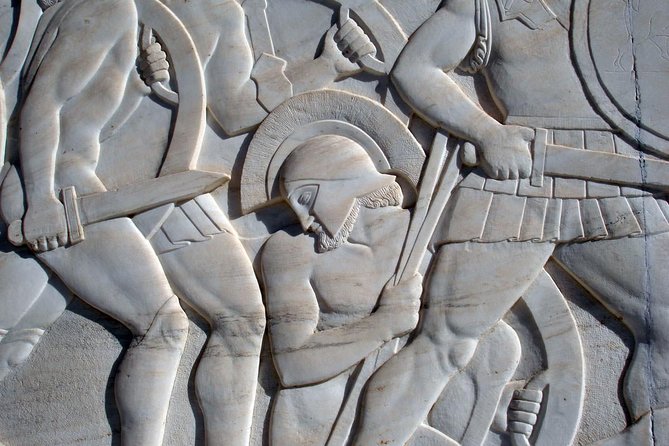
The first stop is Thermopylae, where the narrow pass once linked the mountains and sea. The setting has changed over time, but the name still calls up the 480 BC battle between the Greek forces led by Leonidas of Sparta and the Persian army of Xerxes.
The King Leonidas monument is the clearest symbol here. The bronze Spartan figure holds his shield and spear, and the nearby battle museum gives the famous last stand more structure than the usual movie version. You can connect the terrain, the military story and the later effect of the battle on Greek identity.
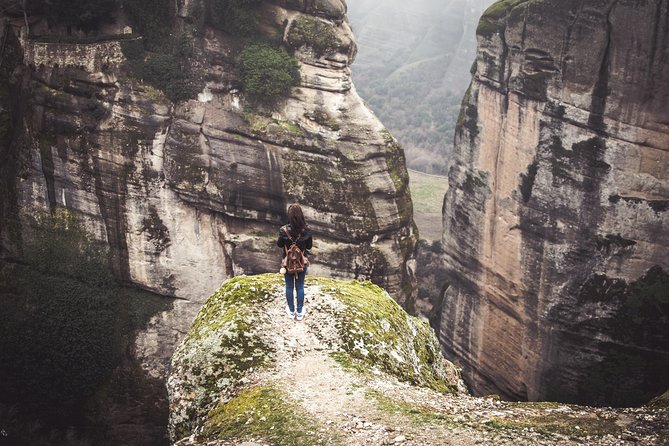
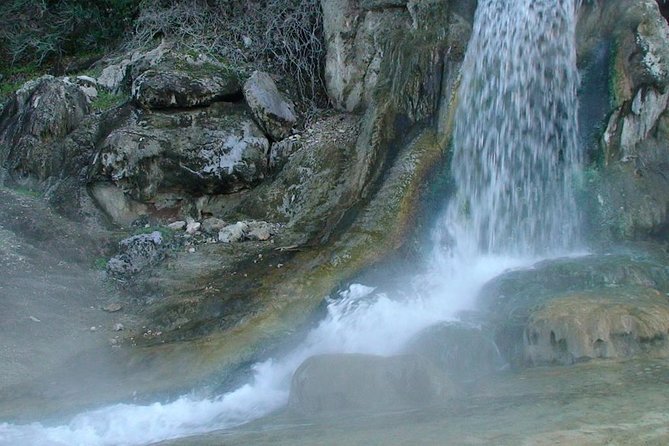
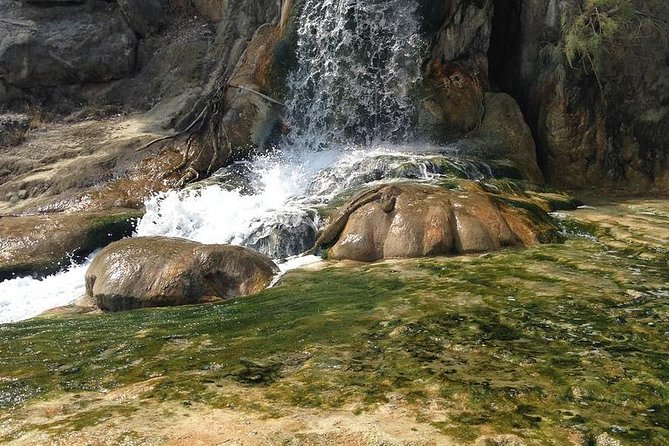
Thermopylae also takes its name from the hot sulfur springs, the Gates of Fire. The area has recognized thermal springs and hydrotherapy facilities, but do not assume your stop automatically includes a full spa treatment. Ask your driver how much time is available and what access is open during your visit.
From Thermopylae, you continue toward Meteora and check into a hotel in Kalambaka or Kastraki. These two towns make useful bases for the monasteries. Kalambaka is the larger center, while Kastraki sits closer to the dramatic rock formations.
A few more Athens tours and experiences worth a look
Sunset beneath Meteora’s hanging monasteries
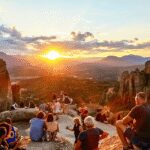
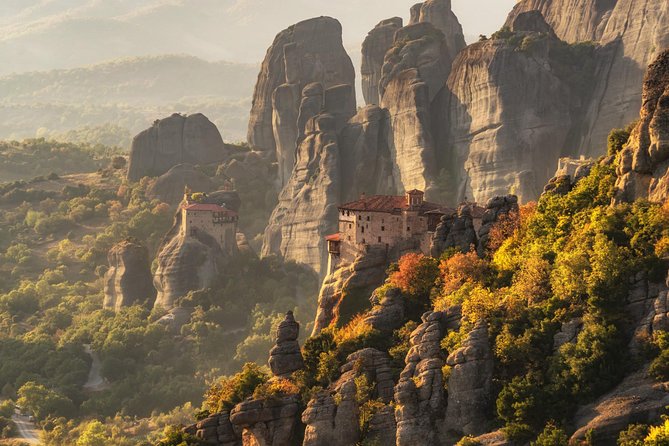
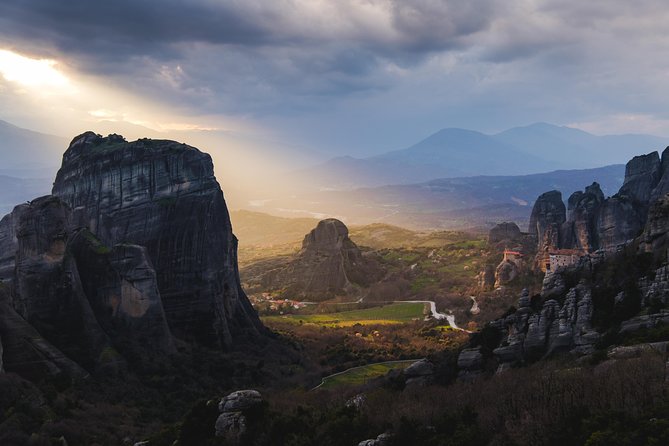
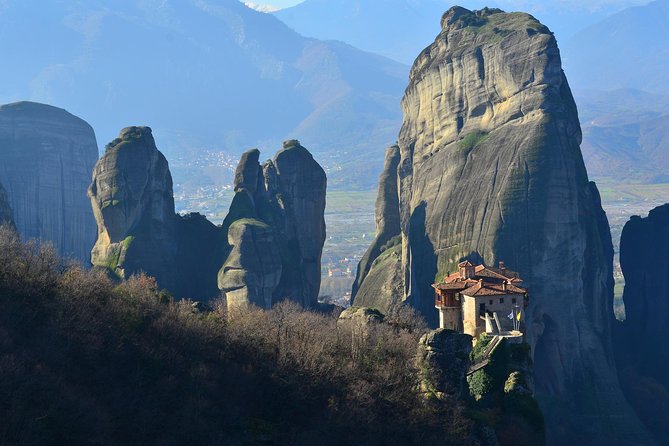
Meteora is the visual high point of the first two days. Monasteries sit on tall rock pillars above the plain, reached by steps and mountain roads. The plan allows one or two monasteries on the first afternoon, followed by a sunset, dinner and a walk through local shops.
The monasteries are active religious places, not simply old buildings. That is why clothing matters. Men and women must cover knees and shoulders, and shorts or sleeveless tops can lead to refused entry at places of worship and selected museums. Carry a light layer or long skirt, even in warm weather.
You may visit St. Nicholas, Rousanou, Varlaam, the Grand Monastery of the Transfiguration, St. Trinity or St. Stephen. The exact order can change, and the number you enter depends on opening hours, time and the day’s driving schedule.
I like the overnight here because Meteora deserves more than a rushed photo stop. After the monastery visits, you can eat at a traditional taverna, browse handmade souvenirs and watch the rock towers change color in the evening. The meal is not included, so budget separately for lunch, dinner and coffee.
The next morning brings breakfast and the remaining monasteries. This is a useful arrangement, since the first afternoon is not overloaded with every religious site in the area. Still, you should expect steps, uneven ground and time outdoors. The tour suits most people, but the physical demands are not zero.
Delphi, where Apollo’s oracle shaped Greek decisions
After Meteora, the road turns south toward Delphi. You spend the night there, with an optional dinner in Arachova, a mountain town known for its tavernas and traditional character.
Delphi was called Pytho in earlier times and was viewed by the ancient Greeks as the center of the world. The Omphalos stone represented that idea. More important than the symbol, though, was the role of the Pythia, Apollo’s priestess, whose pronouncements influenced rulers and city-states.
The archaeological site climbs along the slope, so good shoes help. You will see the Temple of Apollo, the Ancient Theater, the Stadium and the Athenian Treasury. The Sanctuary of Athena Pronaia lies in a separate area and adds another perspective on the site’s religious design.
The Delphi Archaeological Museum makes the ruins easier to understand. Its highlights include the Sphinx of Naxos, the statues of Kleobis and Biton, the Charioteer of Delphi, the Omphalos and the statue of Antinoos. The metopes from the Athenian Treasury and the frieze from the Treasury of Sifnos show how much sculpture once filled these sanctuaries.
A lunch on the Delphi caldera is one of the route’s practical pleasures. You look down toward Itea and Amfissa while eating, then have time for coffee and the village shops. Delphi itself has hotels, guesthouses, tavernas and bars, so the overnight is more than a bed between drives.
The drawback is that Delphi can feel compressed if you want to read every inscription or study every artifact. A private driver can get you there, but the driver is not automatically a licensed guide inside the site and museum. Add one if ancient art and archaeology are central to your trip.
Olympia and the birthplace of the Olympic Games
The next morning takes you to Olympia in the western Peloponnese. This sanctuary hosted the original Olympic Games from the 8th century BC, but it was also a major religious center devoted to Zeus and Hera.
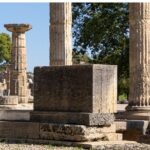
The Temple of Zeus once held the immense gold-and-ivory statue of Zeus, one of the Seven Wonders of the ancient world. The original statue is gone, but the remaining columns and the scale of the temple help you picture the sanctuary’s importance.
The Temple of Hera is older and tied to the modern Olympic flame ceremony. The Philippeion, a circular building dedicated by Philip II of Macedonia and completed by Alexander the Great, offers a different architectural form.
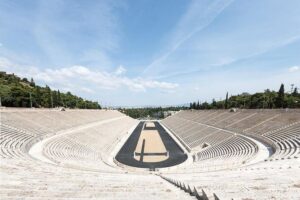
You will also encounter the Palaestra, where athletes practiced wrestling, boxing and jumping, along with the workshop of Pheidias. This workshop is linked to the sculptor who created the great Zeus statue. The ancient Stadium gives you a feel for the athletic side of the sanctuary, while the Hippodrome recalls horse and chariot races.
Olympia has two museums worth separating in your mind. The Archaeological Museum holds artifacts from the site, while the Museum of the History of the Olympic Games in Antiquity explains the contests, equipment and customs of the ancient games. The Museum of Archimedes adds an unusual stop, with working replicas of inventions linked to the famous mathematician and scientist.
Allow energy for this morning. The site spreads across an open area, and the combination of ruins, museums and walking can take more out of you than the drive suggests. An authentic meal in Olympia, including a possible stop at La Belle Helene, gives the day a welcome pause before you continue to Nafplio.
Nafplio brings the best evening on the route
Nafplio is a seaport town with cobbled streets, a waterfront and a graceful old center. It served as the first capital of modern Greece after the War of Independence, and its public buildings and churches connect ancient touring with the country’s newer political story.
The Palamidi fortress rises 216 meters above town. The famous count of 999 steps is a challenge, not a requirement, since access can also be arranged by road. The reward is a wide view across Nafplio and the Argolic Gulf.
At harbor level, Bourtzi is the small Venetian water fortress offshore. You can also see Freedom Square, Constitution Square and the building that housed the first Hellenic Parliament from 1825 to 1826. The former mosque near Syntagma Square is a useful reminder that Nafplio’s past includes Ottoman, Venetian and modern Greek chapters.
The churches add a more personal side to the town. St. Spyridon is linked to the 1831 assassination of Ioannis Kapodistrias, the first governor of Greece. The Church of Anastasios of Nafplia is noted for its dome and interior wall paintings.
This is a good place to slow down. Choose a traditional taverna for lunch, then try gelato at Antica Gelateria di Roma or loukoumades, small honeyed dough balls, at Pergamonto. You have time for shops and a waterfront stroll rather than another sprint through ruins.






Epidaurus and Mycenae, two very different ancient worlds
The following morning begins with a return to Palamidi or the Acronafplia and Arvanitia area before driving to Epidaurus. This may feel like a repeated stop if you already spent a full afternoon at the fortress, so clarify the morning plan when booking.
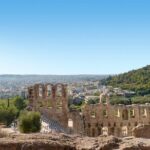
Epidaurus is best known for its theater. Its design and acoustics are remarkable, and the classic test is simple: stand near the stage and make a small sound while someone sits high in the seats. The theater is not just a photo stop. It shows how performance, civic life and religious practice worked together.
The nearby sanctuary of Asclepius was an ancient healing center dedicated to the god of medicine. The archaeological museum, with temple reconstructions and inscribed columns, helps explain the medical side of the site.
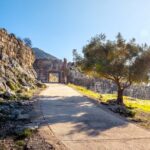
Next comes Mycenae, the Bronze Age citadel associated with Agamemnon in Homeric epic. The Lions Gate, built in the 13th century BC, is the famous entrance. Its huge stone blocks gave rise to the story that only Cyclopes could have moved them.
Look for Grave Circles A and B, the palace remains and the Cyclopean walls. The Treasury of Atreus is a large beehive-shaped tomb, while the Tomb of Clytemnestra is another major tholos tomb. The museum displays gold burial goods, jewelry, weapons, religious figures and frescoes.
Mycenae is exposed and uneven, with a strong sense of ascent and descent. Wear shoes with a firm sole and do not plan this as a quick, effortless stop. The mythology makes the place memorable, but the archaeology is older than the Homeric stories and deserves attention on its own terms.
Acrocorinth, Ancient Corinth and the canal
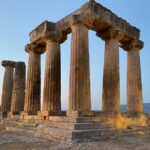
Your fifth night is in Ancient Corinth or Loutraki, often after a late lunch or early dinner overlooking the Temple of Apollo. The location is practical for the final morning, which begins at Acrocorinth.
Acrocorinth is the fortified acropolis above ancient Corinth. Its system of three circuit walls, gates, towers and inner keep reflects centuries of Greek, Roman, Byzantine, Frankish and Ottoman use. Within the walls are the Peirene Spring, remains linked to the Temple of Aphrodite and a Frankish tower.
The climb and footing can be demanding, but the views toward the Corinthian Gulf and Geraneia Mountain are excellent. If you prefer ancient temples to fortification walls, tell your driver how much time you want here before continuing downhill.
Ancient Corinth then fills in the commercial and religious story. The archaeological museum contains finds from Corinth and nearby sites. Outside, you see the Temple of Apollo, the Agora, Roman buildings, the theater, the Odeon and the Lechaion road leading toward the port.
The Bema, or public platform, has a strong Christian connection. Apostle Paul is associated with addressing the Corinthians here in 52 AD. St. Paul’s Church has a mosaic showing Saul’s vision of Christ, giving the stop special value if you are taking this tour for religious as well as classical reasons.
The final drive passes Ancient Diolkos and the Isthmus Canal. Diolkos recalls an older way of moving ships or cargo across the isthmus, while the 19th-century canal cuts through the land as a major engineering project. At Kechries Port, the route follows another setting linked with St. Paul before lunch by the Saronic Sea at the village of the Baths of Helen of Troy.
You then return to Athens and your hotel, Airbnb or apartment. The final driving period takes about two hours, with the return portion listed at roughly ten minutes once you reach the city area.
What the $2,358.13 price really covers
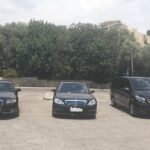
This is a private multi-day tour, not a package holiday. The price covers your driver, private luxury vehicle, hotel or port pickup and drop-off, WiFi, bottled water, refreshing wipes and handmade Greek biscuits. English is offered, and multilingual drivers are available.
The five nights of accommodation are not included. Neither are entrance fees, food, drinks or an airport transfer. Skip-the-line tickets can be requested, and a licensed guide can accompany you into the archaeological sites and museums for an added fee.
That distinction matters. The tour’s value is strongest for a small group that wants a private vehicle, direct transport and the ability to adjust the day. A group of friends or a family can share the cost and gain much more space than on a large coach tour.
The value is weaker if you expect a full guided archaeological program for the listed price. Add hotel rates, admissions, meals and perhaps a licensed guide before comparing it with an organized package.
The private format also gives you a useful degree of flexibility. Tas is one driver associated with the company, and his personal approach includes chatting with teenagers, changing plans around group interests and even finding donuts and pizza for a birthday. You cannot assume he will be assigned to your booking, but you can ask about driver availability when arranging the tour.
Who should book this Greek circuit?
I would choose this tour if you want to see the major mainland sites without renting a car or managing Greek roads yourself. It works especially well for families, small groups, and anyone who values a quiet vehicle and door-to-door service.
It also suits a mixed-interest group. One person can focus on monasteries, another on classical ruins, another on Christian sites, and the driver can help shape the stops. The route includes enough village time and local meals to keep it from becoming six straight days of stones and captions.
I would hesitate if you prefer slow travel. The schedule crosses central Greece and much of the Peloponnese, so driving is a real part of the experience. You should also be comfortable with steps, uneven ruins, monastery dress rules and several long sightseeing days.
Free cancellation is available when you cancel at least 24 hours before the start time. Changes or cancellations inside that window are not accepted for a refund.
Should you book it?
Book this tour if the private format and broad coverage are your priorities. In six days, you reach Thermopylae, Meteora, Delphi, Olympia, Nafplio, Epidaurus, Mycenae and Corinth, with enough overnight stops to avoid returning to Athens every evening.
Before paying, ask for a full accommodation quote, current entrance costs, the airport or port transfer price and the cost of a licensed guide. If those extras fit your budget, this is a smart way to connect Greece’s monasteries, myths, Olympic tradition and Christian landmarks in one well-supported trip.
FAQ
Where does the tour begin and end?
The tour begins with pickup from your Athens hotel, Airbnb or apartment and ends with return to your chosen accommodation in Athens.
What time does pickup begin?
The stated start time is 10:00 a.m. Your driver meets you in your hotel lobby. For an Airbnb, the driver contacts you when arriving at the building entrance.
Is the tour private?
Yes. Only your group participates, and transportation is provided in a private vehicle.
Is a licensed guide included?
No. The tour includes professional English-speaking or multilingual drivers, but a licensed guide inside archaeological sites and museums costs extra on request.
Are hotels included in the price?
No. Five nights of accommodation are excluded, though hotel reservations can be requested.
Are entrance fees included?
No. Entrance fees to the archaeological sites and museums are not included. Skip-the-line tickets can be requested.
What should I wear at the monasteries and religious sites?
You must cover your knees and shoulders. Shorts and sleeveless tops are not allowed at places of worship and selected museums.
Can I cancel for a full refund?
Yes, if you cancel at least 24 hours before the local start time. Cancellations or changes made less than 24 hours before the start time are not refundable.