REVIEW · SANTORINI
Guided Tour to the Akrotiri Archaeological Site in Santorini
Book on Viator →Operated by Pigaia travel · Bookable on Viator
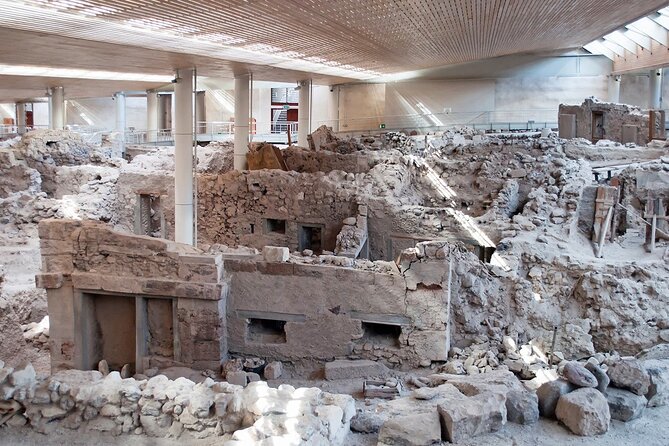
Akrotiri is not just another pile of ancient stones. Under its protective roof, you can walk through a Bronze Age town with cobbled lanes, multi-level buildings, workshops, kitchens, and painted walls. The settlement was buried by the huge volcanic eruption of 1612 BC, preserving a rare look at daily life on prehistoric Santorini.
I like two things right away: a licensed English-speaking guide can point out details you could easily miss alone, and the roughly 2.5-hour visit leaves the rest of your day open. The group format also keeps the price lower than a private tour.
The main catch is cost. At $181.10 per person, you still pay the €20 Akrotiri admission fee separately, so you should compare the final total with other guided options before booking.
In This Review
- Key points to know before booking
- Why Akrotiri matters on a Santorini trip
- Entering Akrotiri through its ancient streets
- The large building with fourteen rooms per floor
- The West House and its working rooms
- The Women’s House and its mural
- What the guide adds to the visit
- Timing, meeting point, and the shape of the day
- Is the $181.10 price good value?
- Who will enjoy this Akrotiri tour most?
- Practical things to remember
- Should you book it?
- FAQ
- How long does the Akrotiri tour last?
- Where does the tour start and end?
- Is the Akrotiri entrance fee included?
- Is the tour offered in English?
- How large is the tour group?
- Is transportation included?
- Can I cancel for a full refund?
Key points to know before booking
- See a preserved prehistoric town: Walk among homes, alleys, storage areas, workshops, and public-looking buildings shaped by the Bronze Age settlement.
- Focus on the murals: The Women’s House is especially notable for the Ladies and the Papyrus mural.
- Hear the story in English: A licensed guide explains the site and helps connect the ruins to Santorini’s volcanic past.
- Allow about 2.5 hours: The archaeological visit itself is listed at about two hours, with transfers from and back to the Fira meeting point.
- Budget for the entrance fee: The tour price does not include the €20 admission charge. Entry is free for children aged 0 to 18.
- Expect a small group: The maximum group size is 20 people, a useful middle ground between a private visit and a large bus tour.
Why Akrotiri matters on a Santorini trip
Santorini is famous for white villages, sea views, and sunset crowds. Akrotiri gives you a different island story. Here, the focus is not on the postcard version of Santorini but on the people who lived on the island long before its present shape emerged.
The settlement was destroyed by the massive eruption dated here to 1612 BC. Ash and volcanic material covered the town, preserving parts of its buildings and artwork. That disaster was terrible for the people who lived there, but it also left behind an unusually clear record of an ancient Aegean community.
You will not simply look at isolated walls. The route takes you through streets and building remains, giving the site a sense of urban planning. You can see how rooms connected, where storage and work took place, and how large some buildings were.
That makes a guide useful. Ancient ruins can blur together when you explore without context. A licensed guide can explain what you are seeing, point out the layout of a building, and show why a faded mural or doorway matters.
You can also read our reviews of more guided tours in Santorini



Entering Akrotiri through its ancient streets
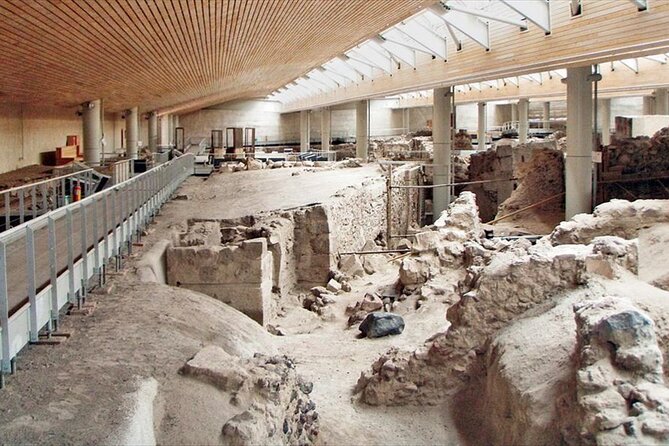
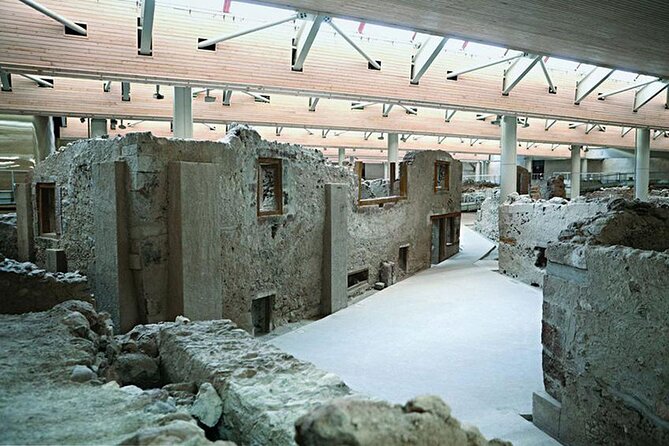
The central appeal of the visit is the chance to walk through the remains of the prehistoric settlement itself. The tour description highlights cobbled alleys and high-rise buildings, an unusual sight in an archaeological site and a reminder that this was a developed town rather than a small rural village.
The buildings were not all alike. Some were large, with at least two floors and fourteen rooms on each floor. Many rooms connected through several doors, suggesting a complex internal arrangement rather than a simple one-room home.
The scale changes how you read the ruins. Instead of seeing only foundations, you begin to picture a place with movement between rooms, storage, work areas, and private spaces. Your guide’s explanation is most valuable here because the remains require some imagination.
The site is covered, according to the supplied information, but no detailed accessibility description is provided. You should expect an archaeological setting with uneven historic surfaces and cobbled areas. If you have mobility concerns, confirm the conditions with the provider before booking.
The large building with fourteen rooms per floor
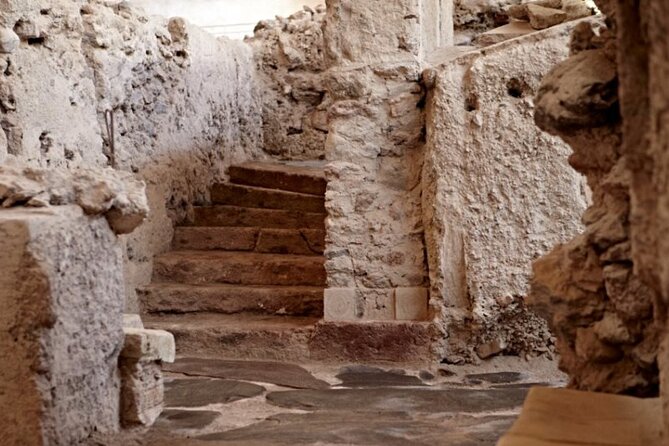
One of the most striking sections is a large building with at least two floors and fourteen rooms on each floor. The number matters because it shows the scale and planning of Akrotiri.
Several rooms were linked by many doors and decorated with murals. That combination tells you two things about the settlement: the buildings could support complicated activity, and decoration was part of the built environment rather than a rare luxury confined to one small chamber.
Your guide can help you read these spaces as connected parts of a home or working property. Without that explanation, it is easy to notice only the walls and miss the clues provided by doorways, room size, and placement.
I would pay close attention to how the rooms connect. The point is not just to count them. It is to understand the flow of life inside a large prehistoric building, where people stored goods, worked, met, and moved between different parts of the house.
The West House and its working rooms
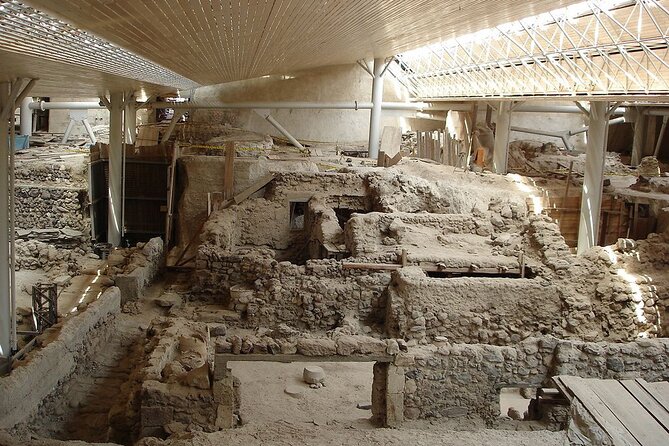
The West House is smaller but well organized. Its ground floor included warehouses, workshops, a kitchen, and a mill installation.
This is one of the most useful parts of the visit for anyone interested in ordinary life. Grand buildings and murals attract attention, but storage rooms and work areas show how the settlement functioned day by day.
The combination of warehouse, workshop, kitchen, and mill also helps you see that homes were not always separated from work. Production, food preparation, and storage could all happen within the same building.
I like this section because it brings the site down to a human scale. You are not only looking at an impressive ancient building. You are considering where supplies were kept, where tasks were carried out, and how a household or local business may have operated.
The available details do not specify exactly how long the guide spends at each structure. The overall archaeological stop is listed at about two hours, so the pace may depend on the group and the guide’s route.
The Women’s House and its mural
The Women’s House is a large two-storey building named for the Ladies and the Papyrus mural that decorated its interior.
This is likely to be one of the most memorable stops because murals give ancient ruins color and personality. Even when you are seeing fragments or preserved sections, painted scenes can tell you more about taste, status, and the people who once occupied the rooms than bare stone can.
The name Women’s House comes from the mural, not from a stated certainty about the building’s occupants. That distinction is worth keeping in mind. Archaeological labels often provide a convenient way to identify a structure, but they do not always tell us exactly how it was used.
Your guide can place the mural within the wider story of Akrotiri and explain how it relates to the building. If you enjoy art, architecture, or archaeology, this is a strong reason to choose a guided visit rather than a quick walk through the site.






What the guide adds to the visit
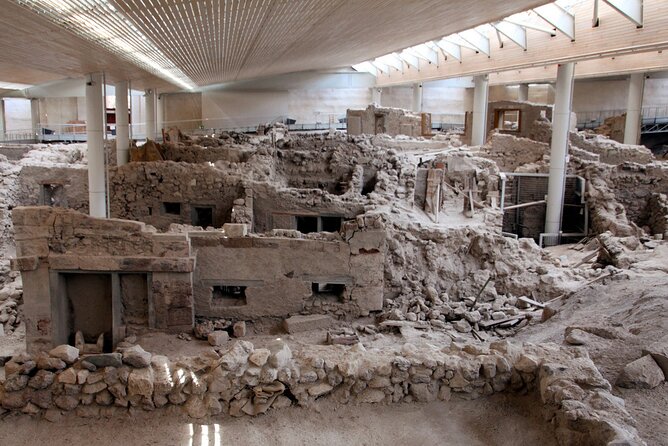
The tour includes a licensed English-speaking guide. The strongest praise attached to this experience focuses on the guide’s ability to explain the site clearly and make the information easy to follow.
That is important at Akrotiri. The settlement has plenty to see, but its meaning is not always obvious from the remains alone. A guide can identify the different buildings, explain the role of rooms, and connect the eruption to the way the site looks today.
You should not expect a private scholar-led visit. This is a group experience with a maximum of 20 people. That size is small enough for a more personal feel than a large coach group, but it may still mean standing with others around popular points.
The guide speaks English, and the available information does not name the individual guide. If you need a specific language or a private pace, this is not the right format. If you want a structured explanation without paying for a private tour, it makes more sense.
Timing, meeting point, and the shape of the day
The meeting point is KTEL Santorini in Fira, at the old hospital on Eparxeio. The tour returns to the same location, which makes planning easier if you are staying in or passing through Fira.
You should arrive with enough time to find the exact meeting point. The description refers to KTEL Santorini and Fira village old hospital, so use the supplied location details and confirm the meeting instructions after booking.
The activity lasts about 2.5 hours in total. The archaeological visit itself is listed at about two hours, with the remaining time likely covering the transfer from and back to the meeting point. Since the timing is relatively short, you can combine it with another Santorini plan later in the day.
That free time is a real advantage. You could schedule lunch, visit another part of the island, or return to your hotel without giving up the entire day. Just avoid placing an important timed activity too close to the end of the tour, since the duration is approximate.
The experience is offered in English and uses a mobile ticket. Confirmation is provided at booking, and the tour is near public transportation.
Is the $181.10 price good value?
The price is $181.10 per person, before the €20 Akrotiri entrance fee. That makes the total higher than the headline figure suggests, and you should include the admission charge in your budget.
The value depends on what you want from the visit. If you only need transport to Akrotiri and prefer to read at your own pace, the cost may feel high. The tour does not include the archaeological admission, so the included transfer and guide are doing most of the work in the package.
I see the value in the explanation. Akrotiri is the kind of place where a guide can change the visit from a walk among ruins into a clear story about homes, work, art, and disaster. The group cap of 20 also keeps it from becoming a very large outing.
Still, price-sensitive visitors should compare options carefully. A group tour can save money compared with a private guide, but $181.10 is not a budget admission-and-guide package once the site fee is added.
The tour may make the most sense if you want a short, organized visit and do not want to arrange transport or research the ruins in advance. It is less compelling if you already have transport, enjoy detailed self-guided visits, or are looking for the lowest possible cost.
Who will enjoy this Akrotiri tour most?
I would recommend this experience to you if you like archaeology but do not want to spend hours decoding a site plan. The guide gives structure to the visit, while the short duration keeps the outing manageable.
It also suits a first-time Santorini visit. Many people plan the island around villages and views, but Akrotiri adds a serious cultural stop without taking the whole day.
Families may appreciate the free admission for children aged 0 to 18, although each family should consider how comfortable children are with an archaeological site and a guided format. The available information says most people can participate, but it does not give detailed child-focused programming.
The tour is also a good fit if you prefer English-language guidance and a group setting. It is not the best choice if you need a private guide, a specific guide by name, or a highly flexible schedule.
Practical things to remember
The €20 entrance fee is paid separately, while children from 0 to 18 enter free. Tips are optional.
The tour requires good weather. If poor weather causes a cancellation, you are offered another date or a full refund. For your own protection, keep the rest of your schedule flexible if the forecast looks uncertain.
Free cancellation is available up to 24 hours before the start time. If you cancel less than 24 hours ahead, you will not receive a refund, and changes inside that same period are not accepted.
The tour is often booked well ahead, with an average advance booking period of 104 days. That suggests you should reserve early if your Santorini dates are fixed, especially during a busy season.
Should you book it?
Book this tour if you want a guided introduction to Akrotiri, need transport from Fira, and value clear English explanations more than the lowest price. The large prehistoric buildings, the West House, and the Women’s House give the visit real substance, while the 2.5-hour schedule leaves room for the rest of Santorini.
Think twice if the $181.10 price feels steep once you add the €20 admission fee. You may prefer a self-guided visit if you already have transport and enjoy setting your own pace.
For most people who want Akrotiri to make sense rather than simply look old, the licensed guide is the main reason to go with this experience. Just budget honestly, meet at the Fira KTEL location, and treat the approximate timing as a guide rather than a promise.
FAQ
How long does the Akrotiri tour last?
The experience lasts approximately 2 hours and 30 minutes. The archaeological site visit itself is listed at about two hours.
Where does the tour start and end?
It starts and ends at KTEL Santorini in Fira, at the old hospital on Eparxeio.
Is the Akrotiri entrance fee included?
No. The entrance fee is €20 per person and must be paid separately. Admission is free for children aged 0 to 18.
Is the tour offered in English?
Yes. The experience includes a licensed English-speaking guide.
How large is the tour group?
The maximum group size is 20 people.
Is transportation included?
Transfer from and back to the meeting point is included.
Can I cancel for a full refund?
Yes, if you cancel at least 24 hours before the experience start time. Cancellations made less than 24 hours before the start time are not refunded. The tour may also be canceled for poor weather, in which case you are offered another date or a full refund.