REVIEW · ANDROS
10-Day Inn-to-Inn Self-Guided Trekking Holiday Andros Trail – Cyclades
Book on Viator →Operated by One Foot Forward · Bookable on Viator
Andros is one of the Cyclades’ best islands for walking, not simply because of its sea views. Ancient stone paths lead through ravines, mountain villages, watermills, monasteries, olive groves, and quiet beaches. This 10-day private trek gives you the freedom of independent travel with the useful safety net of arranged hotels, breakfasts, transfers, and baggage transport.
I especially like the luggage transfer service, since you carry only what you need for the day. I also like the personal Walker’s Pack and briefing from Ariana’s team, which make a self-guided trip feel far less daunting. The catch is that several walks are demanding, with long climbs and hot, exposed sections, so this is not a casual island stroll.
In This Review
- Key points to know before you book
- Why Andros works so well for a walking holiday
- Arrival in Gavrio and a useful first briefing
- Day 2: Froussei Valley, old mills, and Gavrio views
- Day 3: Agios Petros Tower and the bay at Batsi
- Day 4: The demanding Fardia Strada to Menites
- Day 5: Panachrados Monastery and the road to Korthi
- Day 6: Medieval roads, Dipotamata, and Andros Town
- Day 7: Pythara ravine and the Apoikia option
- Day 8: Vourkoti, Kouvara, and the Arni valley
- Day 9: From Arni back to Batsi
- What the $1,037 price includes in practical terms
- How hard is the self-guided format?
- Who should book this Andros trek?
- Should you book this Andros walking holiday?
- FAQ
- How long is the Andros trekking holiday?
- Where does the tour begin?
- Where does the activity end?
- Is the tour guided?
- Is this a private tour?
- Are hotels included?
- Is breakfast included?
- Is luggage transfer included?
- What level of fitness is required?
- What happens if the Apoikia hotel is closed?
- Can I cancel for a full refund?
- What happens if bad weather cancels the walk?
Key points to know before you book
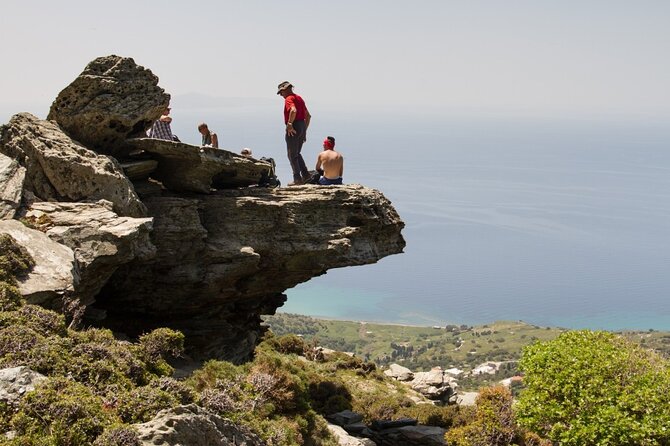
- Ancient paths and watermills: Walk old stone routes through Froussei Valley, Dipotamata Gorge, and the Pythara ravine.
- A full island crossing: The route links Gavrio, Batsi, Menites, Ormos Korthiou, Andros Town, Apoikia, Arni, and other mountain settlements.
- Self-guided, not unsupported: You walk privately with your own group, while the local team provides notes, transfers, luggage handling, and assistance.
- The toughest day is Day 4: The Fardia Strada route combines four trail sections and includes demanding elevation changes.
- Accommodation can change in Apoikia: If the village hotel is closed, you take a 12-kilometer circular walk and sleep another night in Andros Town.
- Best for active hikers: You need a moderate level of fitness, comfort with mountain paths, and sensible preparation for warm weather.
Why Andros works so well for a walking holiday
Many Cycladic islands are dry, bare, and built around a few beaches and a port town. Andros offers a different picture. Its interior has springs, streams, cultivated valleys, wooded slopes, and old routes linking villages that once depended on farming, mills, and sea trade.
That variety gives each day a different feel. One morning you may be following a stream past abandoned watermills. Later, you may be high above the sea on a stone trail, then descending toward a small bay for a swim.
The trails also tell you how Andros once worked. The Fardia Strada was an old route from Venetian times. The road toward Andros Town once connected two medieval castles and served as the main agricultural and commercial route for southeastern Andros until 1950.
I like this kind of walking because the sights are not placed behind museum doors. The history is part of the route itself. You pass through villages, cross old bridges, and see the practical ways people once moved water, crops, and goods around the island.
You can also read our reviews of more guided tours in Andros
Arrival in Gavrio and a useful first briefing
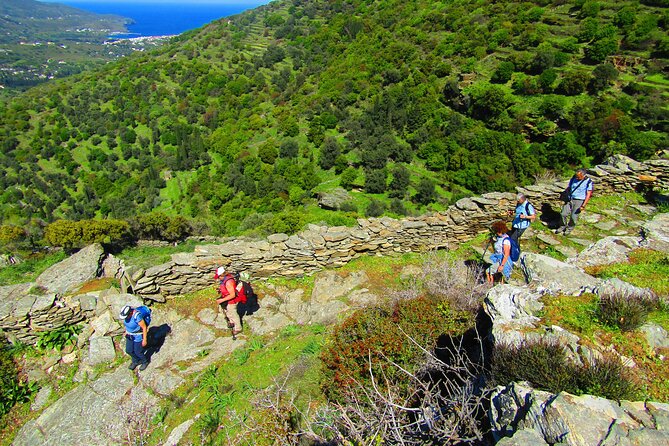
Your trip begins in Gavrio, where the local team meets you at the port and takes you to your hotel. The arrival program includes check-in, welcome drinks, Greek mezes, and a meeting with a member of the team.
This first evening matters. You receive the Walker’s Pack, a set of route information and local recommendations, along with an explanation of the trails, the island, and the schedule. Since there is no guide walking beside you each day, this briefing is your main orientation.
The organization is a strong point here. Ariana and the One Foot Forward team have arranged trips around personal needs, and the available trip feedback repeatedly points to clear communication and careful handling of transfers, hotels, ferry tickets, and luggage. Dimitri and Joseph are also named among the local team.
You should still pay close attention during the talk. Ask about trail markings, daily meeting times, water, and what happens if weather changes. Self-guided walking gives you privacy, but it also means you must read the notes and make sensible choices.
Day 2: Froussei Valley, old mills, and Gavrio views
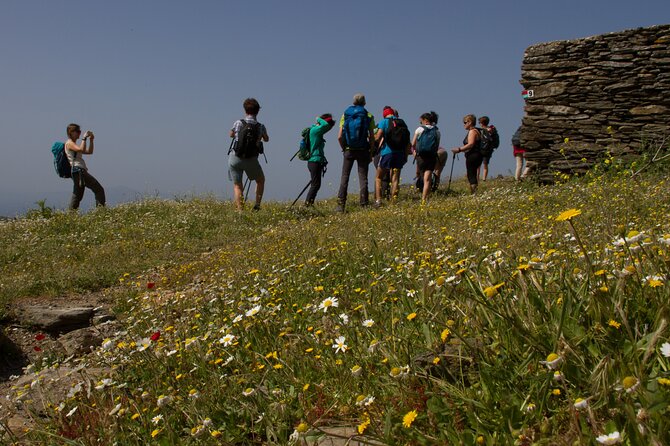
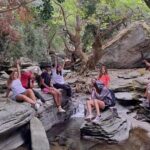
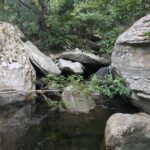
The first walking day begins with a transfer to Froussei Valley, between Ammolohos and Palestou. The route follows a stream through a ravine and passes old stone watermills.
These mills were once part of a millers’ village that served nearby settlements. Their presence is especially interesting on Andros, an island often associated with dry weather and strong winds. Here, water was captured and used as a working power source.
The route then climbs toward Ammolohos and continues to the top of the mountain at about 600 meters. From the higher slopes above Gavrio, you get broad views toward the port and sea before returning to your accommodation in Gavrio.
This is a good opening walk because it introduces several themes that return throughout the trip: stone paths, working water systems, mountain villages, and wide coastal views. It also gives you an early sense of the physical demands. The climb is gradual, but the day is not flat or effortless.
Day 3: Agios Petros Tower and the bay at Batsi
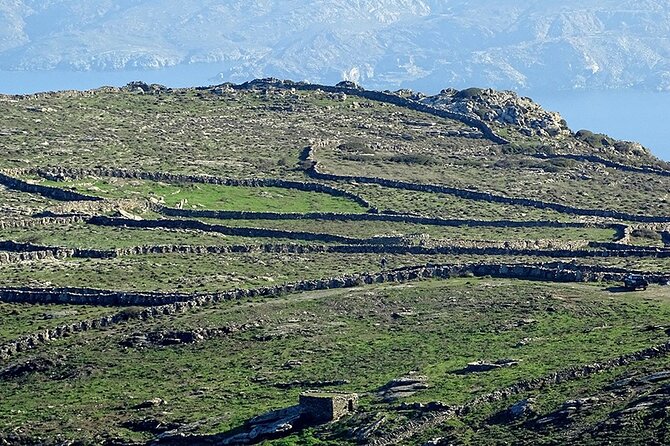
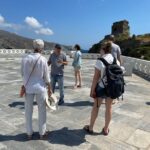
You start from Gavrio and walk toward Batsi, passing the Tower of Agios Petros. Built in the Hellenistic period, around the fourth to third century BC, it is one of the best-preserved towers in the Cyclades.
The tower is more than a quick photo stop. It gives the walk a clear connection to Andros’ ancient past, and its position helps you understand how people once watched and controlled movement across the island.
You continue through the picturesque village of Agios Petros before following the trail toward the Monastery of Agia. From there, the route descends to Batsi, a seaside town gathered around a rounded bay with clear water.
Batsi is a welcome finish after the uphill work. You can spend time by the sea and enjoy a more sociable town atmosphere. Keep in mind that the day is not only a coastal walk. The tower and monastery are reached by inland trails, and the descent can be tiring after the earlier climbs.
Day 4: The demanding Fardia Strada to Menites
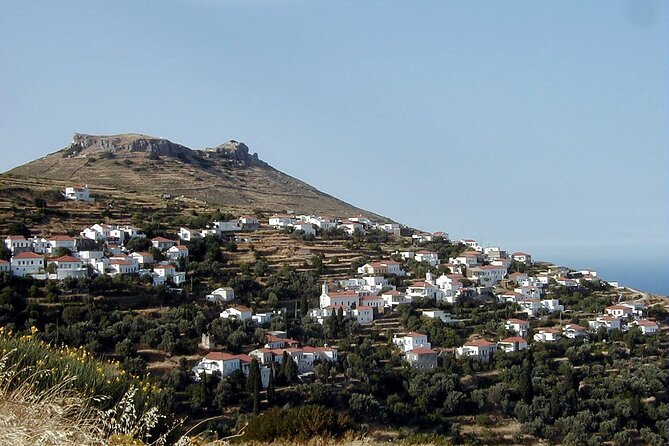
This is the day to take seriously. From your hotel, you follow the Fardia Strada, one of Andros’ oldest and longest routes, toward Pitrofos and Menites.
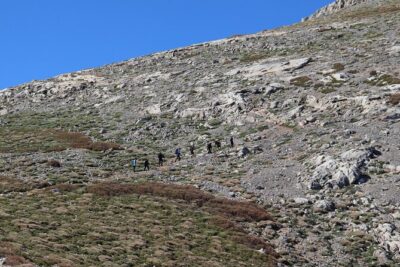
The route combines four sections of the Andros Routes network. You move through changing ground and elevation, with sea views from the mountain and a varied mix of villages, slopes, and old paths.
The appeal is clear: this is one of the most complete walking days, with a strong sense of moving across the island rather than simply taking a short scenic outing. The drawback is equally clear. You need a moderate level of fitness, and anyone unused to long climbs should not treat this as an easy holiday walk.
Start fresh after breakfast, carry enough water for the day, and use the scheduled luggage transfer to your advantage. There is no reason to burden yourself with a large pack. Your daily load should be limited to water, food, sun protection, a phone, and the items you need on the trail.
Menites provides a satisfying finish in a village setting. After a hard day, the change from exposed mountain ground to a settled rural community feels well earned.
Day 5: Panachrados Monastery and the road to Korthi
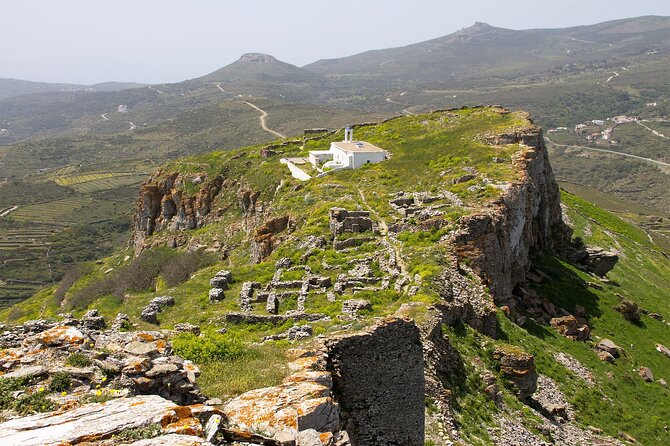
The next route combines two sections of the Andros Routes network and part of the Andros Trail Race course. You climb toward Panachrados Monastery, set in the Gerakonas mountain range at about 550 meters.
The route then crosses to the southern side of the mountain and heads toward the villages of the Korthi area. The scenery shifts toward farmland and cultivated ground, with sea views opening as you approach Ormos Korthiou.
Panachrados adds another layer of Andros’ cultural character. This is not a day built only around a viewpoint. The monastery, villages, agricultural plots, and mountain paths show how closely everyday life has been tied to the island’s terrain.
Ormos Korthiou is a seaside finish, which makes the day easier to appreciate. You begin with a serious climb and end near the water. Still, the distance and elevation can make this another demanding day, especially after Day 4.
Day 6: Medieval roads, Dipotamata, and Andros Town
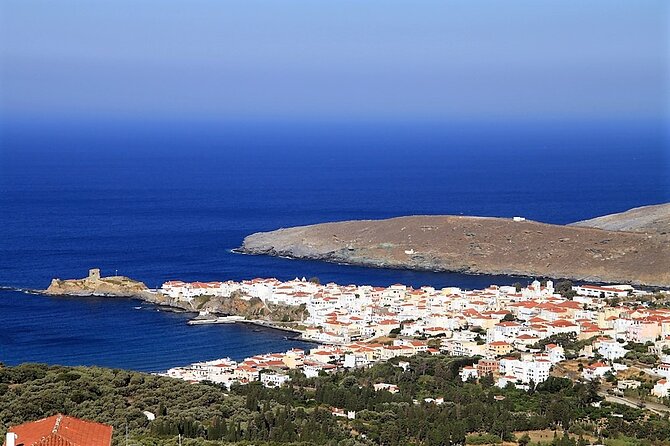
This route follows an old road to Hora, the island’s capital, now commonly called Andros Town. It once linked the island’s two medieval castles and acted as a key farm and trade route until the middle of the twentieth century.
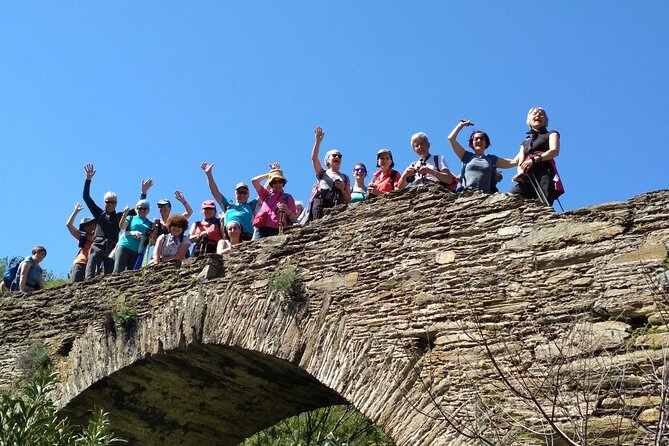
The walk includes the Upper Castle, Dipotamata Gorge, stone watermills, an arched bridge, and the village of Sineti. It is one of the strongest days for combining history and scenery without separating the two.
Dipotamata is particularly rewarding because the gorge shows how water shaped settlement and work on Andros. The old mills and bridge are not isolated monuments. They form part of a system that once helped communities live and trade across difficult ground.
Arriving in Andros Town gives you a change of pace. After several nights in smaller places, the capital offers a more urban base and a chance to explore independently. The walk is still the day’s main event, so save energy for the approach and do not assume the town finish means an easy route.
Day 7: Pythara ravine and the Apoikia option
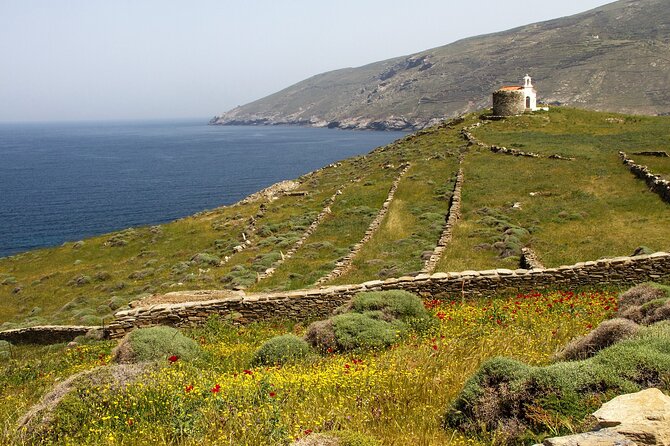
Day 7 is relatively short and begins in Andros Town. The trail heads toward Apoikia, following a well-preserved route beside the Pythara ravine.
The path passes through settlements shaped by seamanship and rural life, then climbs toward the village. A small detour leads to waterfalls, which are worth the extra effort if conditions allow.
Apoikia is the one part of the trip where the plan may change. The village is remote and may have only one hotel. If that property is closed, you take a 12-kilometer circular route and spend another night in Andros Town.
This is not a flaw in the organization. It is a practical issue created by a small rural destination. You should be comfortable with a little flexibility and understand that accommodation on an island trail network cannot always match the choice available in a larger town.
The shorter walking day also gives you a useful pause before the next mountain section.
Day 8: Vourkoti, Kouvara, and the Arni valley
From Apoikia, the route heads through Vourkoti and toward Arni, described as the greenest part of Andros. You walk through rural and mountain scenery, then cross the ridge near Kouvara, the island’s highest point.
This is likely to be one of the most scenic days of the trip. The views change as you gain the ridge, and the route offers a broad look across the island’s varied terrain.
The approach to Arni brings denser vegetation and a more sheltered feel than the dry coastal slopes. That contrast is one of the reasons Andros rewards a multi-day crossing. You are not seeing the same postcard view each morning.
The high point also means exposure to wind and weather. Conditions can change on mountain routes, and the tour requires suitable weather. If the forecast turns poor, the operator offers a different date or a full refund for a canceled experience.
Day 9: From Arni back to Batsi
The final walking day descends from the island’s highest mountain through the green valley of Arni toward Batsi.
The route is known for dense plant growth, varied wildlife habitat, and views down to the sea. It is a fitting final stage because it brings together the island’s mountain and coastal sides.
Descending does not always mean easy. Long downhill sections can be hard on knees and ankles, especially after a week of walking. Trekking poles may be useful, though they are not listed as included equipment, so plan your own kit carefully.
Finishing in Batsi gives you a familiar seaside setting after the remote interior. It also provides a more relaxed end to the walking portion before your transfer to the port on Day 10.
What the $1,037 price includes in practical terms
At about $1,037 per person, the cost needs to be judged against what you would otherwise have to arrange yourself. The package includes eight nights of accommodation, daily breakfast, luggage transfers, transfers to walking starts, the arrival transfer from Gavrio port, the Walker’s Pack, local orientation, and departure transport depending on your sailing time.
That is a useful amount of coordination for a ten-day island trip. You are not paying for a guide to walk beside you, so the price is lower than a fully guided private trek. In return, you handle the walks yourself and make your own decisions during the day.
I see the strongest value in the baggage handling and route planning. Moving between small villages can be awkward when you have to arrange each hotel, taxi, and bag transfer independently. The team’s record for careful organization is especially important here, since one missed transfer could disrupt an entire day.
The price does not remove every expense. The supplied details specifically include accommodation and breakfast, but they do not state that lunches, dinners, drinks, or personal equipment are included. Budget separately for those items.
How hard is the self-guided format?
The trip requires moderate physical fitness. That phrase matters. You should be ready for mountain paths, uneven stone surfaces, long climbs, and descents over several consecutive days.
The route has variety, but not every section is strenuous. Day 7 is shorter, while Day 4 is clearly more demanding. The high routes on Days 8 and 9 add altitude and extended mountain walking.
Self-guided does not mean you are left without support. The Walker’s Pack, personal briefing, transfers, and luggage service provide structure. At the same time, you will not have a guide pointing out every turn or adjusting the pace for you.
The trails are well signposted according to the available trip feedback, but you should still carry the provided information and keep your phone charged. Hot weather has caused difficulty on past trips, so begin early when possible, protect yourself from the sun, and take hydration seriously.
Who should book this Andros trek?
I would choose this trip if you want a real walking holiday rather than a collection of short excursions. It suits people who like to walk independently but do not want to spend months arranging village hotels, taxis, baggage transfers, and daily routes.
It is also a good match for couples, friends, or a family group that wants a private experience. Only your group participates, so you control the pace and can enjoy quiet stretches without being tied to a large party.
I would hesitate if your main goal is beach time, nightlife, or easy sightseeing. The sea appears often, but the core of the trip is mountain walking. You also need to accept changes caused by weather or the limited hotel supply in Apoikia.
Service animals are allowed, and the starting point is near public transportation, but the supplied details do not explain trail suitability for animals or give specific accessibility information. Ask the operator before booking if that affects your plans.
Cancellation is free up to 24 hours before the local start time. Poor weather may lead to a new date or a full refund, while changes made less than 24 hours ahead are not accepted.
Should you book this Andros walking holiday?
Book it if you want Andros beyond the port and beach towns. The combination of ancient tower, monasteries, old mills, medieval roads, farm valleys, ravines, and high ridges gives you a fuller picture of the island than a standard island break.
The best reason to book is the balance between independence and support. You walk alone with your own group, yet Ariana and her team handle the details that can make a self-guided trip stressful. The main caution is fitness and heat. Prepare for real mountain walking, not a gentle coastal ramble, and this becomes a strong-value way to see Andros at foot level.
FAQ
How long is the Andros trekking holiday?
The experience lasts approximately 10 days and includes eight nights of accommodation. The walking program runs across the island, with departure on Day 10.
Where does the tour begin?
It begins in Gavrio, Andros, at the port area. The local team meets you there and transfers you to your hotel.
Where does the activity end?
The activity ends back at the meeting point in Gavrio, with a transfer to the port depending on your departure time.
Is the tour guided?
It is a self-guided trekking holiday. You receive a Walker’s Pack, trail information, local recommendations, and a personal briefing from the One Foot Forward team.
Is this a private tour?
Yes. Only your own group participates in the activity.
Are hotels included?
Yes. Eight nights of accommodation are included, so you do not need to arrange the hotels separately.
Is breakfast included?
Daily breakfast is included.
Is luggage transfer included?
Yes. Your luggage is transferred between accommodations, allowing you to walk with a lighter day pack.
What level of fitness is required?
You should have a moderate level of physical fitness. Some days include demanding climbs, long routes, mountain ridges, and steep descents.
What happens if the Apoikia hotel is closed?
If the only hotel in Apoikia is closed, you take a 12-kilometer circular route and spend another night in Andros Town.
Can I cancel for a full refund?
You can cancel at least 24 hours before the local start time for a full refund. Cancellations or changes made less than 24 hours ahead are not accepted.
What happens if bad weather cancels the walk?
You will be offered a different date or a full refund if the experience is canceled because of poor weather.