REVIEW · ATHENS
5 Days Private Tour: Meteora – Delphi – Olympia & Argolida
Book on Viator →Operated by Olive Sea Travel · Bookable on Viator
The most striking part of this five-day private tour is its reach. In one loop from Athens, you move from the cliffs and monasteries of Meteora to Delphi, Olympia, Mycenae, Epidaurus, Nafplio, and Corinth. It is a big slice of mainland Greece, not a quick bus ride past famous ruins.
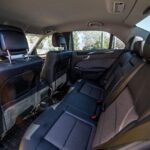
I like the private vehicle and hotel pickup, which remove the stress of Greek roads and let your group stop for views or lunch. I also like the thoughtful mix of ancient sites, medieval monasteries, mountain villages, seaside towns, and modern Greek history. The main drawback is pace: several days involve long drives, and the driver cannot guide you inside the monuments or museums unless you pay extra for a licensed guide.
In This Review
- Key points at a glance
- Five days across mainland Greece
- Day one: Thermopylae and the cliffs of Meteora
- Day two: Delphi and Arachova
- Day three: Nafpaktos and the birthplace of the Olympic Games
- Day four: Mycenae, Tiryns, and the harbor at Nafplio
- Day five: Healing, theater, and Corinth
- What the private format really changes
- Who should book this route
- FAQ
- What time does the tour start?
- Where can pickup and drop-off take place?
- Is the tour private?
- Are entrance fees included?
- Can the driver guide me inside the sites?
- Is accommodation included?
- Should you book it?
Key points at a glance
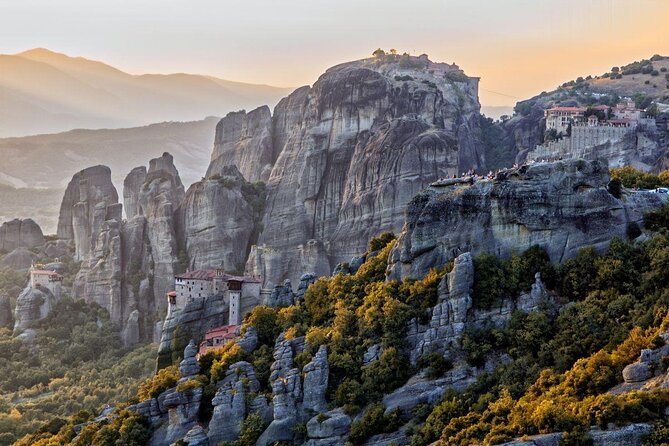
- Meteora at sunset: Reach Kalambaka and head into the hills for photographs of the monasteries in evening light.
- Private touring: Only your group takes part, with pickup from a hotel, Airbnb, or port at about 8 a.m.
- Ancient Greece’s greatest sites: See Delphi, Olympia, Mycenae, Epidaurus, Tiryns, and Corinth in one carefully routed trip.
- Drivers, not site guides: The professional drivers share historical background but are not licensed to accompany you inside sites.
- Accommodation varies: Lodging is arranged according to your booking, while breakfast and entrance fees are not included.
- Best for history lovers: This suits you if you value depth and variety more than a slow beach holiday.
Five days across mainland Greece
This is an ambitious private circuit rather than a relaxed resort break. You cover much of central Greece and the Peloponnese, with time set aside for major archaeological sites instead of stopping only for photographs.
The route also gives you a useful sense of how varied Greece can be. Meteora brings dramatic rock formations and living Orthodox monasteries. Delphi sits high in the mountains. Olympia feels open and pastoral. Nafplio adds Venetian and neoclassical streets, while Corinth connects ancient religion, trade, military power, and the modern Corinth Canal.
At $1,736.40 per person, the value depends heavily on group size and the accommodation selected. A private vehicle, five days of transport, hotel or port pickup, bottled water, and lodging according to your booking are included. Entrance fees, breakfast, and a licensed guide are extra. For a couple, the price is a serious splurge, but it buys privacy and removes the work of planning a complicated route. For a family or small group, the cost can make more sense when divided among several people.
You can also read our reviews of more private tours in Athens

Day one: Thermopylae and the cliffs of Meteora
The first morning begins at about 8 a.m. with pickup in Athens. Your first major stop is Thermopylae, the narrow pass linked with King Leonidas and the 300 Spartans who faced the Persian army.
The historical information center uses a 3D film to explain the battle and its setting. Allow about 30 minutes for the center, with admission charged separately. The nearby Leonidas Monument takes only about 10 minutes, but it gives the visit a clear physical focus. The statue faces Kolonos Hill, where the final Spartan defense took place.
The stop is short, so you will not receive a full military-history lesson on site unless you hire a licensed guide. Still, the combination of film, monument, and terrain helps you picture why this place mattered. I recommend asking your driver for context during the drive, since the drivers are described as having strong knowledge of Greek history and mythology.
From Thermopylae, the route continues through the countryside toward Kalambaka, passing Lamia, Trikala, and Karditsa rather than simply staying on the main national highway. The drive takes about four hours. That choice adds time, but it also gives you a look at inland Greece beyond the standard Athens and island circuit.
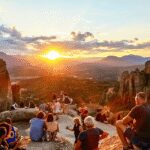
Kalambaka sits beneath the strange rock pillars of Meteora. After settling into your accommodation, the tour includes an evening drive around the hills for sunset photographs. This is one of the most appealing parts of the schedule because the monasteries and cliffs can look very different in late light than they do during a midday visit.
The monastery visits include Great Meteoron, Agios Stefanos, and Varlaam. Great Meteoron is the largest and most imposing of the group. Agios Stefanos is one of the few female monasteries at Meteora, with origins linked to the 15th century. Varlaam takes its name from the hermit who first lived on the rock in the 14th century, though the monastery developed in its later form during the 16th century.
You have about 45 minutes at Great Meteoron, 20 minutes at Agios Stefanos, and 30 minutes at Varlaam. That is enough for an introduction and photographs, but not a slow, detailed study of every chapel, fresco, and museum display. Entrance fees are extra, and you should expect stairs and uneven walking around the monasteries.
Dress respectfully for Orthodox religious sites. The schedule includes several monasteries in one visit, so modest clothing and comfortable shoes will make the day easier.
Day two: Delphi and Arachova
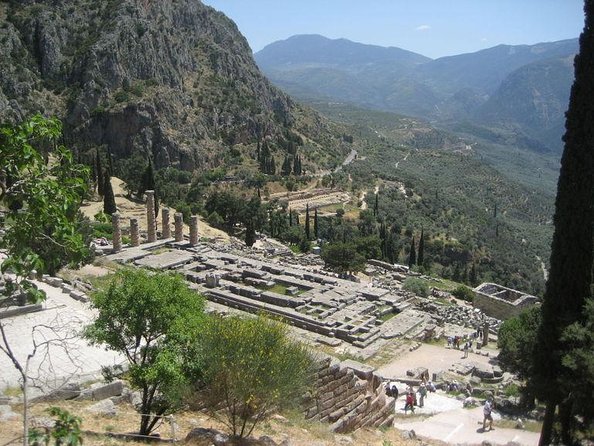
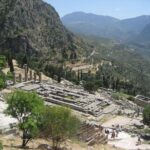
The second day shifts from Orthodox Christianity to ancient Greek religion. Delphi was a Panhellenic sanctuary dedicated to Apollo and the home of the oracle. Ancient Greeks regarded it as the center of their world, and the site’s high mountain setting helps explain its power.
The archaeological area includes the Temple of Apollo, the theater, and the stadium. You have about an hour at the site, followed by another hour in the Delphi Archaeological Museum. The museum contains the famous Charioteer of Delphi and gold-and-ivory works that help fill in the details missing from the stones outside.
I like this split between ruins and museum. Delphi can feel abstract if you only walk among foundations, while the museum gives you objects with faces, clothing, and craftsmanship. The schedule also notes the Gymnasium and the sanctuary of Athena Pronaia, which offer more context if the timing allows.
Delphi is a mountain village about 900 meters above sea level, close to the Parnassus ski area. That elevation matters. The roads are scenic, but the weather can differ from Athens, and the walking areas may feel exposed or steep. Bring a layer even if the morning in Athens is warm.
The afternoon stop is Arachova, a mountain village known as a winter resort for Athenians and a base for skiing at Parnassus. You have about an hour to look around. This is a pleasant counterpoint to the ancient sites, with time to see a modern Greek mountain town rather than another field of ruins.
The important limitation is that your driver is not licensed to accompany you inside Delphi or the museum. You can explore independently, or arrange an additional licensed guide. If ancient religion and mythology are the main reason you booked, that extra guide may be worth the cost.
Day three: Nafpaktos and the birthplace of the Olympic Games
Nafpaktos provides a brief coastal pause before Olympia. Its old port looks toward the area associated with the Battle of Lepanto in 1571, when Ottoman forces faced a united western fleet. The stop lasts about 30 minutes, so think of it as a short walk and photo break rather than a full town visit.
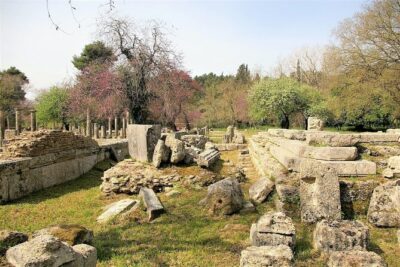
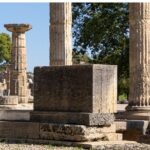
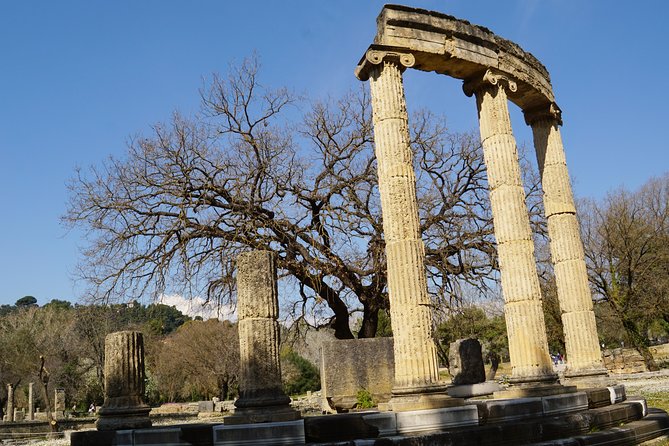
Olympia is the day’s main event. This was the sanctuary of Olympian Zeus and the birthplace of the ancient Olympic Games. The archaeological site leads you past the Gymnasium, Palaistra, workshop of Phidias, Temple of Zeus, and the stadium where Greek competitors sought honor for their cities.
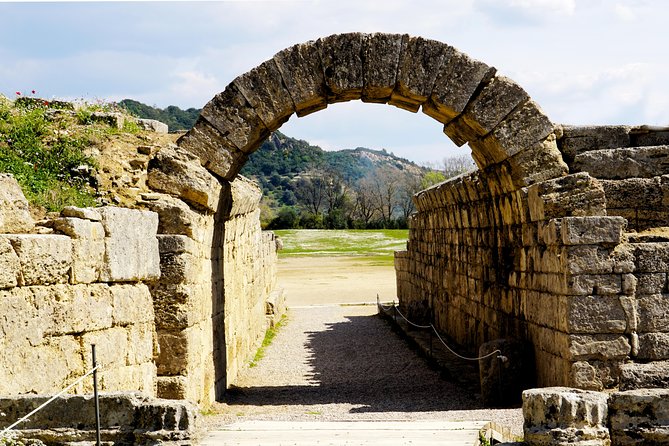
You get about an hour at the ruins. That is a workable introduction, though the site is large and the midday sun can be tiring. The stadium is the emotional payoff. Walking into the long racing area gives the ancient games a physical scale that no photograph can provide.
The Archaeological Museum of Olympia adds another 30 minutes. Its best-known work is the Hermes of Praxiteles, while tools associated with Phidias connect the museum to the workshop that produced the gold-and-ivory statue of Zeus, one of the ancient world’s celebrated wonders.
There is also a Museum of the History of the Ancient Olympic Games, with 463 ancient works and exhibits covering the period from the second millennium BC to the fifth century AD. It explains the games through objects and visual material, not just dates. Afterward, lunch takes place in the village.
This day works well because Olympia is not treated as a single photo stop. You see the outdoor site, the main archaeological museum, and the museum focused on the games. Still, the total schedule is tight. If you want to read every display or linger over the stadium, tell the driver early and ask what can be adjusted.
Day four: Mycenae, Tiryns, and the harbor at Nafplio
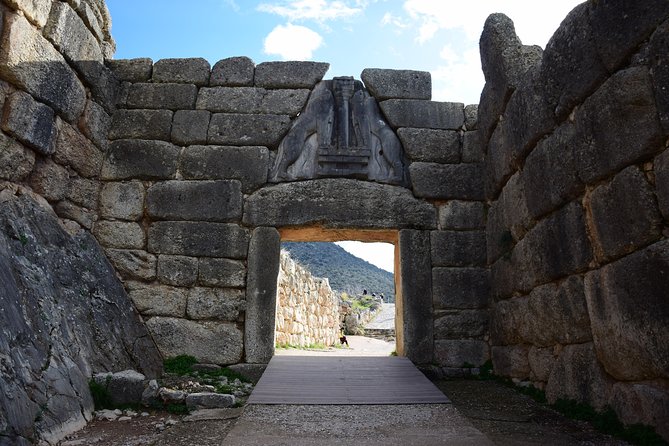
Mycenae takes you back to the second millennium BC, to the Bronze Age world linked with Agamemnon, Achilles, and Helen of Troy. The remains include massive cyclopean walls, Burial Circle A, and the ruins of the palace.
The Lion Gate is the visual centerpiece. Its carved lions form one of Europe’s oldest examples of monumental architectural sculpture. You have about 10 minutes specifically for the gate, within roughly an hour at the wider site.
The small museum at Mycenae displays finds from the ancient city. Before leaving, you stop at the Treasury of Atreus, the best-preserved tholos tomb in the area and a fine example of Mycenaean construction. The beehive-shaped chamber is more impressive when you consider the engineering involved, especially alongside the rough, enormous defensive walls.
Nafplio changes the mood completely. The town served as Greece’s capital until 1834 and combines Venetian, neoclassical, and Oriental architectural touches. Its harbor includes the small fortress of Bourtzi on an islet, while Palamidi and Acronauplia add fortifications above the town.
Lunch is planned at a traditional seaside tavern. You then drive up to Acronauplia for a panoramic view of Nafplio. That viewpoint is useful because the town’s relationship with the harbor, fortresses, and sea becomes clear from above.
The final stop is Tiryns, another Mycenaean site associated with the mythical hero Heracles. It is less famous than Mycenae, but that is part of its appeal. You have about 30 minutes, enough to see the massive walls and understand that the Bronze Age power base extended beyond one citadel.
Mycenae and Tiryns can feel similar if you are rushing. I would pay attention to the difference in scale and setting, and use Nafplio as a chance to slow down. This is one of the tour’s best-balanced days, but only if you accept that each ancient site receives a focused visit rather than unlimited time.
A few more Athens tours and experiences worth a look


Day five: Healing, theater, and Corinth
The final day begins at the Sanctuary of Asklepios at Epidaurus. Asklepios was the Greek god of healing and medicine, and the sanctuary was an important center devoted to care and worship.
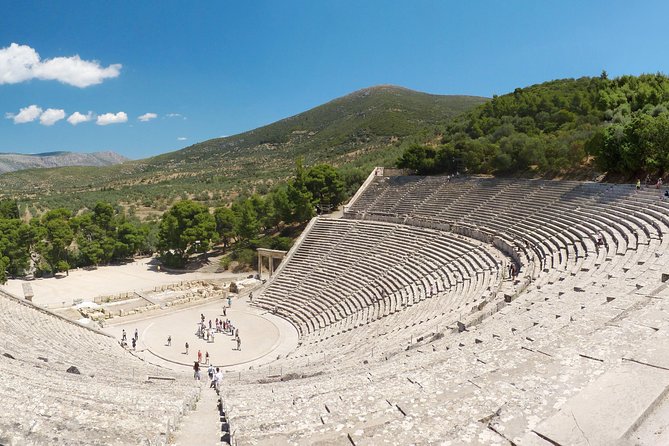
The Ancient Theatre of Epidaurus is the highlight. Built in the fourth century BC, it is renowned for its preservation and acoustics. You have about 30 minutes, enough to climb toward the upper seats and test the sound from the performance area.
That half hour is short for a site with both a sanctuary and a theater. If you want to study the medical buildings, temples, and theater in detail, ask whether the order or timing can be adjusted. The theater itself, however, rewards even a brief visit.
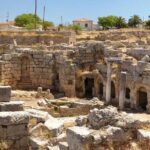
At Ancient Corinth, the focus shifts to a major ancient city and an important early Christian setting. The Apostle Paul preached here, was judged by the tribunal in the Agora, and helped establish a well-organized Christian church.
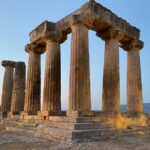
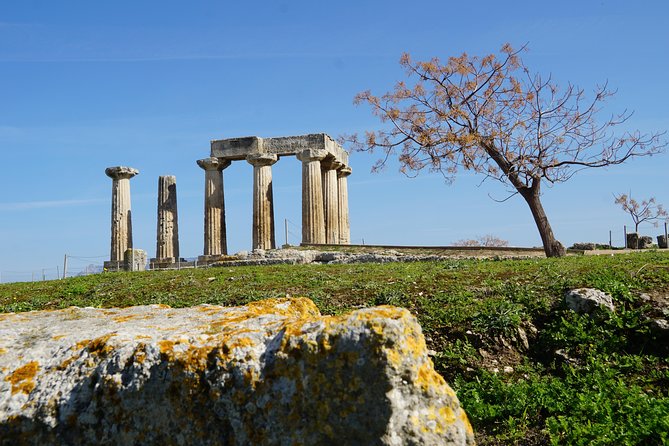
The Temple of Apollo dates to around 560 BC and is one of the earliest Doric temples in the Peloponnese and mainland Greece. A short stop at the temple is followed by Acrocorinth, described as the oldest and largest castle in southern Greece. You have about 20 minutes at the hill, so this is mainly a viewpoint and orientation stop rather than a full exploration of the fortress.
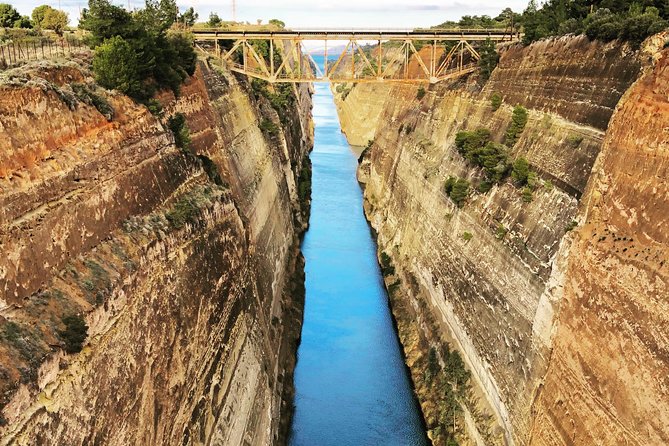
The last stop is the Corinth Canal, opened in 1892 to separate the Peloponnese from the rest of Greece while linking the Saronic Gulf with the Corinthian Gulf. You have about 15 minutes to walk across a pedestrian bridge and look down into the cut. Bungee jumping may be available on some days, but it is an optional activity, not part of the tour.
From the canal, you return to Athens. Traffic affects the exact timing, as it does throughout the trip.
What the private format really changes
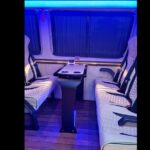
A private tour gives you your own vehicle and group, plus pickup and drop-off at a hotel, Airbnb, or port. That matters on a route with mountain roads, several overnight areas, and many sites that are awkward to connect by public transport.
You can also discuss timing with the driver. The published schedule is approximate, and traffic or time spent at one site can change the day. The tradeoff is that flexibility does not automatically mean guided visits. The drivers can explain history, but they are not licensed to accompany you inside archaeological sites or museums.
If you want a formal explanation at Delphi, Olympia, or Mycenae, add a licensed guide. This raises the cost, but it may be the best use of your money if you prefer stories and interpretation over independent reading.
Accommodation is arranged according to your booking. The supplied details also state that breakfast is not included, so check exactly what lodging level and meal arrangements you are selecting before paying. Bottled water and private transportation are included.
Who should book this route
I would choose this tour if you have five days, care strongly about ancient Greece, and do not want to rent a car. It is especially good for a couple, family, or small group that wants privacy and is happy to spend long periods on the road.
The route also suits a honeymoon with a serious interest in archaeology. One published account described the experience as a good addition to a honeymoon, while another praised the organization, low-stress arrangement, and lodging. If Christos is your driver, the company describes him as especially passionate about Greek history and mythology. Dimitra is also identified as a professional agent who helps shape private arrangements, though driver assignments are not guaranteed.
I would not choose it if you want lazy mornings, beach time, or long museum visits. The itinerary is carefully packed, and several stops last only 10 to 30 minutes. You should also budget separately for entrance tickets, breakfast, and any licensed guide.
The cancellation terms are worth noting before booking: you can receive a full refund if you cancel at least three full days before the start time. Changes or cancellations inside that window are not accepted for a refund.
FAQ
What time does the tour start?
Pickup begins at 8:00 a.m. The exact daily duration can change with traffic and the time spent at each location.
Where can pickup and drop-off take place?
Pickup and drop-off are offered at a hotel, Airbnb, or port.
Is the tour private?
Yes. Only your group participates in the activity.
Are entrance fees included?
No. Entrance fees for the archaeological sites, monasteries, museums, and other attractions are not included.
Can the driver guide me inside the sites?
No. The drivers are not licensed to accompany you inside archaeological sites or museums. You can hire a licensed guide at an additional cost.
Is accommodation included?
Accommodation is arranged according to your booking. Breakfast is not included, so check the selected booking details before confirming.
Should you book it?
Book this tour if you want a broad, efficient introduction to mainland Greece with your own vehicle and a schedule built around major historic sites. The strongest features are the sunset visit around Meteora, the range of places covered, and the freedom of traveling with only your own group.
Skip it if you prefer slow travel or need a guide at every ruin. For the right person, this is a practical way to connect Greece’s ancient sanctuaries, medieval monasteries, mountain towns, and modern landmarks without the burden of driving.