REVIEW · ATHENS
Biblical Tour Letters ToThe Corinthians St Paul’s Footsteps 6Hour
Book on Viator →Operated by Yomadic.Tours & Transfers · Bookable on Viator
Paul’s footsteps in Corinth, without the hassle. This 6-hour circuit ties Athens to the Peloponnese through places connected to Saint Paul, then back again in a way that feels built for real schedules. I like the comfort of a private, air-conditioned ride and the way the route keeps the focus on Paul’s story, not just random ruins.
Two things I really like: first, the transportation is set up for ease—your driver picks you up and returns you to the same place (or to the port), with Wi‑Fi, bottled water, and a small-group vibe. Second, the commentary approach matters here; drivers such as Chris, Yiannis, Panos, Alex, and Andreas are repeatedly praised for explaining each stop clearly and answering questions in a way that makes Paul’s world feel readable.
One consideration: some major archaeological-site entry is not included (notably Ancient Corinth and the Archaeological Site of Isthmia), and your driver can’t act as the licensed guide inside sites unless you request that extra option.
In This Review
- Key things I’d plan around before you go
- Why this Paul-focused day trip fits Athens so well
- The ride: pickup, Wi‑Fi, luggage space, and the small-group rhythm
- Aeropagus Hill: the stage for Paul and the Unknown God
- Daphni Monastery: Byzantine layers after an older temple site
- Corinth Canal: understanding why this strip of land mattered
- Isthmia’s temples and stadium: Paul’s setting meets ancient athletics
- Ancient Corinth and the Bema: where the letters start to feel real
- Kenchreai (Cenchreae): Phoebe’s kind of port connection
- Temple of Apollo at Corinth: quick stop, clear architecture
- Apostolos Pavlou Church: finishing with the living Christian layer
- Budgeting the extra tickets: Ancient Corinth and Isthmia
- Who should book this tour (and who might not love it)
- Final call: should you book this Footsteps of Paul tour
- FAQ
- How long is the tour?
- Where do you get picked up and dropped off?
- What is included in the tour price?
- Which entrance fees are not included?
- Can the driver guide inside archaeological sites?
- What group size should I expect?
- Is this tour good for cruise passengers?
- What if weather is bad or I need to cancel?
Key things I’d plan around before you go
- Small-group, private-vehicle feel: You’re not crammed into a big bus day.
- Comfort extras on the road: A/C, Wi‑Fi, and bottled water are part of the ride.
- Paul-focused site connections: Stops are chosen to map to Acts and the letters to the Corinthians.
- Great “storytelling first” driving: Drivers like Chris and Yiannis are highlighted for personable, question-friendly explanations.
- Corinth’s big geography moment: The Corinth Canal stop helps you understand why ancient travel mattered.
- Budget for separate tickets: Ancient Corinth and Isthmia admissions may be additional.
Why this Paul-focused day trip fits Athens so well
This tour is built for efficiency. It links key Athens-side Paul context with a full Corinth area visit, then gets you back on time—especially useful if you’re departing on a cruise.
The “why it works” is simple: you’re using one private vehicle for the whole arc, so you spend less time coordinating transfers and more time in the right places. That matters when you have limited daylight or a fixed departure time.
You’ll also like that the route is religious and historical at the same time. You’re not only seeing stone; you’re connecting scenes from Acts and the Corinthians letters to real locations, including the Bema area connection and Paul-related church sites.
You can also read our reviews of more tours and experiences in Athens.
The ride: pickup, Wi‑Fi, luggage space, and the small-group rhythm
Logistically, the setup is traveler-friendly. You can be picked up from your Athens hotel, an Airbnb residence, or the cruise port, and you return afterward to the same place or a point you prefer—handy if you want to walk straight back to dinner or back to your ship.
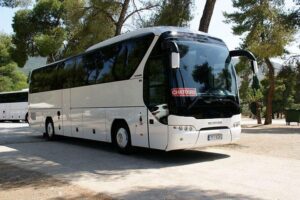
The vehicle is described as a premium luxury minivan (up to 8 passengers), with a small group format (listed as intimate groups of 2 to 4, and also described as up to 2–6 passengers). Either way, you’ll generally get a less rushed feel than large-group tours, and your driver can respond to questions rather than just talking over them.
Two practical comforts are built into the ride: Wi‑Fi and bottled water. If you’re doing this on a hot day, the air-conditioning is a real quality-of-life upgrade, not a luxury detail. There’s also mention that luggage storage in the car may be possible depending on how many bags you bring, which is worth thinking about if you’re coming straight from a cruise.
Aeropagus Hill: the stage for Paul and the Unknown God
Your day starts with a hotel or port pickup, then heads to Areopagus Hill, the place associated with Paul’s famous speech to the Athenians. The stop is short, but it’s a meaningful orientation moment: you’re standing where the message about the Unknown God is tied to the city’s religious mindset.
Even with limited time here, the value is in the context. You’re not learning Paul in a vacuum; you’re placing his ideas in a specific urban world—one where philosophy, religion, and public speaking overlapped.
Drawback to keep in mind: the time at this stop is brief (about 15 minutes), so if you like long photo sessions or want to linger, you’ll need to balance that with the rest of the day’s pacing.
Daphni Monastery: Byzantine layers after an older temple site
Next is the Monastery of Daphni, a major Byzantine monument on the slopes of Mount Aigaleo. The site is special because it’s not just one era layered on another—it’s a layered story: the monastery is believed to have been built on the location of an ancient Apollo temple sanctuary, and it later saw different religious hands over time.
What you’re going to notice most is the fortified feel of the complex. It’s surrounded by strong walls with towers and two entrance gates, which helps you picture the place not only as sacred but also as protected.
The biggest reason this stop earns time is the monastery’s mosaics and ongoing preservation work. Earthquake damage is part of the story, but the restoration emphasis keeps the artistic and spiritual legacy visible today.
You’ll get around 20 minutes here. That’s enough to take in the feel of the grounds and mosaics without turning it into a stressful sprint.
Corinth Canal: understanding why this strip of land mattered
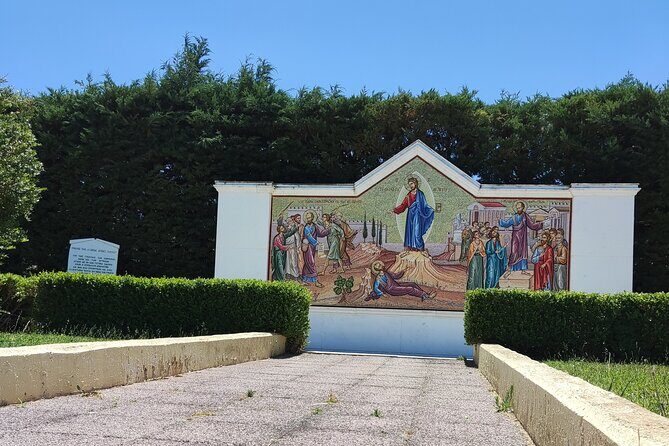
Then you hit a very different kind of site: the Corinth Canal. This stop is about geography and imagination. The canal cuts across the narrow isthmus, separating mainland Greece from the Peloponnese like a practical shortcut that took centuries of dreaming to build.
The story you’ll hear (and that makes the place click) is how ships used to avoid the long loop around the Peloponnese—adding a huge distance to voyages. You also get the idea that the canal wasn’t “born” in the 1800s; it grew out of a much older fascination with moving through this narrow bottleneck.
This is a quick stop (about 20 minutes). The value isn’t deep museum time; it’s that it gives you a visual reason why Corinthians’ world, travel routes, and trade mattered.
- All Day Cruise -3 Islands to Agistri,Moni, Aegina with lunch and drinks included
★ 5.0 · 4,958 reviews


Isthmia’s temples and stadium: Paul’s setting meets ancient athletics
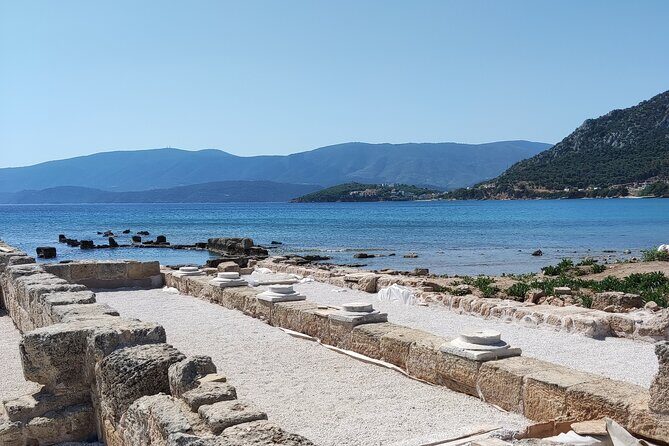
From the canal region you move toward the Isthmia area, tied to major ancient games and to Paul’s presence in the broader setting of the Isthmian region.
This is where the “Paul connection” matters to Christians. The tour framing emphasizes that Paul’s work as a tent maker placed him in the orbit of the Isthmian games, described as the second most important games after Olympia. If you’ve read Acts and the letters, this is the kind of place where those references feel less abstract.
You’ll explore the area in layers:
- Temple of Poseidon and Amphitrite history is part of the story, including fires, rebuilding, and later Roman-era damage and reconstructions.
- A stadium area associated with the games.
- The Sanctuary of Palaimon, connected to worship and sailors.
Time is distributed across several pieces of the archaeological landscape. Some elements are listed as additional admissions not included, while earlier parts of the Isthmia portion are described with free admission. Practically, you should plan for extra entry fees to cover at least some of what you see here.
If you’re short on time, the smart move is to focus on the big silhouettes: temple ruins, stadium setting, and sanctuary area. The mosaics and Roman layers can be fascinating too, but you’ll get the most value by looking for how the site layout matches ancient life.
Ancient Corinth and the Bema: where the letters start to feel real
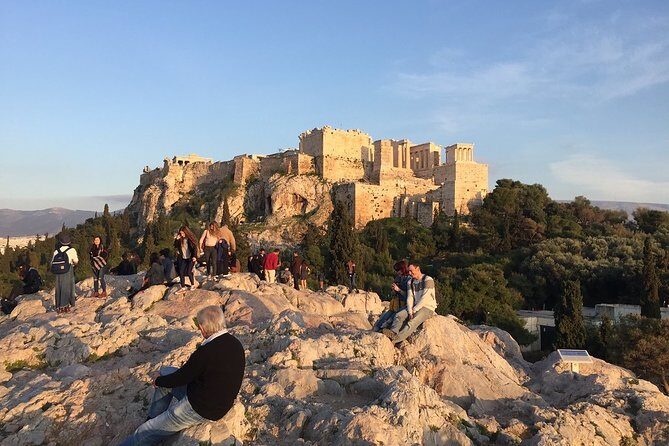
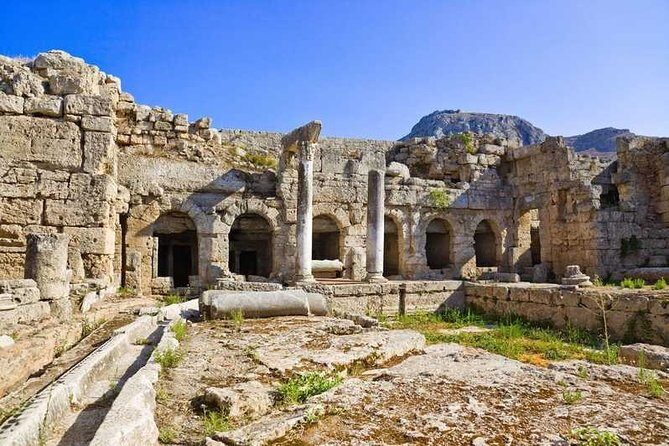
Then comes the heart of the day: Ancient Corinth (Archaia Korinthos). Corinth was a major city-state on the isthmus, halfway between Athens and Sparta. For your Bible study, it’s central because it’s directly tied to Paul’s letters to the Corinthians and his missionary travel.
This is also a Roman-era turning point. The Romans demolished Corinth in 146 BC, rebuilt it later, and the city became the provincial capital. That history helps explain why Corinth was both culturally complex and spiritually contested.
The stop heavily emphasizes the Bema area—linked in tradition to the place where Paul was brought for judgment. The Bema is described as a podium/rostrum from which city officials addressed the public, and it’s also noted that the monument’s connection helped it later be transformed into a Christian church during the Byzantine period.
Practical reality check: the Ancient Corinth entrance fee is not included. You should budget €15 per person for this site ticket.
In terms of pacing, you get about an hour at the ancient site area. That’s enough to walk the main zones at a comfortable speed, read what you can on-site, and still leave time to take photos without feeling like you’re being chased by the clock.
Kenchreai (Cenchreae): Phoebe’s kind of port connection
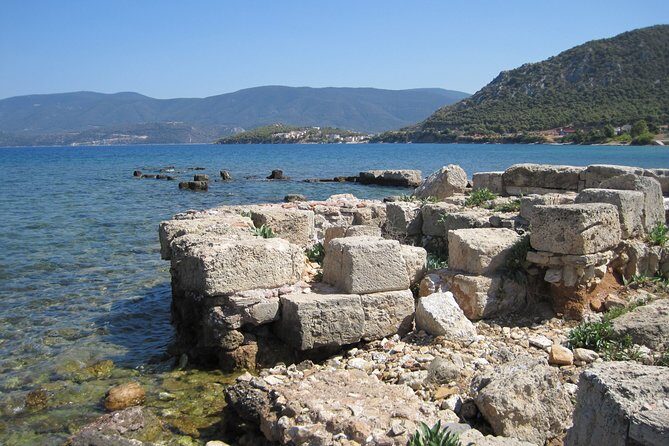
After Ancient Corinth, you’ll visit Kenchreai (Cenchreae), a village area tied to the ancient port location. This part of the day is a nice shift from big-city forums to the maritime rhythm of the region.
The biblical connection here comes from Acts 18:18, with Paul stopping at Cenchreae and having his hair cut to fulfill a vow. The tour framing also highlights Paul mentioning a woman named Phoebe in connection with the local assembly in his letter to the Romans.
You’ll get about 30 minutes. It’s not a long stop, but it’s a strong “Paul moved through real places” reminder. It also helps you visualize how early Christian life spread through networks that included ports and travel routes.
Temple of Apollo at Corinth: quick stop, clear architecture
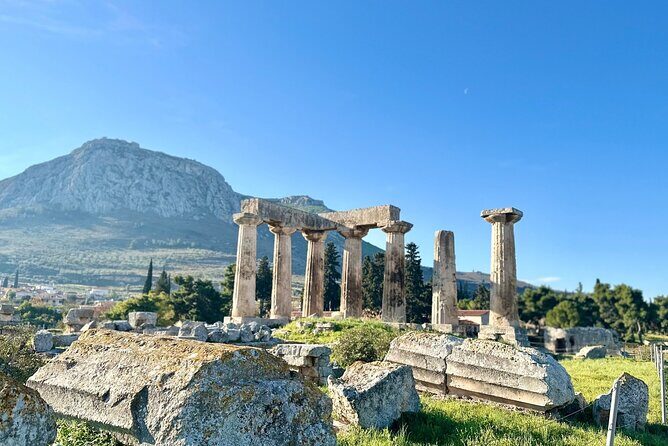
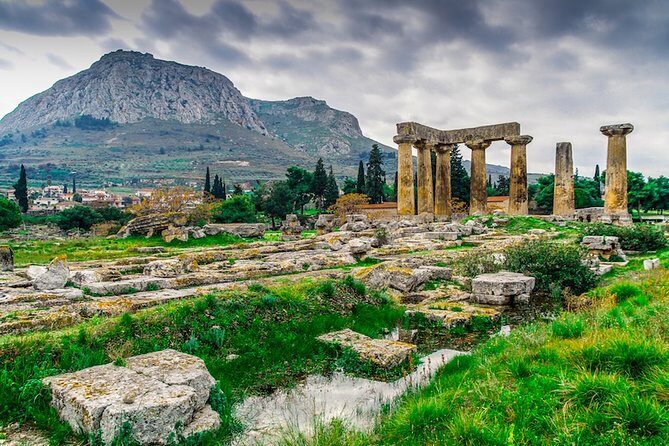
There’s also a short visit to the Temple of Apollo at Corinth. The site is described with key facts: constructed around the mid-500s BC and noted for early Doric temple characteristics, including monolithic columns described as rare in the region and in the ancient world.
This isn’t a long linger. You’ll spend around 10 minutes, so treat it as a visual punctuation mark. You’re looking for the temple form, then moving on with a clearer sense of the religious landscape around Paul’s Corinth.
Not included for entry here, so if the area opens your ticket at the gate, you may want to confirm on arrival.
Apostolos Pavlou Church: finishing with the living Christian layer
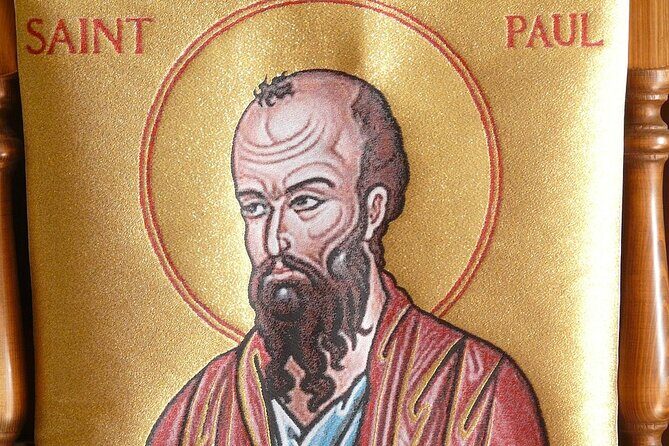
To wrap up, you visit Apostolos Pavlou (St Paul’s) Church in Corinth, described as strongly associated with Paul’s time there and the founding of a metropolitan church around 51–52 AD.
This part feels different from the ruins. It’s not “stand where the emperor watched.” It’s more “stand where the Christian tradition kept memory of Paul in a continuing place.”
The stop is short (about 20 minutes), but it works well as a closure moment. You’ve spent the day moving through ancient civic life, maritime connections, athletics, and local worship, and then you end in a place of active religious identity.
Budgeting the extra tickets: Ancient Corinth and Isthmia
The headline price is $170.50 per person for a roughly 6-hour, 15-minute experience. For many people, the value is that you’re paying for efficient transport, a focused route, and the driver-led Paul-and-Corinth commentary.
Still, do the math up front. Ancient Corinth entrance is €15 per person, and there’s also an Isthmia archaeological site admission fee listed as €5 per person. Some parts of the Isthmia area are referenced as free, but other listed segments are not included, so the safest move is to plan for additional entry costs when you arrive or when the driver collects site fees.
Optional add-on worth knowing: Greek regulations require officially licensed tour guides to lead inside archaeological sites. Your driver can provide extensive commentary around and between sites, but cannot act as your inside licensed guide. There is an option to arrange a licensed guide for site interiors on request, listed at €160 per booking depending on availability.
Who should book this tour (and who might not love it)
Book this if you want a structured “Paul in Greece” day without the logistics headaches. It’s especially fitting for cruise passengers with limited time, because the tour is described as guaranteeing a timely return to the ship when scheduled that way.
It’s also a good fit for first-time visitors who don’t want to guess their way from Athens to Corinth, or for people who like connecting Bible reading to physical places. The itinerary leans into that mapping: Athens-linked speech context, Corinth civic space (including the Bema connection), port geography at Kenchreai, and the broader games world at Isthmia.
You might want to consider a different format if you prefer long, slow time inside major museums with a licensed guide doing the full interpretive work at each site. This one is driver-guided and route-driven; site interiors may require extra planning or an added licensed guide.
Final call: should you book this Footsteps of Paul tour
Yes—if you want the day to feel organized, comfortable, and spiritually connected to real places, this is a strong match. The A/C private minivan, the Wi‑Fi and bottled water, and the question-friendly driver style (people name guides like Chris and Yiannis specifically for that) make a big difference when you’re doing a tight Athens-to-Corinth loop.
Before you book, do two quick checks:
- Confirm how you want to handle Ancient Corinth and Isthmia site tickets so budget doesn’t surprise you.
- Decide whether you want optional licensed guide time inside sites, since that affects how much you’ll get inside the archaeological areas themselves.
If those points fit your style, this is the kind of tour that makes Paul’s story feel much closer to the ground.
FAQ
How long is the tour?
It runs for about 6 hours and 15 minutes (approx.).
Where do you get picked up and dropped off?
Pickup and drop-off are offered from your Athens hotel, Airbnb residence, or the cruise port, and you return to the meeting point or to the port point you prefer.
What is included in the tour price?
The price includes air-conditioned private transportation, bottled water, Wi‑Fi on board, and a mobile ticket. It also includes admission tickets for some stops that are listed as included.
Which entrance fees are not included?
Ancient Corinth has an entrance fee listed as €15 per person, and the Archaeological Site of Isthmia has an entrance fee listed as €5 per person.
Can the driver guide inside archaeological sites?
Your driver can provide historical commentary, but they cannot act as the licensed guide inside archaeological sites due to Greek legislation. A licensed guide can be arranged on request for an additional cost, depending on availability.
What group size should I expect?
This is described as a private tour with an intimate group feel. It’s listed as 2 to 4 for intimacy, with small-group participation also described up to 2 to 6 passengers, and the minivan capacity can be up to 8.
Is this tour good for cruise passengers?
Yes. It’s specifically described for cruise passengers who want to visit Ancient Corinth while following Apostle Paul’s footsteps and to make sure you return to the ship on time.
What if weather is bad or I need to cancel?
The experience requires good weather. If it’s canceled due to poor weather, you’ll be offered a different date or a full refund. You can cancel up to 24 hours in advance for a full refund.