REVIEW · ATHENS
Day tour to Ancient Olympia,Ancient Sparta Mycenae Including Meal
Book on Viator →Operated by Theodores Private Tours - Theodores Travel · Bookable on Viator
One long day, three huge Greek legends. That’s what makes this Athens-to-Peloponnese tour so tempting: you start with the Olympics at Olympia, swing to Sparta’s hard-edged past, then end in Mycenae’s myth-and-stone world. I love how the drive itself turns into part of the experience, with the guide keeping context going between stops.
I especially like the “no-stress” evening payoff: dinner back in Athens includes the famous moussaka, plus the standard Greek set (Greek salad and tzatziki), and you get baklava with ice cream at the end. One thing to consider: this is a long day, and the schedule is built around driving time, so you’ll be hopping between major sites rather than lingering for hours.
In This Review
- Key things to know before you go
- A Peloponnese day trip that’s basically Greek mythology with seatbelts
- Price and what you actually get for the money
- Pickup and the car comfort question (the long drive is real)
- Stop 1: Ancient Olympia, where the Games feel almost staged
- Stop 2: Kaiadas Cave in Sparta, history with a heavy undertone
- Stop 3: Sparta’s archaeological site and the Leonidas connections
- Stop 4: Mycenae’s Lion Gate and the Agamemnon story you can see
- The Corinth Canal stop: quick, dramatic, and easy
- Dinner back in Athens: moussaka, salad, tzatziki, and a real finish
- How the “guided driving” style changes your experience
- Best-fit traveler: who will love this most
- Guides people talk about: Paddy, Ted, Sebastian, Dallas, and more
- Should you book this Athens-to-Olympia-Sparta-Mycenae day tour?
- FAQ
- Is pickup offered for this tour from Athens?
- How long is the tour in practice?
- What language is the tour offered in?
- Are meals included?
- Are entrance tickets included for the archaeological sites?
- What vehicles are used for groups of different sizes?
- Do the guides go inside the monuments with you?
- What happens if weather is bad?
- Can the itinerary change on the day?
- Is the tour private?
Key things to know before you go
- Olympia first: you’ll walk through the sanctuary world of Zeus and the stadium where the Panhellenic Games took shape
- Sparta with context: Kaiadas Cave adds a dark layer, and the Sparta site connects myths to what archaeology suggests
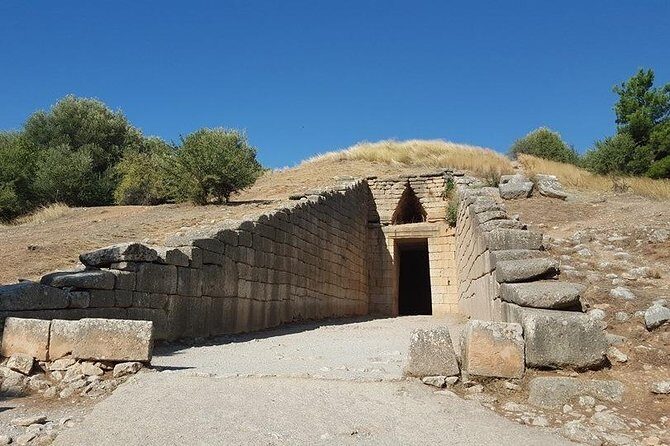
- Mycenae’s drama: Lion Gate, the Tomb of Agamemnon, and Cyclopean walls give you scale fast
- Guided driving style: your driver/guide shares history on the road and helps orient you, but site entry/inside guiding isn’t guaranteed
- Included dinner in Athens: moussaka, salad, tzatziki, and a drink, plus baklava with ice cream
- Flexible routing when needed: the plan can change for weather or site closures, so keep an open mind
A Peloponnese day trip that’s basically Greek mythology with seatbelts
If you’re trying to pack mainland Greece into a short Athens stay, this tour hits the big names without forcing you to rent a car or wrestle with logistics. It’s long, yes, but it’s also efficient: you cover distances by Mercedes vehicle and spend your limited on-site time at the places that actually anchor the stories you’ve heard since school.
What makes it work is the pacing. You don’t just drop off and disappear. The guide narration fills the gaps during the drive, so you’re not staring out the window wondering why any of this matters.
You can also read our reviews of more tours and experiences in Athens.
Price and what you actually get for the money
At $286.62 per person, you’re paying for transport, a guided narrative (from a local guiding chauffeur), and an included dinner back in Athens. You’re also paying for convenience: pickup is offered from where you’re staying in Athens, and you don’t have to coordinate multiple transfers across the Peloponnese.
Two things make the price easier to stomach:
- You get a full-day bundle: water, soft drinks, snacks during the day, then a proper Athens dinner instead of hunting down a restaurant reservation.
- You’re not spending your time figuring it out: the tour is built to get you to Olympia, Sparta, and Mycenae on a single day.
One caution: entrance fees may not be included for certain sites depending on the option you choose. The tour notes an Olympia Archaeological Site ticket (€20) and a Mycenae entry ticket (€20) if that ticket option is selected, so check what’s included in your exact booking.
Pickup and the car comfort question (the long drive is real)
This tour runs from Athens and uses Mercedes vehicles based on group size: a Mercedes E-Class for 1–4 passengers, a Minivan for 5–8, and a Sprinter for 9–15. For most people, the biggest practical win is simply sitting somewhere comfortable while the Peloponnese unfolds outside the window.
Expect the day to feel stretched. Several guides have been praised for timing the stops well, keeping restrooms in mind, and making sure you’re hydrated. Still, you’re looking at a day that can run well past a “standard” 10–12 hours, depending on traffic, weather, and how long each site takes.
Stop 1: Ancient Olympia, where the Games feel almost staged
Olympia isn’t just ruins. It’s a sanctuary landscape—Alfeios River banks, temples, stadium, and those familiar legends of heroes and gods. The tour starts here because Olympia gives you the “why” of the whole Olympic idea. Even before you get to the stadium, you’re stepping into a site that grew into the religious center of the ancient world.
What you’ll see (and why it matters):
- Zeus Temple and the famous statue: you’ll hear about the 12-meter gold-and-ivory Zeus, one of the famed wonders of the ancient world. Even if the statue itself is gone, the scale of the setting helps you understand why this counted as sacred power, not just sports.
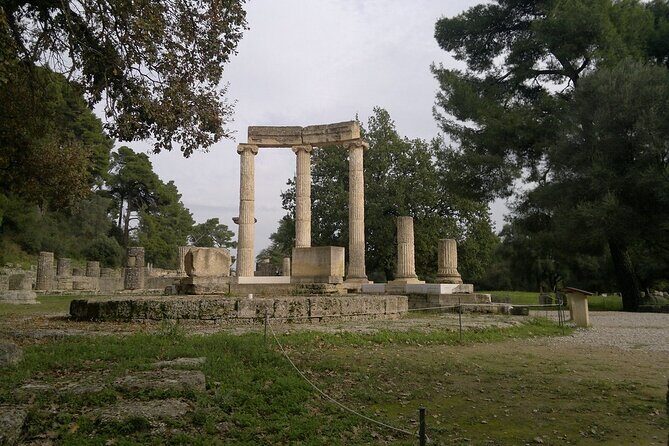
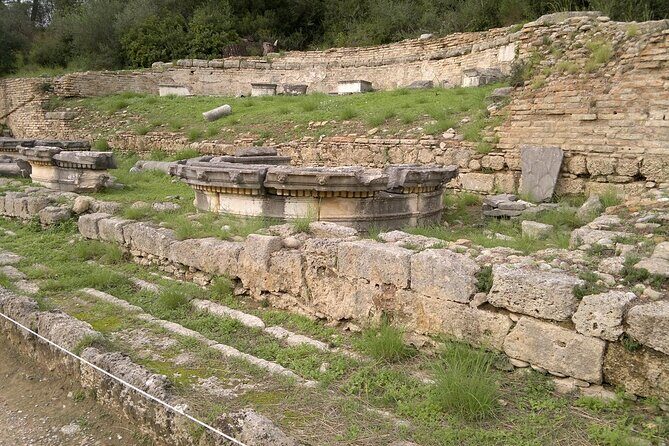
- Philippeion: this circular structure was a gift to Zeus from King Philippos II, tied to Alexander’s family story. It’s a great example of how rulers used religion and architecture to “speak” to the Greek world.
- Ancient Olympic Stadium: walking or standing in the stadium area makes the idea of the Games feel immediate. This is where the event becomes more than a date on a timeline.
- Palaestras and Hera’s Temple: these fill out the daily reality around the Games—training grounds, religious life, and the community that formed around the sanctuary.
You’ll also visit the Olympia museum area. Museums won’t replace the outdoor impact here, but they help when you want details to “stick” after the first awe wears off.
One practical note: this stop is a big one, so give yourself permission to slow down for photos and “wait a minute” moments. It’s tempting to power through, but Olympia rewards unhurried looking.
Stop 2: Kaiadas Cave in Sparta, history with a heavy undertone
Kaiadas Cave is not the gentle kind of ancient. The tour frames it as a pit or underground cavern used for state prisoners and, in some accounts, for corpses. That description sets the tone: this isn’t a stop built for scenic photos—it’s built to make you think about how Sparta functioned.
On the ground, what you’ll want most is time to walk and take in the space. Even without theatrical storytelling, the location does a lot of work.
Consideration: if your idea of “vacation archaeology” is mostly temples and heroes, this may feel emotionally intense. If you’re okay with that, it’s a strong Sparta contrast against the more famous heroic myths.


Stop 3: Sparta’s archaeological site and the Leonidas connections
The Sparta stop gives you the bones of the ancient city: the Acropolis, an ancient theater, and Roman-era houses. You’re looking at a place that was built around political power and military discipline, then later fell through changing wars and larger regional shifts.
Here are the standout moments to look for:
- Leonidas statue references: the tour describes Leonidas’ full outfit from Thermopylae. Even if you’ve read about the stand, seeing the statue-focused presentation helps you visualize Spartan identity as something performative and symbolic.
- Tomb of Leonidas: the tour notes his corpse was transported and buried in Sparta in 430 BC. That detail connects battlefield legend back to Spartan civic memory.
- Lycurgus statue: Lycurgus is tied to Spartan military education, and you’ll get the myth-and-history thread linking Sparta’s system to Apollo’s Oracle in Delphi.
- Museum of the Olive Tree and Kaiadas: this part adds a twist to the usual stories. The tour mentions that research from the 1980s onward suggests there weren’t executed Spartan children with birth defects, but instead adult males and females were involved—sentenced men tied to crime, prisoners of war, and similar categories.
That last point is exactly why this tour can feel more valuable than a generic “Sparta = sandals and slogans” visit. You leave with a more complicated Sparta, not just a headline.
One more practical tip: Sparta’s site is outdoor walking. Bring comfortable shoes, and don’t assume shade will be everywhere.
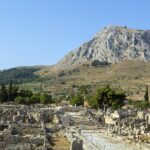
Stop 4: Mycenae’s Lion Gate and the Agamemnon story you can see
Mycenae is where the “mythical” part stops being abstract. It’s presented here as the palace center of the Late Bronze Age and as the kingdom tied to Agamemnon.
The key monuments you’ll want to actively seek:
- Lion Gate: you’ll see the classic gateway that makes Mycenae feel like a fortress.
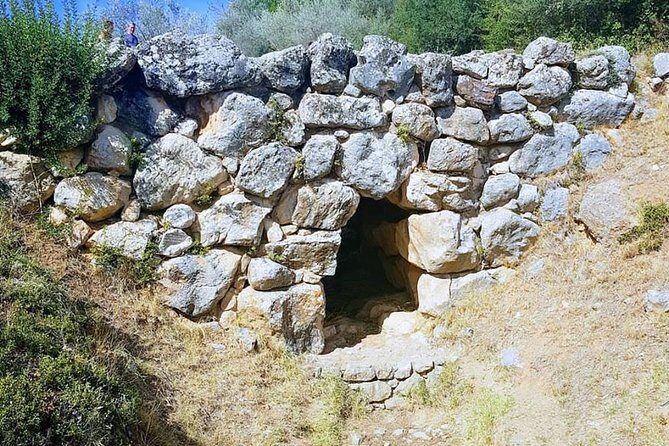
- Tomb of Agamemnon: the tour highlights the impressive “Treasure of Atrea” style tomb in excellent condition. It’s one of those places where you get the sense that wealth was built into stone, not just displayed.
- Cyclopean walls: these walls help you understand how “big walls” were not random; they were political statements in a turbulent era.
The tour also gives the timeline: Mycenae’s prime begins around 1600 BC and lasts until about 1100 BC, with fortification and rebuilding around 1350 BC. If you’re the type who likes dates, this stop gives you a spine for the stories you’ll hear afterward.
The Corinth Canal stop: quick, dramatic, and easy
Corinth Canal is short—think around 15 minutes. The value here is mostly visual and narrative. It’s a quick window into how geography shaped travel and power.
If you’ve been spending all day among the ruins and temple imaginaries, this is a reset. It also breaks the mental monotony of long archaeological viewing with something that feels more modern in scale.
Dinner back in Athens: moussaka, salad, tzatziki, and a real finish
This is one of the easiest parts of the day to love because it removes planning. You return to Athens and eat at a restaurant connected to the tour operator, not a generic tourist strip.
Your dinner includes:
- Moussaka (the centerpiece)
- Greek salad and tzatziki
- One soft drink or beer or a glass of wine per person
- Baklava with ice cream afterward
A practical bonus is pacing. You’re tired. You’re hungry. You don’t want to think about what to order or whether you’ll find a table. This dinner package solves that.
How the “guided driving” style changes your experience
This tour’s guide approach is worth understanding up front. The tour notes that the chauffeur provides local guiding services, and multiple experiences emphasize that guides often share interpretation while you’re traveling, while you explore sites on your own.
That can be a good match if:
- you like walking at your own speed inside each site area,
- you want a strong story thread while you’re between stops,
- you don’t want a rigid, step-by-step group march.
To make this work, do one simple thing: when your driver is talking, lean in. Those explanations are what help Olympia, Sparta, and Mycenae feel like one connected picture rather than three separate visits.
Best-fit traveler: who will love this most
You’ll be happiest with this tour if you:
- want major Peloponnese highlights without car rental stress,
- like big-picture historical context between stops,
- can handle a long day and lots of driving.
This tour may be less ideal if you:
- hate rushing through sites,
- want long guided time inside museums and monuments,
- are sensitive to emotional intensity (Kaiadas Cave),
- prefer a slow travel pace with minimal transit.
Guides people talk about: Paddy, Ted, Sebastian, Dallas, and more
The experience is heavily shaped by the driver/guide running the narration. In real bookings, names like Paddy, Ted, Sebastian, Dallas, George, Marcel, Demos, Michael, and Pantelis come up again and again. The common thread isn’t just facts—it’s the way these guides manage the day: answering questions, keeping timing steady, and making sure you’re comfortable.
If you want to maximize your day, it helps to ask questions as you go. Olympia, Sparta, and Mycenae are easier to enjoy when the mythology, politics, and architecture are clearly tied together.
Should you book this Athens-to-Olympia-Sparta-Mycenae day tour?
My take: yes, if you want the Peloponnese’s biggest ancient hits in one go and you’re okay with a long, driving-heavy day. The included Athens dinner is a real value add, and the guided narrative between stops helps everything connect.
I’d say think twice if you’re the type who needs hours inside each site with a licensed guide holding your hand, or if a heavy Sparta stop like Kaiadas Cave doesn’t match your comfort level.
If you book, plan for comfortable shoes, bring water (even though it’s provided), and go in expecting that this is a fast tour of major places—not a slow study of one site.
FAQ
Is pickup offered for this tour from Athens?
Yes. Pickup is available from locations within the Athens area, including hotels, Airbnbs, and transit areas. You just need to communicate your pickup point after booking.
How long is the tour in practice?
The duration is listed as about 12 hours, but some days can run longer depending on conditions like timing and weather.
What language is the tour offered in?
The tour is offered in English.
Are meals included?
Yes. Dinner back in Athens is included, with moussaka, Greek salad, tzatziki, and a soft drink/beer/wine per person, plus baklava with ice cream.
Are entrance tickets included for the archaeological sites?
Not necessarily. Entrance fees for Olympia and Mycenae are listed as €20 per person if that ticket option is selected.
What vehicles are used for groups of different sizes?
The tour uses Mercedes vehicles depending on group size: E-Class for 1–4 passengers, Minivan for 5–8, and Sprinter for 9–15.
Do the guides go inside the monuments with you?
The tour style is guidance during the day, but site entry and inside guiding are not guaranteed as a package. You should expect to explore parts of the sites on your own with orientation and explanations during travel.
What happens if weather is bad?
The experience requires good weather. If it’s canceled due to poor weather, you’ll be offered a different date or a full refund.
Can the itinerary change on the day?
Yes. The tour may change start time or the itinerary under instructions of the operator, and last-minute changes have been made due to conditions like weather.
Is the tour private?
Yes. It’s described as private, meaning only your group participates.