REVIEW · ATHENS
Blue Lake, Sanctuary of Hera, Mycenae, Ancient Corinth, Canal
Book on Viator →Operated by Ancient Greece Tours & Transfers · Bookable on Viator
Mycenae and Ancient Corinth pack two very different chapters of Greek history into one long day, with the Corinth Canal and a swim at Blue Lake adding variety. You move from Bronze Age tombs and Cyclopean walls to Roman ruins, mountain views, and a seaside sanctuary.
I like the private door-to-door transport, especially because this route covers a lot of ground. I also like the flexible schedule: drivers such as Yannis and Panos can adjust the pace, suggest a local lunch, and sometimes add a sunset stop at Hera’s Sanctuary. The drawback is simple: nine hours is a lot, and several stops are brief. This is best for seeing many highlights, not for studying each site at leisure.
In This Review
- Key points to know before booking
- Why this private Athens day trip works
- The Corinth Canal gives you a fast engineering lesson
- Mycenae brings Homer’s world into view
- The Treasury of Atreus shows Bronze Age ambition
- Acrocorinth is the day’s big climb
- Ancient Corinth connects Greek, Roman, and Christian stories
- Hera’s Sanctuary and Blue Lake change the mood
- Comfort, flexibility, and the role of your driver
- Who should book this $337.15 excursion?
- Should you book it?
- FAQ
- How long does the tour last?
- Is hotel pickup included?
- Are entrance fees included in the price?
- Does a licensed guide accompany the group into the sites?
- Can I swim at Blue Lake?
- Is the tour private?
Key points to know before booking
- The Corinth Canal is an easy first stop, with time for views of the 19th-century waterway and the ancient Diolkos track.
- Mycenae gets the strongest archaeological focus, including the Lion Gate, royal tombs, palace remains, museum, and Treasury of Atreus.
- Ancient Corinth combines ruins, a museum, and lunch, with the Temple of Apollo and the Bema among the main sights.
- Acrocorinth adds a dramatic hilltop fortress, but its steep setting and one-hour visit may not suit everyone.
- Blue Lake and Hera’s Sanctuary give the day a softer ending, though the swim depends on weather and season.
- Admission fees and a licensed site guide cost extra, so check the total before booking.
Why this private Athens day trip works
From Athens, the Peloponnese can feel awkward to reach on your own in a single day. Public transport does not give you the same easy combination of Mycenae, Corinth, Acrocorinth, and Perachora. Here, your driver collects you at your hotel and returns you there in a private vehicle, so you can spend the day looking out the window instead of managing routes and parking.
The tour costs $337.15 per person and lasts about nine hours. That is a serious price, but it covers private transport, hotel pickup and drop-off, an English-speaking driver, WiFi, bottled water, refreshing wipes, and handmade Greek biscuits. For a couple or family that values comfort and schedule control, the price can make sense. For solo visitors or budget-minded pairs, public transport and separate tickets may cost less, though you will give up the easy door-to-door service.
This is not a traditional escorted sightseeing tour. Your driver provides background and practical help on the road, but does not accompany you into the archaeological sites or museums unless you add a licensed guide. That distinction matters. I like having time to walk through the ruins at my own pace, but you should be ready to read signs or arrange the extra guide if you want detailed explanations on site.
You can also read our reviews of more tours and experiences in Athens.
The Corinth Canal gives you a fast engineering lesson
The first main stop is the Isthmus of Corinth, where the modern canal cuts through the narrow strip of land linking mainland Greece with the Peloponnese. You get around 45 minutes here, enough to take in the channel, photograph the steep sides, and understand why this route mattered to Mediterranean shipping.
The canal is a 19th-century engineering project, but the idea of crossing the isthmus is much older. Nearby, Ancient Diolkos recalls an earlier solution. This paved trackway allowed boats and cargo to be moved overland, avoiding the longer and riskier voyage around the Peloponnese.
I like this stop because it gives the day a clean opening. You are not yet facing a large ruin complex. Instead, you get a short visual lesson in geography, trade, and human effort. The visit is also fairly easy, though the allocated time is not intended for a long exploration.
Mycenae brings Homer’s world into view
Mycenae is the emotional center of the day. This Bronze Age citadel was a major center of the late Bronze Age, and Greek legend connects it with Agamemnon, the king associated with the Trojan War. The myths are not a substitute for archaeology, but they give the site a powerful sense of place.
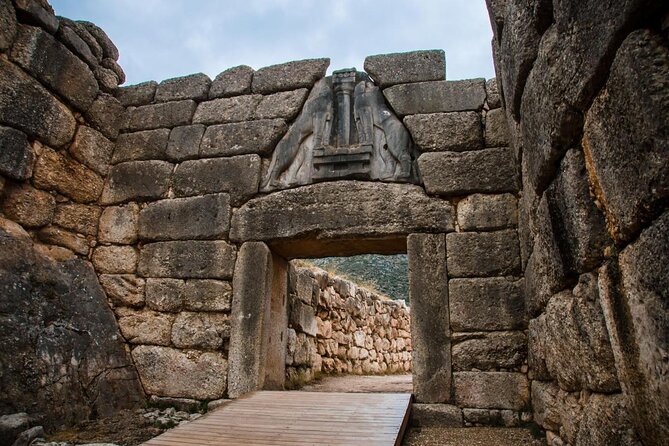
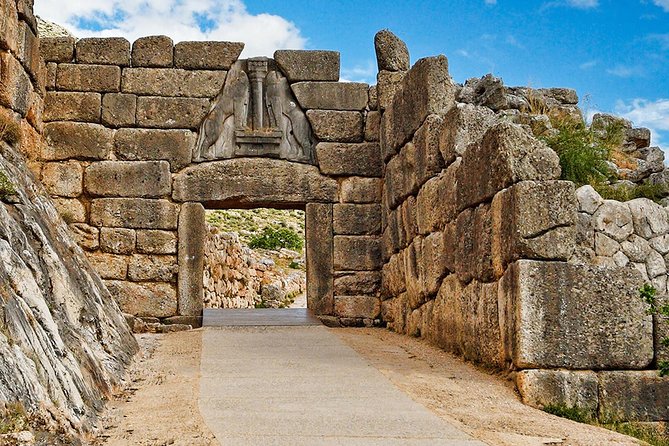
The Lion Gate is the famous entrance. Built in the 13th century BC, it uses a massive stone relief of two lions above the doorway. The gate is not large by modern standards, but the stones and surviving walls make the entrance feel serious and defensive.
Those walls are called Cyclopean because later Greeks believed only the Cyclopes could have moved such huge limestone blocks. You can see why the story took hold. The fortifications are rough, enormous, and built without the neat appearance of later classical architecture.
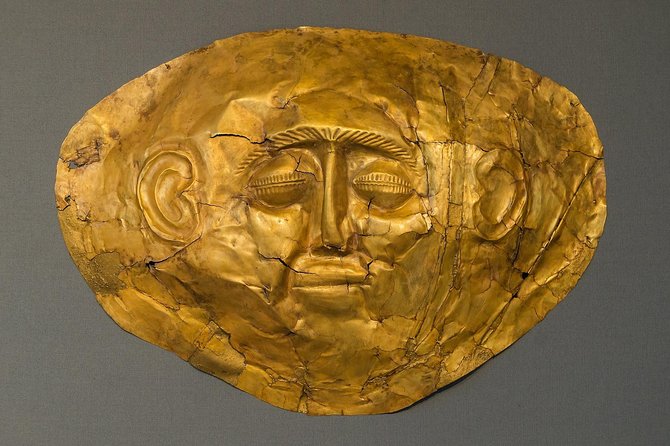
The royal cemeteries are also important. Grave Circles A and B sit outside the Bronze Age citadel and held elite burials. Gold objects, masks, weapons, jewelry, and other burial goods helped give Mycenae its reputation as a place rich in gold. The famous gold mask once linked with Agamemnon is part of the wider story, but the archaeological evidence does not prove that the legendary king was buried here.
You also see the remains of the royal palace, including domestic rooms, the Throne Room Suite, a grand staircase, offices, and a forecourt. Much of the palace survives as foundations, so a good explanation helps you picture the rooms that once occupied the hilltop.
The visit is split across several listed stops, but you should think of it as one connected archaeological area. Plan for roughly two to three hours across the citadel, tombs, gate, museum, and nearby tholoi. The stated times include 30 minutes at the archaeological site, 90 minutes at Mycenae, 15 minutes at the Lion Gate, 15 minutes at the citadel and tombs, and 30 minutes in the museum. In practice, the schedule is quite tight if you want to linger.
The Treasury of Atreus shows Bronze Age ambition
The Treasury of Atreus is one of the most memorable structures at Mycenae. It is a tholos tomb, built around 1250 BC, with a beehive-shaped chamber made from carefully laid stone. The entrance passage leads to a tall, rounded interior that feels far more spacious than you expect from the outside.
The tomb was not a treasury in the modern sense. The name came from later tradition, while its original purpose was a royal burial place. The nearby Tomb of Clytemnestra is another tholos tomb from around the same period, named after Agamemnon’s wife in the later mythic tradition.
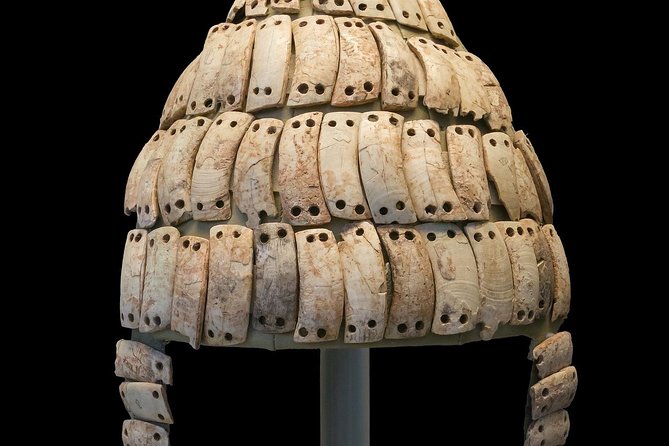
The museum helps put the outdoor remains into focus. Inside, you can see burial masks, gold objects, jewelry, weapons, small religious figures, and fragments of frescoes. If you have time for only a quick look, concentrate on the objects that show how much effort went into royal burials. The museum is small enough to visit without exhausting yourself, but it adds meaning to the stone ruins outside.
Entrance fees are not included. The tour includes skip-the-line ticket service on request, but you should confirm whether that service carries an extra charge and ask for the current combined admission cost.
Acrocorinth is the day’s big climb
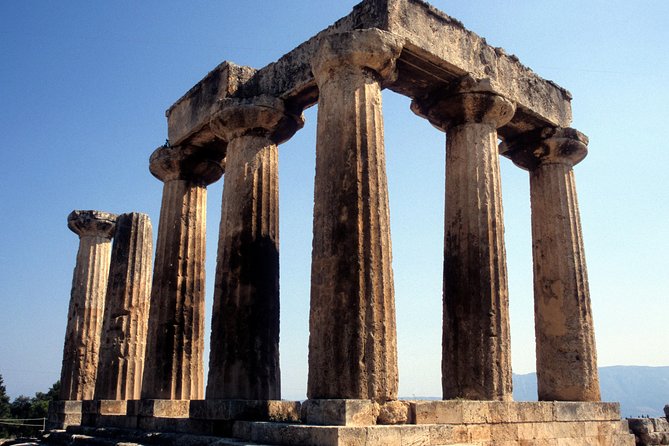
Acrocorinth is the fortified acropolis above Ancient Corinth. It occupies a single rocky mass with wide views toward the Corinthian Gulf and the surrounding countryside. The site includes three lines of defensive walls, towers, gates, a keep, remains linked with the Temple of Aphrodite, and a Frankish tower.
Later builders also left traces of churches, mosques, houses, fountains, and cisterns. That mix gives Acrocorinth a different feel from Mycenae. Mycenae is a Bronze Age citadel tied to heroic legend. Acrocorinth shows centuries of military and religious use layered onto one commanding hill.
The one-hour stop is enough to see the main areas if you keep moving, but it is not generous. The rocky setting also means you should wear secure shoes and be comfortable walking on uneven ground. The tour data does not promise a particular accessibility level, so ask before booking if anyone in your group has trouble with steep or rough paths.
I would not treat Acrocorinth as an optional photo stop. It is one of the most visually impressive parts of the route. At the same time, it can be the point where a busy day begins to feel rushed. If Mycenae matters most to you, ask your driver to protect enough time there before adding extra time on the fortress hill.


Ancient Corinth connects Greek, Roman, and Christian stories
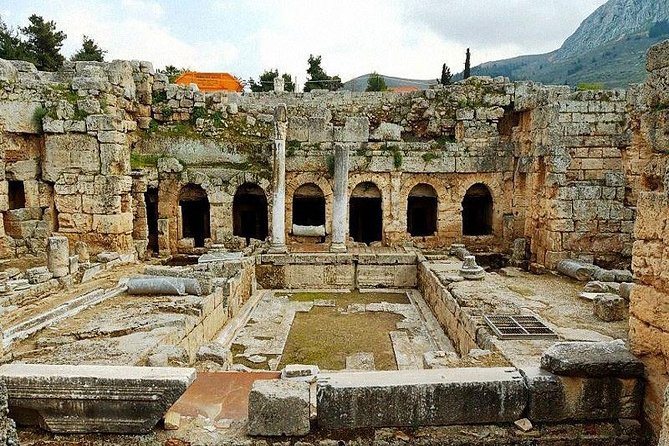
Ancient Corinth receives about three hours, including time for the archaeological site, museum, lunch, and village shops. This is the longest stop, and it deserves that space.
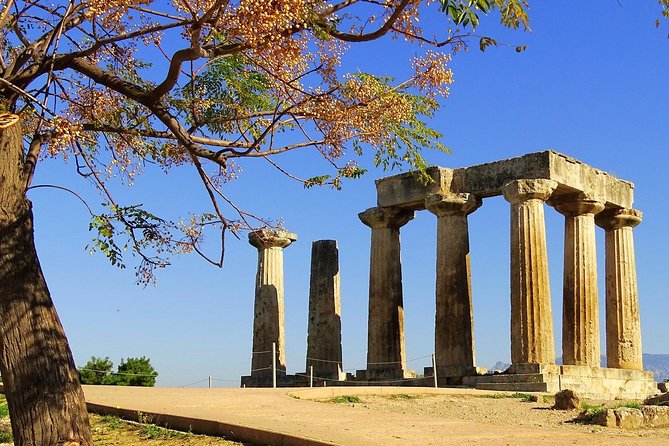
The Temple of Apollo is the key view. Built around 560 BCE, it is among the earliest Doric temples in the Peloponnese and on mainland Greece. Its monolithic columns are especially striking because each column was made from one large piece of stone rather than several drums.
The ancient agora was a large rectangular public center, about 160 meters long and 70 meters wide. Shops, small temples, an altar, and the Bema occupied this area. The Bema, or speaking platform, is linked with the Apostle Paul’s address to the Corinthians in AD 52. You can also see the Lechaion Road leading toward the port, along with Roman buildings, the theater, the odeon, and the Asklepieion.
The archaeological museum holds objects from Ancient Corinth and smaller nearby sites. It gives you a useful change of pace after the open ruins, especially if the sun is strong. The Hadgimoustafa spring, built during Ottoman times, adds another reminder that Corinth was used long after the classical era.
St. Paul’s church contains a mosaic mural showing Saul’s vision of Christ on the road to Damascus. The church is a later religious stop rather than an ancient ruin, but it fits the broader story of Corinth as a place shaped by many eras.
Lunch is arranged at a village-style restaurant on a terrace overlooking the archaeological site and Temple of Apollo. Food and drinks are not included, so budget separately. The setting is part of the appeal, and the driver can recommend a place, but you should still confirm menu prices if you are watching expenses.
After lunch, village shops offer handmade souvenirs. This is a practical place to buy a small gift without giving up time at a major archaeological site. Keep the shopping brief if you want the full three hours for Corinth.
Hera’s Sanctuary and Blue Lake change the mood
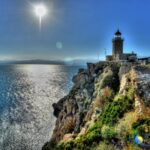
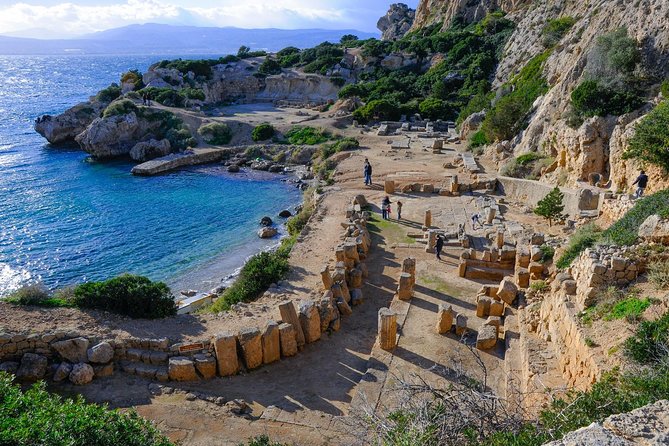
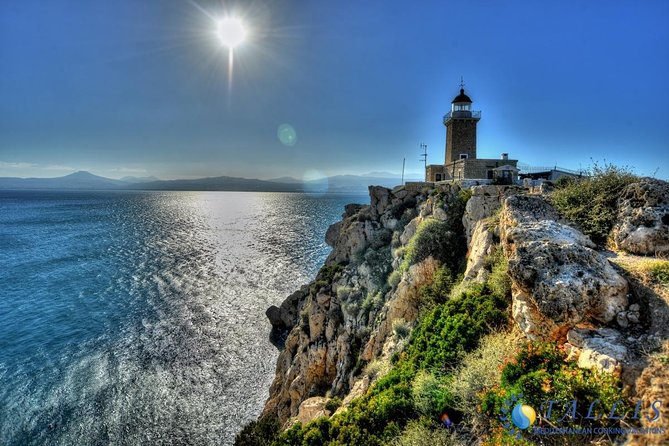
The final major stop is the Sanctuary of Hera at Perachora, also called the Heraion. The site lies near Blue Lake and includes the Malagavi Lighthouse. After a full day of ruins, this coastal setting feels like a welcome reset.
The tour allows about an hour here, including time for a swim and sunbathing. In warm weather, the clear water and sheltered setting can be the perfect ending. Bring swimwear, a towel, and suitable footwear if you plan to enter the water, though the provided information does not specify changing facilities.
The stop is seasonal in practice. A winter visit may not suit a swim, and one booking chose an 18th-century castle instead of Blue Lake because of the season. The itinerary can be adjusted, so ask what alternatives are available for your travel date rather than assuming the water stop will operate exactly as described.
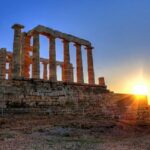
The Sanctuary of Hera is also worth seeing on its own. The combination of ancient ruins, the lake, and the lighthouse gives you a final hour that is less demanding than the hilltop sites. One driver even added a sunset visit to the Temple of Hera after the planned schedule, showing how useful the private format can be when time and light work in your favor.
Comfort, flexibility, and the role of your driver
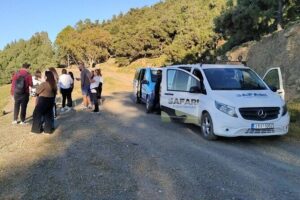
The private vehicle is the backbone of this experience. You receive hotel pickup and drop-off in Athens, bottled water, WiFi, refreshing wipes, and handmade Greek biscuits. Airport pickup is available for an extra cost, while port pickup is also offered with the driver meeting you in the arrivals area.
Drivers such as Yannis and Panos are praised for being friendly, punctual, attentive, and good at explaining the places along the way. Yannis has also provided a history book for children, which can help younger members of the group follow the day. These details matter on a nine-hour outing, when a patient driver can make the difference between a pleasant excursion and a tiring transfer marathon.
You still need to set expectations correctly. The driver is not a licensed guide accompanying you through each site. You can add a licensed guide at extra cost, which is the better choice if you want detailed archaeological interpretation. Without one, you get useful explanations during the drives and freedom to explore independently.
The private format lets you stay longer at the places you care about and shorten stops that feel less important. One group stayed longer at selected sites and still reached a separately booked guide on time. That flexibility is a real benefit, but it works best when you discuss priorities at pickup. Ten stops on paper can become too many if every one receives equal attention.
Who should book this $337.15 excursion?
I would recommend this tour to families, couples, and small groups who want to cover the Corinth and Mycenae region without renting a car. It suits you especially well if hotel pickup, air conditioning, a private vehicle, and schedule control are worth paying for.
Families may appreciate the private setting, the book for children, snacks, and the chance to adjust the day. Couples can enjoy the coastal finish and perhaps request a sunset stop. History-minded visitors should consider adding the licensed guide, since the driver does not enter the sites with you.
I would hesitate if you want a slow archaeological study day. Mycenae, Acrocorinth, and Ancient Corinth each deserve more time than a packed route can provide. I would also think twice if Blue Lake is your main reason for booking, since the swim depends on season and weather.
The tour is offered in English, with multilingual drivers available, and it is a fully private activity for your group. Confirmation is provided at booking, service animals and pets are allowed, and most people can participate. Free cancellation is available up to 24 hours before the start time, which gives you some protection if your Athens plans change.
Should you book it?
Book this private day trip if you want a comfortable, efficient way to see Mycenae and Corinth in one outing, with a swim and coastal sanctuary added at the end. The strongest value comes from the private transport, flexible timing, hotel service, and personal attention from drivers such as Yannis and Panos.
Before paying, ask for the current entrance fees, decide if you want a licensed guide, and confirm whether Blue Lake is suitable for your date. If you make those choices in advance, this is a well-shaped escape from Athens: ambitious, long, and full of memorable stops, but not pretending to be a leisurely archaeological seminar.
FAQ
How long does the tour last?
The tour lasts approximately nine hours, including travel from Athens, the archaeological stops, lunch time, the visit to Hera’s Sanctuary, and the return drive.
Is hotel pickup included?
Yes. Your driver picks you up from your Athens hotel and returns you there. Pickup from an Airbnb is arranged at the building entrance, and airport pickup is available for an additional cost.
Are entrance fees included in the price?
No. Entrance fees to the archaeological sites and museums are not included. Skip-the-line ticket service is available on request, so confirm any additional charge before booking.
Does a licensed guide accompany the group into the sites?
No licensed site guide is included by default. Your professional driver provides information during the journey, but a licensed guide to accompany you inside the sites and museum can be arranged for an extra cost.
Can I swim at Blue Lake?
The itinerary includes time for a swim at Blue Lake near the Sanctuary of Hera in Perachora. The swim is best suited to warm weather, and the schedule may be adjusted in winter or other unsuitable conditions.
Is the tour private?
Yes. Only your group participates in the activity, and transportation is provided in a private vehicle. Group discounts may be available, and the tour is offered in English with multilingual drivers.