REVIEW · ARCHAEOLOGICAL SITE OF OLYMPIA
Olympia: The Famous VR Glasses Tour with Audio Guide
Book on GetYourGuide →Operated by Olympia Back In Time · Bookable on GetYourGuide
Put on the goggles, and Olympia returns. This is a self-guided way to understand ruins that otherwise feel like scattered stone, with VR glasses that are straightforward to use and a chance to step inside the Temple of Zeus in virtual form.
The second big win is the audio guide paired with a virtual map, which keeps you moving stop to stop without needing a human guide in your ear. The one consideration: you’re on a set rental window (about 2 hours), so plan your pace if you’re also aiming to see the nearby museum(s).
In This Review
- Key highlights you’ll notice right away
- What the VR time travel feels like at Ancient Olympia
- From the office to the ruins: how the tour actually runs
- A practical tip: expect a learning moment
- The route’s big reconstructions (and what each one helps you understand)
- Ancient Gymnasium: seeing training in context
- Palestra: the training grounds feel human
- Phidias Workshop: why art and architecture are linked
- Temple of Zeus: where the experience turns from helpful to unforgettable
- Stadium scenes: the Olympic Games in action
- Ancient Stadium: cheering the races, not just staring at seats
- Why this section works for families too
- Crowds, water, and ceremony: Nymphaeum and the Olympic Flame
- Nymphaeum of Herodes Atticus: the water problem made visible
- Olympic Flame: the ritual ending that ties it together
- Gear and pacing tips that keep the experience smooth
- Bring comfortable shoes and expect uneven outdoor terrain
- Follow directions, not your gut
- Use the self-guided flexibility strategically
- If something glitches, rely on support
- Price and value: does $29 make sense with a separate entry ticket?
- Who should book this VR Olympia tour
- Should you book Olympia Back in Time?
- FAQ
- Where do I meet for the Olympia VR tour?
- How long is the VR tour?
- Is the Olympia entry ticket included in the $29 price?
- Are there times when entry to Olympia is free?
- What’s included with the tour price?
- What languages are available for the audio guide?
- What should I bring with me?
- Is an ID deposit required?
- Is the tour wheelchair accessible?
- What happens if I cancel last minute or arrive too late?
Key highlights you’ll notice right away
- 15 monuments in 3D reconstructions, so you can picture scale and layout, not just fragments
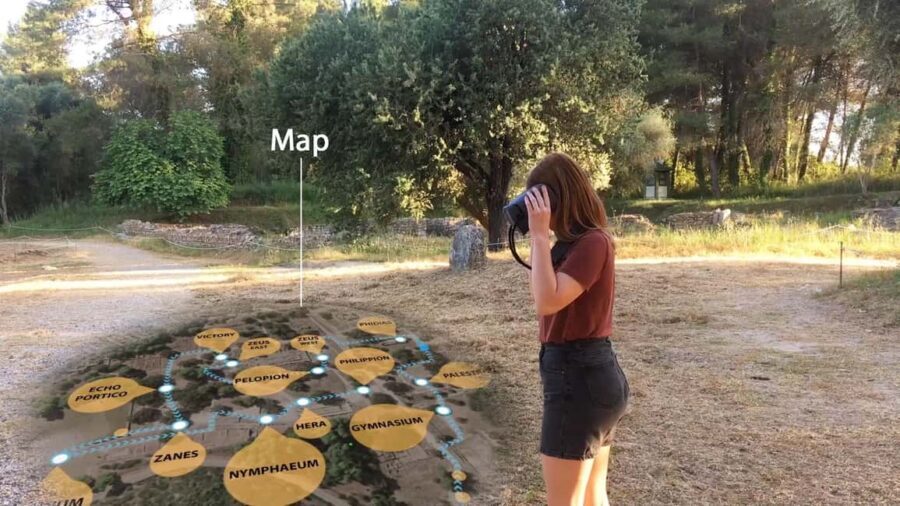
- Audio guide + virtual map for a smoother route through a large outdoor site
- Temple of Zeus walkthrough with the legendary statue experience
- Olympic Games re-creations that show training and competition, not only architecture
- Herodes Atticus’ Nymphaeum and the Olympic Flame scenes that explain how the sanctuary worked for huge crowds
What the VR time travel feels like at Ancient Olympia
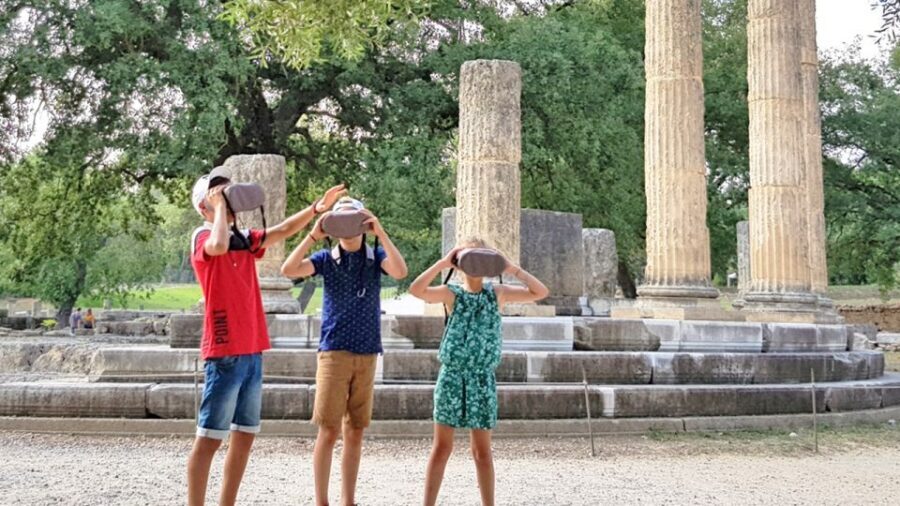
Ancient Olympia is gorgeous, but it’s also mostly ruins. Columns are missing. Rooflines are gone. Without context, you can end up walking through a museum of stone bits, trying to guess the original picture.
This tour’s strength is that the VR glasses rebuild the missing parts right where you’re standing. You’re not just reading signs; you’re watching structures and characters line up with the real site around you. That changes how you “read” the place. Instead of wondering what you’re looking at, you start recognizing function: training spaces, ceremony spaces, spectator spaces.
The experience is also designed to be manageable. You get a quick demo at the pickup office, then you’re free to follow the route at your own pace. That matters because Olympia rewards slow attention—especially when you’re trying to visualize how athletes and crowds moved through the sanctuary.
You can also read our reviews of more guided tours in Archaeological Site Of Olympia


From the office to the ruins: how the tour actually runs
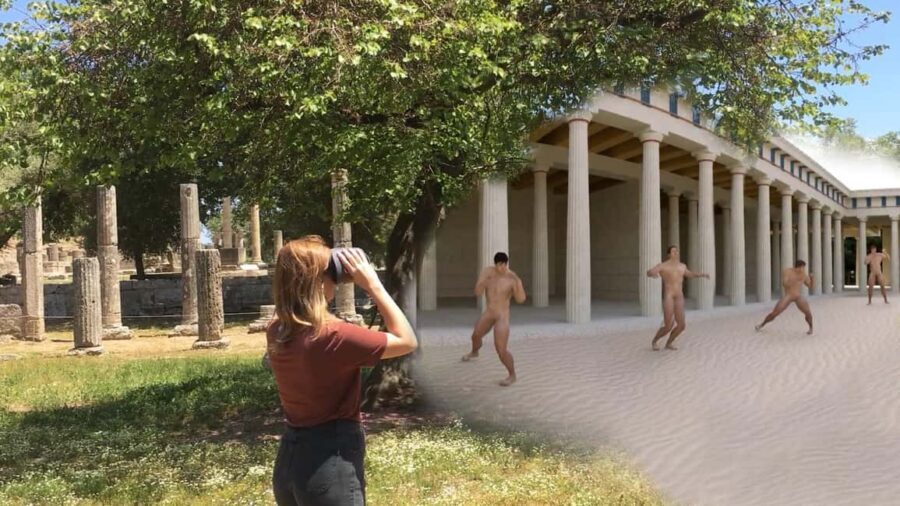
You start at the local partner office, found by searching Olympia back in time on Google Maps. The office is described as being across from the main church, and it’s set up for simple check-in and headset handout.
After a short introduction on how the VR glasses and audio guide work, you head to the Archaeological Site and begin your virtual journey. The experience is built around map-based stops. In practice, that means you’ll often be directed to move toward a specific area, then trigger the next monument as you arrive.
This is a big plus if you dislike rigid group schedules. You can pause, take photos, and spend a little extra time where something grabs you. You’re not forced to keep pace with a large tour group.
A practical tip: expect a learning moment
The start can feel slightly confusing if you’re not used to map-guided headsets. One of the best pieces of advice to take with you is to follow the on-screen directions rather than your instinct about where you think you’re facing. Once you’re aligned, the tour clicks into place and feels much more fluid.
The route’s big reconstructions (and what each one helps you understand)
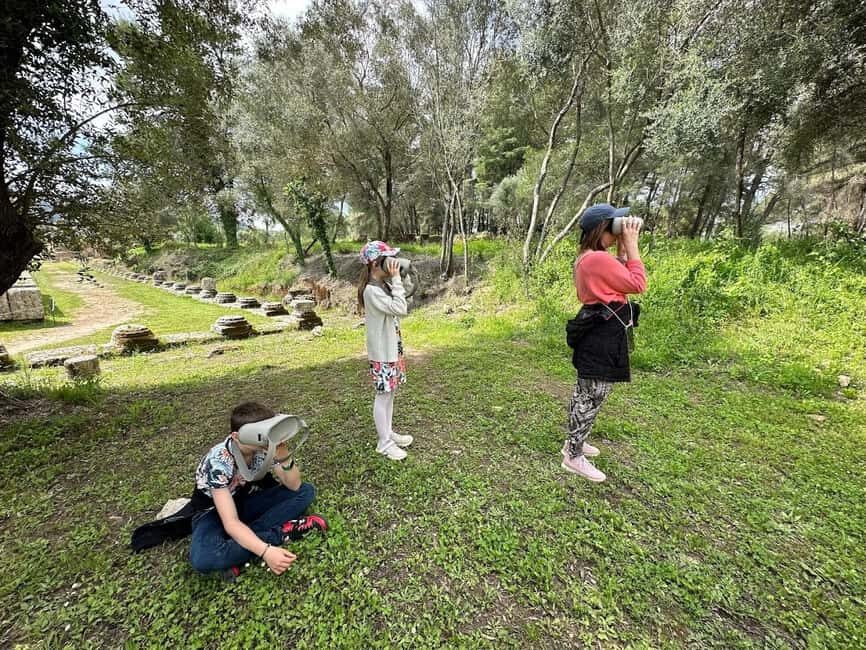
You’ll see 15 iconic monuments through the VR system, with the audio guide explaining what you’re looking at as you go. Not every stop is equally dramatic on first glance—some are about context and function—but together they create a fuller picture of how the sanctuary worked.
Below are some of the most memorable stops and why they matter.
Ancient Gymnasium: seeing training in context
The Ancient Gymnasium is where the tour does more than reconstruct buildings. It brings the idea of preparation to the front. You can watch athletes training in the same space conceptually tied to Olympic-era preparation.
What I like about this type of stop is that it changes your mental model. Olympia isn’t only about winners and ceremonies. It’s a training ground. When you connect that to the physical layout, you start understanding why certain spaces existed where they did.
Palestra: the training grounds feel human
Next comes the Palestra—depicted as the arena-like training grounds where athletes prepared through intense work. Even if the VR visuals are stylized (they’re virtual reconstructions, not live replays), they still help you grasp how athletes used the site.
This is one of those moments that makes history feel less abstract. You stop thinking about ruins as old. You start thinking about routine: practice, discipline, and repeated movement.
Phidias Workshop: why art and architecture are linked
Phidias is mentioned as the craftsman associated with the Statue of Zeus, and the virtual stop places you near the workshop area tied to that creation.
Even if you’re not a sculpture person, this helps explain something important: monumental art and sanctuary prestige went together. The statue wasn’t just decoration. It was a statement of power, belief, and artistic skill—tied directly into the site’s identity.
Temple of Zeus: where the experience turns from helpful to unforgettable
The standout architectural moment is the Temple of Zeus. The VR lets you virtually walk inside this colossal space and then experience the awe of the Statue of Zeus in its original form.
This is the stop that makes the tour feel worth it for most people, because it tackles the biggest problem with ruins: scale. In front of collapsed stone, you can’t easily judge what “colossal” means. VR fills in the missing structure so you can understand the geometry and grandeur you’re standing near.
A good way to use this moment is to slow down. Look around, then let the audio narration ground what you’re seeing. If you rush, you lose the feeling that the site is bigger than your first impression.
Stadium scenes: the Olympic Games in action
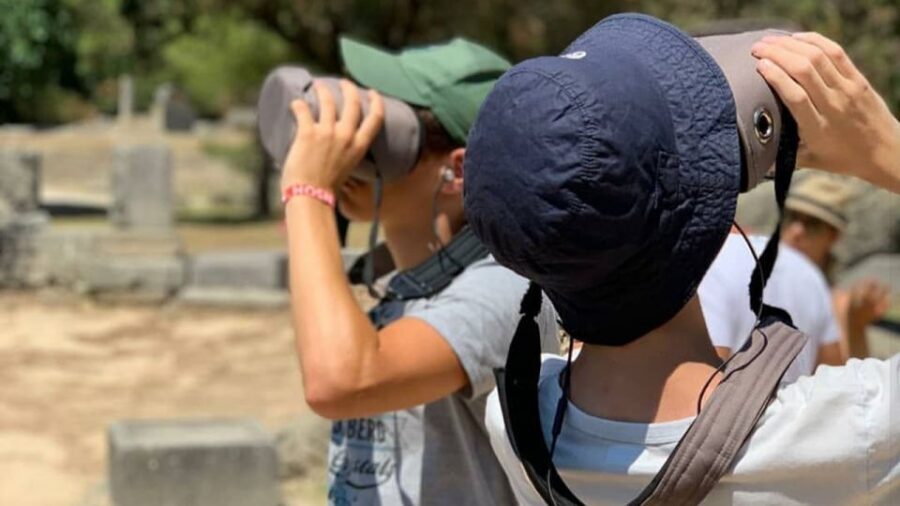
Olympia’s reputation comes from the Games. This VR tour leans into that by staging competition and athletic energy inside the Ancient Stadium.
Ancient Stadium: cheering the races, not just staring at seats
In the Ancient Stadium, the VR transport turns the space into a live competition scene. You’re able to watch athletes compete, and it’s framed as the original Olympic spirit.
Even if you’ve read about the Olympics before, it’s different to see the event shape in a space built for spectators. You start understanding sightlines: where people stood, what “front” and “finish” would have meant, and why the stadium structure was essential.
Why this section works for families too
This portion is often the most engaging for kids and teens because it’s active. It turns Olympia into a story you can follow instead of a lecture delivered by stone signage.
If you’re traveling with younger visitors, this is a solid strategy: use VR where movement and drama help attention, then let the rest of the site be calmer and reflective.
Crowds, water, and ceremony: Nymphaeum and the Olympic Flame
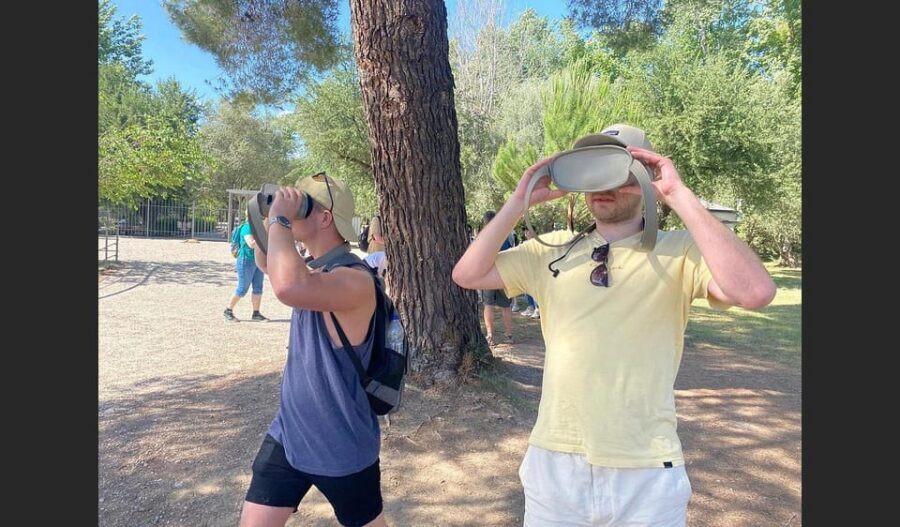
Not every VR stop is about spectacle. Some are about practical systems that made the sanctuary work.
Nymphaeum of Herodes Atticus: the water problem made visible
The Nymphaeum of Herodes Atticus is described as a fully restored fountain tied to solving a severe summer water shortage for thousands of spectators during the Ancient Games.
This kind of stop is quietly smart. It reminds you that big events require infrastructure. Olympia wasn’t only a spiritual stage; it was a logistics machine for crowds, heat, and hydration. Seeing the fountain context helps you connect daily needs to sacred space.
Olympic Flame: the ritual ending that ties it together
The tour ends by witnessing the ceremony of lighting the Olympic Flame. That final moment gives the whole experience a narrative arc: from training, to competition, to ceremony.
Even if you’ve seen modern Olympic symbolism before, it lands better when you’ve just walked through the ancient sanctuary’s role in the Games’ origin.
Gear and pacing tips that keep the experience smooth
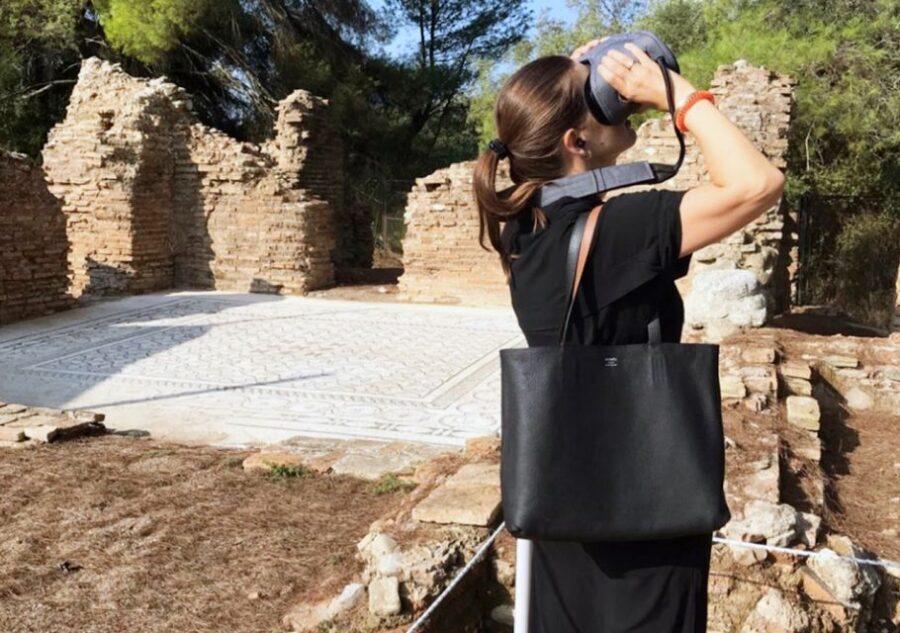
You’re renting the VR glasses, using an audio guide, and relying on technical support and information. In other words: it’s not just a gadget rental. The tour format is meant to help you avoid the usual “tech confusion” problem.
Here’s how to set yourself up for success:
Bring comfortable shoes and expect uneven outdoor terrain
Olympia is outdoors and walk-heavy. Comfortable shoes matter more than you might think, especially if you want to pause for photos or stand still to watch a VR scene properly.
Follow directions, not your gut
Because it’s map-guided, your physical orientation can throw you off at first. The best workaround is to trust the headset’s guidance, such as following the route indicator directions even if you feel turned around.
Use the self-guided flexibility strategically
The tour is designed for you to go at your own pace. That’s great for photo breaks and for lingering at the most interesting stops.
A useful tactic: if you’re also planning museums, don’t let “I’ll just spend extra time” stretch beyond your VR rental window. The VR headset time is the precious part, because it powers the reconstructions.
If something glitches, rely on support
Sometimes electronics act up in real outdoor conditions. The experience is set up with technical support and information, and the setup includes a live demonstration beforehand to help you get started correctly.
Price and value: does $29 make sense with a separate entry ticket?

The cost is listed at $29 per person, and the VR glasses rental plus audio guide plus live demonstration and technical support are included. Entry ticket to Olympia is not included and is listed at 20€.
So you should look at value in two parts:
- What you pay for: the VR system and guided reconstructions for 15 monuments.
- What you still need: the standard site entry ticket.
For many people, the value comes from the fact that Olympia is largely ruins. If you’re the kind of visitor who wants to understand what buildings looked like and how events took place, the VR component is a strong “learning upgrade.” If you’re okay with reading signs and letting your imagination do the heavy lifting, you might find the standard self-visit sufficient.
Where the price feels especially fair is if you’re traveling with kids or you’re short on time. VR helps keep attention, and it delivers context fast—without needing to coordinate with a large guided group.
One more consideration: you’ll need passport or ID card, and a deposit is mentioned as required. Plan ahead so check-in goes smoothly.
Who should book this VR Olympia tour
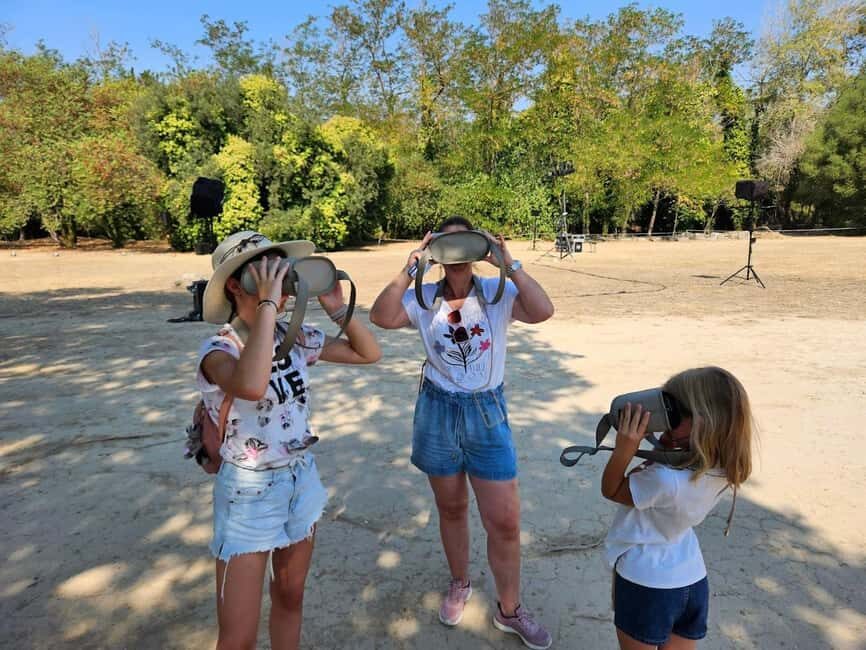
This is a good fit if:
- You want to understand ruins as lived spaces, not just stone remnants
- You like a self-guided format but still want structured narration
- You’re traveling with kids or teens and want an attention-friendly way to make the site engaging
- You’re a history lover who cares about scale, especially at the Temple of Zeus and stadium stops
It’s also a reasonable pick if your itinerary is tight and you want a high-impact way to see more meaning in less time.
Should you book Olympia Back in Time?
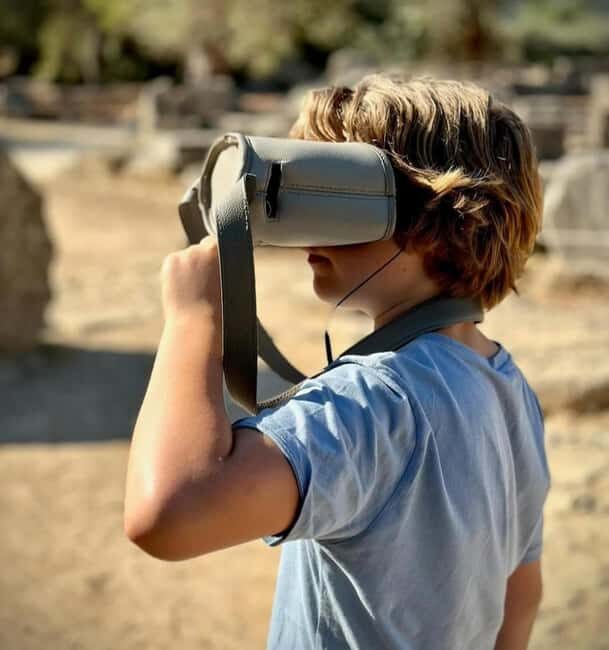
Yes, with one planning caveat.
Book it if you want Olympia to feel like an ancient sanctuary again—especially if you’re excited by the idea of stepping into the Temple of Zeus, watching stadium action, and understanding how crowds worked through things like the Nymphaeum and ceremony scenes.
Skip it or rethink timing if you’re the type who will spend most of your day wandering slowly through every museum and every sign. The VR headset rental time is about 2 hours, and you don’t want to feel rushed at the end.
If you want the best experience, arrive ready to move, follow the headset guidance, and save extra museum time for when you’re done with the reconstructions.
FAQ
Where do I meet for the Olympia VR tour?
You meet at the local partner office found by searching Olympia back in time on Google Maps. The office is described as being across from the main church.
How long is the VR tour?
The tour duration is 2 hours.
Is the Olympia entry ticket included in the $29 price?
No. The entry ticket to Olympia is listed separately at 20€ and is not included in the tour price.
Are there times when entry to Olympia is free?
Yes. The information provided states that visitors from the EU under 25 years old and non-EU under 18 years old enter for free.
What’s included with the tour price?
Included are the VR glasses rental, an audio guide, a live demonstration, and technical support and information.
What languages are available for the audio guide?
The audio guide is available in Dutch, French, English, German, Spanish, Italian, and Greek.
What should I bring with me?
Bring a passport or ID card and wear comfortable shoes.
Is an ID deposit required?
Yes. A passport/Driving licence/ID deposit is required according to the important information.
Is the tour wheelchair accessible?
Yes, it is listed as wheelchair accessible.
What happens if I cancel last minute or arrive too late?
Cancellation is free up to 24 hours in advance for a full refund. Late arrivals over 45 minutes will be canceled without a refund.