REVIEW · ATHENS
Private Tour in Athens Corinth
Book on Viator →Operated by Athens Taxi Tours - Michael Sterianos · Bookable on Viator
The main appeal here is the chance to connect St. Paul’s time in Greece with the big ancient sights of Athens and Corinth in one long private day. You move from the Areopagus and Ancient Agora to the Corinth Canal and the ruins where Paul lived and preached for 18 months.
I like the door-to-door private transport, especially for a group of up to four, and I like the freedom to stop for photos, a drink, lunch, shopping, or a museum. Michael Sterianos and Nikolai Viktorov are named as guides and drivers, with English and Greek offered.
The catch is the pace. Seven to nine hours is a lot of ground for Athens and Corinth, and the admission information contains some confusing place names and duplicate fees. Confirm the exact ticket costs and daily plan before you go.
In This Review
- Key points to know before booking
- Why the Paul connection gives this day a clear purpose
- Paleo Faliro: a brief beginning by the water
- The Areopagus and Paul’s speech in Athens
- The Acropolis: major monuments in a tight schedule
- Hadrian’s Arch, the stadium, and Athens from the vehicle
- Parliament Square and the changing guard
- The central market and Athens by car
- Ancient Agora: where Athens worked and argued
- The road to Corinth and the canal stop
- Ancient Corinth: the strongest stop for Paul’s story
- What the $458.56 price really buys you
- Who should book this private day
- Practical advice for making the day work
- Should you book it?
- FAQ
- How long does the private Athens and Corinth tour last?
- How many people can join the private tour?
- Is transportation included?
- Are meals and drinks included?
- Which sites require separate admission?
- What is the cancellation policy?
Key points to know before booking

- Paul-focused sightseeing: Connect the Areopagus, Ancient Agora, Corinth, and Ancient Corinth with the apostle’s work in Greece.
- A private group of up to four: The $458.56 group price works out to about $114.64 per person for four people, before meals and admission.
- A full Athens-to-Corinth day: Allow roughly seven to nine hours, with the Corinth Canal about an hour and a half from Athens by road.
- Comfortable transport: You receive private transport in an air-conditioned vehicle with WiFi. One detailed account describes a Mercedes-style van with leather reclining seats, trays, and phone charging ports.
- Flexible stops: You can request time for photos, a beach break, food, shopping, a museum, or a quiet drink.
- Check the ticket wording: The published admission list refers to an Acropolis of Rhodes and a Temple of Zeus in Stratos, which do not match this Athens and Corinth route.
Why the Paul connection gives this day a clear purpose
Many Athens day tours pile on famous monuments without much sense of how they fit together. This one has a strong thread: Paul’s arrival in Greece, his public speaking in Athens, and his long stay in Corinth.
That focus matters if you are interested in biblical history, early Christianity, or the ancient cities described in the Acts of the Apostles. You are not simply looking at broken columns. You are moving between places linked to preaching, public debate, government, trade, and daily life.
The guide’s role matters here. Michael Sterianos is identified with the company, and Nikolai Viktorov is also named as a driver and guide. The available comments describe both the guiding and driving as professional, friendly, and well prepared in Greek history. The company also says its guides speak excellent English as well as Greek.
I would still tell you to set expectations clearly. This is described as a private tour with transportation and guiding, but the precise format of the commentary is not spelled out. Ask whether your guide will enter each archaeological site with you or explain the monuments mainly from outside.
You can also read our reviews of more private tours in Athens


Paleo Faliro: a brief beginning by the water
The first listed stop is Paleo Faliro, where you see a statue of Paul walking toward Athens with a scribe. It is a short 15-minute stop, and admission is free.
This is more of a visual introduction than a major sightseeing visit. The statue gives the day a human starting point before you reach the ancient center. You can take a few photographs and get into the theme without spending much time.
Do not expect a long visit here. If your main goal is classical Athens, this stop may feel secondary. If you are following Paul’s journey, however, it helps frame the route before the monuments begin.
The Areopagus and Paul’s speech in Athens
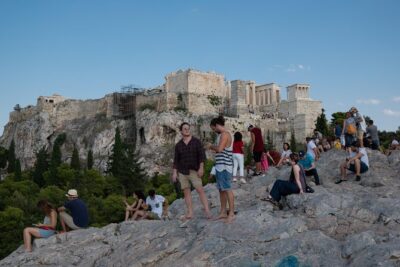
At the Areopagus, the tour connects you with the famous setting where Paul was asked to speak to Stoic and Epicurean philosophers. The planned visit lasts about 30 minutes, with no admission charge listed.
This is one of the most meaningful stops for a faith-based itinerary. The rocky hill and its position above the city make it easier to picture a public conversation taking place within sight of Athens’s major civic and religious buildings.
You should wear steady shoes and take care on uneven stone. The stop is short, so use the time well. Ask your guide to explain the setting, the philosophical groups Paul addressed, and how the nearby Acropolis fits into the scene.
The Areopagus is also a good place to ask questions. A private guide can adjust the discussion to your interests instead of giving a fixed speech. If you want biblical context, say so. If you prefer archaeology and civic history, say that instead.
The Acropolis: major monuments in a tight schedule
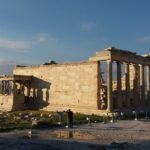
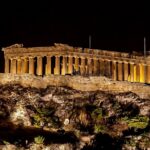
The Acropolis visit is planned for about 90 minutes. The route lists the Temple of Athena Nike, the Propylaea, the Parthenon, and the Erechtheion with its Porch of Maidens.
That is a useful selection of the hill’s major monuments, but 90 minutes is not generous. You will get an overview rather than a slow examination of every building, sculpture, and viewpoint. The climb and crowds can also affect how much ground you cover.
The Parthenon is the visual center, but do not rush past the smaller Temple of Athena Nike. The Propylaea gives you the grand entrance, while the Erechtheion is known for its unusual design and the carved female figures on the porch.
The supplied details call this the Acropolis of Rhodes and place it in Rhodes Town. That is clearly inconsistent with the Athens route and the monuments listed. Before paying, confirm that your ticket and visit are for the Acropolis of Athens.
Admission is not included in the tour price. The fee information says 20 euros per person for the Acropolis, but the wording attaches it to Rhodes. Treat that figure as something to verify, not as a final promise.
Hadrian’s Arch, the stadium, and Athens from the vehicle
The route also includes a pass by Hadrian’s Arch and the stadium. It does not provide a separate stop length or clearly say that you enter either site.
This part is useful for orientation. Hadrian’s Arch marks the transition between the older Greek city and the Roman extension of Athens, while the stadium gives you another major landmark tied to the city’s public life and later sporting traditions.
Because the tour covers a wide area, you may see these places from the vehicle rather than explore them on foot. If either is important to you, ask in advance whether the vehicle will stop and whether admission is included. Do not assume that every named monument means a full visit.



Parliament Square and the changing guard
The Hellenic Parliament stop lasts 10 to 15 minutes. You see the guards at the Tomb of the Unknown Soldier and the nearby neoclassical trilogy of schools.
The guard ceremony gives the day a modern Greek moment between ancient sites. It is brief, easy to fit into the schedule, and free according to the tour details.
The wording describes the changing of the Gods, which appears to mean the changing of the guards. Since the stop is short, it may not include a full ceremonial change every time. Ask your guide what timing is planned if seeing the ceremony is a priority.
The trilogy of schools adds architectural context. Even without a long stop, this section helps you see Athens as more than an archaeological site. It is a working capital with government buildings, public squares, and daily street life.
The central market and Athens by car
You continue through Athens’s traditional market area without a planned stop. This is a small detail, but I like that it gives you a glimpse of the city beyond the monuments.
A drive-by market view cannot replace time on foot. Still, it can help you see the contrast between formal ancient sites and the ordinary commerce of the modern city. If food and local shopping interest you, ask whether the schedule allows a short stop here instead of treating it only as a pass-by.
The company says you decide when to stop, but the day has a fixed route and a long drive to Corinth. Flexibility is real, yet it has limits. Every extra pause in Athens reduces time available later.
Ancient Agora: where Athens worked and argued
The Ancient Agora receives about an hour. Admission is not included, and the listed fee says 8 euros per person, though the admission section repeats the same Ancient Agora charge.
This is an important stop for both classical Athens and the Paul theme. The Agora was a civic and commercial center, with government activity, public discussion, and a market. It is also presented as a place where Paul preached and met important Athenians.
The Temple of Hephaistos is the star here. It is one of the best-preserved ancient Greek temples, and its condition helps you understand the proportions and structure of a classical temple more clearly than a heavily ruined site can.
One hour lets you see the main points, but it does not leave much room for a slow walk. I would ask your guide to point out the temple first, then explain the civic buildings and Paul’s connection to the area. Bring water, especially in warm weather, since outdoor archaeological visits can feel demanding.
The road to Corinth and the canal stop
The drive from Athens to Corinth takes about an hour and a half on a straightforward road. That travel time is a major part of the day, so the private vehicle makes a practical difference.
A detailed account describes a comfortable Mercedes-style van with leather reclining seats, trays, and charging ports. The tour also includes air conditioning and WiFi on board. These details matter more on a full day than they would on a short city transfer.
The first Corinth stop is the canal, with about 20 minutes to look at the crossing and the view. This is a quick photo stop, not a long engineering visit, but it breaks up the drive and gives you one of the route’s most memorable modern sights.
Use those 20 minutes for photographs and a stretch. If you want more time at the canal, ask before the day begins. A private tour gives you a better chance of adjusting the stop than a large coach tour, but the visit to Ancient Corinth still needs enough time.
Ancient Corinth: the strongest stop for Paul’s story
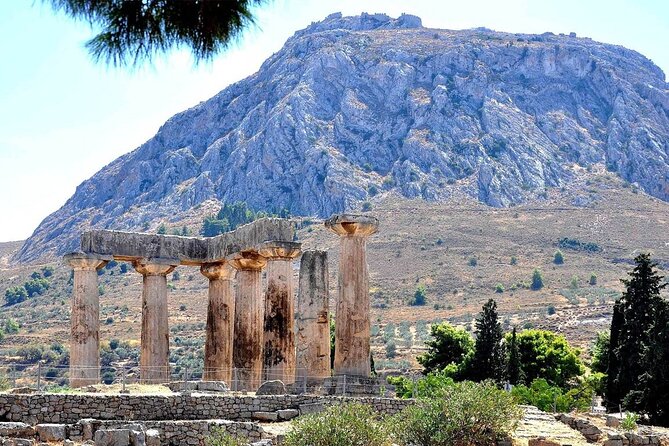
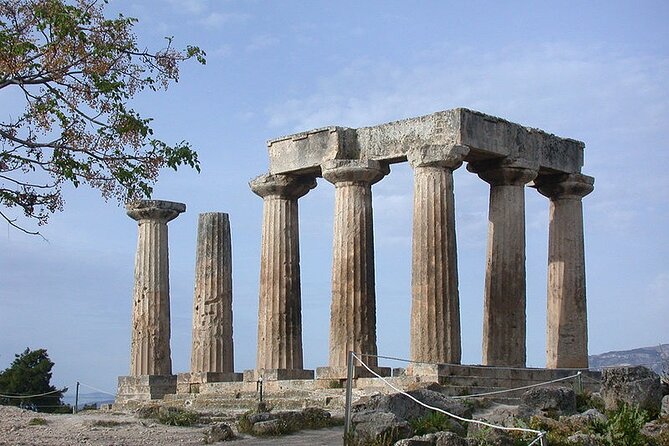
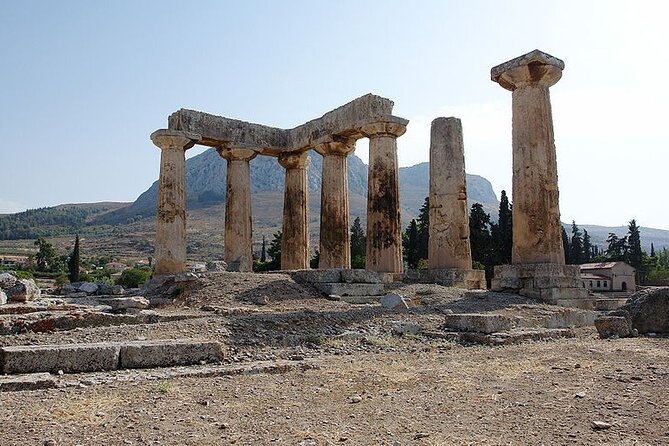
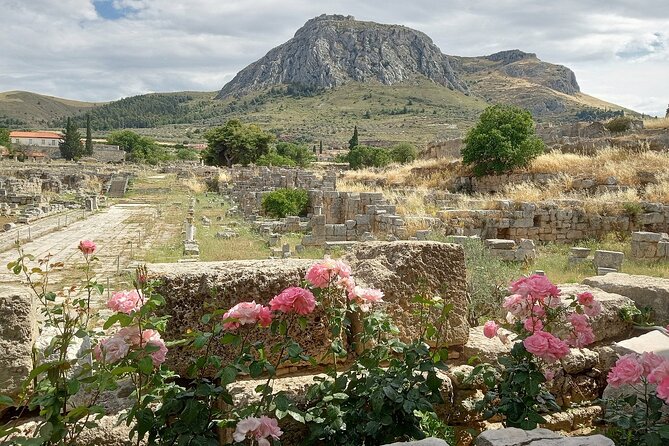
At Ancient Corinth, the planned visit lasts about an hour. You see the Temple of Apollo, the ancient theater, and a stone engraved with the name Erastus. The site is also tied directly to Paul’s 18-month stay and preaching in Corinth.
For me, this is the day’s central stop. The Athens locations connect Paul with public debate and the city’s civic life. Corinth adds the sense of a longer period of work and residence.
The Temple of Apollo gives you a clear view of an early Greek temple setting, while the theater shows how public entertainment and gathering shaped the ancient city. The Erastus inscription is especially interesting because a named person can make an otherwise abstract ancient setting feel more personal.
The one-hour visit is enough for an introduction, but not for every corner of the archaeological site. Ask your guide to organize the visit around the parts that matter most to you. If Paul is your main interest, say that at the start. If architecture and Roman Corinth matter more, the explanation can shift.
Lunch follows, but it is not included. The route says the guide will take you for lunch and then drop you at your hotel. You pay for your own food and drinks, and you should tell the guide about any dietary needs before setting out.
What the $458.56 price really buys you
The price is $458.56 per group of up to four. With four people, that works out to about $114.64 per person. For two people, it is about $229.28 each, before admission, lunch, and tips.
The value improves sharply with a full group. You are paying for a private vehicle, an air-conditioned ride, WiFi, the driver-guide’s time, and the ability to shape some stops around your interests. A family or group of friends can find that more practical than buying several separate transfers and trying to organize Corinth independently.
The price is less attractive for a solo visitor or couple who want only a short Athens visit. You spend much of the day on the road, and major archaeological admission charges are extra.
The included fees and taxes simplify the basic price, but food, drinks, lunch, dinner, tips, and site tickets are not included. The published ticket section needs clarification because it lists an Acropolis of Rhodes, a Temple of Zeus in Stratos, and a duplicated Ancient Agora charge. None of those references should be accepted without confirmation.
Who should book this private day
I would choose this tour if you want Athens and Corinth in one day, prefer a private vehicle, and care about the connection between Paul and the ancient Greek cities.
It suits:
- A family or group of up to four sharing the cost
- Visitors with a strong interest in biblical history
- First-time Athens visitors who want a broad overview
- People who value hotel pickup and a flexible private schedule
- Anyone who prefers a guide who can explain Greek history and customs in English
It is less suitable if you want a relaxed Acropolis visit, extensive museum time, or a slow lunch. It is also not the best fit if you already know Athens well and want a narrow, specialist tour of one archaeological site.
The physical demands are not fully described, but the Acropolis and Areopagus involve uneven ancient surfaces. Most travelers can participate according to the tour information, yet you should mention mobility concerns when booking.
Practical advice for making the day work
Start by confirming the pickup time and hotel details. Pickup is offered, and the total duration is approximately seven to nine hours, but traffic and the amount of time you request at each stop will affect the return.
Ask who will guide your group, Michael Sterianos or Nikolai Viktorov, and clarify whether the guide enters the archaeological sites with you. Their roles are described as both driving and guiding, so this question helps you know what kind of commentary to expect.
Confirm every admission price in writing. The Ancient Agora fee is listed as 8 euros per person, Ancient Corinth as 12 euros per person, and the Acropolis as 20 euros per person, but the place names in the fee list are not consistently matched to this route.
Bring water, sun protection, a phone charger, and shoes suited to stone paths. Keep some time in reserve for lunch, since it is not part of the tour price and the final drop-off follows the meal.
Free cancellation is available if you cancel at least 24 hours before the start time. Changes or cancellations inside that window are not accepted for a refund.
Should you book it?
Book this tour if your priority is a private Athens and Corinth connection, not a leisurely deep look at Athens alone. The Paul-focused route gives the day a clear purpose, and the private vehicle is a real benefit when you are covering sites separated by a long drive.
I would book it for four people, confirm the ticket details, and ask for a firm plan for the Acropolis, Ancient Agora, lunch, and Corinth. If the provider clears up the mismatched Rhodes and Stratos references, this can be a useful and personal way to link Athens’s public world with Corinth’s archaeological remains.
FAQ
How long does the private Athens and Corinth tour last?
The tour lasts approximately seven to nine hours.
How many people can join the private tour?
The price covers one private group of up to four people. Only your group participates.
Is transportation included?
Yes. Private transportation in an air-conditioned vehicle, WiFi on board, and all fees and taxes are included.
Are meals and drinks included?
No. Food, beverages, lunch, and dinner are not included. The route includes time for lunch, but you pay for it separately.
Which sites require separate admission?
Admission is not included for the Acropolis, Ancient Agora of Athens, and Ancient Corinth. The listed prices are 20 euros per person for the Acropolis, 8 euros per person for the Ancient Agora, and 12 euros per person for Ancient Corinth, but the Acropolis and other fee descriptions contain location errors that should be confirmed before booking.
What is the cancellation policy?
You can cancel for a full refund up to 24 hours before the experience start time. Cancellations or changes made less than 24 hours before the start time are not accepted for a refund.