REVIEW · FIRA
Santorini: Akrotiri Entry Ticket and Audio Guide
Book on GetYourGuide →Operated by Clio Muse Tours · Bookable on GetYourGuide
Akrotiri feels like time travel with training wheels: you walk through excavated streets and rooms, and your phone tells you what you’re looking at. I like the hassle-free entry (e-ticket plus a set time slot for the museum) and the way the audio focuses on daily life and the big eruption story. The biggest catch is that the audio can be a little tricky to follow in spotty areas where sections are roped off or the route differs from what you expect.
If you want maximum context for a reasonable price, this setup makes sense. You get offline audio, text, and maps, plus multiple language options, and the site is under a large tent so it’s usable even when Santorini heat is doing its thing. The drawback to plan around: you need a compatible smartphone, enough storage, and your own headphones, and the “audio choreography” isn’t always perfectly obvious on the ground.
In This Review
- Key Things to Know Before You Go
- Akrotiri’s Frozen Streets: What You’re Actually Visiting
- The Phone Audio Guide: Download Smart and Save Your Sanity
- Ticket Timing and Getting Into Akrotiri Without Stress
- Walking the Ruins: Double Horns, the House of Ladies, and the Xeste Homes
- Why Akrotiri Really Earns the Pompeii of the Aegean Label
- Shelter Comfort: Hot Day Proof, So You Can Actually Take Your Time
- Audio vs Live Guide: Is This Worth It at $41?
- Common Frustrations and How to Handle Them
- Who Should Book This Akrotiri Audio + Ticket?
- Should You Book This Akrotiri Entry Ticket and Audio Guide?
- FAQ
- What’s included in the Akrotiri ticket and audio guide?
- Do I get a live guide with this experience?
- Where do I start the audio tour?
- Can I use the audio offline?
- How long is the ticket valid?
- Is the audio tour compatible with all phones?
Key Things to Know Before You Go
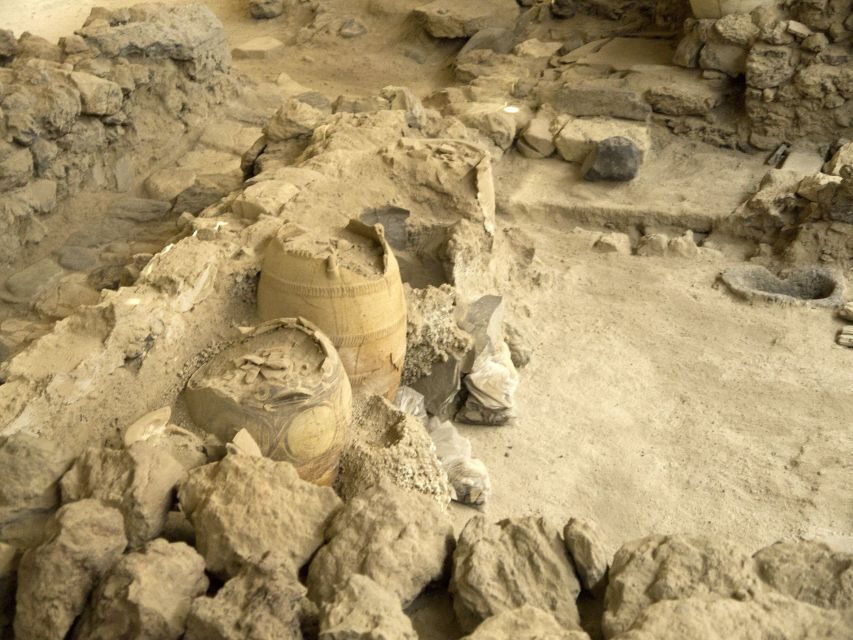
- Offline audio, text, and maps: download ahead so you are not stuck hunting for reception
- Marked route with frequent “standing points”: helpful when it matches the site, frustrating when parts are closed
- Top highlights are built into the tour: including the Square of the Double Horns and the House of the Ladies
- You’ll learn why it’s called the Pompeii of the Aegean: a buried settlement with preserved details
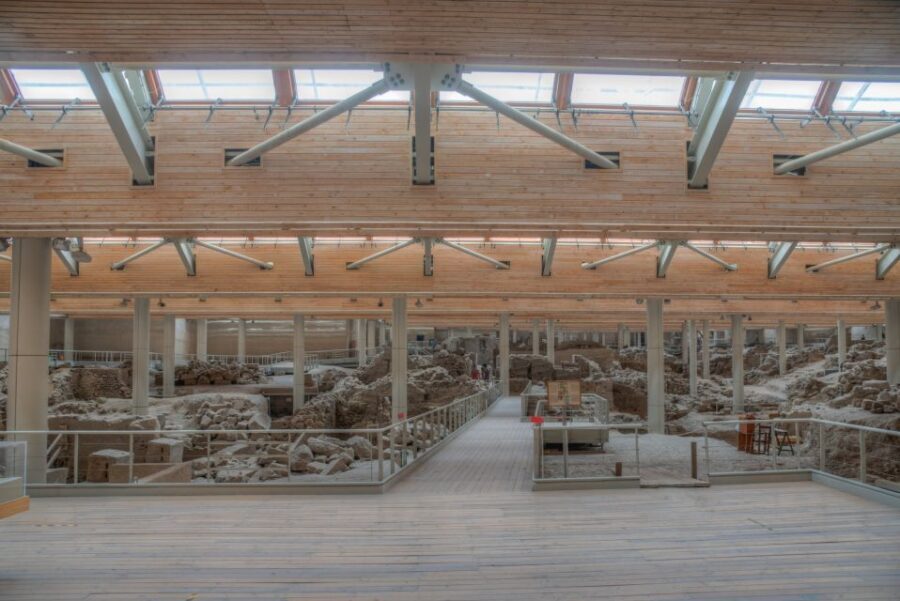
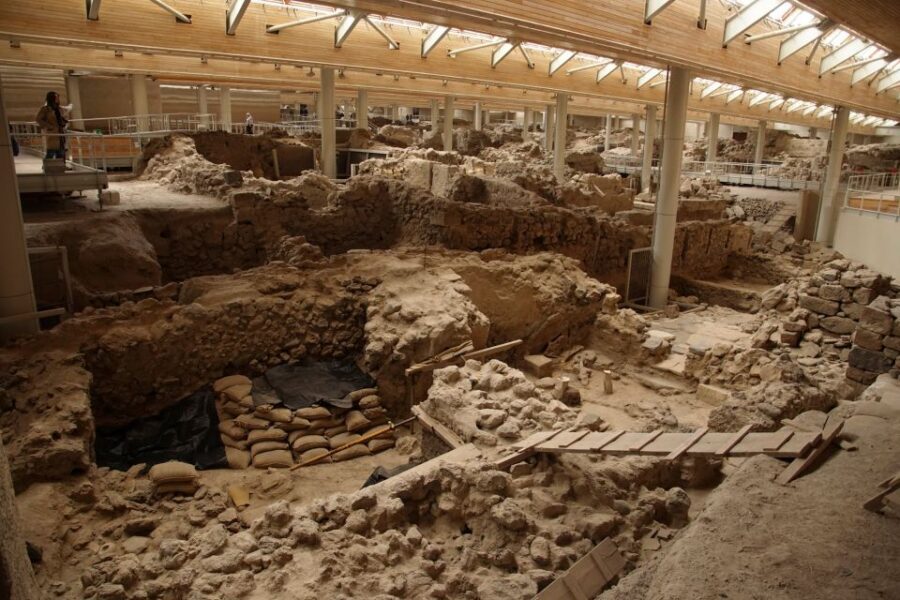
- Comfort comes from the shelter: the ruins are under a big tent, with shade most of the time
- No live guide: questions aren’t part of the experience, so you rely on the narration and site signage
Akrotiri’s Frozen Streets: What You’re Actually Visiting
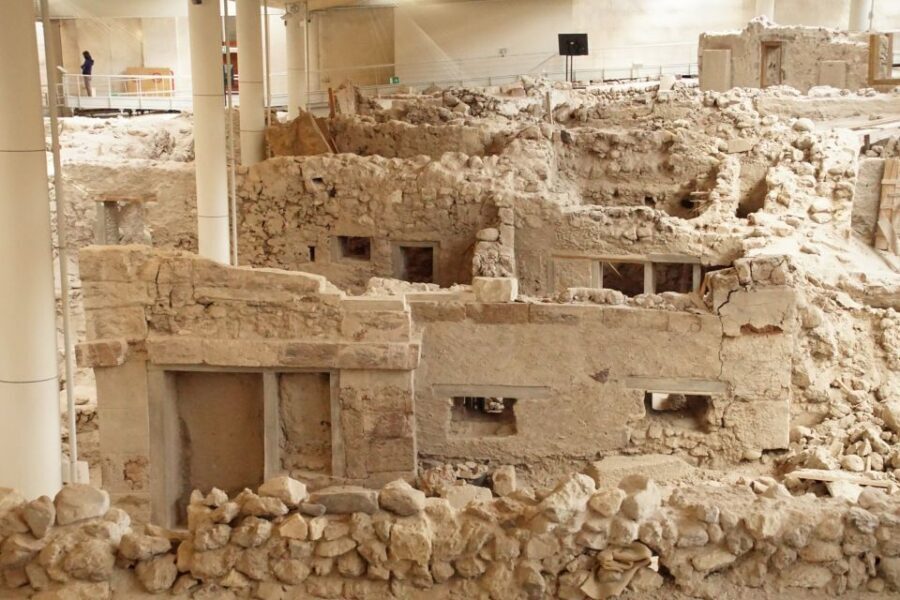
Akrotiri is one of those places that makes the word ruins feel too small. This isn’t a few walls and some pottery sherds. It’s a whole Bronze Age settlement laid out as a town: rooms, corridors, thresholds, and open spaces you can picture as part of everyday life. The twist is the cause of that survival. A volcanic eruption from nearby Santorini’s volcano buried the town under ash, essentially sealing it in place.
That’s why people compare Akrotiri to Pompeii. Both were famously preserved by a sudden disaster. But Akrotiri goes further back in time, and it shows a very different world than the Roman one most visitors know. If you enjoy archaeology, town planning, and the human story behind artifacts, this is a strong use of time on Santorini.
What you’ll notice as you start moving is that the town design is the star. You’re not just looking at objects in glass cases. You’re reading a layout. Your audio guide is designed to help you connect the layout to how people lived: where they traveled through the space, how rooms were organized, and what kinds of homes belonged to wealthier residents.
You can also read our reviews of more tours and experiences in Fira.



The Phone Audio Guide: Download Smart and Save Your Sanity
This experience is self-guided, which means the quality of your visit depends on how ready you are with your phone. The good news is that the audio package is built for real-world travel. You get an activation link and offline content (text, narration, and maps), so you’re not chasing Wi‑Fi once you arrive.
Before you go, do three practical things:
- Download the app and the audio tour at home (or somewhere with reliable signal).
- Check compatibility: Android (version 5.0 and later) or iOS are required. Windows phones and older iPhone/iPod/iPad models aren’t compatible.
- Make space for the download: plan on about 100–150 MB of storage.
Bring your own headphones. They’re not included, and you don’t want to discover that right as you’re trying to sync the audio to your position in the site.
One more tip that matters: the app can be confusing if you’re expecting a simple ticket scan. After booking, you’ll receive an email with instructions and an access link, and you should check your spam folder. Also remember the booking rule: it’s per device, not per participant. If you’re traveling as a pair, make sure you have enough devices set up for both people, or plan for only one audio stream.
Ticket Timing and Getting Into Akrotiri Without Stress
Your ticket includes entry to the prehistoric site of Akrotiri and the self-guided audio tour. The key timing detail is about how the site is organized: the time slot is binding to your entrance to the museum, but you can enter the archaeological site anytime on your selected date.
So you’re not walking in with a 60-minute countdown for the whole experience. You’re mostly matching your arrival to the museum side, then you’re free to explore the ruins within the day.
The meeting point is straightforward: start your audio tour inside Akrotiri. There’s no live guide waiting for you, so your job is to start the audio when you’re in the correct place. If you’re traveling with children, or if your group is slow to settle in, give yourselves extra time at the start so you can begin the audio without rushing.
Also note the “house rules” feel real here. Follow site guidelines at all times. Some sections are roped off, and the audio tour may reference spaces or views that are partially blocked depending on the day and current access.
Walking the Ruins: Double Horns, the House of Ladies, and the Xeste Homes
The tour is built around a guided walk through the town’s structure. You’ll move along a path and through areas that show you how the settlement was arranged. Even if you skip the audio, the basic layout is compelling. With the audio, you get the “what am I looking at and why does it matter” layer.
Two featured stops are especially worth tracking:
- Square of the Double Horns: this is one of the more recognizable named spaces in Akrotiri. The audio helps you understand it as part of civic or public life in the settlement, not just a label on a wall.
- House of the Ladies: another key named residence. The audio framing helps you connect room layouts and features to the kind of life a home like this represented.
The audio also focuses on wealth and residence types, including the affluent homes known as Xeste. This is where the experience becomes less “wow, ruins” and more “oh, so this society had strong households and organization.” Instead of treating rooms as random architecture, you start to see how people likely moved through the space and what different zones might have meant.
Here’s the balanced reality check: the audio is excellent when you can clearly match the narration to what you’re standing in front of. A number of visitors found it harder when the tour references points that aren’t obvious from where you’re positioned, or when the route you’re hearing doesn’t perfectly align with the path you can walk. If you’re the kind of person who gets frustrated when directions are slightly off, it helps to move slowly and re-check the text on nearby signage as you go.
Why Akrotiri Really Earns the Pompeii of the Aegean Label
The nickname isn’t just marketing. It’s about preservation caused by catastrophe. Akrotiri’s eruption buried the town, which protected it in a way you don’t usually get from normal decay. That preservation is why the excavation feels so substantial and why the site can teach you more than a typical “walk through a few ruins.”
But the comparison to Pompeii also does something else: it gives you a framework for thinking about what happened after the disaster. In Pompeii, you get a Roman city frozen by eruption and ash. In Akrotiri, you get a Bronze Age residential settlement frozen in the moments before people fled or the eruption’s effects grew too severe.
That’s the spine-chilling part: you’re looking at a place that likely had an active routine, and then it stops—suddenly and completely. The audio’s storytelling style is meant to make that break in time feel real, not academic. You hear about daily life, housing structure, and what archaeologists think those spaces were used for.
If you want a Santorini experience beyond caldera views and sunsets, this is one of the most direct ways to connect the island to a larger story of environment, disaster, and human life.
You can also read our reviews of more guided tours in Fira




Shelter Comfort: Hot Day Proof, So You Can Actually Take Your Time
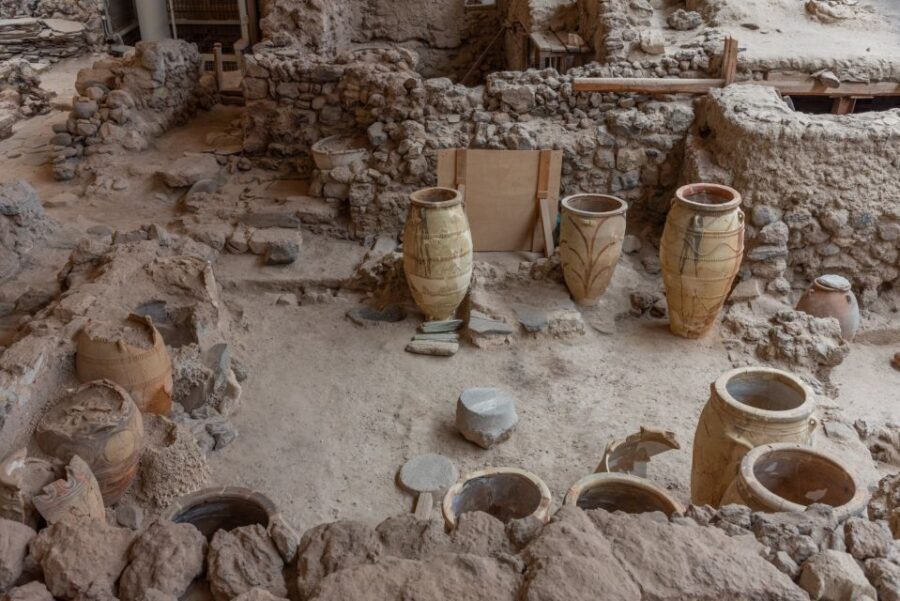
Akrotiri is covered by a large tent. That means shade is available and the site stays more comfortable than many open-air ruins. A big reason this matters is pacing. The audio guide encourages you to stop, listen, and move when you’re ready.
You also don’t need to sprint. Many visitors like that the route is marked and the narration lets you pause or rewind, so you can re-join the story if something draws your attention or you step into a side view.
What I recommend you bring is simple and boring, which is the best kind of advice:
- Comfortable shoes
- Sunscreen
- A charged smartphone
- Your own headphones
Even with the shelter, Santorini sun can be sneaky once you’re outside the tent areas, and it’s better to be protected than sorry.
Audio vs Live Guide: Is This Worth It at $41?
At around $41 per person, you’re paying for two things: entry and a self-guided audio tour on your phone. You’re not paying for a live guide, and that changes the experience.
Here’s the value math:
- If you’re budget-minded and you want more than the minimal signage, the audio is what turns the visit into a story.
- If you already enjoy reading signs and you don’t mind filling in the blanks yourself, the audio can feel like extra work.
In practice, I think this is best value when you’re the type of visitor who hates guesswork. The audio does the hard part: it translates the layout into human terms, and it helps you notice details you might otherwise miss.
But if you hate audio instructions, or you strongly prefer asking questions face-to-face, a live guide might be more satisfying. Since this is self-guided, there’s no built-in chance to clarify something on the spot. You’re listening, reading, and observing—then moving on.
Common Frustrations and How to Handle Them
This experience is popular for good reason, but it’s not perfect for every brain type. The self-guided format can cause a few predictable issues:
1) It can be hard to know where to stand
Some visitors found the audio direction points not always clear on the ground, especially if the audio order or reference points changed. Your best defense is to slow down, look for markers, and use the site signage as your anchor.
2) Closed sections can break the audio flow
If parts of the route are roped off, you might not see what the narration describes. This doesn’t ruin the entire visit, but it can make certain segments feel vague.
3) Some references may point beyond the site
A couple of people noted that parts of the audio discuss objects or context that might be in museums in places like Fira or Athens. That means you might hear about items you can’t directly see inside this shelter on your route. Still, the broader explanation can be useful, just not perfectly satisfying as a “see it here” tour.
4) Phone setup is part of the journey
If the audio doesn’t play smoothly (storage issues, compatibility issues, or download problems), you’ll feel stuck. The simplest fix is to test your download before you leave home and keep your phone charged.
Who Should Book This Akrotiri Audio + Ticket?
This is a good match for you if:
- You want a structured visit without paying for a live guide.
- You like learning the story behind what you see, not just scanning labels.
- You’re comfortable using your phone as a navigation and interpretation tool.
- You want the option of stopping, rewinding, and exploring at your own speed.
It may be a weaker match if:
- You prefer human interaction and questions.
- You dislike audio directions or need very obvious “stand here” cues.
- You have a phone that isn’t compatible, or you can’t reliably download offline content and keep it accessible.
Also think about your group setup. Because it’s per device, plan how you’ll handle audio for multiple people so nobody ends up listening at the wrong time or searching for the correct file while others are already moving.
Should You Book This Akrotiri Entry Ticket and Audio Guide?
Book it if you want Akrotiri to feel like a guided story rather than a solo walk through labeled rooms. The price is reasonable for the entry + offline audio bundle, and the shelter makes it a smart daytime activity on Santorini. The highlights (including the Square of the Double Horns, the House of the Ladies, and the Xeste residences) land better when the audio helps you connect the dots.
Skip it or rethink it if you know you’ll get annoyed by audio instructions, you hate using apps, or you prefer a live guide’s flexibility and Q&A. In that case, you might be happiest reading the on-site information at your own pace, even if it’s less detailed.
If your goal is to leave Akrotiri with a clear picture of how a Bronze Age city worked and what the volcanic burial preserved, this audio-first ticket setup is one of the best ways to do it on a budget.
FAQ
What’s included in the Akrotiri ticket and audio guide?
You get an adult entry ticket to the prehistoric site of Akrotiri, a self-guided audio tour on your smartphone (Android & iOS), an activation link to access the audio tour, and offline content (text, narration, and maps) to help you avoid roaming charges.
Do I get a live guide with this experience?
No. This is a downloadable self-guided audio tour. There is no live guide.
Where do I start the audio tour?
You start your audio guide tour inside Akrotiri.
Can I use the audio offline?
Yes. The audio tour includes offline content (text, narration, and maps), designed so you don’t need roaming charges.
How long is the ticket valid?
The ticket is valid for 1 day. You’ll need to check available starting times when you book.
Is the audio tour compatible with all phones?
No. It works on Android (version 5.0 and later) and iOS, but it’s not compatible with Windows phones, and it is not compatible with older iPhone/iPod/iPad models listed in the activity details.