REVIEW · SANTORINI
Santorini , Akrotiri tour by a licensed guide
Book on Viator →Operated by EXPLORE AKROTIRI · Bookable on Viator
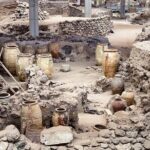
Akrotiri is not a pile of broken columns. It is a buried Bronze Age town, with two and three-storey buildings, household rooms, toilets, kitchens, and a drainage system that feels startlingly modern. Around 1600 BC, a massive volcanic eruption covered the settlement in ash and kept much of it safe for nearly 4,000 years.
I like the private format, since your group of up to 10 can ask questions without waiting for a large tour party. I also like the way the guide connects the ruins to daily life, including the town’s society, culture, and vivid wall paintings. The main drawback is simple: the $213 group price does not include the €12-per-person entrance fee, so a full group pays that extra amount on top.
In This Review
- Key points to know before visiting Akrotiri
- Why Akrotiri feels different from most ancient ruins
- Walking through the prehistoric city
- Kitchens, toilets, and an ancient drainage system
- The eruption that sealed Akrotiri in ash
- Frescoes and the people behind them
- What the private format is worth
- Timing your visit between 8:30 AM and 3:30 PM
- Who will enjoy this Akrotiri tour most
- What the guide adds to the ruins
- Booking, cancellation, and practical value
- Should you book the licensed Akrotiri tour?
- FAQ
- How long does the Akrotiri tour last?
- How much does the private tour cost?
- Is the Akrotiri entrance fee included?
- Is this a private tour?
- What does the licensed guide cover?
- Where does the activity begin and end?
- When is the tour available?
- Can I cancel for a full refund?
Key points to know before visiting Akrotiri
- A real prehistoric town: Walk past preserved buildings rather than viewing only isolated objects or monuments.
- Private guiding for up to 10 people: Your group receives the guide’s attention and can ask about current ideas concerning the ruins and their former residents.
- A short but useful visit: Plan on approximately 1 hour and 15 minutes, with the archaeological site itself listed at about 1 hour.
- Admission costs extra: The tour price is $213 per group, while entry to Akrotiri costs €12 per person.
- A striking engineering story: Look for the remains of kitchens, toilets, and a carefully planned drainage system.
- Easy to fit into a Santorini day: The activity runs daily from 8:30 AM to 3:30 PM and returns to the meeting point.
Why Akrotiri feels different from most ancient ruins
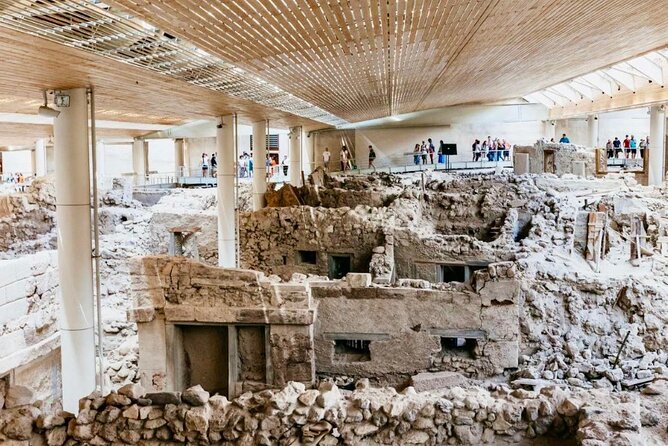
Many ancient sites ask you to imagine the town that once occupied the stones. Akrotiri gives you more to work with. Volcanic ash buried the settlement before later building, weather, or centuries of stone reuse could erase it. What you see is not every part of the old town, but enough of its streets and buildings to suggest a functioning community.
The site is often compared with Pompeii because both places were preserved by volcanic material. The comparison is useful, though Akrotiri is far older. Its story reaches back nearly 4,000 years, to the Bronze Age and the world of about 2000 BC.
I find the most interesting detail is not just the eruption. It is the evidence of ordinary life. A kitchen tells you more about a home than a grand statue does. Toilets and drains show planning, labor, and concern for sanitation. Multistory buildings point to a dense settlement with people living and working close together.
That is where a licensed guide earns the fee. Without help, you can see walls, doorways, and stonework. With help, you get a clearer picture of how these pieces may have worked together and why they matter.
You can also read our reviews of more guided tours in Santorini



Walking through the prehistoric city
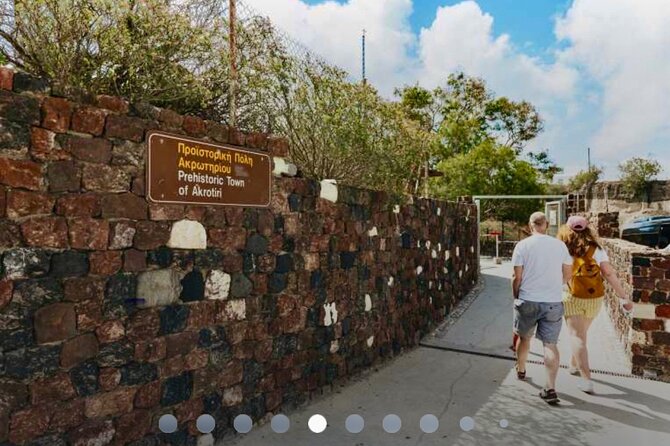
The visit begins at the Akrotiri Archaeological Site, where you walk through the excavated remains of the prehistoric settlement. The route focuses on the built environment: rooms, structures, streets, and the systems that supported daily life.
The excavation revealed dense urban planning. That phrase can sound dry, but the meaning is practical. The settlement was not a loose cluster of huts. Buildings were arranged in an organized way, and some rose two or three storeys. As you move around the site, you can consider how much work was needed to build, maintain, and connect such a town.
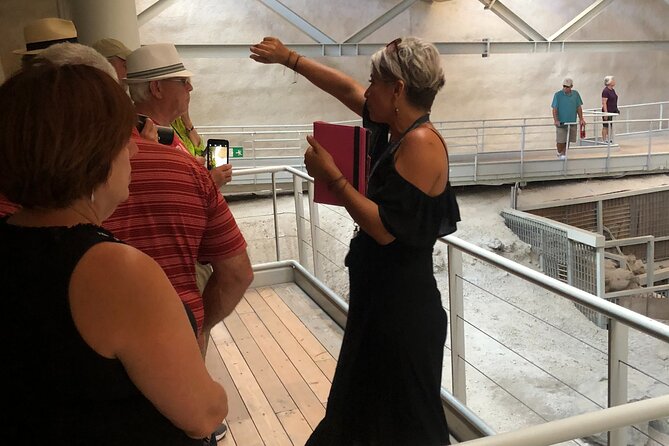
Your guide explains the remains as part of a living community. You hear about the people who lived there, the society they formed, and the culture reflected in the town. This turns the walk from a visual survey into a lesson in how a Bronze Age settlement functioned.
The tour takes about an hour at the site, with the overall experience listed at approximately 1 hour and 15 minutes. That short length is useful if you are fitting Akrotiri into a larger Santorini day. It also means the guide needs to keep the explanation focused, so this is not a slow, all-day archaeological study.
Kitchens, toilets, and an ancient drainage system
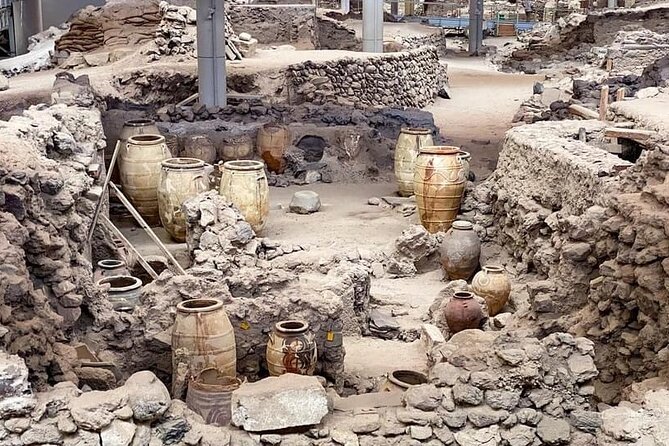
The most memorable parts of Akrotiri may be the least glamorous. Kitchens and toilet facilities help you picture the people who lived here as families, workers, and neighbors rather than distant names from a textbook.
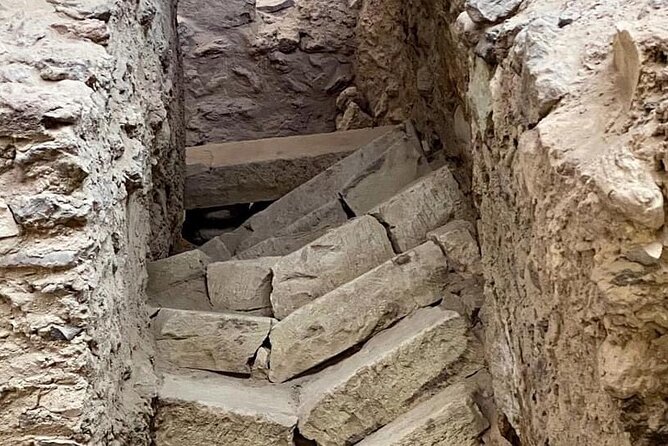
The drainage system is another strong point. Its presence shows that the settlement required careful planning. You can look at the remains and ask how water moved through the town, how households were arranged, and how builders solved practical problems without modern equipment.
I especially like this side of the tour because it gives you useful evidence rather than vague claims about an advanced civilization. A drainage system is something you can understand. A kitchen is something you can relate to. These details make the age of the site feel real.
The guide also helps connect these small features to the bigger picture. You learn how a town with several-storey buildings, household spaces, and public systems could operate before the eruption brought life there to a halt.
The eruption that sealed Akrotiri in ash
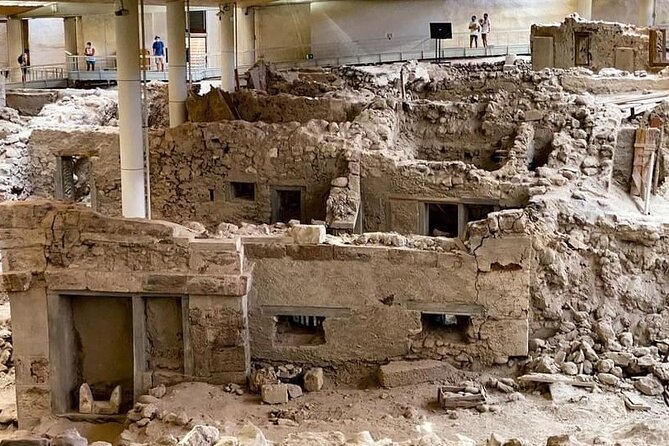
At some point around 1600 BC, a major volcanic eruption changed Santorini forever. The settlement was buried under a thick layer of volcanic material, preserving it for almost 4,000 years.
The eruption is not treated only as a dramatic disaster. It is also the reason Akrotiri survived in such an unusual form. Volcanic ash covered the structures and protected many remains from the slow damage that affected other ancient settlements.
The town was later found by chance during work to obtain volcanic soil from Santorini. That soil was intended for construction and insulation connected with the Suez Canal. This discovery story adds a curious modern chapter to the site. Akrotiri was not found because someone already knew exactly where the city lay. It emerged during practical work on the island.
As you walk, the guide explains how the settlement came to be buried and what the excavation tells us about its former inhabitants. The emphasis is on current historical ideas, so you can ask questions instead of receiving only a fixed, simplified story.
Frescoes and the people behind them
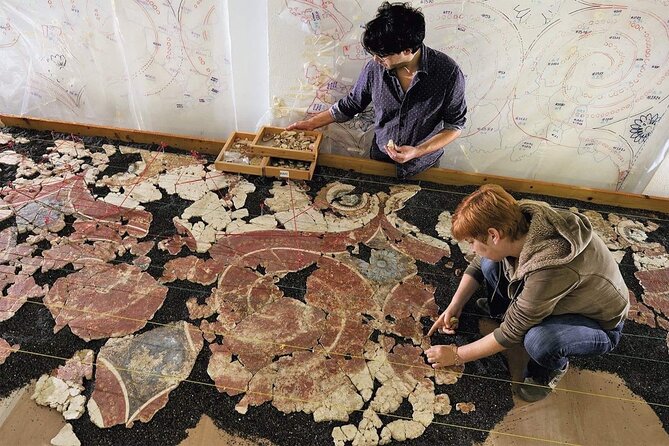
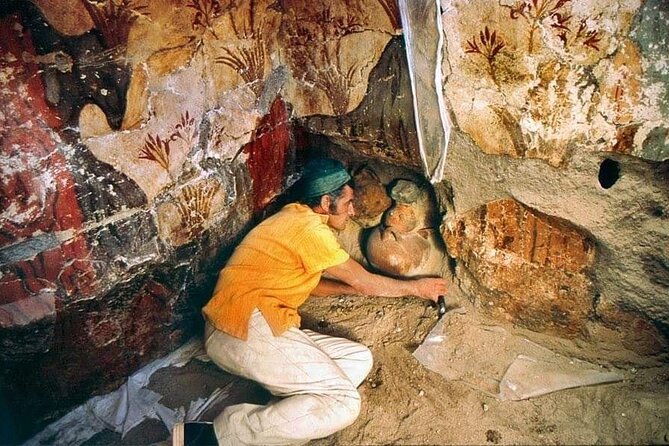
The wall paintings once found at Akrotiri are among the site’s most evocative remains. The guided visit includes an explanation of the vivid frescoes that decorated the buildings, even though the main walk centers on the excavated settlement.
These paintings offer clues about the people who lived there, their artistic choices, and the world they wanted to show. They also remind you that Akrotiri was more than a practical town of drains and storage rooms. Its residents cared about appearance, decoration, and visual storytelling.
I would ask the guide how the frescoes help archaeologists understand the culture of the settlement. The tour is designed for questions, and past visitors specifically valued explanations that addressed current thinking about the ruins, the island, and its people.
Because the tour is private, you are not limited to listening from the back of a group. If your children want to know why the paintings matter, or if you want to compare the art with other Bronze Age sites, you can use the guide’s time in a more personal way.






What the private format is worth
The price is $213 per group of up to 10 people. That works out differently depending on the size of your party. For two people, the guiding cost is substantial. For a family or a full group of 10, the per-person value improves considerably.
You also pay the Akrotiri entrance fee separately, at €12 per person. That extra cost is easy to overlook when comparing tours, so include it in your budget before booking. A group of 10 would add €120 in admission charges, while a couple would add €24.
I see the strongest value in the guide rather than in the length. You are paying for a private explanation of a complex archaeological site, not for a full-day excursion with transport, meals, or several attractions. If you already enjoy archaeology and are happy reading signs at your own pace, the added cost may feel less essential.
If you want the ruins to make sense quickly, the price is easier to justify. The guide explains what you are looking at, answers questions, and helps you form a picture of the town. One family found that the guide made the community vivid and helped them get much more from the visit. That is exactly the kind of benefit a short private tour can provide.
Timing your visit between 8:30 AM and 3:30 PM
The activity runs Monday through Sunday, with operating hours listed from 8:30 AM to 3:30 PM. That gives you a broad daytime window, though your exact start depends on availability when the booking is confirmed.
A morning visit may be useful if you want to keep the rest of your day open for Santorini. An afternoon visit can work if you are planning the archaeological site after other activities. Since the tour returns to the meeting point, you do not finish at a separate location.
The meeting point is in Santorini, with the listed map code 8G879C22+6QV9C22+6QV. The activity is near public transportation, but the supplied information does not specify a hotel pickup or transport service. You should therefore treat this as a guided site visit and arrange your own way to the meeting point unless your booking confirmation says otherwise.
Confirmation is sent within 48 hours of booking, subject to availability. If your schedule is tight, do not leave this until the last minute. The activity is often booked well ahead, with an average booking lead time of about 54 days.
Who will enjoy this Akrotiri tour most
I would choose this tour for several kinds of visitors:
- Families who want children to see how ancient people actually lived
- Couples who prefer a focused cultural visit over a long group excursion
- First-time visitors who want context without spending an entire day at an archaeological site
- History fans interested in Bronze Age architecture and volcanic preservation
- Small groups that can share the $213 guiding cost
The tour can also work for people who do not normally seek out ancient ruins. Kitchens, toilets, drains, and apartment-like buildings offer clear points of connection. You do not need to know Greek archaeology before arriving.
It may be less suitable if you want a broad Santorini tour with several stops, scenic viewpoints, or transportation around the island. This experience concentrates on Akrotiri. The short duration is an advantage for some schedules, but anyone wanting a long archaeological lecture may find it brief.
Most people can participate, and service animals are allowed. The information supplied does not give detailed notes about surfaces, stairs, shade, or wheelchair access, so ask the provider about those points if they affect your plans.
What the guide adds to the ruins
A good guide does more than name rooms. The guide here explains the settlement, its people, and the ideas archaeologists use to interpret the evidence. That matters at Akrotiri because the remains can seem abstract when you first see them.
You may look at a wall and wonder if it belonged to a home, a workshop, or another kind of building. You may see a drainage channel without understanding its place in the town. The guide’s role is to connect those fragments into a readable picture.
The strongest praise for this experience centers on answers and explanation. The guide is described as giving clear replies to questions and updating the group on current historical theory about the ruins, the island, and its people. Another family found the guide painted a vivid picture of the community.
Those are useful signs for a private tour. I would take advantage of the format by asking about anything that catches your attention. Ask about the buildings, the frescoes, the eruption, or what the settlement reveals about Bronze Age culture. Your questions can shape the visit.
Booking, cancellation, and practical value
You receive a mobile ticket, which keeps the booking details on your phone. The tour provider is Explore Akrotiri, and the activity is private, so only your group participates.
Free cancellation is available if you cancel at least 24 hours before the start time. A cancellation made less than 24 hours before the experience is not refunded, and changes inside that same window are not accepted. The cut-off follows Santorini local time.
The booking pattern suggests that many people reserve well ahead, with an average lead time of 54 days. That does not guarantee every date will sell out, but it is a sensible reason to book early if you have a fixed itinerary.
Remember the two-part cost: $213 for the group tour, plus €12 per person for admission. The group price can be a fair deal for a family or group of friends. For one or two people, compare the cost with your interest level and decide how much personal explanation is worth to you.
Should you book the licensed Akrotiri tour?
I would book this tour if you want Akrotiri to feel like a real town rather than a collection of ruins. The preserved multistory buildings, household facilities, drainage system, volcanic burial, and frescoes provide plenty to see in a compact visit.
The private setting is especially helpful for families and small groups. You can ask questions, move through the site with a clear explanation, and finish in roughly an hour and 15 minutes. The guide’s ability to explain current ideas and create a vivid picture of the community is the main reason to choose this experience.
Skip it if you want transportation around Santorini, several attractions in one package, or a long day devoted to archaeology. Also budget for the €12 entrance fee per person. For visitors interested in the island’s oldest story, though, this is a focused and worthwhile way to meet the buried city of Akrotiri.
FAQ
How long does the Akrotiri tour last?
The experience lasts approximately 1 hour and 15 minutes. The archaeological site portion is listed as about 1 hour.
How much does the private tour cost?
The tour costs $213 per group, with up to 10 people included.
Is the Akrotiri entrance fee included?
No. Admission costs €12 per person and must be paid separately.
Is this a private tour?
Yes. Only your group participates, with a maximum group size of 10 people.
What does the licensed guide cover?
The guide explains the prehistoric settlement, its buildings, kitchens, toilet facilities, drainage system, inhabitants, society, culture, volcanic burial, and the frescoes that once decorated the walls.
Where does the activity begin and end?
The tour begins at the listed meeting point in Santorini, identified by the map code 8G879C22+6QV9C22+6QV. It ends back at the same meeting point.
When is the tour available?
It operates Monday through Sunday from 8:30 AM to 3:30 PM, during the listed operating period from February 1, 2023, through June 17, 2026.
Can I cancel for a full refund?
Yes, if you cancel at least 24 hours before the experience start time. Cancellations made less than 24 hours in advance are not refunded, and changes inside that period are not accepted.