The big draw here is simple: in four hours, you can get a quick but meaningful look at Athens from several angles, from the Parthenon and ancient Acropolis to modern government buildings, Plaka lanes, and the city view from Lycabettus Hill. A private car removes the hassle of finding buses, taxis, and parking during a short stay.
I like the door-to-door pickup from an Athens hotel or Piraeus cruise pier, and I like the freedom of a private vehicle for a small group of up to three. One booking specifically praised driver Peter for taking the group to places that were not easy to reach on foot from their hotel.
The main thing to consider is that this is a fast overview, not a slow archaeological tour. Admission fees are extra, and your English-speaking driver can explain the sites before you enter but cannot accompany you inside without arranging a licensed guide at an additional cost.
In This Review
- Key points to know before booking
- A smart four-hour introduction to Athens
- From Piraeus to the Acropolis
- The Acropolis: four monuments, one crowded hill
- Propylaea
- Temple of Athena Nike
- The Parthenon
- Erechtheion
- Syntagma Square and the center of modern Greece
- The Neoclassical Trilogy in five-minute stops
- Plaka: a short taste of the old neighborhood
- The Panathenaic Stadium and Mount Lycabettus
- What the private Mercedes adds
- Is $323.91 good value for three people?
- Who should book this Athens tour?
- Should you book it?
- FAQ
- How long is the private Athens tour?
- Where can pickup and drop-off take place?
- Is the tour suitable for cruise ship passengers?
- Are Acropolis admission tickets included?
- Does the driver guide visitors inside the Acropolis?
- How many people can join the private tour?
Key points to know before booking
- The Acropolis is the main event: Allow for a short visit to the Propylaea, Temple of Athena Nike, Parthenon, and Erechtheion.
- Piraeus pickup is built in: This makes the tour useful for cruise passengers with limited time ashore.
- You travel privately: The air-conditioned Mercedes is reserved for your group of up to three people.
- The tour covers old and new Athens: Ancient monuments share the route with Parliament, Syntagma Square, the Neoclassical Trilogy, and modern city districts.
- Lycabettus Hill adds a wide city view: The final high point gives you a different perspective from the Acropolis.
- Tickets and a licensed guide cost extra: Pre-purchase site admission, especially if you want to make the most of the short schedule.
A smart four-hour introduction to Athens
Athens can feel scattered at first. The Acropolis rises above the center, Plaka spreads below it, Syntagma Square sits farther northeast, and Lycabettus Hill gives the whole city a high perch. Walking between all these places would take much of a day, especially in warm weather.
This tour handles that spread by using a private car and a route that mixes short stops with brief drives. You get the famous ancient monuments, important civic buildings, traditional neighborhoods, and a broad city view without spending your morning working out public transport.
The four-hour format works best if you want orientation rather than complete coverage. You will see many major sights, but several stops are short photo and explanation visits. The Acropolis deserves the most time, so think of the other locations as carefully chosen glimpses rather than full tours.
The start time is 8:00 a.m. That is useful for cruise passengers and for anyone hoping to reach the Acropolis before the day feels too hot. Pickup is available from Athens hotels and the Piraeus port, and the return is to the same general pickup point.
You can also read our reviews of more private tours in Athens


From Piraeus to the Acropolis
For a cruise passenger, the tour begins at the pier in Piraeus. The port is about 12 kilometers, or seven miles, from central Athens, though the actual drive can vary with traffic. The route follows the coastal road along the Saronic Gulf before turning toward the Acropolis.
That coastal start gives you a quick look at the connection between port and capital. Piraeus is not just a cruise stop. It is Greece’s main seaport and one of Europe’s largest passenger ports, so the drive helps place Athens within its wider setting.
The tour then heads directly toward the Acropolis. Since the port transfer takes about 20 minutes in the planned schedule, cruise passengers should confirm their ship’s docking time and allow enough room for the return drive and any traffic delays. The operator provides port pickup and drop-off, which is a major convenience when your ship is your hotel and your time ashore is limited.
The Acropolis: four monuments, one crowded hill
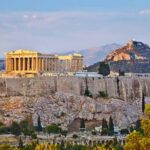
The Acropolis is the portion of the tour that can justify the booking by itself. This rocky citadel above Athens holds the monuments most closely tied to classical Greek civilization, including the Parthenon, the Propylaea, the Temple of Athena Nike, and the Erechtheion.
Your driver can provide background before you enter the archaeological site. Keep in mind that the driver is not licensed to guide inside the Acropolis or other archaeological sites. If you want detailed commentary beside each monument, ask the company to arrange a state-licensed guide before the day of the tour.
Propylaea
The Propylaea is the grand entrance to the Acropolis. Its location on the western side of the hill makes it your first major architectural encounter after the climb. The present monumental gateway was built as part of the Periclean building program in the fifth century BC.
The planned visit is about 15 minutes. That is enough to admire the scale and position of the gateway, but not enough for a long study of its construction or earlier versions. The first entrance here dates to the sixth century BC, and earlier structures were damaged during the Persian Wars.
Temple of Athena Nike
This small temple sits on a bastion near the entrance. Its position is easy to miss when the larger monuments pull your attention uphill, but its setting is one of the Acropolis’s fine details.
The classical temple was designed by Kallikrates and built between 426 and 421 BC. Earlier temples on the site were destroyed or replaced over time. The visit is scheduled for about 15 minutes, so you will mainly take in the temple’s compact form and its placement above the city.






The Parthenon
The Parthenon gets about 45 minutes, the longest stop on the Acropolis portion. That is the right priority. Even with restoration work and crowds, the temple’s scale and precision are hard to grasp from photographs alone.
Dedicated to Athena Parthenos, the city’s patron goddess, the Parthenon was built between 447 and 438 BC under the leadership of Pericles. Architects Iktinos and Kallikrates designed it, while Pheidias supervised its sculptural program.
The building replaced earlier temples destroyed during the Persian Wars. Its importance is not only visual. It represents Athens at the height of its political power, when democracy, public building, sculpture, and philosophy were closely linked.
Your time here will still be limited by the four-hour schedule. The tour does not include admission, and tickets are not included at any of the archaeological sites. Pre-purchased tickets are strongly suggested because same-day availability may be limited. The operator can arrange advance ticket purchases for a small service fee.
Erechtheion
The Erechtheion provides a contrast to the Parthenon. Built between 421 and 406 BC, it had an irregular plan shaped by the sacred traditions connected with the Acropolis. The sanctuary was linked with Athena, Poseidon, the mythical king Erechtheus, and the ancient king Kekrops.
Its most famous feature is the Porch of the Caryatids, where six sculpted female figures take the place of ordinary columns. The planned stop lasts about 15 minutes, enough to see the porch and hear the basic story behind the building.
The Acropolis involves an uphill route and uneven ancient surfaces. The tour notes that most people can participate, but you should still expect walking at the site. Comfortable shoes and water are sensible, particularly under the Greek sun.
Syntagma Square and the center of modern Greece
After the Acropolis, the car shifts from ancient Athens to the capital of the modern Greek state. Syntagma Square is the city’s political heart, named Constitution Square after the uprising that led King Otto to grant a constitution in 1843.
The Hellenic Parliament occupies the former royal palace overlooking the square. The building first served as the residence of Kings Otto and George I before becoming the home of Parliament and the Senate. You will have about 10 minutes here, with no admission fee.
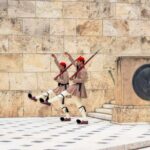
In front of Parliament is the Tomb of the Unknown Soldier, a memorial to Greek soldiers killed in war. It is guarded by the Evzones, members of Greece’s Presidential Guard, whose distinctive uniforms and slow ceremonial movements have become a familiar part of Athens sightseeing.
The planned stop is another 10 minutes. If your visit falls on Sunday, the full ceremonial guard change takes place at 11:00 a.m., accompanied by a military band. The guard also changes hourly in a slower, formal procedure. Since the tour begins at 8:00 a.m. and lasts around four hours, the Sunday ceremony may or may not fit your exact route and traffic conditions. Ask when booking if this is a priority.
The Neoclassical Trilogy in five-minute stops
The Academy of Athens, National and Kapodistrian University of Athens, and National Library form the city’s Neoclassical Trilogy. The tour includes short stops of about five minutes at each building.
These are primarily exterior visits, so you should expect architecture and explanation rather than interior access. The Academy was founded in 1926 as an institution for science, humanities, and fine arts. The university, founded in 1837, was the first university in the modern Greek state and the first in the Balkans and eastern Mediterranean area.
The National Library completes the group. Its building was constructed between 1887 and 1902 from plans by Danish architect Theophile Hansen, with Ernst Ziller supervising the work. The library holds more than a million books and magazines, along with handwritten codices dating from the ninth to the nineteenth centuries.
Five minutes is enough to photograph the buildings and understand their place in Athens. It is not enough for a serious architectural visit, so treat this section as a moving city tour rather than a museum stop.
Plaka: a short taste of the old neighborhood
Plaka lies beneath the Acropolis and gives the tour a more intimate city view. Its narrow streets, small shops, sidewalk cafes, family-run tavernas, and neoclassical buildings create a village-like feel in the middle of Athens.
The planned visit is 15 minutes. That allows for a short walk and a look at the atmosphere, but not much shopping or a relaxed meal. If you want time for ceramics, jewelry, local food, or the whitewashed lanes of nearby Anafiotika, you will need to return later on your own.
I like Plaka as part of this route because it connects the ancient hill with everyday Athens. After seeing temples built for gods and monuments built by statesmen, you get a neighborhood where people eat, shop, and live beneath the same rocky hill.
The Panathenaic Stadium and Mount Lycabettus
The Panathenaic Stadium, also called the Kallimarmaro, receives a 10-minute stop. It is made entirely of marble from Mount Pentelicus, the same general marble associated with major monuments in Athens. The stadium hosted the first modern Olympic Games in 1896.
The marble can change color with the daylight, appearing cooler in the morning and more golden later in the day. The tour does not include admission, so confirm the ticket situation if you want to enter rather than view the stadium from outside.
The final major stop is Mount Lycabettus, planned for about 30 minutes. At 277 meters, or 909 feet, it is the highest point in central Athens. From the hill, you can look across the capital toward the coastline and see how the Acropolis fits into the wider city.
Lycabettus is reached on foot, by funicular railway, or by car. This tour’s private vehicle makes the stop practical within a half-day route, although the exact amount of walking or time at the top depends on traffic and the day’s pace. The hill also offers a quieter contrast to the central streets below, with the small Chapel of Saint George at the summit.
What the private Mercedes adds
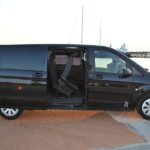
The vehicle is an air-conditioned Mercedes sized for your group, with private use for up to three people. That matters in Athens, where a short route can lose time to heat, traffic, and finding the right street.
You also avoid splitting up from a larger group. You can ask the driver to adjust the pace within the limits of the schedule, spend a little longer at a preferred viewpoint, or explain what you are seeing as you move between stops.
The included driver speaks English and has a good working knowledge of Greek history and culture. The important distinction is that this is a driver-led tour, not a fully guided archaeological visit. Inside the Acropolis and museums, the driver must stop at the entrance unless you arrange a licensed state guide for an added fee.
One driver named Peter is specifically praised for knowing Athens well and reaching places that were difficult to walk to from a hotel. Driver assignments can vary, so treat Peter’s involvement as something to confirm rather than a guarantee.
Is $323.91 good value for three people?
The price is $323.91 per group of up to three, not per person. With three people, that works out to about $108 per person before admission fees and food. For two people, the per-person cost rises to about $162, and a solo booking pays the full group rate.
That price buys roughly four hours of private transport, hotel or port pickup, an air-conditioned vehicle, and an English-speaking driver. It is not the cheapest way to see Athens, but it can be fair value for a cruise group that wants a direct route and does not want to manage taxis or public transit.
The value is strongest when you have limited time or when three people can share the cost. It is weaker if you want to spend most of the day inside the Acropolis, shop in Plaka, or explore museums at a slow pace. In that case, a longer private tour with a licensed guide may suit you better.
Admission fees are separate, as are food and drinks. A licensed guide inside archaeological sites and museums is also extra. Add those costs before comparing this tour with other Athens options.
Who should book this Athens tour?
I would choose this experience for a cruise passenger with one morning in Athens, a small group staying at an Athens hotel, or anyone wanting a broad first look before exploring the city independently.
It is especially useful if you care about seeing the Acropolis, but also want Syntagma Square, Plaka, the Panathenaic Stadium, and Lycabettus Hill in the same outing. The route covers more ground than most visitors could manage on foot in four hours.
I would not choose it as my only Athens experience if detailed ancient history is your main goal. The driver can explain the sites, but the short timing and lack of included licensed guide mean you will need to supply some of the archaeological detail yourself or pay extra for a guide.
Free cancellation is available if you cancel at least 24 hours before the start time. Changes or cancellations made inside that window are not accepted for a refund. Airport transfers can also be arranged for an additional cost.
Should you book it?
Book this tour if time and transport are your main concerns. It gives you a private ride from Piraeus or your hotel, a strong Acropolis focus, and a useful sweep through both ancient and modern Athens.
Before booking, decide how much time you need inside the Acropolis and confirm ticket arrangements. If you want a relaxed morning, a full Sunday guard ceremony, or detailed commentary at every monument, choose a longer tour with a licensed guide. If you want an efficient Athens introduction and can accept quick stops, this is a practical choice for a small group.
FAQ
How long is the private Athens tour?
The tour lasts approximately four hours and starts at 8:00 a.m.
Where can pickup and drop-off take place?
Pickup and drop-off are available at Athens hotels and at the Piraeus port. Airport transfers can be arranged on request for an extra cost.
Is the tour suitable for cruise ship passengers?
Yes. The tour includes pickup and return to the Piraeus cruise port, making it suitable for a limited morning or shore excursion.
Are Acropolis admission tickets included?
No. Entrance fees to archaeological sites and museums are not included. Advance ticket purchase is suggested, and the operator can arrange tickets for a small service fee.
Does the driver guide visitors inside the Acropolis?
The English-speaking driver provides information until you enter archaeological sites and museums. Drivers are not licensed to accompany guests inside. A state-licensed guide can be arranged for an additional cost, subject to availability.
How many people can join the private tour?
The price covers one private group of up to three people, traveling in an air-conditioned vehicle appropriate for the group size.