REVIEW · GREECE
“Tour in Athens in 4 hours”
Book on Viator →Operated by Greece Athens Taxi GAT · Bookable on Viator
Athens packs ancient temples, grand neoclassical buildings, lively lanes, and wide city views into a tight urban center. This private four-hour tour uses a Mercedes and door-to-door pickup to connect the big sights without making you wrestle with traffic, heat, or a map.
I like the flexible start time and the easy hotel, Airbnb, or Piraeus pickup. I also like the personal service: drivers such as Andreas, Konstantinos, and Dennis have adjusted the pace, explained what you were seeing, and helped guests handle unexpected problems. The catch is important: your driver guides you in the vehicle, but cannot accompany you inside archaeological sites or museums, and admission costs extra.
In This Review
- Key points at a glance
- What this Athens tour does well in four hours
- The Acropolis: the essential first stop
- Panathenaic Stadium and the Olympian Zeus area
- Parliament, Syntagma, and the changing of the guard
- Athens’ neoclassical trio
- Mount Lycabettus for Athens from above
- Plaka, Monastiraki, and the old city feel
- The driver service and what you actually receive
- Price, timing, and practical value
- Who should book this private Athens tour?
- Should you book it?
- FAQ
- How long does the Athens tour last?
- What is the price?
- Is hotel pickup included?
- Are airport transfers included?
- Are Rafina and Laurio port transfers included?
- Is the Acropolis admission ticket included?
- Can the driver guide me inside the Acropolis?
- Is this a private tour?
- What is provided in the vehicle?
Key points at a glance
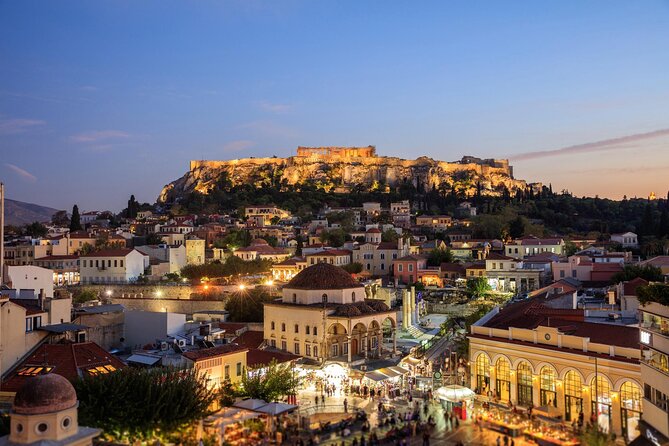
- Acropolis time is built in: Plan about 1 hour and 15 minutes for the Parthenon, Erechtheion, Temple of Athena Nike, Propylaea, Theatre of Dionysus, and Odeon of Herodes Atticus. Admission is not included.
- A private Mercedes keeps the day cool: Air-conditioning, bottled water, onboard WiFi, and mobile chargers matter during Athens’ hot summer months.
- You see both ancient and modern Athens: The route links the Acropolis with Parliament, Syntagma Square, the Academy, the National Library, and the University.
- Mount Lycabettus adds a different view: You get about 30 minutes at Athens’ second-highest point, with the Church of Agios Georgios and cable car area at the top.
- Plaka and Monastiraki provide street life: Allow about an hour for Plaka, with nearby access to Hadrian’s Library, the Ancient Agora, and the Stoa of Attalos.
- The driver is not a site guide: You receive historical explanations in the vehicle and help buying skip-the-line tickets, but you must explore each paid site on your own unless a licensed guide is arranged separately.
What this Athens tour does well in four hours
The clever part of this experience is not simply the number of sights. It is the way a private car links places that are close on a map but can take time to reach on foot, especially under the strong Athens sun.
You get the city’s major ancient landmark, a ceremonial stadium, Roman ruins, government buildings, a hilltop viewpoint, and old neighborhoods in one compact outing. That makes the tour especially useful on a cruise stop, during a long connection, or at the start of a short Athens stay.
I would not treat it as a slow archaeological study. The Acropolis alone deserves much longer if you want to read every sign, study every column, and visit a museum afterward. Think of this as a well-organized first look, with enough time to recognize Athens’ main chapters and decide what deserves a second visit.
The private format is a real advantage. Your group does not wait for strangers, and the start time can be adjusted to suit your schedule. The driver can also extend the tour for an extra fee, which gives you some room if you want more time at the Acropolis or another stop.
You can also read our reviews of more tours and experiences in Greece.


The Acropolis: the essential first stop
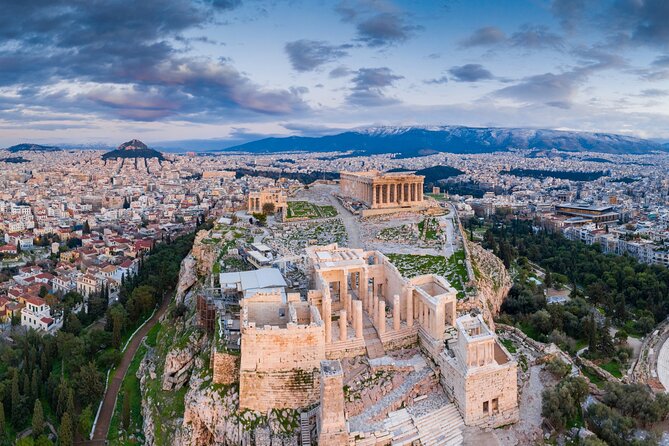
The Acropolis receives about 1 hour and 15 minutes, making it the main event. The rocky hill rises 156 meters above sea level and about 70 meters above central Athens, so the approach includes uphill walking and uneven ancient surfaces.
At the summit, the Parthenon is the star. Built in the fifth century BC for Athena, the city’s patron goddess, it is the clearest symbol of Classical Athens. Its size and setting matter as much as its famous columns. From here, you see how the ancient sanctuary occupied the high point above the city.
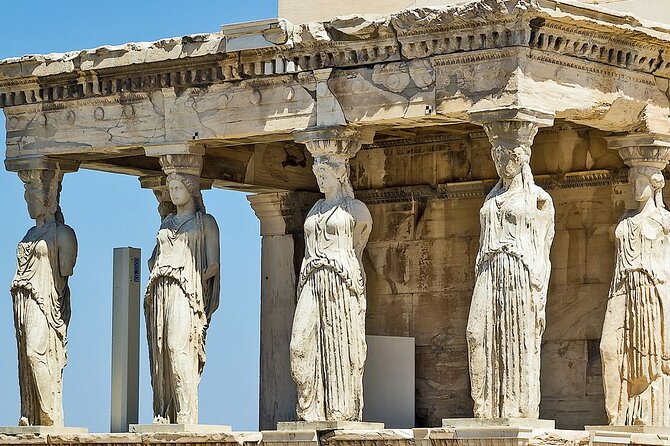
The Erechtheion offers a different kind of beauty. This Ionic temple on the north side of the Acropolis is known for its Caryatid figures, the sculpted female forms that serve as architectural supports. The Temple of Athena Nike is smaller, but its position near the entrance gives it a graceful profile and a strong connection to the military and protective side of Athena.
The Propylaea forms the monumental gateway. Below and around the south slope, you can look toward the Theatre of Dionysus, where ancient dramatic performances took place, and the Odeon of Herodes Atticus, a Roman-era stone theatre still used for performances.
Your admission ticket is not included. The stated Acropolis fee is €30 per person, and tickets for other archaeological places and museums also cost extra. The driver can assist with purchasing skip-the-line tickets, but you should understand the limit of that help: your driver cannot accompany you through the site as a licensed guide.
That distinction affects the value. If you want transportation, timing help, and a clear overview, the arrangement works well. If you want detailed explanations beside every monument, request a licensed guide in advance, subject to availability and an additional charge.
Panathenaic Stadium and the Olympian Zeus area
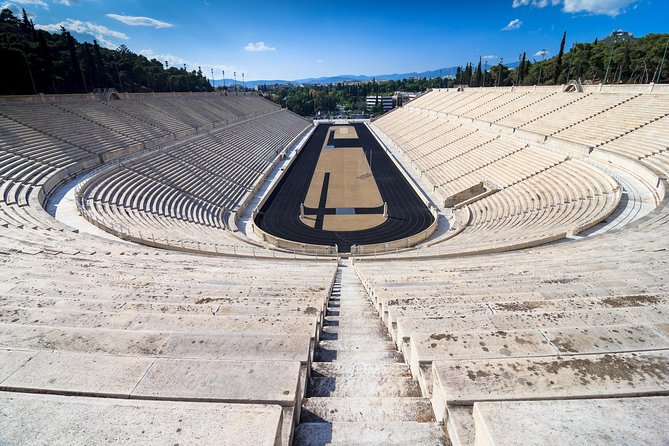
The Panathenaic Stadium gets about 15 minutes. This long, white-marble stadium is tied to the modern Olympic story and gives you a quick photo stop with a very different look from the weathered Acropolis stone.
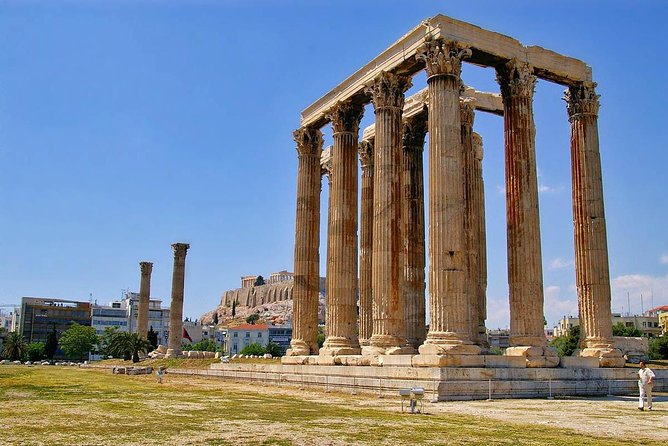
The schedule also includes about 10 minutes at the Temple of Olympian Zeus. The surviving columns give you a sense of the temple’s intended scale, even though the building was never fully completed and later suffered destruction. Its open setting makes it easy to appreciate the enormous ambition behind the project.
The Temple of Olympian Zeus is near Hadrian’s Arch, Zappeion, the National Garden, and the Panathenaic Stadium. That cluster is one reason a car helps. You can cover several major landmarks without spending your short tour searching for entrances or doubling back.
Admission is not included at these sites. Since the scheduled time is short, I would ask the driver before entering any paid monument. The tour is designed mainly for exterior views and brief stops, not extended time inside every location.
Parliament, Syntagma, and the changing of the guard
The Monument to the Unknown Soldier in front of Parliament receives about 10 minutes, with the chance to see the changing of the guard by the Evzones, Greece’s ceremonial presidential guards.
The setting is Syntagma Square, the central square of modern Athens. The Greek Parliament occupies the former royal palace, and the square has been a center of Greek political and public life since the nineteenth century.
This stop gives the tour useful balance. After ancient temples and Roman ruins, you see the institutions of present-day Greece. The guards’ uniforms and formal movements add ceremony, but the square itself is also a working part of the city, not just a staged attraction.
Timing matters here. The provided schedule allows a short stop, so do not expect a long ceremony every time. Your driver can help position the route around your pickup time and the day’s traffic, but exact public events and road conditions can affect what you see.
Athens’ neoclassical trio
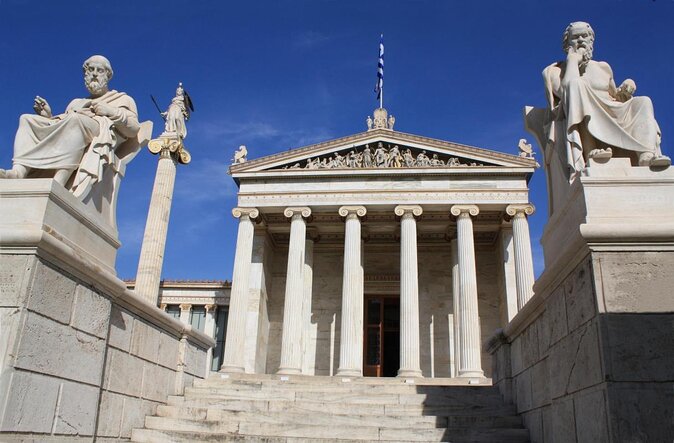
The National Library, Academy of Athens, and National and Kapodistrian University form a handsome neoclassical group along central Athens streets.
The Academy is Greece’s national research institution, founded in 1926, with a connection in name and purpose to Plato’s ancient Academy. Its building is one of the city’s best-known neoclassical landmarks.
The University is the country’s oldest, founded in 1837 as the Othonian University. The National Library’s grand reading room once held more than two million books and manuscripts, including thousands of Greek New Testament manuscripts and handwritten works associated with Aristotle, Plato, and Homer.
These are usually exterior viewing stops on a fast city tour. That is still worthwhile. Their columns, statues, and formal facades show how modern Greece used Classical Greek forms to express national identity.



Mount Lycabettus for Athens from above
Mount Lycabettus gives you a change of scale. At 277 meters above sea level and 227 meters above the city, it is the second-highest point in the Attica basin after Turkovounia.
You get about 30 minutes here. The hill has the small Church of Agios Georgios at the top, and a cable car operates in the area. The view helps you understand Athens as a whole, from the dense central districts to the Acropolis rising on its own hill.
This stop is especially useful early in a stay because it gives you a mental map. After seeing the city from above, streets and monuments make more sense when you return to them at ground level.
The tradeoff is time. Thirty minutes is enough for a viewpoint visit, not a full hill experience. If the Acropolis or Plaka matters more to you, ask how the schedule will be balanced before adding extra stops.
Plaka, Monastiraki, and the old city feel
Plaka receives about an hour, the longest allocation outside the Acropolis. It sits directly below the Acropolis and is known for narrow lanes, steps, neoclassical homes, red-tiled roofs, balconies, tavernas, and cafes serving cold frappés.
This is where I would slow down. Ancient Athens can feel monumental and formal, while Plaka gives you a more intimate sense of the city. You can look for a small cafe, browse the lanes, and enjoy the contrast between daily life and the archaeological hill overhead.
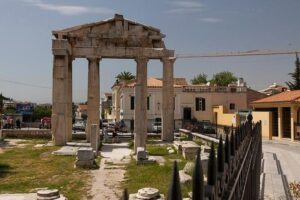
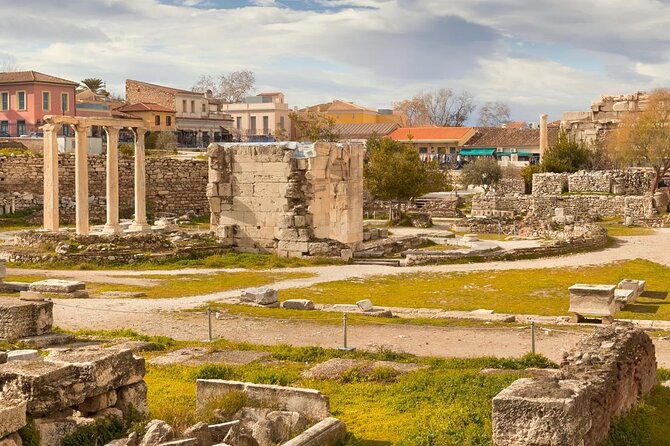
The wider Monastiraki area brings you close to Hadrian’s Library, the Ancient Agora, and the reconstructed Stoa of Attalos. Hadrian’s Library was built in AD 132 on the north side of the Acropolis. The Agora was the central gathering and political space of a Greek city-state, while the Stoa of Attalos has been rebuilt as a major visual feature of the site and houses a museum of Athenian artifacts.
The tour does not include admission to these archaeological locations. Your one-hour Plaka stop may include views of nearby monuments, but entering them will require extra time and ticket costs. If you want the Ancient Agora or Stoa museum in depth, discuss a revised plan or an hourly extension.
The driver service and what you actually receive

The English-speaking driver provides historical information during the ride and helps shape the day around your group. The strongest service examples involve practical care as much as facts. Andreas adjusted plans to reduce lines and helped a guest who fractured an ankle at the Acropolis. Konstantinos was praised for giving extensive explanations from the vehicle, and Dennis accommodated requests for more Acropolis and museum time.
The supplied service also includes child seats, air-conditioning, bottled water, WiFi, and mobile chargers. These are modest details, but they have real value when you are moving through Athens in hot weather or carrying phones used for tickets, maps, and photos.
The vehicle is private, so only your group participates. That gives you room to ask questions and change the pace. It also means the driver’s quality matters greatly. The named drivers connected with this experience have been described as warm, accommodating, and helpful with children.
Still, keep the guiding boundary clear. A driver with historical knowledge is not the same as a licensed guide inside the Acropolis, a museum, or another archaeological site. You can request a licensed guide depending on availability, but that service is separate.
Price, timing, and practical value
The listed price is $169.12 per person. For a solo guest or a couple, that can feel high beside public transit and self-guided sightseeing. For a family or small group, the private vehicle, pickup, flexible timing, and group discounts can make the cost easier to justify.
Hotel, Airbnb, and Port Piraeus pickup and drop-off come without an extra charge. Pickup from Rafina or Laurio ports costs more, and airport pickup or drop-off also carries an additional charge. An extra fee may apply if the tour ends somewhere other than the designated meeting point.
The experience usually lasts three to four hours. You can choose a flexible pickup time, and hourly extensions are available for a fee. The tour is booked on average 40 days ahead, so advance planning is sensible if you need a particular start time or a port connection.
Free cancellation is available up to 24 hours before the start time. Changes or cancellations inside that window are not accepted for a refund.
Who should book this private Athens tour?
I would choose this tour if you are visiting Athens for the first time and want the major sights organized in one sweep. It is also a strong fit for cruise passengers using Piraeus, families who need air-conditioning and a private pace, and anyone with limited mobility who benefits from reduced walking between districts.
It works well in hot weather. One review described the vehicle as a comfortable way to see Athens while keeping children cool, and that is a practical point, not a small luxury.
I would be more cautious if your main goal is archaeology. The Acropolis time is limited, entrance fees are extra, and the driver cannot guide you inside. A private car tour gives you reach and convenience, but a licensed guide and a longer site visit may offer more value for someone who wants detailed interpretation.
Should you book it?
Book this tour if your priority is efficient coverage with private transport. You will see the Acropolis, central Athens, Lycabettus, Plaka, and several major monuments without spending your short stay sorting out taxis, traffic, or directions.
Before paying, decide which sites you want to enter. Ask for a licensed guide if detailed explanations inside the monuments matter to you, and confirm the extra ticket and port charges. For a first look, a cruise-day outing, or a family-friendly introduction to Athens, the flexible schedule and attentive drivers make this a sensible choice.
FAQ
How long does the Athens tour last?
The tour lasts approximately three to four hours.
What is the price?
The listed price is $169.12 per person. Group discounts are available.
Is hotel pickup included?
Pickup and drop-off at hotels, Airbnbs, and Port Piraeus are included without an extra charge.
Are airport transfers included?
No. Airport pickup and drop-off cost extra.
Are Rafina and Laurio port transfers included?
No. Pickup and drop-off at Rafina Port or Laurio Port require an additional charge.
Is the Acropolis admission ticket included?
No. The stated Acropolis entrance fee is €30 per person, and the customer pays for the ticket.
Can the driver guide me inside the Acropolis?
No. The English-speaking driver provides information in the vehicle and can assist with skip-the-line ticket purchases, but is not licensed to accompany you inside archaeological sites or museums.
Is this a private tour?
Yes. Only your group participates in the activity.
What is provided in the vehicle?
The Mercedes vehicles have air-conditioning, child seats, WiFi, mobile chargers, and bottled water.