REVIEW · ATHENS
Ancient Corinth, Mycenae, Epidaurus, Nafplion Private Day Trip With Great Lunch
Book on Viator →Operated by CRISPY LOCAL MONOPROSOΡΙ Ι.Κ.Ε. · Bookable on Viator
The best part of this long day is its sweep through the Peloponnese. You move from St. Paul’s Corinth to the Bronze Age citadel of Mycenae, the elegant streets of Nafplion, and the near-perfect theatre at Epidaurus, all without changing buses or keeping pace with a large group.
I like the private car and flexible schedule, especially for a day with several major stops. I also like the included taverna lunch, where mezedes, a main course, salad, drinks, and wine turn a busy sightseeing day into something more local and relaxed.
The drawback is the pace. Nine to eleven hours on the road, plus uphill paths and ancient stones, makes this a demanding outing. Admission fees are also extra, and the driver cannot provide official guiding inside the archaeological sites.
In This Review
- Key points to know before booking
- Why this private day trip covers so much
- Crossing the Corinth Canal
- Ancient Corinth and the world of St. Paul
- Mycenae, Agamemnon, and Cyclopean walls
- Nafplion, Palamidi, and a proper Greek lunch
- Epidaurus and the famous acoustic test
- The driver makes or breaks the day
- Timing, comfort, and practical effort
- Who should book this Peloponnese route
- FAQ
- How long does the tour last?
- Does the tour pick me up at my Athens hotel?
- Is this a private tour?
- Is lunch included?
- Are entrance fees included?
- Is a licensed guide included?
- What sites does the route visit?
- Is the tour suitable for people with mobility issues?
- What is the cancellation policy?
- Should you book this tour?
Key points to know before booking
- Five major Peloponnese sights in one day: The route covers the Corinth Canal, Ancient Corinth, Mycenae, Nafplion, and Epidaurus.
- Private transport from your Athens address: Pickup is offered at Athens hotels and Airbnb properties in an executive car or minivan.
- A real meal is included: You get Greek mezedes, one main course per person, salad, drinks, wine, and bottled water.
- Site admission adds to the price: The three paid archaeological stops total €55 per person based on the listed fees.
- Your driver is not an official site guide: George, Sokrates, and Yiannis are named examples of drivers praised for local explanations and care on the road.
- Good weather and sturdy shoes matter: The tour includes uphill walking at Mycenae and Palamidi, as well as uneven ancient paving.
Why this private day trip covers so much
The tour costs $297.42 per person and lasts roughly nine to eleven hours. That is a high day-trip price compared with a basic coach excursion, but the calculation changes if you value a private vehicle, hotel pickup, flexible stops, and a meal without having to plan the route yourself.
You also avoid the awkward gaps that come with public transport. Corinth, Mycenae, Nafplion, and Epidaurus are spread across the northeastern Peloponnese. Reaching all four by local buses in one day would be difficult, if not impossible, while a private driver keeps the route moving.
The total cost is not just the advertised fare. Ancient Corinth is listed at €15, Mycenae at €20, and Epidaurus at €20, adding €55 per person. Coffee and ice cream in Nafplion are extra, as is a certified guide if you request one. Airport pickup or drop-off also carries an additional charge.
For a couple or family that wants privacy, this can be good value. For a solo visitor, the per-person cost is harder to justify unless the convenience and range of sights matter more than saving money.
You can also read our reviews of more private tours in Athens



Crossing the Corinth Canal
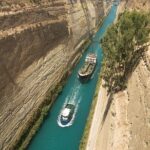
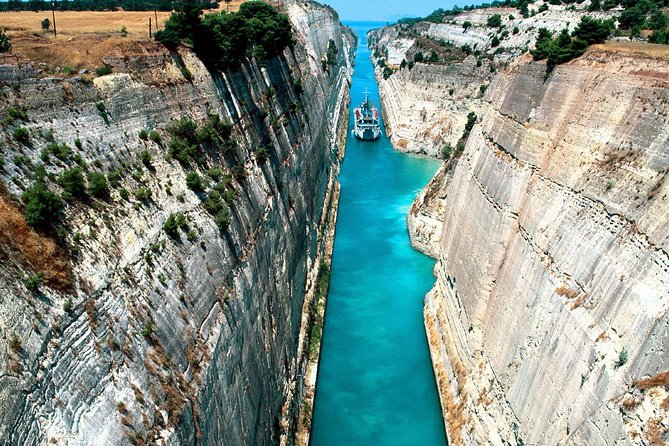
The first stop is the Corinth Canal, reached after a drive west from Athens along the coast. You get about 15 minutes here, which is enough for photographs and a quick look down into the narrow cut.
The canal is impressive because of its sharp geometry. It slices through the Isthmus of Corinth, the thin bridge of land linking mainland Greece with the Peloponnese. The steep walls and water far below make this a quick but memorable opening stop.
Do not expect a long visit or a guided presentation here. The attraction is mainly the view, and the tour treats it that way. Keep your camera ready, since the stop is brief.
Ancient Corinth and the world of St. Paul
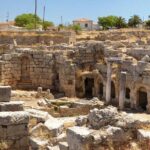
Ancient Corinth gives you the first substantial ruins of the day. The site was one of the most important Greek city-states, helped by its position on the isthmus between Athens and the Peloponnese. In 400 BC, it had a population estimated at about 90,000, a striking figure for the ancient world.
The Roman story adds another layer. Rome destroyed Corinth in 146 BC, then rebuilt the city in 44 BC. The later Roman settlement became the provincial capital of Greece. You are not looking at one single period here, but at a place reshaped by Greek power, Roman rule, and Christian history.
For many people, the strongest connection is St. Paul. Corinth appears in Acts of the Apostles and in the New Testament letters known as First and Second Corinthians. If that link matters to you, ask your driver to set the scene before you enter.
You have about an hour at Ancient Corinth. The admission fee is not included, so budget €15 per person. The driver may explain the wider story during the journey, but the provider clearly states that drivers are not licensed to accompany you as official guides inside the sites.
That distinction matters. You get transportation and local commentary, not a formal archaeological tour. If you want detailed explanations at each monument, request a certified guide in advance, at an extra cost and subject to availability.
Mycenae, Agamemnon, and Cyclopean walls

Mycenae is the emotional center of the route for many history-minded visitors. This hilltop citadel was a major center of the later Bronze Age, around 1350 BC, and is linked in Greek myth with Agamemnon, the king who led the Greek forces at Troy.
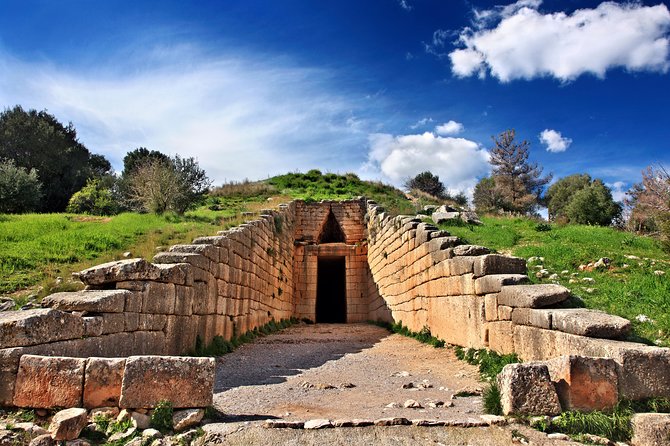
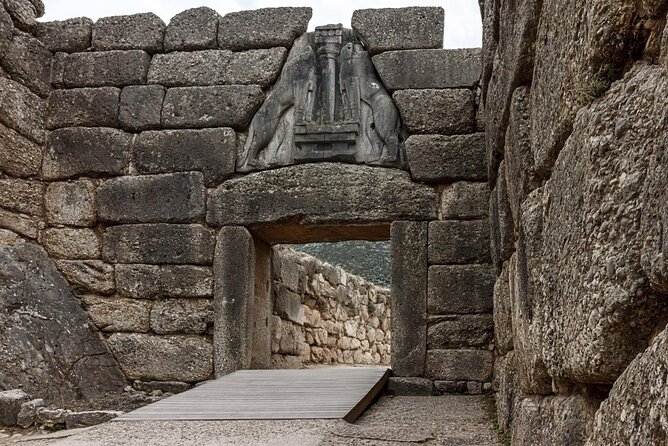
You enter through the Lion’s Gate, the massive gateway decorated with two lions above the doorway. The enormous stone blocks are known as Cyclopean masonry because later Greeks thought only the Cyclopes could have moved them. Even if you set the legends aside, the construction is startling.
The route also includes the royal tombs associated with Agamemnon and Clytemnestra, along with the Treasury of Atreus. You may hear about the famous gold mask called the Mask of Agamemnon, though the actual mask is associated with the archaeological collection rather than sitting on the hilltop for you to inspect.
The site visit lasts about an hour and includes uphill walking. Mycenae is not a flat museum-style attraction. You cross rough ground, climb around ancient remains, and walk in exposed conditions. I would wear solid shoes and bring water, even though bottled water is supplied.
The admission fee is listed at €20 per person. The site is best for you if you enjoy standing among ruins and using your imagination to reconstruct a vanished palace center. If you prefer intact buildings, the scattered remains may feel less rewarding. One honest criticism applies to the whole day: after several ancient sites, the stones can begin to blur together if you are not interested in archaeology or Greek myth.
Nafplion, Palamidi, and a proper Greek lunch

Nafplion gives the day a welcome change of rhythm. This seaside town served as the capital of the First Hellenic Republic and the Kingdom of Greece from the beginning of the Greek Revolution in 1821 until 1834.
The old town is made for a slower walk. You pass narrow lanes, neoclassical houses, Turkish fountains, small squares, and balconies decorated with bougainvillea. The town’s architecture reflects Venetian, Byzantine, Ottoman, and modern Greek influences, so it feels different from the stark archaeological sites earlier in the day.
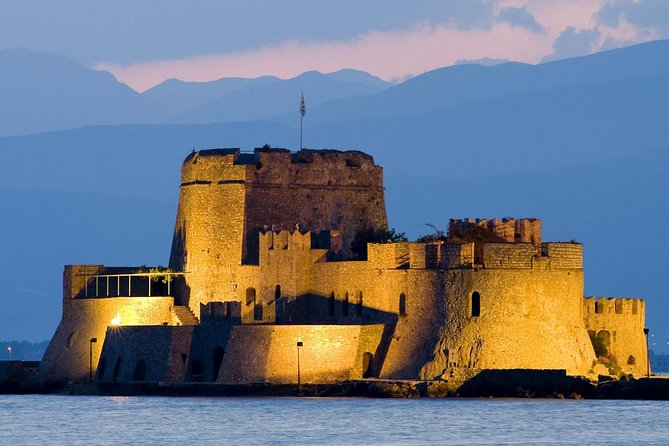
From Nafplion, you can see the hilltop Palamidi Castle and the sea fortress of Bourtzi. Acronauplia adds another layer of fortifications above the old town. The schedule gives 30 minutes at Palamidi Castle and two hours for Nafplion, including lunch, coffee, or homemade ice cream.
The Palamidi stop needs careful interpretation. The castle is famous for a staircase often called the 999 steps, though the tour notes that the actual count is 857. You may take the steps if conditions suit you, but with only 30 minutes allocated, you should not assume you can fully explore the fortress at a leisurely pace.
If you have knee, heart, or mobility concerns, treat Palamidi as an optional challenge rather than a required climb. The ancient sites also involve walking, and one past guest specifically found the whole outing difficult for anyone with mobility issues. The vehicle can make the route easier, but it cannot remove the stairs and uneven ground.
Lunch is one of the strongest practical features. You visit a cozy taverna and choose from local dishes, with mezedes, one main course per person, salad, drinks, and wine included. The wording leaves the exact menu open, which is useful if you like choice but less useful if you need a specific dietary arrangement.
I like this pause because it gives you time to talk about Greek food and customs rather than simply eating near a bus stop. The included meal also keeps the day from becoming a string of entrance tickets and hurried snacks. Coffee, tea, and ice cream are not included, so bring a little extra if you want to linger afterward.
A few more Athens tours and experiences worth a look





Epidaurus and the famous acoustic test

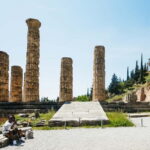
The final major stop is the Ancient Theatre of Epidaurus, part of the sanctuary dedicated to Asclepius, the ancient Greek god of medicine. The sanctuary was one of the major healing centers of the ancient world and competed in importance with sites dedicated to Zeus at Olympia and Apollo at Delphi.
The theatre is celebrated for both its design and acoustics. Its tripartite structure includes the theatron, orchestra, and skene, the basic elements of a Hellenistic theatre. Unlike many Greek theatres, it was not substantially altered during Roman times.
You get about an hour at Epidaurus, including the theatre and the Temple of Asclepius. The familiar acoustic demonstration may be possible depending on the conditions and site rules, but the important point is the theatre’s design. Its symmetry, seating, and position against the mountain help explain why quiet sounds can carry across the space.
The admission fee is listed at €20 per person. Like Mycenae and Ancient Corinth, this is a site where your driver can provide background on the journey but is not a licensed guide inside the monument.
Epidaurus is a fine final stop because it is visually clear. At Mycenae, you interpret foundations and walls. At Epidaurus, the theatre’s shape is immediately readable. You can see how the seats curve around the orchestra and understand why ancient performance was tied to religion, healing, and public life.
The driver makes or breaks the day

A private tour depends heavily on the person behind the wheel. The provider names drivers including George, Sokrates, and Yiannis in connection with this experience. George is noted for adapting the route to personal wishes and taking guests to places that became memorable parts of the day. Sokrates is praised for careful explanations and a safe, comfortable ride. Yiannis is singled out for making a disappointing replacement trip enjoyable after a canceled island cruise.
These details point to the real strength of the experience: the human service between the monuments. A good driver can explain the countryside, keep the schedule practical, and help you decide how much time to spend at each stop.
Still, keep the driver’s role clear. This is not automatically a private guided archaeology tour. The professional driver has local knowledge but is not licensed to guide inside the sites. You can request a certified guide for an extra fee, depending on availability.
I would decide before booking how much explanation you need. If you enjoy reading signs, asking questions in the car, and exploring independently, the standard arrangement may suit you. If Mycenae or Epidaurus is a major reason for your trip, paying for an official guide could make the entrance fees more worthwhile.
Timing, comfort, and practical effort
The tour is private, so only your group participates. That gives you more control than a large coach trip. You can ask for more time at Nafplion, shorten a stop that does not interest you, or discuss the order of the day with the driver, although the total route still requires a long day.
Pickup is offered from Athens hotels and Airbnb properties. Airport or airport-area pickup and drop-off cost extra. The vehicle is air-conditioned, private, and described as an executive car or minivan. Bottled water is included.
The route is not suitable for anyone expecting a gentle, mostly seated excursion. Mycenae includes an uphill walk. Palamidi may involve hundreds of steps. Ancient Corinth and Epidaurus also require walking over open archaeological ground. Most people can take part, but I would not choose this outing if you have serious mobility limits.
Weather matters, too. The experience requires good weather and can be moved or refunded if poor conditions force cancellation. The free cancellation window is 24 hours before the start time. Changes made inside that period are not accepted, so check the forecast before the deadline.
Who should book this Peloponnese route
I would recommend this day for first-time visitors to Athens who want to see more of mainland Greece without arranging several separate trips. It is especially suited to couples, families, and small groups who value a private vehicle and can share the cost.
It also fits you if St. Paul’s Corinth, Homeric myth, Bronze Age archaeology, Greek theatre, or the Revolution-era town of Nafplion all appeal. The route offers a broad sample of Greek history, from ancient Greek city-states and Roman Corinth to Christian tradition and modern Greek independence.
I would hesitate if you prefer a slow holiday. Five major stops sound exciting, but the schedule is full. You will spend much of the day moving between sites, and the archaeological visits are short enough that serious history fans may want more time.
The rating is 4.8 from 10 reviews, with 90 percent recommending the experience. That is encouraging but a small sample, so I would focus less on the number and more on the recurring strengths: kind drivers, safe transport, adaptable timing, and generous food. The one clear caution is the physical effort and the possibility that several ruin sites may feel repetitive.
FAQ
How long does the tour last?
The tour lasts approximately nine to eleven hours, depending on the day and the time spent at the various stops.
Does the tour pick me up at my Athens hotel?
Yes. Pickup is offered from Athens hotels and Airbnb properties. Airport and airport-area pickup or drop-off requires an extra charge.
Is this a private tour?
Yes. Only your group participates, and transportation is provided by private executive car or minivan.
Is lunch included?
Yes. Lunch includes Greek mezedes, one main course per person, an appetizer, salad, drinks, and wine at a local taverna.
Are entrance fees included?
No. The listed fees are €15 per person for Ancient Corinth, €20 for Mycenae, and €20 for the Ancient Theatre of Epidaurus.
Is a licensed guide included?
No. The professional driver provides local knowledge but is not licensed to guide inside the archaeological sites. A certified guide may be requested for an additional cost, depending on availability.
What sites does the route visit?
The route includes the Corinth Canal, Ancient Corinth, the Archaeological Site of Mycenae, Palamidi Castle, Nafplion, and the Ancient Theatre of Epidaurus.
Is the tour suitable for people with mobility issues?
Most people can participate, but the tour includes uphill walking, uneven ancient sites, and the optional Palamidi staircase. It is not an easy outing for anyone with significant walking or mobility difficulties.
What is the cancellation policy?
You can cancel at least 24 hours before the start time for a full refund. Cancellations or changes made less than 24 hours before the start time are not accepted. If poor weather causes cancellation, you will be offered another date or a full refund.
Should you book this tour?
Book it if you want a wide-ranging Peloponnese day with your own vehicle, an included Greek lunch, and a driver who can adjust the experience to your interests. The convenience is real, especially when you are staying in Athens and want Corinth, Mycenae, Nafplion, and Epidaurus in one outing.
Before paying, add the €55 in site admissions to the advertised price, decide if you need a certified guide, and be honest about your stamina. If you want depth at one archaeological site, choose a shorter specialist tour. If you want a substantial taste of the region with good food and no transport headaches, this private route is a sensible choice.
You Might Also Enjoy


More Lunch Experiences in Athens
- All Day Cruise -3 Islands to Agistri,Moni, Aegina with lunch and drinks included
★ 5.0 · 4,958 reviews