REVIEW · ATHENS
Athens Acropolis and Parthenon Walking Tour
Book on Viator →Operated by Athens Walking Tours · Bookable on Viator
Acropolis gets real with a good guide. In about two hours, you’ll hike the UNESCO-listed hilltop with a licensed guide, while earsets keep the stories clear even when the crowd swells.
I love how this tour turns big stone into clear meaning: you stop at the major landmarks and get the why behind each one. I also like that you leave with an Athens map and a guide magazine, so you’re not just done after the climb.
One thing to plan for: this is a steep, uneven walk. You’ll want comfortable shoes and a moderate fitness level to enjoy it without rushing.
In This Review
- Key things that make this Acropolis walk worth your time
- Why a 2-hour Acropolis tour feels like the smart move
- Meeting at the yogurt bar and climbing in a small group
- The walking route: what each stop teaches you (and what you should watch for)
- Acropolis entry zone: first look at the big idea
- Theatre of Dionysus: the stage that shaped Western drama
- Temple of Asclepios (Asklepeion): a quiet break from the noise
- Odeon of Herodes Atticus: ancient stone still hosts modern performances
- Philopappos Hill: a viewpoint with a Roman connection
- Temple of Athena Nike: quick stop, big payoff views
- Propylaea: the marble gateway that sets expectations
- Erechtheion: caryatids and the Temple of Athena and Poseidon
- Parthenon: the main event, explained like you actually care
- Earsets, guide style, and the difference between hearing and not hearing
- Ticket options: how to judge the real value of the $41.12 price
- What to bring and how to stay comfortable on the hill
- Who this tour is best for (and who might feel annoyed)
- My honest booking advice: should you do this tour?
- FAQ
- How long is the Athens Acropolis and Parthenon walking tour?
- What is included in the price?
- Is Acropolis admission included?
- Does the tour include skip-the-line access?
- Where does the tour start and end?
- What kind of walking is involved?
- Are baby strollers allowed on the Acropolis?
- Are there toilets at the Acropolis site?
Key things that make this Acropolis walk worth your time
- Licensed guide + earsets: you hear the commentary without fighting the crowd.
- UNESCO Acropolis focus in ~2 hours: you hit the top sights fast and efficiently.
- Stop-by-stop landmarks: from the Theatre of Dionysus to the Parthenon.
- Optional admission upgrade: if selected, you get skip-the-line entry assistance.
- Small group size (max 24): easier pacing than the giant bus-tour crush.
- Photo-friendly pauses: you’ll get moments to look closely and take pictures.
Why a 2-hour Acropolis tour feels like the smart move
The Acropolis isn’t one attraction. It’s a whole layer-cake of temples, theaters, sanctuaries, and political power. If you go in on your own, you can easily spend your time bouncing between plaques and guesses.
This is different because you get a structured walk with expert context. Even if you only have a morning or afternoon, the guide helps you connect what you’re seeing to what it did in classical Athens. That’s the real value: you leave understanding the shapes, not just collecting photos.
And the earsets matter more than you’d think. The hill can feel like a noisy amphitheater of its own—people shuffling, guides calling, footsteps on stone. Having personal earsets lets you hear the explanation as you move from spot to spot. In the best moments, it feels like the Acropolis is talking directly to you.
You can also read our reviews of more walking tours in Athens



Meeting at the yogurt bar and climbing in a small group
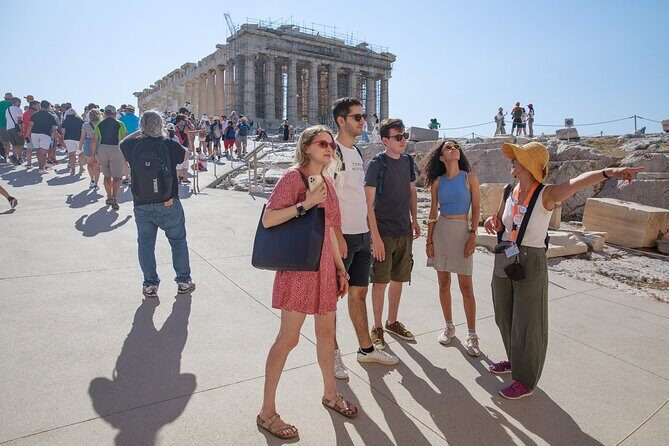
You meet your guide at a yogurt bar near the base of the Acropolis, at your chosen time. The meeting point is listed at LUKUMAΔΕΣ, Dionysiou Areopagitou 3, Athina 117 42, Greece, and the tour ends at AcropoliAthens 117 42, Greece.
From there, it’s uphill. The route is built to get you to the key viewpoints without making you wait around all morning. Expect a moderate amount of walking on uneven ground. Some of the stops are short, but the climb adds up.
This tour can run with a max group size of 24, which helps. You still feel the bustle, but you’re not swallowed by a crowd of 50+.
The walking route: what each stop teaches you (and what you should watch for)
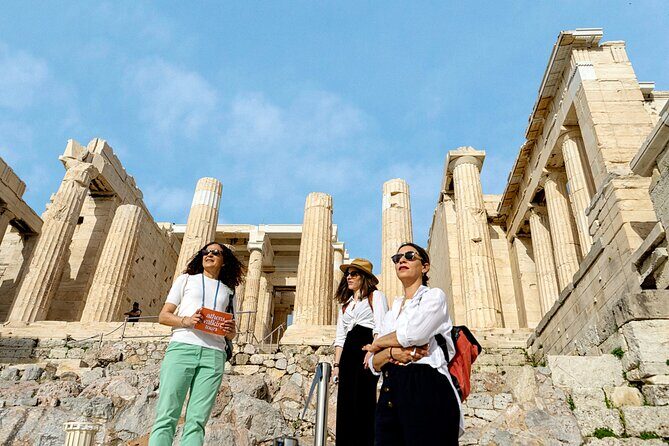
This itinerary is designed to build a story as you climb: theater and worship, civic culture and architecture, then the big finale at the Parthenon.
Acropolis entry zone: first look at the big idea
Your first major stop is the Acropolis itself. Plan for around 20 minutes here. This is where you get the overview—what the Acropolis was, why it mattered, and how later monuments fit into that bigger plan.
If you want to see more than the Parthenon alone, this is the right opening move. You’ll learn how the hill’s buildings worked as a set, not as separate tourist stops.
Theatre of Dionysus: the stage that shaped Western drama
Next you head to the Theatre of Dionysus for about 15 minutes. This is framed as the birthplace of theater, tied to the authors whose tragedies became foundational in Western literature.
What to watch for: your guide will point out how the theater fits into civic life. It wasn’t just entertainment. It was a cultural machine that helped define identity, values, and public debate.
- All Day Cruise -3 Islands to Agistri,Moni, Aegina with lunch and drinks included
★ 5.0 · 4,958 reviews




Temple of Asclepios (Asklepeion): a quiet break from the noise
Then you move to the Temple of Asclepios for about 10 minutes. The Asklepeion was a sanctuary dedicated to Asclepius, the god of medicine, and it’s described as a place where ancient Athenians sought healing and gave thanks for restored health.
This stop works because it changes the vibe. You go from performance and public spectacle to a calmer, more personal kind of spirituality. If you’re the type who likes a contrast moment—this is it.
Odeon of Herodes Atticus: ancient stone still hosts modern performances
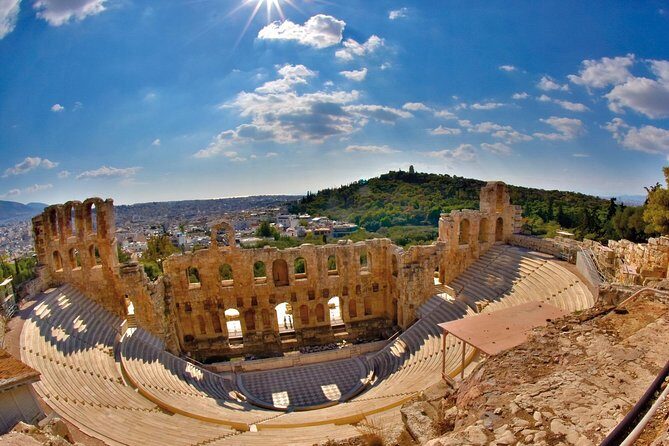
About 10 minutes goes to the Odeon of Herodes Atticus, built in 161 AD. It’s a stone theater that still hosts performances today.
Even if you never catch a show, the impact is real. The scale and shape help you understand why acoustics mattered so much. You start to see how Greeks designed spaces for voices and collective listening.
Philopappos Hill: a viewpoint with a Roman connection
You’ll also stop at Philopappos Hill, known as the Hill of the Muses, with time for the monument of Philopappos. This is one of the more scenic breaks in the walk, with city views below.
It’s also a reminder that the hill didn’t stop being important after the classical era. The layers continue—Greek, then Roman, then later centuries that left their marks.
Temple of Athena Nike: quick stop, big payoff views
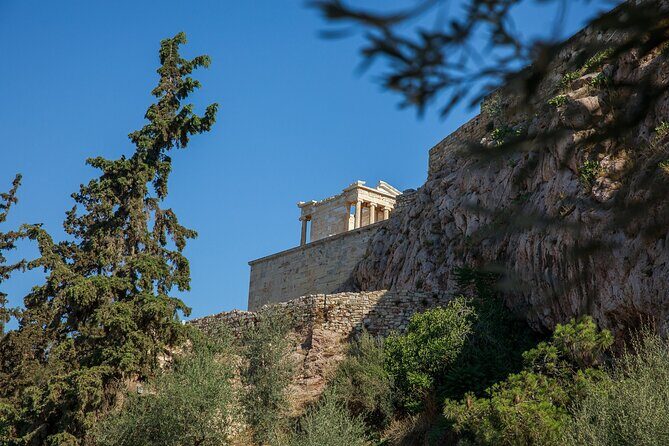
For about 5 minutes, you reach the Temple of Athena Nike on a bastion at the southwestern edge of the Acropolis. It’s dedicated to Athena as the goddess of victory.
The key value here is the viewpoint. Your guide points out why this location mattered—both spiritually and politically—and the panorama helps you place the Acropolis in the city’s layout.
Propylaea: the marble gateway that sets expectations
Next comes the Propylaea, around 5 minutes, the grand marble gateway designed by Mnesikles. This is a classic “pause for the frame” moment.
Look at the gate like you’re approaching it as a guest of ancient Athens. The architecture is meant to create anticipation and ceremony before you enter the most famous spaces.
Erechtheion: caryatids and the Temple of Athena and Poseidon
You’ll spend about 15 minutes at the Erechtheion, known for architectural beauty and its dedication to both Athena and Poseidon. The star attraction is the Caryatid Porch, with six female columns supporting the structure.
The best way to experience this stop is slowly. Your guide will explain why the design is so distinctive and why the figures matter, not just that they look impressive. If you’ve only seen “tall people holding roofs” in photos, this is where it becomes real.
Parthenon: the main event, explained like you actually care
Finally, you reach the Parthenon for about 25 minutes. This is the iconic temple dedicated to Athena Parthenos and the high point of the hill.
Here’s what good guiding changes: the Parthenon stops being just a famous building and becomes a statement. You’ll learn how it connects to classical Athens—power, identity, artistry, and religion—then you’ll look at the structure with a sharper eye.
If you’re worried you’ll feel rushed at the end, don’t. That longer final block is your reward for climbing.
Earsets, guide style, and the difference between hearing and not hearing
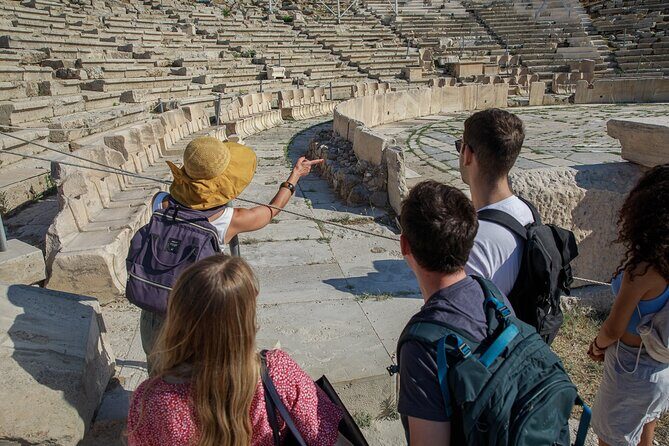
One of the most praised parts of this tour is the audio setup. The system uses earsets for clear commentary, and many people like that everyone can hear without being pressed shoulder-to-shoulder with the guide.
Still, plan for reality. Wind and technical glitches can happen on an outdoor archaeological site. If sound quality is crucial to your experience, arrive on time, keep your headset snug, and give the guide your attention as you move between stops.
On the guiding side, there’s a consistent pattern in what people enjoy: guides who tell myths clearly, answer questions without brushing you off, and keep a pace that doesn’t turn the walk into a sprint. Names that have come up include Elena (storytelling mythology to life), Andrea (passion for Athens’ past), Alexia (attentive guidance and help finding shade), Dora (history clarity), Victor (helpful context), Phillipa (fast answers plus humor), Hermes (excellent explanations), and Annie (highlighting key sites and artifacts). The point: you’re not stuck with a monotone script.
Ticket options: how to judge the real value of the $41.12 price

The base price is listed as $41.12 per person for an about 2-hour tour. Admission is not automatically included unless you choose the tour option that includes tickets.
Here’s the practical way to think about value:
- If you pick the option without entrance tickets, you’re paying mainly for the guide, earsets, and the structured route. You’ll still need a valid Acropolis entry ticket.
- If you pick the option with an admission ticket, the tour claims skip-the-line ticket office help for the Acropolis of Athens and the museum.
In other words, the guide portion is the constant. The admission choice is what changes the total spend.
Also pay attention to the fact that entrance times are strict. Airport-style security applies, and peak season waits can be 30+ minutes. So the ticket path you choose can matter more than it does for a typical museum.
If you’re on a tight schedule, the guided route is already a win. If you’re also trying to reduce waiting and uncertainty, the ticket upgrade can make the day feel smoother.
What to bring and how to stay comfortable on the hill
This is an outdoor climb, and the tour specifically recommends practical basics: wear comfortable shoes and clothes, bring sunscreen and a hat, and carry water.
A few site rules also affect your comfort:
- Baby strollers are not allowed on the Acropolis archaeological site.
- There is no cloakroom at the side entrance used to enter, so don’t plan to leave things behind.
- If you’re eligible for reduced admission, you’ll need a valid ID or passport for age and nationality checks.
Also remember: strict entry times mean the guide can’t wait for latecomers. You don’t want a small delay turning into a missed entry moment.
Who this tour is best for (and who might feel annoyed)

This tour is ideal if you want the highlights with guidance and you’re short on time. It’s also a good fit if you’re the kind of person who likes to understand what you’re looking at—not just admire it silently.
You’ll likely enjoy it most if:
- You’re traveling with people who don’t want to play archaeologist alone.
- You want the Acropolis landmarks explained in a tight, efficient sequence.
- You like hearing myths and history in context as you move through real spaces.
Where it might be less ideal:
- If you have trouble with steep walking or uneven ground, the hill will feel like work.
- If you’re hoping for long stays at just one monument, the time at each stop is limited by the structure of the walk.
My honest booking advice: should you do this tour?
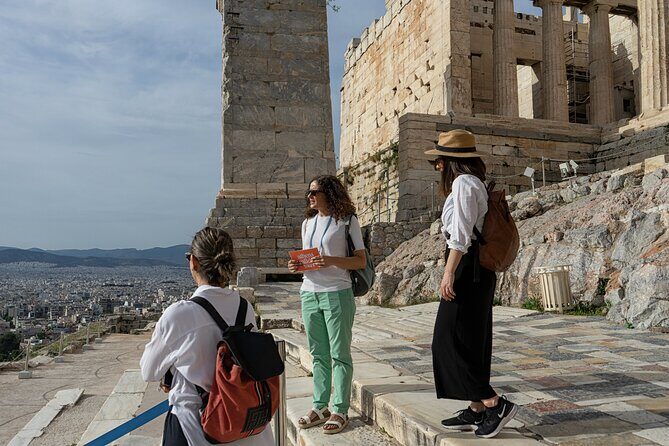
I’d book this tour if you want a fast, guided path through the Acropolis highlights with earsets and a clear storyline. For most people, the combination of a licensed guide, short stop times that cover the main monuments, and the practical handoff (map plus guide magazine) makes it feel like good value.
Skip it only if you already know exactly what you want to study and you’re comfortable building your own route without a guide. Also consider alternative plans if you don’t handle hills well—because this isn’t a flat stroll, even though the total duration is about two hours.
If you want the most stress-free Acropolis day, aim to be early, wear sturdy shoes, and choose the ticket option that matches your schedule so you’re not scrambling.
FAQ
How long is the Athens Acropolis and Parthenon walking tour?
It’s about 2 hours (approx.).
What is included in the price?
You get a local professional licensed guide, Athens guide magazine, an Athens map, and earsets for better hearing.
Is Acropolis admission included?
Admission is not included unless you select the tour option that includes an admission ticket. If you don’t select tickets, you’ll need a valid Acropolis entrance ticket.
Does the tour include skip-the-line access?
If you choose the option with an admission ticket, it includes skip-the-line at the ticket offices for the Acropolis of Athens & Museum.
Where does the tour start and end?
The start is at LUKUMAΔΕΣ, Dionysiou Areopagitou 3, Athina 117 42, Greece. The tour ends at AcropoliAthens 117 42, Greece.
What kind of walking is involved?
It involves uphill walking and uneven surfaces, and it’s recommended for travelers with moderate physical fitness.
Are baby strollers allowed on the Acropolis?
No. Baby strollers are not allowed on the Acropolis archaeological site.
Are there toilets at the Acropolis site?
There are no toilets once you are on the Acropolis archaeological site.