REVIEW · ATHENS
Athens Highlights Walking Tour beyond Acropolis
Book on Viator →Operated by Athens Walks Tour Company · Bookable on Viator
Athens reveals itself best when you leave the Acropolis hill and follow its streets downhill into Plaka and Anafiotika, where tiny shops, old homes, cafes, and ancient stones share the same few blocks. This three-hour walk links those local corners with major sights such as the Roman Agora, Syntagma Square, the Panathenaic Stadium, and Hadrian’s Arch.
I like the smart route, which gives you both everyday Athens and big historical landmarks without spending the whole morning at one archaeological site. I also like the hearing devices and small maximum of 20 people, especially when a guide such as Dimos is leading with strong local feeling and clear storytelling. The main drawback is that this is a fairly active walk, and it does not include Acropolis entry, hotel pickup, or drop-off.
In This Review
- Key points to know before booking
- Why this Athens walk works beyond the Acropolis
- Plaka and Anafiotika: Athens with a village feel
- Syntagma Square and the Tomb of the Unknown Soldier
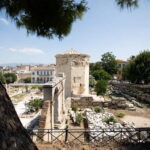
- The Roman Agora and the Tower of the Winds
- Athens Metropolitan Cathedral and the city’s Orthodox center
- The Panathenaic Stadium and its marble setting
- Hadrian’s Arch: a fitting finish near the ancient city
- The price, group size, and walking effort
- Who should book this walking tour
- Should you book the Athens Highlights Walking Tour?
- FAQ
- How long does the Athens Highlights Walking Tour last?
- What time does the tour start?
- Where does the tour begin?
- Where does the tour end?
- Is Acropolis admission included?
- Is a guide included?
- Are hearing devices provided?
- What is the maximum group size?
- Is hotel pickup or drop-off included?
- Can I cancel for a full refund?
- What happens if bad weather cancels the tour?
Key points to know before booking

- A three-hour route beyond the Acropolis: You see central Athens from Plaka to Hadrian’s Arch rather than focusing on the Acropolis itself.
- Anafiotika adds a Greek-island feel: Whitewashed homes and narrow lanes create one of the city’s most unexpected scenes.
- The Roman Agora is a major history stop: Look for the Gate of Athena Archegetis, the Tower of the Winds, and an Ottoman mosque.
- Dimos is a guide to request if possible: His name is singled out for passionate, memorable guiding.
- The group is capped at 20 people: That keeps the walk more manageable than a large street tour.
- The Panathenaic Stadium is seen from outside: The tour gives you the landmark and its story, but the supplied details do not include stadium admission.
Why this Athens walk works beyond the Acropolis
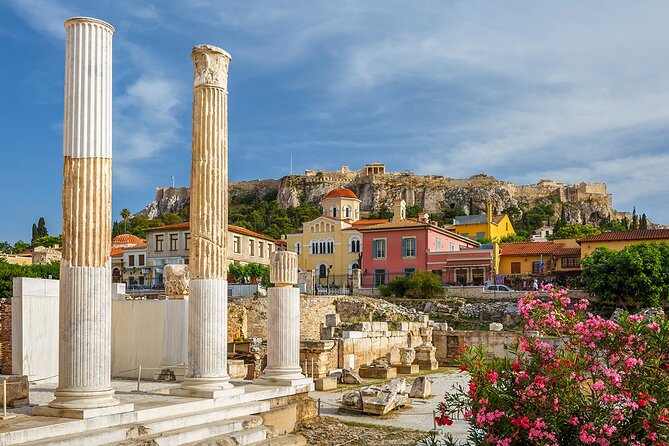
Many first visits to Athens revolve around the Acropolis, and rightly so. But the city center below it offers a more varied picture. Here, classical ruins sit beside Orthodox churches, royal buildings, marble stadiums, souvenir shops, and ordinary city streets.
This tour is designed around that mix. You begin at Porinou 5 at 9:00 a.m., close to the Acropolis area, then move through Plaka, Syntagma, the Roman Agora, and several central landmarks. The route ends at Hadrian’s Arch, giving you a useful finish near another major ancient monument.
I like the way the walk connects places that can feel unrelated when you visit them alone. The Tomb of the Unknown Soldier is not simply another photo stop. Syntagma Square helps explain modern Greek government. The Panathenaic Stadium links ancient athletic traditions with the modern Olympic era. Hadrian’s Arch marks a change in the city under Roman rule.
The guide is licensed, and hearing devices are included. That matters in Athens, where traffic, street noise, and hard stone walls can make it difficult to follow a normal speaking voice. The maximum group size is 20, so you should have a better chance of hearing and staying close to the guide.
You can also read our reviews of more walking tours in Athens



Plaka and Anafiotika: Athens with a village feel
The tour spends about 45 minutes in Plaka, the longest stop of the morning. That makes sense. Plaka is not one single monument. It is a district best understood by walking slowly through its narrow cobblestone streets.
You pass small shops selling jewelry, clothing, and local ceramics. Sidewalk cafes and family-run tavernas give the area a lived-in feel, even though it is one of Athens’ most visited neighborhoods. Cine Paris, known for classic films shown outdoors, adds another small piece of local character.
The best part for me is the shift into Anafiotika. Its whitewashed homes and compact lanes recall a Greek island, an unexpected sight beneath the Acropolis temples. The neighborhood is small, and the streets can be uneven or steep, so this is where sensible shoes matter most.
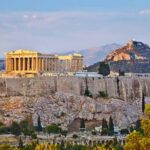
Plaka is also a useful orientation stop. You begin to see how closely Athens’ ancient and modern layers sit together. The Acropolis rises above the roofs, but the experience here is about the streets below it.
The trade-off is that Plaka can be busy and commercial. You should not expect a totally quiet village. Still, the tour’s guided route can help you notice details you might pass while shopping or searching for lunch on your own.
Syntagma Square and the Tomb of the Unknown Soldier

The walk continues to Syntagma Square, Athens’ central civic space. The square takes its name from the constitution granted by King Otto after the uprising of September 3, 1843. That single detail gives the place more meaning than its broad pavement and traffic might suggest.
In front of the Old Royal Palace, now home to the Greek Parliament, you see the Tomb of the Unknown Soldier. This cenotaph honors Greek soldiers killed in war. Sculptor Fokion Rok created the memorial between 1930 and 1932.
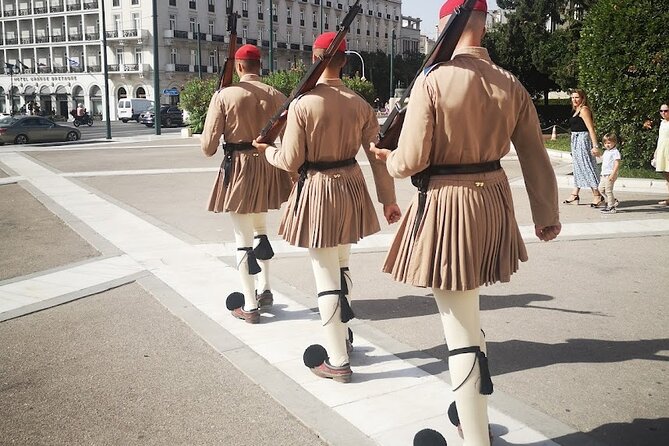
The tomb is guarded by the Evzones of the Presidential Guard. Their ceremonial presence is one of the most recognizable sights in central Athens, but the guide can give you the setting and national meaning rather than leaving you with a quick photograph.
The scheduled time here is short, about 15 minutes at the monument and another 15 minutes at Syntagma Square. That is enough for orientation and explanation, not an extended look at the square or Parliament. If you enjoy modern political history, you may wish to return later on your own.
The Roman Agora and the Tower of the Winds
The Roman Agora receives about 30 minutes, followed by 10 minutes focused on the Tower of the Winds. This is one of the strongest historical sections of the route.
Under Roman rule, this was Athens’ market area, and it once covered more ground than the present archaeological boundary suggests. Even from outside the fence, you can see parts of the site. Going closer gives you a better look at the Gate of Athena Archegetis, the entrance structure that once welcomed people into the market.
You also see an Ottoman mosque and the Tower of the Winds. The tower is an octagonal structure made of Pentelic marble, with eight large reliefs of wind gods around its upper section. Its unusual shape and carved figures make it one of the easiest ancient buildings in Athens to remember.
This stop rewards a guide who explains how the buildings were used. A market, an entrance gate, a weather-related tower, and an Ottoman religious building reflect different periods of Athens in one compact area. I especially like that the tour does not treat the Roman Agora as a quick pile of stones.
The details provided for the tour list the Agora and Tower stops without an admission charge. Since ticket arrangements can vary, you should confirm with the operator if entering the archaeological site is important to you. The description specifically says much can be seen from outside the fence.
Athens Metropolitan Cathedral and the city’s Orthodox center
The Metropolitan Cathedral of the Annunciation, usually called the Mitropoli, receives about 20 minutes. It is the cathedral church of the Archbishopric of Athens and all of Greece, so this stop gives the walk a religious and civic dimension.
I like the change of pace here. After streets, ruins, and public squares, the cathedral offers a look at the institution that remains central to Greek Orthodox life. The stop is listed with admission included, unlike most of the tour’s outdoor landmarks.
Twenty minutes is enough for a concise visit and explanation. It is not enough for a long study of every interior detail, so you should treat this as an introduction. The cathedral also sits in a part of central Athens where daily city life continues around important religious buildings.
One posted experience gives special credit to the combination of the Ancient Agora and the city cathedral. That pairing is a good reason to choose this walk over a tour that only strings together famous outdoor photo stops.






The Panathenaic Stadium and its marble setting
The Panathenaic Stadium receives about 30 minutes, making it one of the longer stops. Known as the Kallimarmaro, it is built entirely of marble and is described as the only stadium in the world made wholly from that material.
This is a striking place to see even before you know the story. The pale marble seating rises in a long sweep, and the stadium’s shape is easy to understand from the outside. The tour gives you time to take in its scale and historical role.
The supplied details list the admission as free for this stop, but they do not state that the walking tour includes entry inside the stadium. I would ask before booking if you specifically want to walk into the arena or explore its interior areas.
The stadium is also a useful reminder that Athens is not only about ancient temples. Athletic competition, public ceremony, national identity, and modern international sport all meet here. Your guide can help connect those ideas without requiring a separate stadium tour.
Hadrian’s Arch: a fitting finish near the ancient city
The walk ends at Hadrian’s Arch, also called Hadrian’s Gate, on Leoforos Vasilisis Amalias. The stop lasts about 10 minutes, and the end point is outside the monument.
The arch once spanned an ancient road leading from central Athens toward the eastern part of the city, including the Temple of Olympian Zeus. Its form resembles a Roman triumphal arch, but its role was also to mark a transition between parts of Athens.
This is a good final stop because it leaves you near one of the city’s best-known ancient landmarks without requiring the tour to circle back to its starting point. You can continue exploring from here, though no onward transport is included.
A short stop is enough to understand the arch and take photographs. If you want a full visit to the Temple of Olympian Zeus, that is separate from this experience.
The price, group size, and walking effort

At $46.30 per person, this is not the cheapest way to stroll around Athens, since many of the sights can be viewed from public streets. The value comes from the licensed guide, organized route, historical context, hearing devices, and the chance to fit eight distinct stops into three hours.
I think the price makes the most sense early in your Athens stay. A guide can help you understand the city’s layout, show you where Plaka and Syntagma fit together, and give you a useful base for later independent exploring.
The group maximum is 20 people. That is still large enough that you may not have much one-on-one time, but it is more practical than a large coach-style walking group. The two especially praised parts of the guiding are the clear enthusiasm for Athens and the ability to bring out less obvious parts of the city. If Dimos is available, you may request him, but the tour does not promise a particular guide.
The route lasts approximately three hours and requires moderate physical fitness. You should expect sustained walking through city streets, cobblestones, and some hillside areas in Plaka and Anafiotika. Hotel pickup and drop-off are not included, so plan your way to Porinou 5 and from the Hadrian’s Arch end point.
Who should book this walking tour
I would recommend it to a first-time visitor who wants more than the Acropolis but does not want a full-day history program. It suits you if you enjoy moving between neighborhoods, public monuments, and ancient sites while someone explains how they fit together.
It is also a good choice for travelers who prefer a small organized group rather than exploring every stop alone. The hearing devices are useful for anyone who worries about missing commentary in a noisy city.
You may want something else if your priority is entering every archaeological site, spending long periods inside museums, or moving at a slow pace. The tour is a survey of central Athens, not a private deep examination of each monument. The short visits at Syntagma, the cathedral, and Hadrian’s Arch keep the schedule moving.
The start time is 9:00 a.m., which helps you cover the route before the day becomes hotter and busier. The experience requires good weather, and a minimum number of participants is required. If poor weather or low enrollment cancels the walk, you are offered another date or a full refund.
Free cancellation is available up to 24 hours before the start time. After that point, the amount paid is not refunded, and late changes are not accepted.
Should you book the Athens Highlights Walking Tour?
Book it if you want a compact, well-planned introduction to the Athens city center beyond the Acropolis. Plaka, Anafiotika, the Roman Agora, and the Panathenaic Stadium give the walk a good mix of local atmosphere and major landmarks.
The strongest reason to choose it is the guide. A good guide can turn Syntagma Square, the cathedral, and the Roman Agora into connected chapters rather than isolated stops. Dimos is specifically praised for making Athens memorable, though you should not assume he will lead every departure.
Skip it if you want extensive interior visits or complete freedom to linger. For everyone else, the $46.30 cost is reasonable for a three-hour, guide-led introduction, especially near the beginning of a stay.
FAQ
How long does the Athens Highlights Walking Tour last?
The tour lasts approximately three hours.
What time does the tour start?
The stated start time is 9:00 a.m.
Where does the tour begin?
The meeting and ticket redemption point is Porinou 5, Athina 117 42, Greece.
Where does the tour end?
The walk ends at Hadrian’s Arch, Leof. Vasilisis Amalias 50, Athina 105 58, Greece.
Is Acropolis admission included?
No Acropolis admission is listed. The tour focuses on central Athens beyond the Acropolis crowds.
Is a guide included?
Yes. A licensed tour guide is included.
Are hearing devices provided?
Yes. Hearing devices are included so you can listen to the guide during the walk.
What is the maximum group size?
The tour has a maximum of 20 travelers.
Is hotel pickup or drop-off included?
No. Pickup and drop-off services are not included.
Can I cancel for a full refund?
Yes, if you cancel at least 24 hours before the experience start time. Cancellations made less than 24 hours in advance are not refunded.
What happens if bad weather cancels the tour?
You will be offered a different date or a full refund if poor weather causes cancellation.