REVIEW · SANTORINI
Cooking Class with Private Chef – prepare & enjoy local menu
Book on Viator →Operated by To Spitiko Mas · Bookable on Viator
The best part of this Santorini cooking class is its setting: you prepare a local meal inside a traditional cave house, using recipes tied to the chef’s grandmother, then eat what you made with Assyrtiko wine poured throughout. It feels more personal than a standard restaurant meal and gives you a taste of how Santorini’s humble ingredients become island classics.
I like the family recipe stories and the full menu, which moves from salad and fava to tomato fritters, garlic pasta, and halva. I also like that the class includes the food, equipment, lunch, and wine, so the $130.18 price covers more than a demonstration. The main drawback is the small kitchen: you may do more stirring and chopping than actual cooking, and the menu contains no meat or other substantial protein.
In This Review
- Key points to know before booking
- Cooking in a Santorini cave house
- The menu begins with Santorini’s strongest ingredients
- Tomato fritters turn island produce into comfort food
- Garlic pasta keeps the main course simple
- Halva finishes the meal with island sweetness
- Assyrtiko wine keeps the meal moving
- The meal matters as much as the cooking
- What the $130.18 price covers
- Practical details for planning your visit
- Who should book this Santorini cooking class
- Should you book it?
- FAQ
- How long does the cooking class last?
- What time does the experience start?
- Where does the class meet?
- Does the activity include transportation?
- What food and drinks are included?
- Is the menu vegetarian?
Key points to know before booking
- Grandmother’s recipes: The chef shares the background of traditional Santorini dishes rather than simply handing you a recipe sheet.
- A full vegetarian menu: Expect salad, fava spread, tomato fritters, garlic pasta, and halva, with no meat or separate protein course.
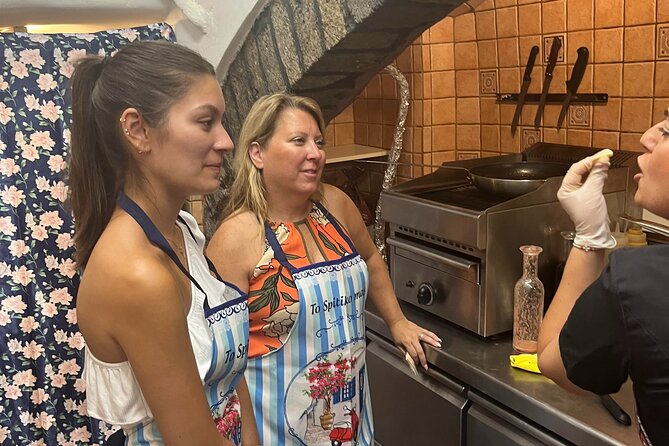
- Small traditional kitchen: The old home adds character, but limited space means hands-on cooking may be modest.
- Wine is part of the class: Local Santorini Assyrtiko is served while you prepare the food and during lunch.
- Megalochori meeting point: You meet at To Spitiko Mas at 11:00 a.m. and finish back there.
- Three hours and up to 15 people: The length allows time to cook, hear the food stories, and sit down for the finished meal.
Cooking in a Santorini cave house
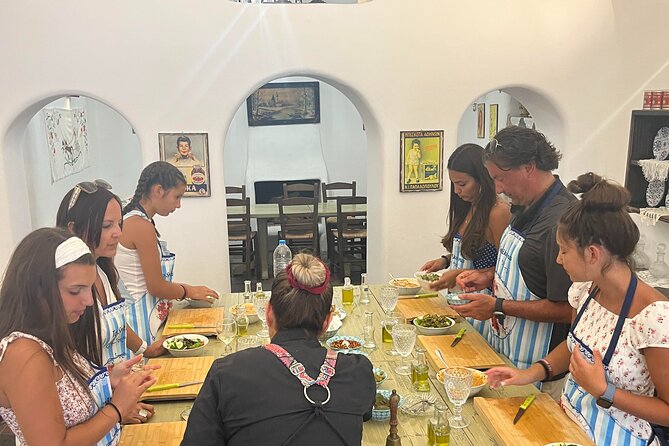
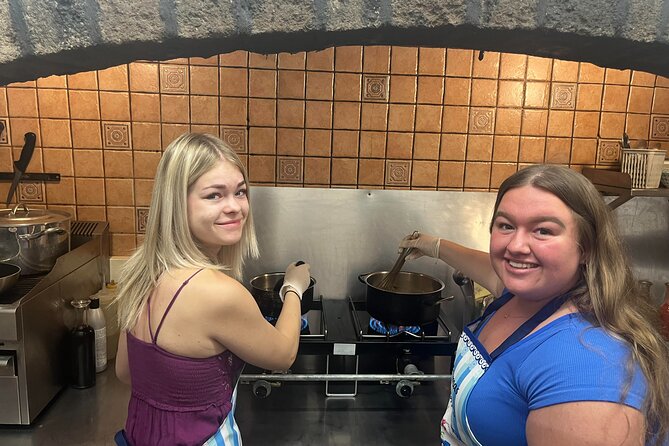
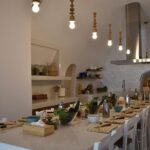
This experience begins at 11:00 a.m. at To Spitiko Mas in Megalochori, one of Santorini’s traditional villages. The exact appeal is not a polished cooking school with rows of workstations. It is an old home, a compact kitchen, and a meal prepared in a setting that feels connected to local domestic life.
That distinction matters. A modern teaching kitchen would give you more counter space and perhaps more individual tasks. Here, the house itself is part of the experience. You might cook in close quarters, pass ingredients around, and pay attention to the chef’s instructions rather than working through every step alone.
The class is offered in English, and the maximum group size is 15 people. That is not a private lesson in the strict sense, despite the private-chef wording. A group of 15 can still work well, but the smaller the group on your date, the more likely you are to receive a direct task or ask detailed questions.
The setting may be the cave house or the area beneath a large bougainvillea tree. Both are useful reminders that Santorini food is not separate from the island’s buildings, gardens, and climate. You are eating in a place designed for shade, coolness, and simple daily living, not in a staged dining room.
You can also read our reviews of more private tours in Santorini


The menu begins with Santorini’s strongest ingredients
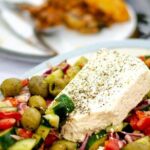
The first dishes are a good introduction to the island’s cooking because they depend on a short list of local ingredients. The Santorini salad combines tomatoes, cucumber, green bell pepper, onion, olives, capers, and feta cheese.
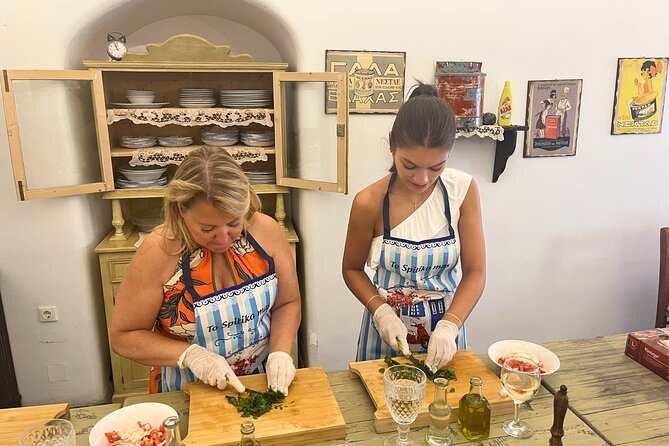
This is not simply a Greek salad with a different label. Santorini’s dry conditions give its tomatoes a particular importance, and the salad lets you notice how much flavor can come from ripe produce, salty capers, olives, and feta. You will help cut or slice vegetables, one of the practical tasks that makes up much of the hands-on work.
Next comes fava bean spread, one of Santorini’s best-known foods. Despite its name, this is not the green bean dish many visitors may expect. It is a smooth spread made from local yellow split peas, though the supplied menu identifies it simply as the island’s famous fava spread.
The dish is valuable in a class because it shows how local food can be filling without relying on meat. It also gives you a preparation method you can repeat at home. The final texture and seasoning matter as much as the ingredients, so listen closely when the chef explains how the dish is handled.
Tomato fritters turn island produce into comfort food
Tomato fritters are the menu’s most distinctive savory item. They use local tomatoes, flour, spices, and herbs, transforming fresh produce into a crisp, filling dish.
This is also one of the recipes most likely to make the class feel specifically Santorinian rather than simply Greek. The dish reflects a practical island habit: use what grows well, stretch it with basic pantry ingredients, and create something satisfying.
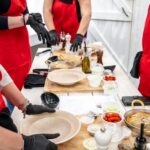
Your role may involve cutting ingredients, mixing, or stirring rather than frying every fritter yourself. The compact kitchen limits how many people can work at once. That is worth knowing in advance, especially if your main goal is to practice professional cooking techniques.
Still, watching a chef manage a traditional recipe has its own value. You can see how the mixture comes together, how the herbs affect the flavor, and how a recipe passed through a family differs from a measured cooking-school formula. If you enjoy food stories and shared preparation, this will likely be more rewarding than having a separate burner all to yourself.
Garlic pasta keeps the main course simple
The main dish is Santorini garlic pasta, made with pasta in a red sauce and plenty of garlic. It is a straightforward course, but its simplicity is part of the point. The menu does not try to turn lunch into a large restaurant spread. It shows how a few familiar ingredients can form a traditional local meal.
You should also read the menu carefully before booking. The meal is entirely vegetarian, apart from the pasta being the main course, and there is no meat, fish, or other named protein. The fava provides some substance, but this is not a class for someone hoping to learn a lamb, seafood, or chicken recipe.
For vegetarians, this focus is a clear benefit. For everyone else, it is a consideration rather than a flaw. Santorini’s food traditions include more than this menu, but the class chooses dishes that fit a home kitchen and a shared midday meal.
The garlic pasta also balances the sharper flavors of the salad, capers, and tomato fritters. Once everything reaches the table, the lunch should feel varied even though the ingredient list remains modest.
Halva finishes the meal with island sweetness
Dessert is halva made with semolina, Santorini dried grapes, syrup, and cinnamon. This gives you a final recipe that is different in texture and method from the savory dishes.
The dried grapes are an especially useful local detail. Santorini is better known internationally for wine, but dried grapes connect the dessert to the island’s agricultural traditions as well. Cinnamon and syrup add warmth and sweetness, while semolina gives the dish a firm, grainy texture.
You will be baking or preparing this dessert as part of the class, then eating it after lunch. It is a fitting finish because it is not a complicated pastry project requiring special equipment. The recipe uses ingredients you may be able to find outside Greece, though the local dried grapes add a distinctly Santorini touch.
You can also read our reviews of more cooking classes in Santorini

Assyrtiko wine keeps the meal moving
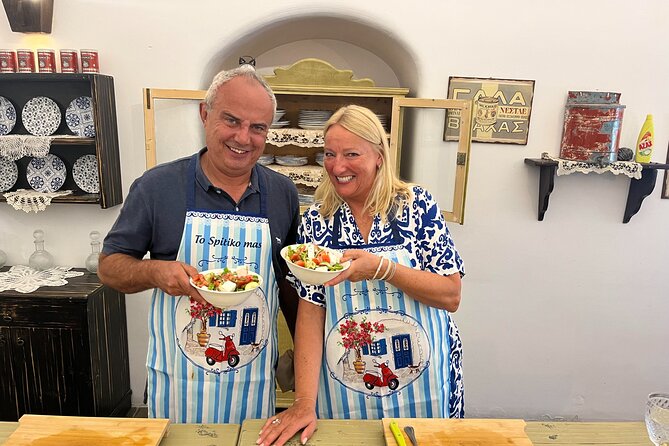
Local Assyrtiko wine is served throughout the preparation and again with lunch. This is an important part of the experience, not just a drink added to the booking.
Assyrtiko is Santorini’s signature white wine, and serving it during a food class helps you connect the dishes with the island’s winemaking culture. You are not simply sampling wine in a tasting room. You are drinking it alongside tomatoes, capers, feta, garlic, fava, and sweet halva.
The wine is included in the price, along with the food products and all equipment used in the class. If you do not drink alcohol, the supplied details do not specify a nonalcoholic alternative, so ask the provider before booking if that matters to you.
Because the class begins at 11:00 a.m., the timing suits a long lunch rather than an evening activity. You will want to plan the rest of your day with the roughly three-hour duration in mind. The activity ends back at the meeting point, so you are not left at a different part of the island.
The meal matters as much as the cooking
At the end, you eat the dishes prepared during the class. You may sit inside the traditional cave house or under the bougainvillea tree, depending on the arrangement for the day.
This shared meal is where the format pays off. A demonstration can teach you what a dish looks like, but eating it after helping prepare it gives you a better sense of balance, texture, and portion. You can compare the salad with the richer fritters, taste the garlic sauce with the pasta, and finish with halva and wine.
The old home also adds a useful sense of place. The cooking is not isolated from Santorini’s traditional architecture. You are working and eating in the same kind of domestic setting where recipes would naturally have been prepared.
The trade-off is comfort and workspace. An old house may have charm, but the kitchen is small. If you need a highly active class with each person cooking a full dish from start to finish, this may not meet your expectations. Think of it as a guided shared meal with cooking tasks, not a professional culinary workshop.
What the $130.18 price covers
At $130.18 per person, this is not a bargain meal. You are paying more than you would for a simple lunch in Santorini, and the kitchen limitations make the value depend on what you want from the experience.
I think the price makes more sense if you value the complete package: an English-language chef, a traditional setting, a full local menu, the ingredients, equipment, lunch, and Assyrtiko wine. You are also paying for the recipe background and the chance to connect the food with the chef’s grandmother.
The value is weaker if you mainly want a large meal or a hands-on lesson with extensive individual cooking time. Since the kitchen is compact, you may spend much of the class stirring, slicing, and watching the chef handle the more technical steps.
For a first visit to Santorini, the class can replace both a cultural activity and a midday meal. You are not only eating local dishes; you are learning how the menu fits together. That makes the price easier to justify for food-focused visitors, couples, and small groups who want a relaxed activity with a strong local angle.
Practical details for planning your visit
Private transportation is not included. You are responsible for reaching To Spitiko Mas, Megalochori 847 00, Greece, for the 11:00 a.m. start. The location is near public transportation, but the supplied details do not identify a specific bus route or pickup service, so check your route before the day of the class.
The activity uses a mobile ticket, and confirmation is normally received when you book. If you book within two days of the date, confirmation can take up to 48 hours and remains subject to availability.
The group can include as many as 15 people. That maximum is manageable for a social food activity, but it is not the same as a one-to-one lesson. If personal instruction is important to you, ask how many people are booked for your date.
You can cancel for a full refund if you do so at least 24 hours before the local start time. Cancellations or changes made less than 24 hours before the experience are not accepted for a refund.
Who should book this Santorini cooking class
I would recommend this class to you if you enjoy local food with a personal story, prefer a meal that includes wine, and like the idea of cooking in a traditional home rather than a purpose-built studio.
It is especially suitable for vegetarians, couples, families with an interest in food, and anyone who wants a slower midday activity in Megalochori. The three-hour length gives you time to cook, listen, eat, and enjoy the setting without making the day feel rushed.
I would hesitate if you want a meat-based menu, a formal wine tasting, or extensive time at the stove. I would also think twice if you dislike small kitchens or prefer a tightly structured lesson where every person prepares an individual dish.
The strongest feature is the combination of grandmother’s recipes, an old home, and a shared lunch. The weakest point is the mismatch between the promise of a cooking class and the limited amount of actual cooking each person may do. Go in expecting guided preparation, local stories, and a meal you help assemble, and the experience should make sense.
Should you book it?
Book this experience if you want to understand Santorini through its everyday food rather than only through views and famous sites. The tomato fritters, fava spread, dried grapes, and Assyrtiko wine give the class a clear island identity, while the cave house and bougainvillea setting add atmosphere without needing a long itinerary.
Skip it if you need meat, want a fully hands-on culinary course, or feel $130.18 is too much for a shared vegetarian lunch. For the right audience, the combination of food, family recipes, wine, and place makes this a thoughtful Santorini experience. Just arrive knowing that you will be part cook, part student, and part lunch companion.
FAQ
How long does the cooking class last?
The class lasts approximately three hours.
What time does the experience start?
The start time is 11:00 a.m.
Where does the class meet?
You meet at To Spitiko Mas, Megalochori 847 00, Greece.
Does the activity include transportation?
No. Private transportation is not included. The meeting point is near public transportation.
What food and drinks are included?
The class includes all cooking equipment, the ingredients and other products used, lunch made during the class, and local Santorini Assyrtiko wine.
Is the menu vegetarian?
Yes. The listed menu includes Santorini salad, fava bean spread, tomato fritters, Santorini garlic pasta, and halva. No meat or other separate protein course is listed.