REVIEW · ATHENS
Athens Sights & Acropolis Museum – Private Half Day Tour
Book on Viator →Operated by JG Athens Tours · Bookable on Viator
The best thing about this Athens tour is how much ground you cover without wasting time changing buses or finding taxis. In about six hours, you visit the Acropolis and Acropolis Museum, then sweep through the city’s major ancient and modern sights with a private English-speaking driver.
I like the hotel or Piraeus port pickup, and I like the chance to set your own pace. Drivers such as George have helped with entrance access, timing, water, chargers, and practical advice, while guides including Ellen have added history and humor. The main drawback is important: your driver cannot enter the archaeological sites or museum with you, and admission costs an additional €100 per person.
In This Review
- Key points to know before booking
- Why a private car helps in Athens
- The Acropolis in a focused 90 minutes
- The Acropolis Museum puts the stones in context
- Zeus, Hadrian, and the Panathenaic Stadium
- Syntagma Square and the changing of the guard
- Lycabettus Hill gives you the wide view
- The Ancient Agora and Athens’s older streets
- What the driver can and cannot do
- Timing, comfort, and who should book
- Is the $372.49 group price good value?
- Should you book this Athens tour?
- FAQ
- Is hotel pickup included?
- Can I be picked up at the Piraeus cruise terminal?
- Is airport pickup included?
- Are Acropolis and museum admission tickets included?
- Does the English-speaking driver enter the Acropolis or museum?
- How many people can join the private tour?
Key points to know before booking
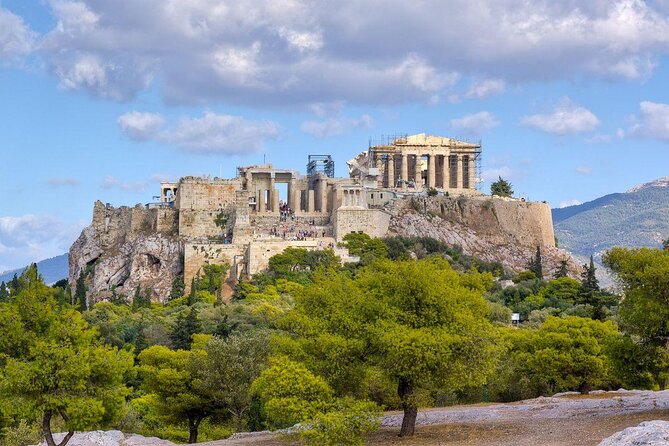
- The Acropolis gets the prime time: You have about 90 minutes for the Parthenon, Erechtheion, Propylaea, and Temple of Athena Nike.
- The driver stays outside paid sites: A licensed guide can accompany you inside, but that service costs extra.
- You see Athens from several angles: Ancient ruins, Olympic landmarks, government buildings, old neighborhoods, and Lycabettus Hill all fit into one route.
- Pickup is built in: Meet outside your Athens hotel or apartment, or at the Piraeus cruise terminal exit with a name sign.
- The private vehicle saves energy: This matters in Athens, where heat, traffic, hills, and scattered sights can consume a day.
- The €372.49 price is per group of up to three: Add the €100-per-person admission charge before comparing the total cost with other private tours.
Why a private car helps in Athens
Athens is compact on a map but not always easy to handle in a short visit. The Acropolis, museum, Olympic stadium, Syntagma Square, Ancient Agora, and Lycabettus Hill sit in different parts of the city. Walking between every stop would take time and energy, especially after climbing the Acropolis.
This tour gives you an air-conditioned vehicle, bottled water, onboard WiFi, fuel, and hotel or port pickup. Those are practical benefits, not decoration. You can begin at your hotel, see the main sights, and return without working out the next metro connection.
The private format is also useful for a small family or a group of friends. The listed rate is $372.49 for up to three people, rather than a price per person. For three people, that is about $124 per person before admission. Add the stated €100 entrance charge per person, and the total becomes a serious expense, but you are paying for a private vehicle, a dedicated driver, and a tightly organized route.
I would not book this mainly to save money. I would book it to save time and reduce the strain of moving around Athens. A shared group tour may cost less, but it will not give you the same control over stops, pace, or pickup.
You can also read our reviews of more private tours in Athens



The Acropolis in a focused 90 minutes
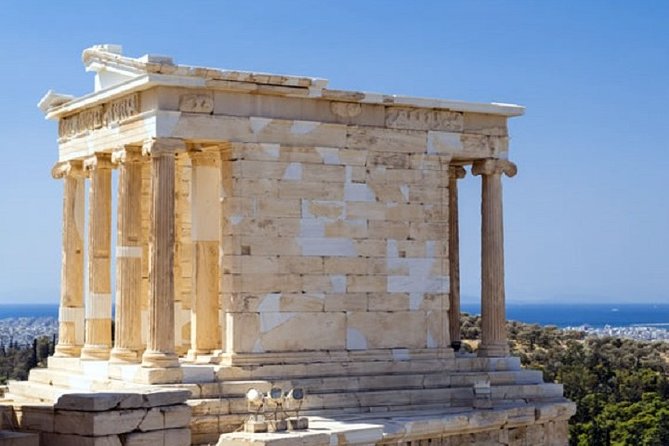
The Acropolis is the heart of the day. You walk up the naturally fortified hill through the Propylaea, the monumental entrance, and see the Temple of Athena Nike near the approach. The Parthenon is the main event, but the Erechtheion and its famous porch are just as important for understanding the hill’s religious role.
Allow yourself time to look outward, too. From the top, you can see the Theater of Dionysus and the Odeon of Herodes Atticus below. The view connects the monuments on the hill with the larger city around them.
The scheduled visit lasts about an hour and a half. That is enough for a good first look, but not enough for a slow archaeological study. You will need to keep moving, especially if the entrance area is crowded or the climb takes longer than expected.
Your driver does not enter the archaeological area. The driver can give you background before you go in, and the supplied experience includes an English-speaking driver, not an inside escort. If you want detailed explanations beside each monument, request a licensed guide for an additional charge.
A useful point from the tour’s practical record is that George helped a visitor with a knee injury reach the Acropolis entrance and spoke with security about an express elevator. Do not treat that as a promise of automatic access, but do tell the operator about mobility concerns before the day begins. The Acropolis is not a flat stop.
The Acropolis Museum puts the stones in context
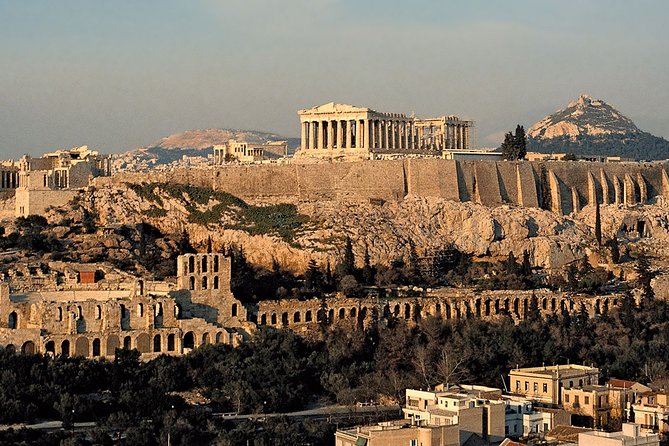
The Acropolis Museum is the second major stop, with about 90 minutes inside. I like this order because you see the hill first, then encounter sculptures and objects connected to the place you have just visited.
The permanent displays include the Gallery of the Slopes of the Acropolis, the Archaic Gallery, the Parthenon Gallery, and the Classical Acropolis Gallery. The collection includes finds from the Propylaia, the Temple of Athena Nike, and the Erechtheion.
The museum helps fill in what the outdoor ruins cannot show. On the hill, you see columns, foundations, and surviving sculpture. Inside, you get a closer look at archaeological material and a clearer sense of how the buildings were decorated and used.
Again, the driver waits outside. One past visitor specifically wished they had booked a guide inside the museum. That is sound advice if museum labels alone do not give you enough context. The extra licensed guide fee may make sense here more than at some of the brief photo stops, since the museum rewards explanation and careful looking.
You have only 90 minutes, so do not expect to see every display in detail. Focus on the galleries tied to the Acropolis and leave time to pause at the Parthenon Gallery.
Zeus, Hadrian, and the Panathenaic Stadium

After the Acropolis and museum, the tour shifts into short city stops. The Temple of Olympian Zeus receives about 20 minutes. The surviving columns show the scale of the ancient project, while nearby Hadrian’s Arch marks the connection between older Athens and the Roman city.
Twenty minutes is enough for a look and photographs. It is not a full archaeological visit. Admission is not included, and you should factor the additional entrance charge into your budget even if you spend only a short time at the site.
The Panathenaic Stadium follows, with about 15 minutes. Built of white marble and linked with the revival of the modern Olympic Games in 1896, it is one of Athens’s most recognizable landmarks. The short stop works well for a quick look at the sweeping horseshoe shape and a few photographs.
The tradeoff is clear: this is a survey tour, not a series of long site visits. You see more places, but you give each one less time. I find that worthwhile for a first day in Athens, especially if you have only a day from a cruise ship or a short hotel stay.
Syntagma Square and the changing of the guard
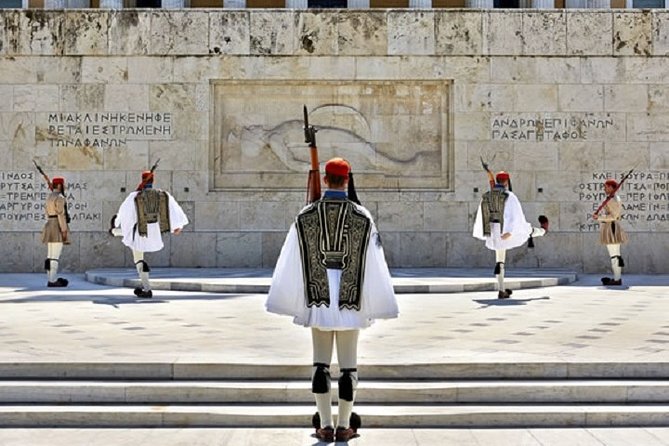
The route includes the Presidential Mansion, the former Royal Palace, and Syntagma Square, where you see the Parliament building and the Tomb of the Unknown Soldier.
The listed timing gives about 10 minutes at the Presidential Mansion and another 10 minutes at Syntagma Square. The traditional guard change is a highlight, but timing matters. Ask your driver when the ceremony is expected and where to stand. George has helped people find a good viewing position and time their video.
This is one of the tour’s useful human touches. A private driver can adjust the route around a public ceremony more easily than a large group. Still, a 10-minute allocation is brief, and the exact view depends on the schedule and city conditions.
You can also read our reviews of more museum experiences in Athens



Lycabettus Hill gives you the wide view
The car climbs St. George Lycabettus Hill for roughly 20 minutes. This is your best chance to see Athens spread below you rather than looking at the city from street level.
The hill is especially useful after several ancient sites. You can place the Acropolis, central Athens, and the surrounding urban area in one view. Bring your camera, but do not expect a long hilltop visit. The stop is built around the panorama and photographs.
This is also where private transport earns its keep. The car takes you uphill instead of requiring you to make another climb after the Acropolis. For many people, that change in effort is more valuable than another historical explanation.
The Ancient Agora and Athens’s older streets
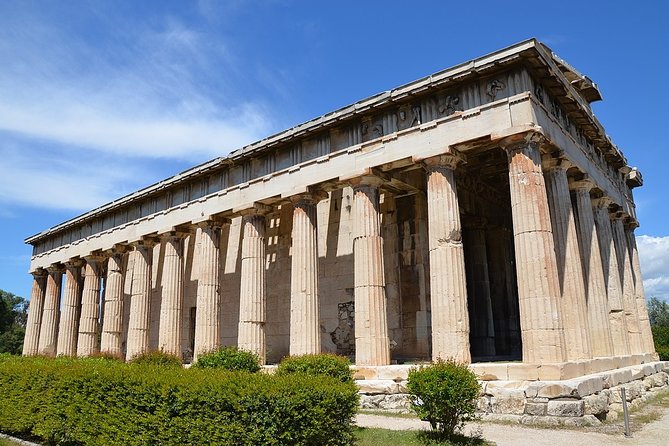
The Ancient Agora receives about 40 minutes. The route refers to the Hellenic Agora and the Areopagus, along with the Roman Agora. These sites help you picture Athens as a working city, not only as a hilltop sanctuary.
The Agora area is especially helpful after seeing the Parthenon. It gives you a different view of ancient life and civic space. The Areopagus also provides another angle on the Acropolis, though footing can be uneven and care is sensible.
Admission is not included. Forty minutes lets you get a useful introduction, but the site could easily fill much more time for anyone interested in ancient urban life. If you want a slower visit, ask if the schedule can be adjusted by shortening one of the photo stops.
The final stop is Plaka, with about an hour. This is the most relaxed part of the day. You can walk narrow streets, browse for souvenirs, or sit in a café for a refreshment.
Plaka is not a substitute for the major archaeological sites, but it gives the day a more ordinary, lived-in finish. After monuments, museum galleries, and formal squares, you get time to wander without a strict checklist. Shopping and food are not included, so plan to pay directly for anything you buy.
What the driver can and cannot do
The English-speaking driver is central to this experience, but the role needs to be clear. The driver can collect you, handle the route, offer commentary before the stops, manage the vehicle, provide water, and help with practical details. The driver is not allowed to enter the archaeological areas or museum as your guide.
Past drivers have included George, Andreas, and Andreo, while Ellen has led some parts of private touring. The exact person assigned to your booking may differ. What you can reasonably expect is an English-speaking driver rather than a guaranteed named guide.
Several details make the service more useful than a simple transfer. George reportedly used short historical videos on the vehicle screen during longer drives, helped with a charger, and kept explanations light enough for a family ranging from a seven-year-old to adults. Those are specific examples, not listed guarantees, but they show the kind of practical service the company has provided.
If history is your main reason for visiting Athens, pay for the licensed guide option. If you mainly want transport, orientation, and a few well-placed explanations, the driver-only setup may be enough.
Timing, comfort, and who should book
The full route lasts approximately six hours. It includes the Acropolis and museum, several short exterior or archaeological visits, a hilltop view, and free time in Plaka. That makes it a strong choice for a first introduction, but a demanding one.
You will spend much of the day getting in and out of the vehicle and walking at major sites. The Acropolis itself requires effort, and the Agora involves more walking. Comfortable shoes, water, and sun protection are sensible, even though bottled water is provided.
Pickup is available from an Athens hotel or apartment, just outside the entrance gate. Cruise passengers can be collected at the Piraeus cruise terminal exit, where the driver waits with a sign showing the passenger’s name. Airport pickup is not included, though it can be arranged for an additional cost.
The tour suits:
- First-time visitors with only one full day in Athens
- Cruise passengers with a limited port stop
- Families who want private transport and a flexible pace
- Small groups of up to three sharing the vehicle
- People who prefer not to navigate Athens traffic and public transport
- Visitors who want a city overview before returning to selected sites independently
It may not suit you if you want long, detailed visits at every monument. It is also less appealing if you already know Athens well and would rather spend several hours in one museum or archaeological area.
Free cancellation is available up to 24 hours before the start time. After that point, the amount paid is not refunded, and late changes are not accepted.
Is the $372.49 group price good value?
The price is easiest to judge by group size. For three people, the base cost is reasonable for a private six-hour vehicle with pickup, water, WiFi, and a dedicated driver. For one person, it is much harder to justify unless convenience matters more than cost.
The added admission charge changes the calculation. Entrance fees for the archaeological sights and museums are listed at €100 per person. A licensed guide inside the sites costs extra as well. Before booking, ask for the final total in writing, including the sights you plan to enter and any guide supplement.
The strongest value comes from the time saved. You are not simply buying a ride. You are buying a route that links Athens’s hardest-to-combine highlights in one day. That matters most from Piraeus, during a short stay, or for a family that does not want to manage transport.
I would compare the full cost against a private tour that includes entrance tickets and an inside guide. The cheaper-looking option may not remain cheaper after you add €100 per person and guide fees.
Should you book this Athens tour?
Book it if you want a fast, comfortable first look at Athens with hotel or port pickup and your own vehicle. The combination of the Acropolis, museum, Lycabettus Hill, Syntagma, the Agora, and Plaka gives you a broad picture of the city in one day.
Before paying, confirm three things: the total entrance cost, the exact role of the driver, and whether you want a licensed guide inside the sites. If you need detailed archaeological commentary, add the guide. If you want flexibility, efficient transport, and practical help from a driver such as George or Andreas, the standard private format can work very well.
FAQ
Is hotel pickup included?
Yes. Pickup and drop-off are included from an Athens hotel or apartment. The meeting point is just outside the entrance gate of the hotel or apartment building.
Can I be picked up at the Piraeus cruise terminal?
Yes. Pickup and drop-off at the Piraeus cruise terminal are included. The driver waits at the cruise terminal exit holding a sign with the passenger’s name.
Is airport pickup included?
No. Airport pickup and drop-off are not included in the standard price. They can be requested for an additional cost.
Are Acropolis and museum admission tickets included?
No. Entrance fees are listed separately at €100 per person for the archaeological sights and museums.
Does the English-speaking driver enter the Acropolis or museum?
No. The driver is not allowed to enter the archaeological areas or museum as an escort. A licensed tour guide can accompany you inside for an additional charge.
How many people can join the private tour?
The listed price is for one private group of up to three people. Only your group participates in the tour.