REVIEW · ATHENS
Footsteps Of Paul, Letters to Corinthians, Private Biblical Tour
Book on Viator →Operated by Ancient Greece Tours & Transfers · Bookable on Viator
Paul’s Corinth was a hard-working port city shaped by trade, travel, religion, and politics. This private 8-hour tour from Athens follows that world from the Corinth Canal and ancient Diolkos to the ruins where Paul preached, then ends at Kenchreai, the port linked with his departure for Ephesus.
I like the strong Bible-based storytelling, especially the attention given to Paul’s 18 months in Corinth, his hearing before Gallio, and the letters known as First and Second Corinthians. I also like the private format, since guides such as Peter and Tas can adjust the pace, explain Scripture in context, and make room for practical needs such as water, snacks, and bathroom stops.
The main consideration is cost: at $312.83 per person, this makes the most sense for a small group that values private transport and a dedicated guide. The entrance fee to Ancient Corinth is extra, and a licensed guide inside the archaeological site and museum is not included.
In This Review
- Key points at a glance
- Why this journey matters to readers of Paul’s letters
- From Athens to the Corinth Canal
- Ancient Diolkos and the old route across the isthmus
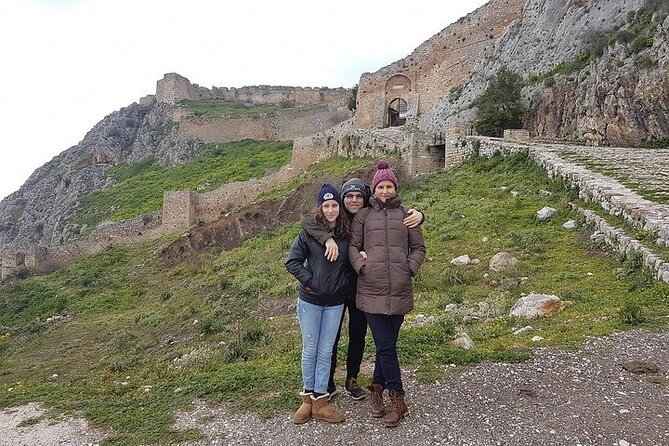
- Acrocorinth, fortifications, and the view from above
- Ancient Corinth and the church of Paul
- The archaeological museum and the Roman city
- Lunch in Ancient Corinth or beside the sea
- Kenchreai, Paul’s eastern port
- What the private format adds
- Is $312.83 per person a fair price?
- Who should book this Corinth tour?
- Should you book it?
- FAQ
- How long does the tour last?
- Where does pickup take place?
- Is this a private tour?
- Is transportation included?
- Is the entrance fee to Ancient Corinth included?
- Is a licensed guide included inside the museum and archaeological site?
- Is lunch included?
- Can I cancel for a full refund?
Key points at a glance
- Paul’s Corinth in context: Connect First Corinthians and Paul’s ministry with the actual city, roads, ports, and court where he worked.
- The Corinth Canal: Spend about 50 minutes at the modern waterway, a major engineering project and the gateway to the Peloponnese.
- Ancient Diolkos: See the route used to move boats across the isthmus before the canal existed.
- Acrocorinth views: Visit the high fortress for wide views toward both the Corinthian and Saronic seas.
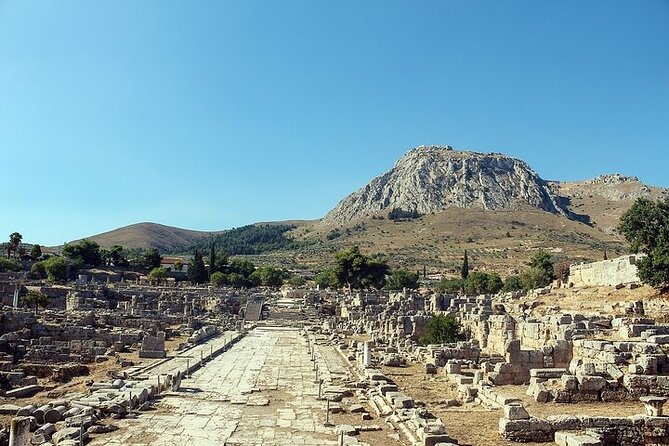
- Ancient Corinth and its museum: Explore the Temple of Apollo, Roman Agora, forum, baths, roads, and archaeological collection.
- Private, door-to-door service: Ride in a private air-conditioned vehicle with hotel, apartment, Airbnb, or port pickup and WiFi onboard.
Why this journey matters to readers of Paul’s letters
The best reason to choose this tour is that it gives the biblical text a physical setting. Corinth was not simply a place name in the New Testament. It was a major city linked to two seas, busy routes, colonies, merchants, sailors, Roman officials, and many competing religious traditions.
Paul stayed in Corinth for 18 months, according to Acts. That long stay makes sense when you see the city’s position. Corinth controlled the narrow isthmus between mainland Greece and the Peloponnese, with access to the Corinthian Gulf on one side and the Saronic Gulf on the other.
I like that the tour does not treat Paul as an isolated religious figure. It explains how roads, ports, trade, and Roman government shaped his work. That setting helps you read First Corinthians with more clarity, especially the tensions around status, worship, morality, community life, and public debate.
This is also a useful choice for families or church groups. You can ask questions without holding up a larger group, and the guide can spend more time on the passages that matter most to you.
You can also read our reviews of more private tours in Athens

From Athens to the Corinth Canal
Pickup begins at your chosen hotel, Airbnb, apartment, or port in Athens. The drive toward the Corinth Canal takes you out of the capital and toward the narrow isthmus that connects mainland Greece with the Peloponnese.
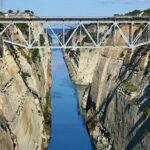
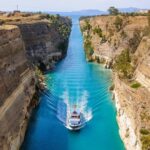
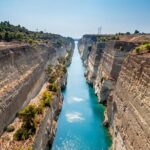
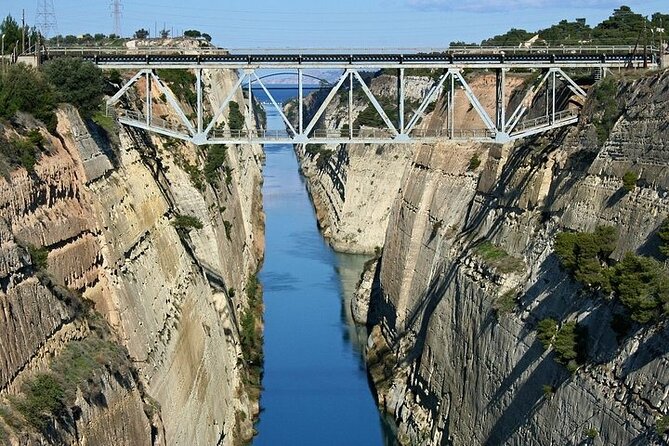
The canal stop lasts about 50 minutes and has no admission fee. It is a short visit, but it gives the day a modern starting point. The canal was built in the 19th century and became an important route for Mediterranean trade.
You will see steep rock walls and the narrow waterway below. The contrast is useful: ancient Corinth depended on the same geographic bottleneck long before modern engineers cut through the isthmus.
This stop is more about orientation than ruins. If your main interest is Paul, do not expect the canal itself to provide a biblical site. Its value is in showing why Corinth mattered in the first place.
Ancient Diolkos and the old route across the isthmus
The next stop is Ancient Diolkos, where you can see the remains of an ancient limestone route. Before the canal, boats could be hauled overland from the Corinthian Gulf toward the Saronic Sea.
The work involved boat trailers, slaves, oxen, and other animals. It was difficult, slow labor, but it allowed Corinth to control movement between the two bodies of water. That control helped the city direct trade and influence a large network of Greek colonies.
I find this one of the most useful stops for understanding Paul’s Corinth. A city that controlled transport naturally drew people from many places. Paul’s decision to establish his ministry there was tied to this busy setting, not just to the city’s religious life.
The Diolkos is not presented as a polished monument. You are looking at the remains of an ancient working route, so the experience depends heavily on the guide’s explanation. This is where someone like Peter or Tas can make the difference by linking the stones to Paul’s movements and the city’s economic power.
Acrocorinth, fortifications, and the view from above
Acrocorinth rises to about 1,886 feet above sea level and is one of the most dramatic stops of the day. The monolithic rock is ringed by about 4.9 miles of walls and was protected by a keep and three gates.
The site reflects many periods of Greek history. You can see remains connected with churches, mosques, houses, cisterns, and the Temple of Aphrodite, which once occupied the summit area. The exact mix of ruins makes Acrocorinth feel less like a single ancient site and more like a fortified place reused over many centuries.
You also get views toward the valley, the Corinthian Sea, and the Saronic Sea. The Frankish tower adds another layer to the scene. On a clear day, this is one of the finest visual points on the tour.
The tour also includes Hadgimoustafa Spring, a fountain built during the Ottoman period in 1555. Water still runs from the Upper Peirene spring. The site’s legend connects the spring to Pegasus striking the ground with his hoof while trying to escape Bellerophon, with the goddess Athena also part of the story.
There is a practical point here. Acrocorinth is a high, fortified site, and the stop lasts about an hour. You should be comfortable with uneven ground and some walking. The supplied information says most people can participate, but the steep setting may still be tiring for anyone with limited mobility.
Ancient Corinth and the church of Paul
At Ancient Corinth, the biblical focus becomes more direct. The tour includes visits to the Neo-Byzantine Church of the Virgin Mary and the church dedicated to the Apostle Paul.
Inside the Church of the Virgin Mary, you can see a marble plaque connected with First Corinthians 13. It refers to the Hymn of Love and the line about love being the greatest. For readers who know the chapter well, this creates a clear link between a familiar passage and the place associated with Paul’s Corinthian ministry.
The nearby church dedicated to Paul includes a depiction of the Apostle’s vision and material about his life in Corinth. A mosaic by Vlasis Tsotsonis shows Saul on the road to Damascus in 34 AD, before his change of direction. The guide uses this scene to discuss the voice, the blinding light, his baptism by Ananias, and the hardships that followed.
The tour also discusses Paul’s appearance before Gallio in Acts 18. This is a valuable connection because it places Paul’s preaching within the Roman legal and political world. Corinth was not only a religious setting. It was a city where disputes could reach Roman officials.
You get about 40 minutes at this part of the visit. That is enough for a focused discussion, though it is not a long church tour. If you want extended time for prayer, quiet reflection, or detailed study of every passage, tell the guide early so expectations are clear.
- All Day Cruise -3 Islands to Agistri,Moni, Aegina with lunch and drinks included
★ 5.0 · 4,958 reviews





The archaeological museum and the Roman city
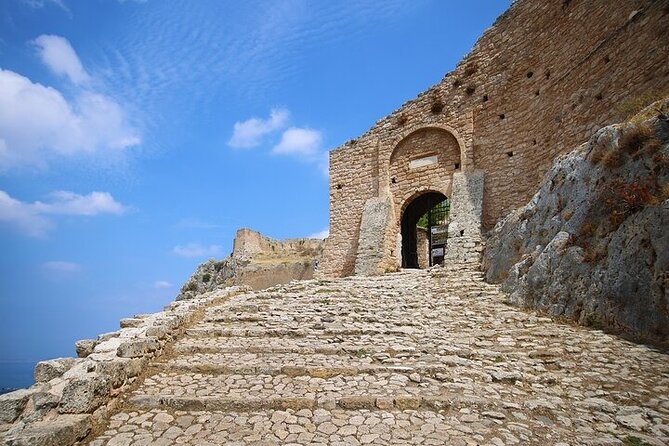
The Archaeological Museum of Corinth and the adjoining archaeological site are allotted about 1 hour and 40 minutes. The entrance fee is not included, so plan for that added cost. A licensed guide inside the site and museum is also not included, although the professional driver-guide accompanies the tour and explains the historical and biblical setting.
The museum holds objects from Corinth and nearby sites. Its collection covers Greek, Roman, Byzantine, and Ottoman periods, which helps explain how the area changed long after Paul’s lifetime.
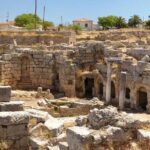
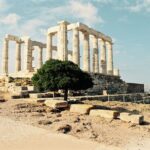
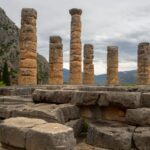
Outside, the Temple of Apollo is the key ancient landmark. It dates to around 560 BCE and is among the earliest Doric temples in the Peloponnese and mainland Greece. Its monolithic Doric columns are unusual and give the site a powerful sense of age.
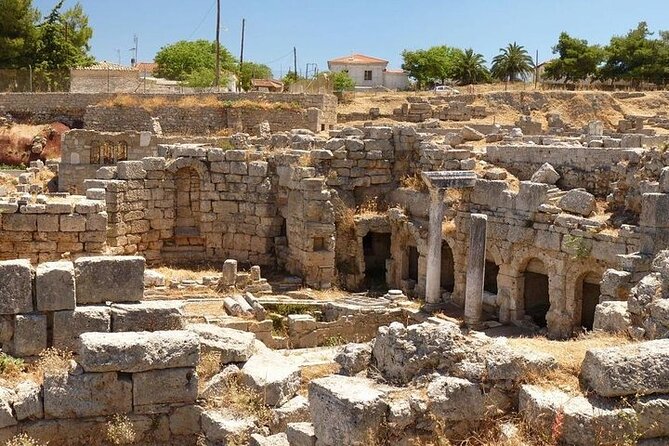
The Roman Agora shows a later Corinth, with shops, small temples, altars, Roman buildings, and public spaces. You can also see remains linked with the amphitheater, Roman Odeon, Glaukus Fountain, Roman baths, Lechaion Road, and Roman forum.
This is where you need to balance expectations. The archaeological site is essential for understanding Corinth, but the allotted time is not enough for a slow, expert study of every structure. I would focus on the Temple of Apollo, the Agora, the major roads, and the features that connect to Paul’s time.
The site also gives you a clear reminder that Paul preached in a city filled with older religious buildings and Roman public life. First Corinthians becomes easier to picture when you understand the setting around the early church.
Lunch in Ancient Corinth or beside the sea
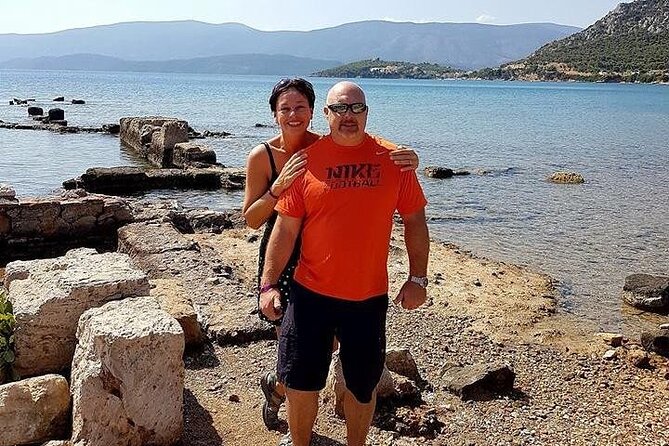
Lunch lasts about 1 hour and 20 minutes. You can eat in Ancient Corinth in a village-style setting or have a seaside meal at the Baths of Helen of Troy.
Food and drinks are not included, so this is an extra expense. That gives you freedom to choose according to your appetite and the day’s pace, but it also means you should allow room in your budget.
I like having lunch as part of the day because Corinth is a long excursion from Athens. A proper break keeps the schedule from feeling like one archaeological site after another. It also gives you time to ask the guide about Paul, the ancient city, or the places still to come.
Restaurant choice matters on a private tour. Tas was specifically praised for choosing a good restaurant, so if dining is important to you, mention your preferences before the day begins. You may want a village meal, a seaside setting, a lighter stop, or more time at the ruins.
Kenchreai, Paul’s eastern port
The final major stop is Kenchreai, also spelled Cenchreae, on the Saronic Sea. It was one of Corinth’s two ports and is linked with Paul’s departure from Corinth in 53 AD.
The tour connects this stop with Acts 18:18, including Paul’s Nazarite vow and the cutting of his hair. Paul is associated here with sailing to Ephesus alongside Aquila and Priscilla.
Kenchreai gives the day a fitting finish. You have seen the route across the isthmus, the city that Paul served, and now the port from which he left. It makes Paul’s journeys feel like real movements through a working region rather than a series of disconnected Bible references.
The stop lasts about 30 minutes, followed by a return drive to Athens of about 70 minutes. It is a short visit, and the remains may not satisfy someone seeking a large, intact port complex. Its value lies in the biblical connection and the chance to complete the route.
What the private format adds
This is not a shared coach excursion. Only your group takes part, and transport is provided in a private, air-conditioned premium vehicle with WiFi and bottled water.
Pickup and drop-off are offered at your hotel, apartment, Airbnb, or port. That saves time and removes the need to find a bus connection to Corinth. For a full day outside Athens, that convenience has real value.
The driver-guide is described as well versed in ancient, biblical, and modern Greek history. Keep in mind that a licensed guide to accompany you into the museum and archaeological site is not included. If detailed site interpretation is your priority, ask at booking how the guide handles the archaeological portions.
The strongest guide names connected with this experience are Peter and Tas. Peter is described as attentive to practical needs, including bathroom stops, snacks, and water. Tas is described as personable, efficient, and helpful with restaurant selection. Those details matter on an eight-hour private outing, especially for families and church groups.
Is $312.83 per person a fair price?
At $312.83 per person, this is not a budget day trip. The price becomes easier to justify when you divide it among a small private group and consider the hotel or port pickup, private vehicle, driver-guide, bottled water, and WiFi.
You are also covering a long route with several distinct sites: the canal, Diolkos, Acrocorinth, Ancient Corinth, the museum, lunch, and Kenchreai. A cheaper group excursion may cover some of the same ground, but it is less likely to give you the same ability to ask questions or adjust the pace.
The value is highest for people who want biblical context, not just photographs of ruins. If your main aim is a quick look at the Corinth Canal, the price may feel high. If you want Paul’s ministry explained across the full Corinthian setting, the private approach is more convincing.
Remember to budget for the Ancient Corinth entrance fee, lunch, drinks, and gratuities. The tour includes transportation and water, but not food or the archaeological admission.
Who should book this Corinth tour?
I would recommend it most strongly to:
- Church groups and pastors who want the setting behind Acts and First Corinthians
- Families who prefer a private vehicle and flexible attention
- Visitors with one full day available from Athens
- People who want both biblical sites and ancient Greek and Roman archaeology
- Small groups that can share the cost of private transport
You should think twice if you want a slow archaeological study with a licensed museum specialist, since that service is not included. You may also find the day demanding if you dislike long drives, uneven ruins, or a full schedule.
Free cancellation is available when you cancel at least 24 hours before the start time. Changes or cancellations inside that window are not accepted for a refund.
Should you book it?
Book this tour if Paul’s letters and Acts are central to your interest in Greece. The route gives you more than a quick photo stop: it connects Corinth’s trade routes, fortress, temples, Roman public spaces, churches, and ports with the story of Paul’s ministry.
I especially like the combination of Diolkos, Ancient Corinth, and Kenchreai. Together, those stops explain why Paul came, how he worked in the city, and how he continued his travels. The private setting and guides such as Peter or Tas add useful personal attention.
Skip it if you want the lowest-cost way to see Corinth or prefer to explore the archaeological site at a very slow pace. For a small group seeking a focused biblical day with door-to-door service, this is a strong and purposeful choice.
FAQ
How long does the tour last?
The tour lasts approximately 8 hours, including the visits and transportation between Athens, Corinth, and the sites.
Where does pickup take place?
Pickup and drop-off are offered from your chosen hotel, Airbnb, apartment, or port in Athens.
Is this a private tour?
Yes. Only your group participates in the activity.
Is transportation included?
Yes. The tour includes transportation in a private, air-conditioned premium vehicle, along with WiFi and bottled water.
Is the entrance fee to Ancient Corinth included?
No. The entrance fee to the Ancient Corinth archaeological site is not included.
Is a licensed guide included inside the museum and archaeological site?
No. A licensed guide to accompany guests into the site and museum is not included. The tour does include a professional driver-guide familiar with ancient, biblical, and modern Greek history.
Is lunch included?
No. Food and drinks are not included. Lunch can be arranged in Ancient Corinth or at the Baths of Helen of Troy.
Can I cancel for a full refund?
Yes. You can cancel at least 24 hours before the experience start time for a full refund. Cancellations or changes made less than 24 hours before the start time are not accepted for a refund.