REVIEW · ATHENS
Greece Military History Private Tour
Book on Viator →Operated by Athens Classic Tour · Bookable on Viator
Ancient Athens, naval warfare, secret weapons, and modern aircraft all fit into this four-hour private tour. You begin beside the sea with a full-size replica of the trireme that helped Athens defeat Persia, then move through Greek military history from antiquity to the 20th century.
I like the private pickup and drop-off, which saves you from piecing together several museums across Athens. I also like the unusual mix of exhibits: the Averof battleship and trireme make the story physical, while Kotsanas Museum turns ancient technology into something children can understand.
The main drawback is pace. Four hours is enough for a strong overview, but not for a slow look at every display. Museum admission also costs extra, and the Hellenic Air Force Museum is only available on specific dates.
In This Review
- Key points to know before booking
- Why this Athens tour feels different
- Start beside the sea with the Greek trireme
- Enter the Averof, a 140-meter naval survivor
- See ancient machines at Kotsanas Museum
- Put Greek battles in order at the Athens War Museum
- The optional Hellenic Air Force Museum
- What the private format adds
- Who will enjoy this route most
- Booking, cancellation, and practical checks
- Should you book the Greece Military History Private Tour?
- FAQ
- How long does the Greece Military History Private Tour last?
- Where can pickup and drop-off be arranged?
- Is this a private tour?
- What is included in the tour price?
- Are museum admission fees included?
- Is the Hellenic Air Force Museum included on every tour?
- Can I cancel for a full refund?
Key points to know before booking
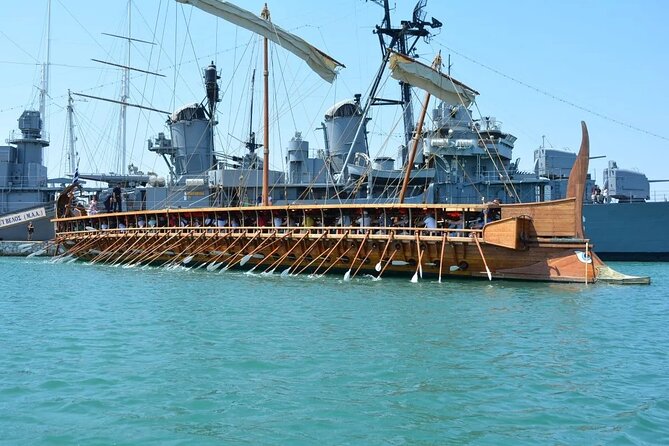
- See an operating replica of an ancient trireme: This rare full-size reconstruction introduces the naval power behind Athens’ victory over Persia.
- Board the Averof battleship if open for your visit: The 140-meter ship adds a real naval setting to the tour, with admission paid separately.
- Handle ancient Greek technology through reconstructions: Kotsanas Museum includes devices linked to warfare, engineering, and the Antikythera Mechanism.
- Cover 30 centuries at the Athens War Museum: Weapons and battle displays show how military change shaped Greek history.
- Ride privately from your hotel, Airbnb, or port: Your driver provides transport, fuel, tolls, and historical commentary for your group alone.
Why this Athens tour feels different
Many history tours in Athens stay among temples, statues, and archaeological ruins. This one takes a less expected route. It asks you to understand Greece through the tools used to defend it: ships, weapons, machines, aircraft, and military strategy.
That approach works especially well for families. A child may not want a long lecture about the Classical period, but a full-size warship or a working ancient machine gives the story a clear shape. Adults get the larger political picture, including the rise of Athens, its defeat, later foreign rule, and the long struggle for independence.
The tour’s central idea is blunt: Greece has spent far more time at war than at peace over the past 3,500 years. The exact balance is presented as roughly 300 years of peace in total. You are not simply looking at old objects. You are following the repeated pressure of invasion, resistance, naval power, and technological change.
Your driver is described as a professional with a strong command of Greek history. The experience is private, so you can ask questions and adjust the conversation to your interests. One Italian-language comment praised the guide for explaining everything on view and answering questions beyond the formal subject of the tour. That is useful here, since the route covers a wide span and benefits from a person who can connect the separate stops.
You can also read our reviews of more private tours in Athens



Start beside the sea with the Greek trireme
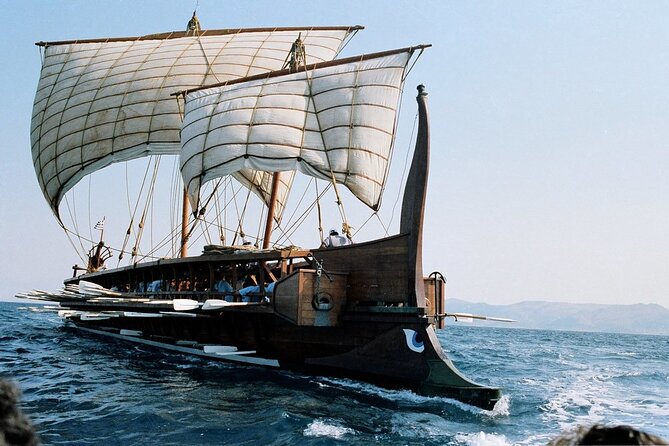
The first stop is the Hellenic Maritime Heritage Park by the water. The main attraction is a full-scale replica of an ancient Greek trireme, the oared warship associated with the Athenian navy.
This is not just a model behind glass. The ship is described as fully operational, which gives you a much better sense of its size and purpose. You can look at the vessel as a piece of naval engineering, then connect it to the famous battle in which Greek forces defeated the Persians. The tour explains the conflict as roughly 400 Greek ships facing 1,200 Persian ships, with the Athenian navy playing a key role in protecting the city’s young democracy.
The setting helps. You are near the sea rather than in a standard indoor gallery, and the ship gives the opening section a physical focus. I would pay attention to how the tour explains Athens as a maritime power. Its political success was tied not only to speeches and assemblies, but also to the fleet that could defend the city and control important waters.
The maritime stop lasts about one hour. The Greek Maritime Museum and trireme experience are part of the opening visit, but admission details for the museum are not included in the tour price. Ask at booking what is covered at this stop.
Enter the Averof, a 140-meter naval survivor
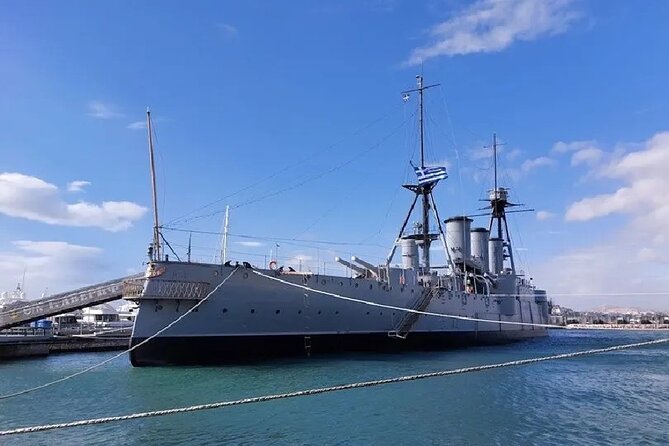
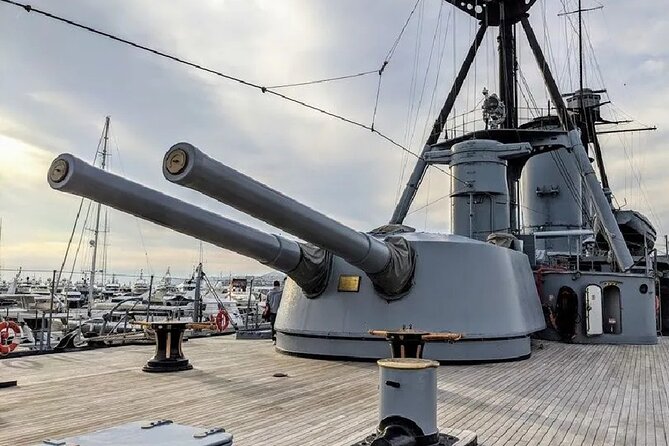
Beside the trireme is the battleship Averof, a 140-meter vessel with a long service record. The ship became the flagship of the Aegean fleet and took part in naval battles in the early 20th century. It also served during World War I as an escort vessel for convoys before being decommissioned in 1952.
The Averof gives the tour a useful change of scale. The trireme shows how ancient Athens used speed, rowing power, and naval tactics. The battleship shows a later age of armor, artillery, engines, and fleet command. Seeing both in the same visit makes military technology easier to compare.
Entry to the Averof is optional and costs 5 euros for adults aged 18 to 64, or 2.50 euros for children aged 7 to 17 and adults aged 65 or older. Since the tour itself is only about four hours, check how much time is available if you want a full visit inside the ship.
I would choose the optional boarding if naval history is your main reason for booking. If you are more interested in ancient engineering or the Athens War Museum, you may prefer to keep this stop shorter. The important point is that you get a real historic warship beside the replica ancient vessel, not just a general museum explanation.
See ancient machines at Kotsanas Museum
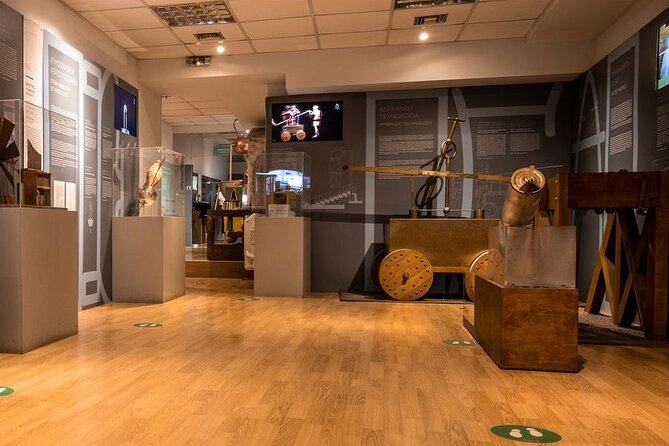
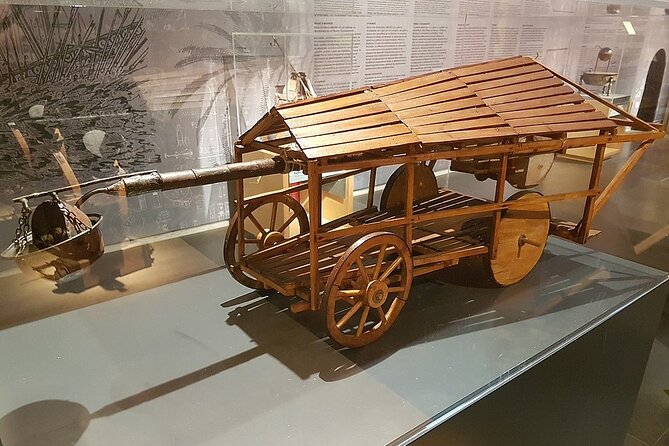
The Kotsanas Museum of Ancient Greek Technology is the most playful stop on the route. It focuses on reconstructions of ancient devices, including military inventions and engineering systems. The displays are designed to show how the machines worked, not merely what they looked like.
The subject matter can surprise you. The tour specifically highlights ancient flame throwers along with other weapons and mechanical devices. You may also encounter reconstructions connected to the Antikythera Mechanism, one of the most famous examples of ancient Greek scientific engineering.
This museum is small, but the tour description makes clear that it is packed with working or interactive artifacts. That matters because ancient technology can seem abstract when you only see fragments in a case. A reconstruction lets you understand movement, force, gears, or a weapon’s basic purpose.
The stop lasts about 90 minutes, making it one of the larger sections of the morning. Admission costs 5 euros and is not included. I would allow time for questions here, especially if you are visiting with children. The machines provide a natural way to talk about how much Greek engineers understood about mechanics long before modern industry.
There is also a practical souvenir tip: look for something connected to the Antikythera Mechanism. The museum is noted for related souvenirs, which may be more meaningful than a generic Athens keepsake.
Put Greek battles in order at the Athens War Museum
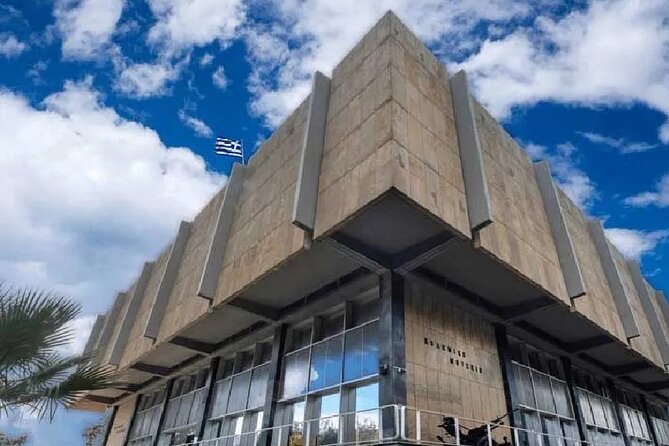
The Athens War Museum supplies the broad timeline. It presents weapons used across roughly 30 centuries and connects them with major battles and military strategies. The museum is described as the largest of its kind in Southeastern Europe.
This is where the tour moves from individual machines and ships to the larger story of Greek survival. You hear about the fights that shaped the country and the periods when Greek territory was controlled by outside powers. The central theme is freedom, and the museum uses arms and battle history to explain the cost of defending it.
The museum visit lasts about 90 minutes, with admission priced at 6 euros. That relatively modest extra fee is worth considering in the overall value of the tour because it gives the ancient and naval stops a wider frame. Without it, you might enjoy several impressive objects but miss the long sequence linking them.
The museum is also likely to be the most information-heavy stop. If you enjoy military history, you may want to use your private format to ask for the most important battles rather than trying to absorb every display. If you are traveling with young children, the trireme and interactive technology museum may hold their attention more easily than a weapons collection.
The tour’s quotation from Pericles centers on the idea that freedom belongs to those willing to defend it. You do not need to treat that line as a lesson in patriotism to see its role here. It explains why the museum presents military history as part of Greece’s national story, not as a separate subject.
You can also read our reviews of more historical tours in Athens



The optional Hellenic Air Force Museum

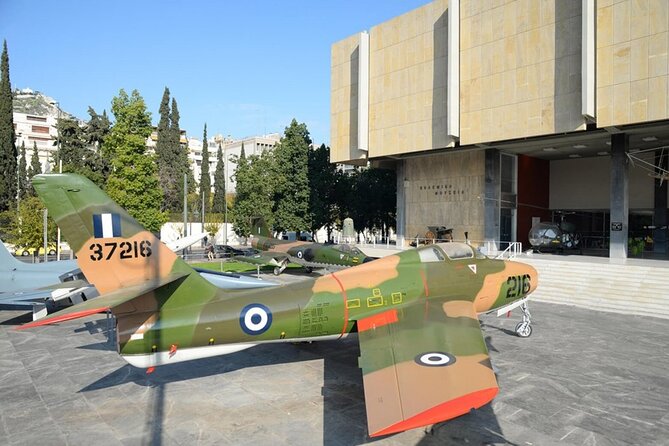
On specific dates, the tour may include the Hellenic Air Force Museum. It has more than 40 aircraft, adding a modern aviation chapter to a route that begins with oared ships and ancient machines.
This option could be especially appealing to anyone interested in 20th-century military history. It also gives children a clear visual finish, since aircraft are easy to recognize and compare. The supplied information does not give a separate admission price or a guaranteed schedule, so you should confirm the available date before booking if this stop matters to you.
Do not assume the Air Force Museum is included on every departure. The regular route already fills around four hours, and the aviation visit is described as optional and date-dependent. Think of it as a possible bonus, not the main reason to book unless the provider confirms it for your day.
What the private format adds
The tour costs $64 per person. For four hours of private transport, fuel, tolls, hotel or port pickup, bottled water, and a driver who supplies historical guidance, that can be fair value, particularly if your group has several people and wants a custom conversation.
The entry fees are separate. If you are an adult aged 18 to 64 and visit the Averof, Kotsanas Museum, and Athens War Museum, the listed admissions add up to 16 euros per person. The Averof costs less for children aged 7 to 17 and adults aged 65 or older. The Air Force Museum price is not provided.
The price makes less sense if you only want one museum or are happy using public transport. It makes more sense if you want to combine several places that are not presented as one standard city-center attraction and prefer not to manage the transfers yourself.
Pickup is offered from a hotel, Airbnb, or port. Drop-off is included too. The tour is listed as operating daily from 9:30 AM to 1:00 PM during the stated season, from September 15, 2023 through June 17, 2026. Since the experience lasts about four hours, that schedule suggests a morning departure, but confirm the exact pickup time when reserving.
Public transportation is nearby, though the included pickup is the more convenient choice. Bottled water is included, while lunch and drinks are not. Plan to eat before or after the tour rather than expecting a meal break during the route.
Who will enjoy this route most
I would recommend this tour to adults and children who like machines, ships, military stories, or hands-on museum exhibits. It is also a good fit if you have already seen the Acropolis and want a different side of Athens.
History-minded adults will appreciate the broad sequence from Persian Wars to the Averof and modern aircraft. Families may find the trireme and Kotsanas Museum more engaging than a traditional lecture. The private setting is useful for mixed-age groups because you can spend more time on the parts that catch your attention.
This is less suitable if your priority is classical sculpture, mythology, or archaeological sites. It also may not satisfy someone who wants a highly specialized account of one war. The route covers an enormous period, so the reward is connection and range rather than exhaustive detail.
You should also be comfortable with a morning built around several museum visits. The tour is not a relaxed seaside outing, despite its opening location. It is a concentrated history lesson with transport between stops.
Booking, cancellation, and practical checks
Confirmation is provided when you book, and most people can participate. Because the tour is private, only your own group joins the activity.
Free cancellation is available up to 24 hours before the local start time for a full refund. Changes or cancellations made within 24 hours are not accepted for a refund, so check your schedule carefully, especially if you are coordinating a port arrival.
Before paying, confirm three details: the exact pickup point, the cost and availability of boarding the Averof, and whether the Hellenic Air Force Museum operates on your date. Those questions matter more than usual because the Air Force Museum is optional and date-specific, while some admissions are paid separately.
Should you book the Greece Military History Private Tour?
Book it if you want Athens history told through ships, weapons, machines, and aircraft rather than only through temples. The full-size trireme, the Averof battleship, and the interactive technology displays give the four-hour route plenty of variety, while the Athens War Museum provides the wider story.
I would be especially happy to recommend it to families, private groups, and visitors with limited time who want pickup and a guide-led overview. Skip it if you dislike military subjects, want a slow museum day, or need every admission included in the upfront price.
For the best fit, treat this as a focused morning of Greek military history. Add the listed admissions to your budget, confirm the optional aviation stop, and let your driver know which period interests you most.
FAQ
How long does the Greece Military History Private Tour last?
The tour lasts approximately four hours.
Where can pickup and drop-off be arranged?
Pickup and drop-off are offered from your hotel, Airbnb, or port.
Is this a private tour?
Yes. Only your group participates in the activity.
What is included in the tour price?
The price includes a professional driver with historical expertise, hotel, Airbnb, or port pickup and drop-off, fuel, tolls, and bottled water.
Are museum admission fees included?
No. The Averof battleship costs 5 euros for adults aged 18 to 64 and 2.50 euros for children aged 7 to 17 and adults aged 65 or older. The Athens War Museum costs 6 euros, and the Ancient Greek Technology Museum costs 5 euros.
Is the Hellenic Air Force Museum included on every tour?
No. The Hellenic Air Force Museum is optional and available on specific dates. It has more than 40 aircraft.
Can I cancel for a full refund?
Yes. You can cancel at least 24 hours before the local start time for a full refund. Cancellations or changes made less than 24 hours before the start are not refunded or accepted.