REVIEW · ATHENS
From Athens: Marathon and Thermopylae Full Day Private Trip
Book on GetYourGuide →Operated by Olive Sea_Travel · Bookable on GetYourGuide
The most powerful part of this day is the contrast between Marathon and Thermopylae. At Marathon, you see where Athens defeated the Persian army in 490 BCE. At Thermopylae, you face the place where Leonidas and his 300 Spartans made their last stand ten years later.
I like the private car, hotel pickup, and the chance to cover two distant battlefields in one day. I also like the Marble Dam at Marathon Lake, an unusual engineering work made entirely of Pentelic marble. The tradeoff is a long day with several short stops, and your driver cannot guide you inside the archaeological sites.
In This Review
- Key points at a glance
- Why Marathon and Thermopylae belong together
- Leaving Athens along the original Marathon route
- The Tumulus of the Athenians at Marathon
- Marathon Museum and the prehistoric cemetery
- Marathon Lake and the Pentelic marble dam
- The long drive north to Thermopylae
- The Thermopylae Historical Information Center
- Leonidas’s statue and Kolonos Hill
- A seaside lunch in Kamena Vourla
- What the $536 price means
- Who should book this full-day trip
- Should you book Marathon and Thermopylae?
- FAQ
- How long does the Marathon and Thermopylae trip last?
- Where can pickup and drop-off take place?
- Is transportation private?
- Is lunch included?
- What are the entry fees?
- Can I add a licensed tour guide?
- Can the driver enter and guide at the archaeological sites?
- Is the tour wheelchair accessible?
Key points at a glance
- Two Persian War battlefields in one day: Visit Marathon and Thermopylae from Athens without arranging separate transport.
- The Athenian burial mound: See the Tumulus of the Athenians, built for those who died defending Athens in 490 BCE.
- A marble dam with an Acropolis connection: Marathon Dam uses Pentelic marble, the same prized stone used for the Parthenon.
- Leonidas at Thermopylae: Visit the statue and the nearby hill linked with the Spartans’ final stand.
- Private transportation: Enjoy hotel, Airbnb, or port pickup in a private vehicle, with bottled water included.
- Bring extra money for the day: Entry fees are €13 per person, and lunch is not included. A licensed guide costs an additional €380 if available.
Why Marathon and Thermopylae belong together
This is not a standard Athens sightseeing trip with a quick photo stop at an ancient ruin. It is a full day devoted to two moments in the Persian Wars, both tied to the idea of defending Greek freedom.
Marathon was the earlier victory. In 490 BCE, the Athenian army defeated the Persians on the plain near the eastern coast of Attica. Thermopylae came ten years later, when King Leonidas and his Spartans resisted a much larger Persian force.
I like the way the route connects these places in chronological order. You begin with an Athenian triumph, then continue to the Spartan sacrifice. The sites are not decorated or staged for visitors. Their force comes from the setting, the names, and the knowledge that real armies fought here.
This is also a useful choice if you are staying in Athens but do not want to rent a car. Marathon and Thermopylae are far enough apart to make public transportation awkward for a single day. A private vehicle lets you make the journey without worrying about roads, parking, or returning to Athens after dark.
The main limitation is pace. You have roughly 30 minutes at the Marathon Tomb, 30 minutes at the museum, 20 minutes at the Thermopylae information center, and several brief photo stops. That works for a focused introduction, but it will feel too quick if you want long museum visits or quiet archaeological study.
You can also read our reviews of more private tours in Athens


Leaving Athens along the original Marathon route
The drive from Athens heads through Attica Highway and Marathon Avenue. Along the route, signs mark the kilometers of the original Marathon Race. That gives the drive a useful connection to both ancient and modern Greece.
You are not simply heading to a battlefield. You are following the route associated with the modern race that took its name from the ancient battle. The road also gives you a sense of how far the plain of Marathon lies from central Athens.
Private pickup is included from an Athens hotel, Airbnb, or port. Airport pickup and drop-off cost extra, so you should confirm the meeting point before booking if you are flying in or out on the same day.
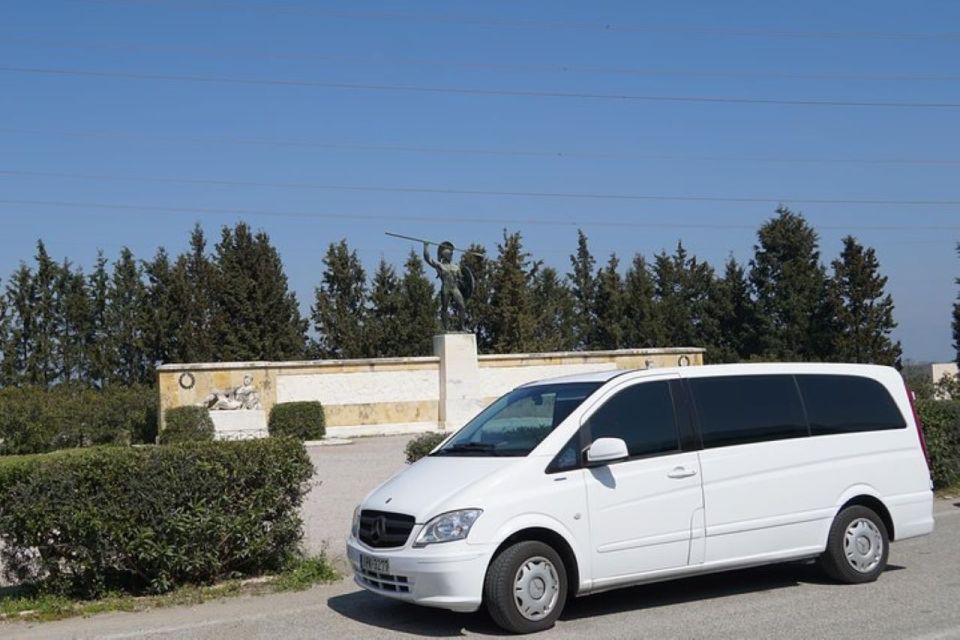
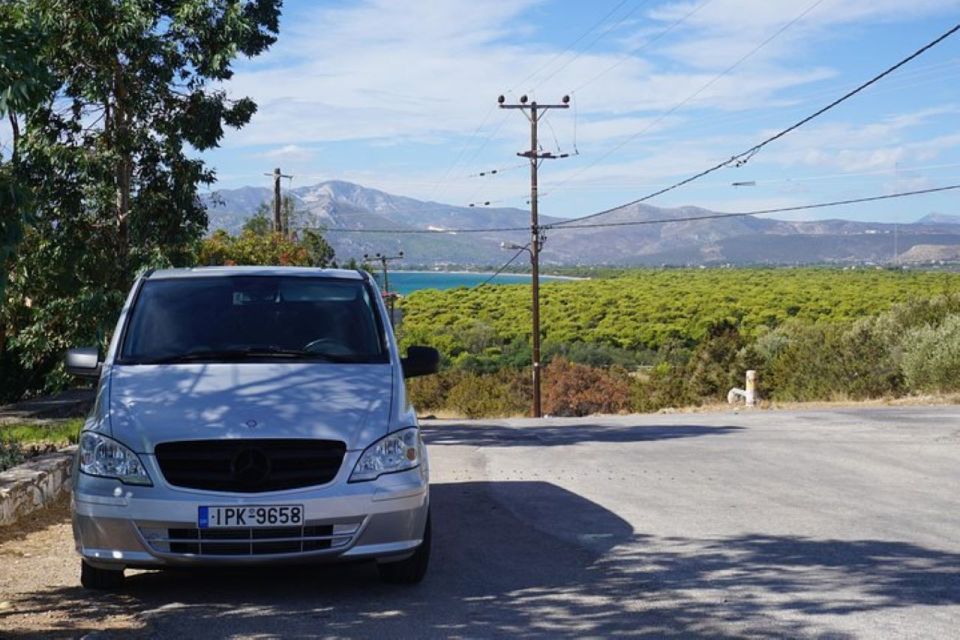
The transportation is one of the strongest practical features. You get a private vehicle, bottled water, and an English-speaking driver. The driver is there to handle the road and explain the history during the journey, but is not licensed to accompany you inside the archaeological sites.
That distinction matters. You will make your own way through each site unless you arrange a licensed guide in advance. A licensed guide may be available for an additional €380, a significant extra cost that makes more sense for a group sharing the fee.
The Tumulus of the Athenians at Marathon
The first major stop is the Tumulus of the Athenians, also called the Marathon Tomb Archaeological Area. This burial mound honors the Athenian soldiers who died in the battle of 490 BCE.
You have about 30 minutes for a self-guided visit. That is enough time to see the mound, absorb the setting, and read the information available on site. It is not a long archaeological session, so I suggest reviewing the basic story before you leave Athens.
The site works best when you pause and consider its purpose. This is not a palace, temple, or city center. It is a burial place created for people who died in the battle. The mound gives the visit a solemn quality that a quick battlefield photo cannot provide.
The route also helps you understand the scale of the ancient fight. The Persian defeat happened on this plain, not inside a fortified monument. Much of the experience comes from standing in an open setting and imagining two armies meeting there.
Because the visit is self-guided, your enjoyment depends partly on preparation. If you want detailed explanations of tactics, troop movements, and the archaeological evidence, the optional licensed guide would add value. Without one, the driver can explain the broader story during the drive, while you explore the site independently.
Marathon Museum and the prehistoric cemetery
The Archaeological Museum of Marathon follows the burial mound and receives about 30 minutes. The museum helps fill in details that are difficult to grasp outdoors, including the archaeological evidence connected with the battlefield.
A prehistoric cemetery in the area provides proof of an earlier civilized presence at Marathon. That expands the story beyond the famous battle. The region was not important only because Persian and Athenian armies met here. People lived and died in this area long before the Persian Wars.
I like this pairing of outdoor and indoor stops. At the mound, you get the emotional setting. At the museum, you get objects and evidence that make the history more concrete.
Half an hour is a sensible introduction, but it is still brief. If you read every display slowly, you may need to choose what matters most. The driver waits according to the tour schedule, so this is not the place for an unhurried museum afternoon.
The museum is also a reason to bring glasses or make sure your phone has enough battery if you plan to use a translation app or take notes. Those are simple preparations, but they matter when your visit is self-guided.
Marathon Lake and the Pentelic marble dam
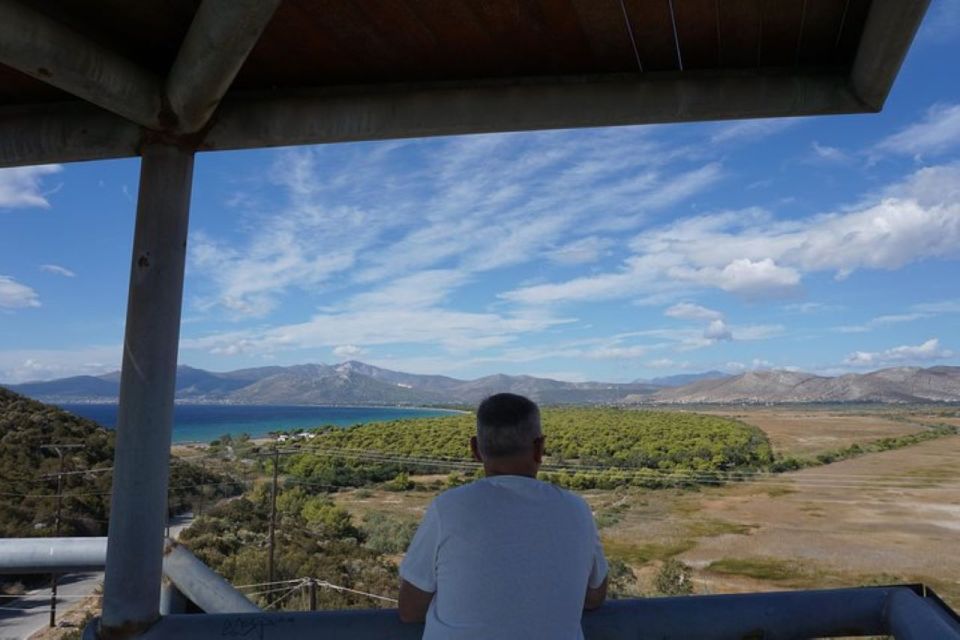
After the archaeological stops, the route passes through the present city of Marathon and continues to Marathon Lake. The lake is an artificial reservoir and serves as Athens’s main water supply.
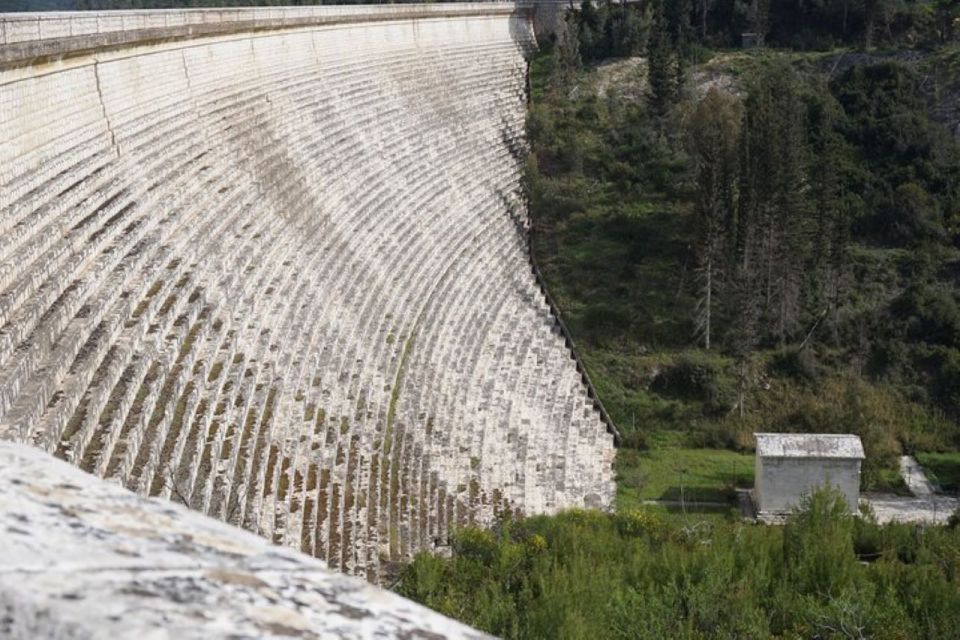
The planned stop is at Eudap, where you have about 15 minutes for photographs. The view is a welcome change after the battlefield and museum. You see the lake, the surrounding slopes of Mount Penteli, and the Marathon Dam.
The dam is the unusual feature. It is made entirely of Pentelic marble, the same famous marble used for the Parthenon on the Acropolis. That makes this more than a routine scenic stop. The material links a modern water project with one of Greece’s best-known ancient monuments.
You also see a modern model of the Treasury of the Athenians, associated with the sanctuary of Delphi. It is a small detail, but it gives the stop another connection to ancient Athens.
Do not expect a long walk or an extensive visit here. The stop is mainly for the view and photographs. Still, I would not dismiss it as filler. The dam shows how Marathon remains important to Athens in a practical way, not only as a battlefield remembered in history books.
A few more Athens tours and experiences worth a look
- All Day Cruise -3 Islands to Agistri,Moni, Aegina with lunch and drinks included
★ 5.0 · 4,958 reviews



The long drive north to Thermopylae
Thermopylae requires a substantial drive from Marathon. This is the point in the day when the private vehicle earns its keep. You can sit back, keep your schedule together, and let the driver handle the distance.
The full outing lasts one day, but the exact departure time is based on availability. You should expect a long day on the road, with most of the rewards coming from the importance of the places rather than from extended time at any single stop.
An English-speaking driver accompanies you. The provider describes the drivers as professional and experienced in Greek history, but they are not licensed site guides. You can ask questions while driving, then explore the formal sites independently.
That setup suits you if you enjoy some freedom and do not need a lecture at every monument. It is less ideal if you want a specialist to lead you through every display, identify every archaeological feature, and answer detailed questions on the spot.
The Thermopylae Historical Information Center
At Thermopylae, you visit the Historical Information Center for about 20 minutes. A 3D film explains the battle and gives the site a sense of movement that the open field alone cannot provide.
The film is especially useful because the ancient geography has changed. Thermopylae was known for its narrow passage between the mountains and the sea, but the shoreline is not exactly as it was in 480 BCE. A visual presentation can help you picture the old route and understand why this location mattered.
The stop is self-guided, and 20 minutes is short. You will get the main presentation and an introduction to the battle, but you should not expect a long museum visit.
Thermopylae is often reduced to the phrase Leonidas and the 300. The information center gives that story a little more shape. The battle involved a wider Greek force, and the location mattered because it offered a defensive position against the invading Persian army.
Still, the emotional center of the visit is not inside the center. It comes next, at the statue of Leonidas.
Leonidas’s statue and Kolonos Hill
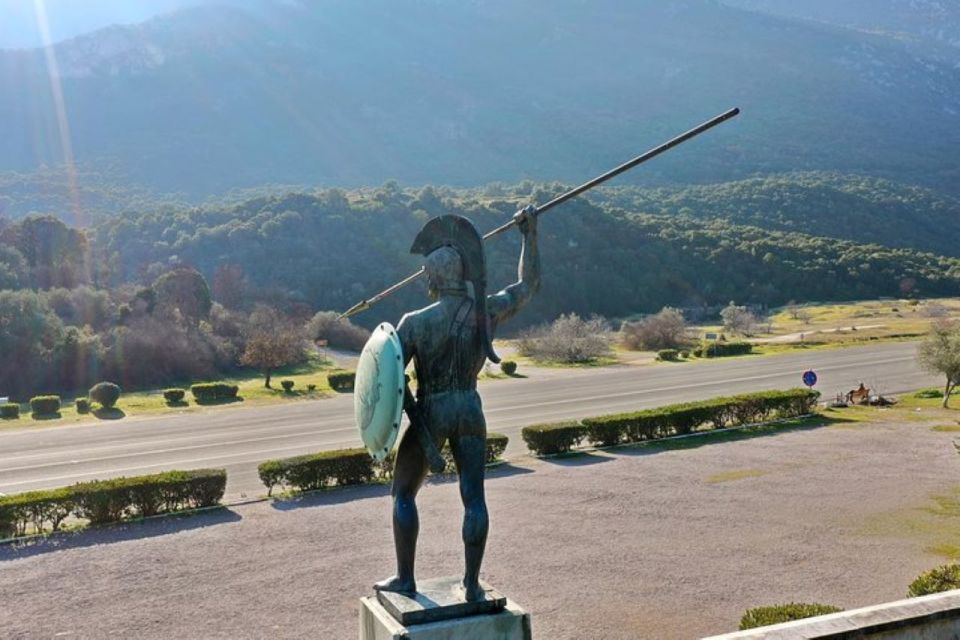
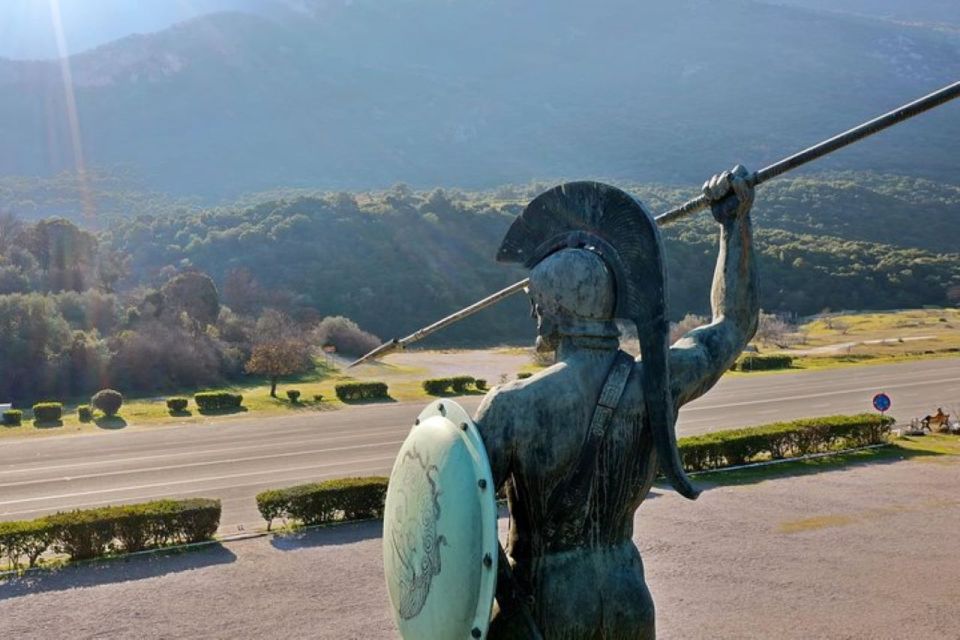
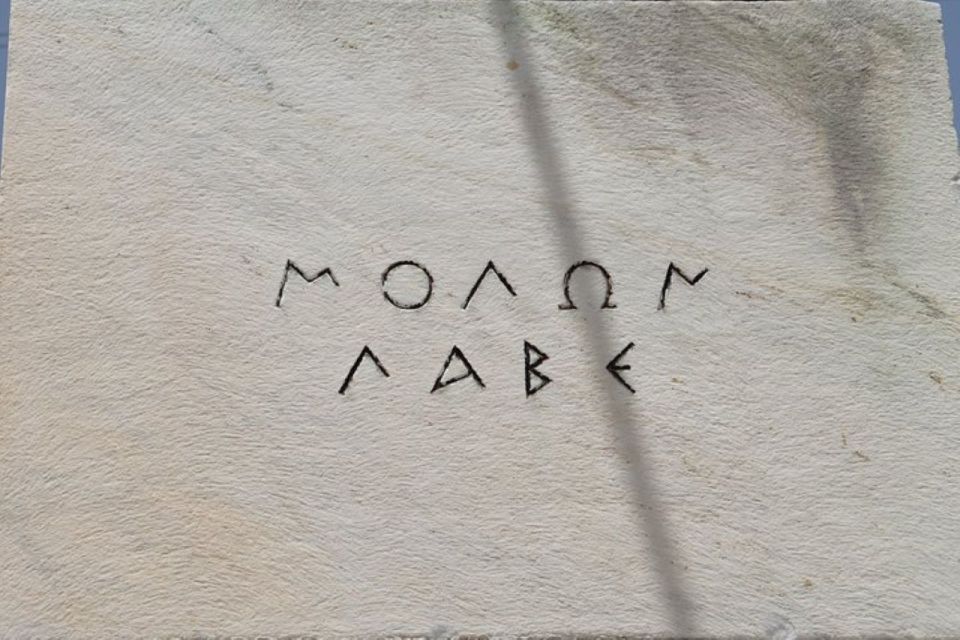
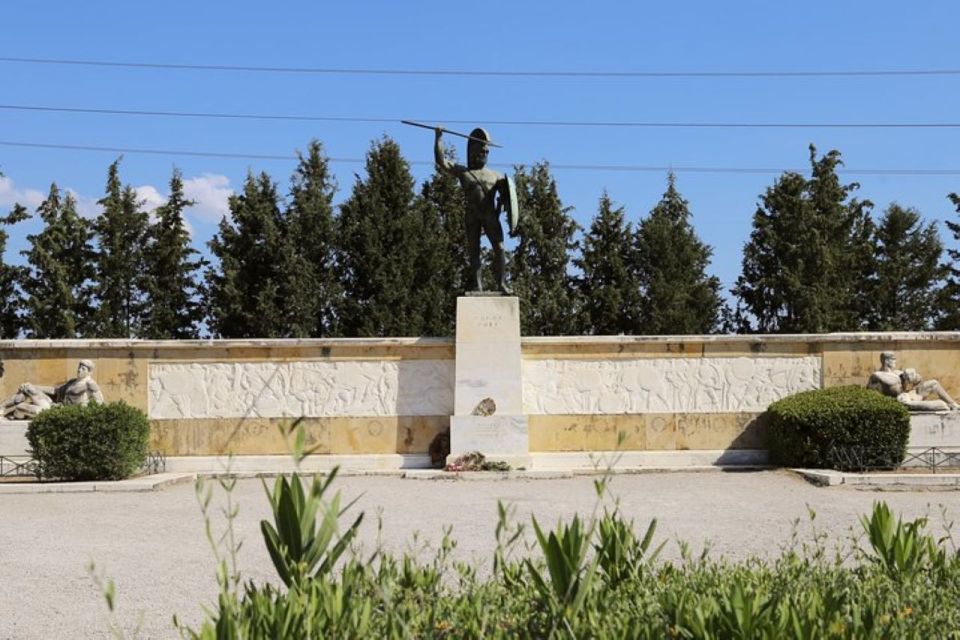
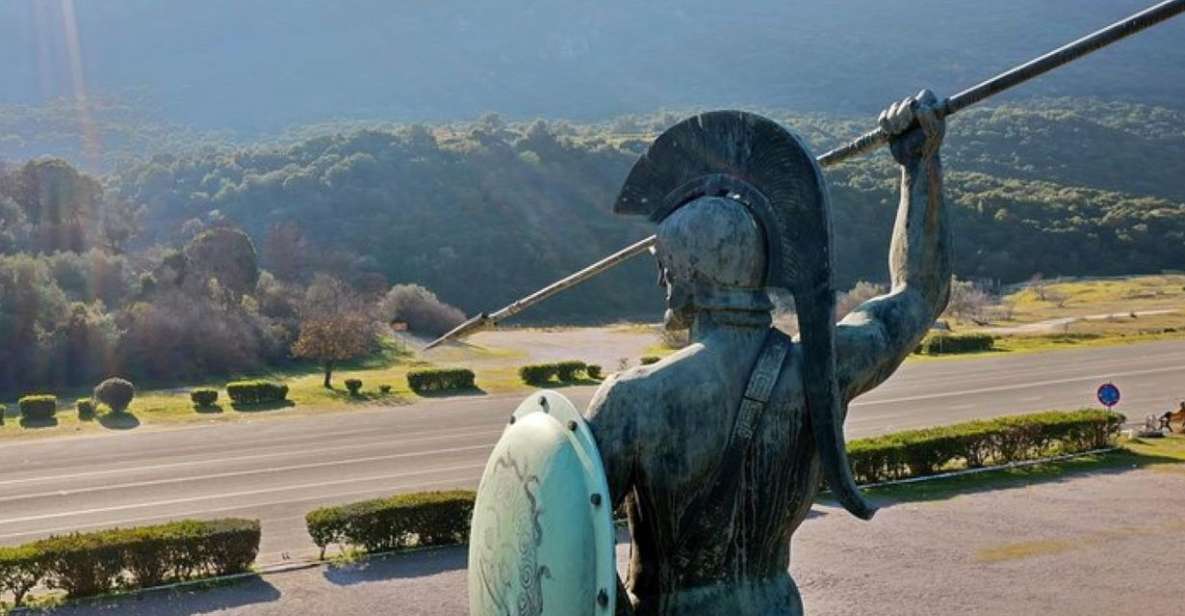
The statue of Leonidas is directly opposite Kolonos Hill, where the surviving Spartans made their final stand. You have about 15 minutes for the statue, followed by a 10-minute photo stop at Thermopylae.
This is a compact visit, but it can be the most memorable part of the day. The statue gives you a clear physical marker for the story, while Kolonos Hill connects the monument with the place where the Spartans died.
I recommend taking a moment before reaching for your camera. The value here is not the number of photographs you take. It is the connection between the statue, the hill, and the decision to remain and fight despite overwhelming odds.
The tour presents Thermopylae as a place tied to sacrifice and freedom. You do not need grand words to understand the point. The hill and the statue do most of the work.
After the main stop, the schedule includes a five-minute break at a natural thermal pool. The timing suggests a quick pause rather than a long bathing visit, so you should not plan the rest of your day around swimming there.
A seaside lunch in Kamena Vourla
On the return journey, the route stops in the coastal town of Kamena Vourla for a traditional Greek lunch by the sea. Lunch is not included in the tour price, so you pay for your own meal.
This is a good place to slow the day down. After several history stops and a long drive, a meal beside the water gives you a more ordinary piece of Greek life. The tour does not specify a restaurant or a set menu, so you should ask the driver what is available on the day.
Because the lunch is separate, budget for it in addition to the entry fee. The stop can also be useful if you want to ask questions about the places you have seen while the day is still fresh.
You should keep your expectations practical. This is a scheduled meal stop, not a dedicated food tour. Its value comes from the setting and the break in the journey.
What the $536 price means
At $536 per person, this is an expensive day trip if you are traveling alone. The cost becomes easier to justify when several people share the private vehicle, particularly if you value door-to-door service and do not want to manage long-distance transport yourself.
The price includes private transportation, hotel, Airbnb, or port pickup and drop-off in Athens, bottled water, and the driver. It does not include the €13 entry fee per person, lunch, personal expenses, airport transportation, or a licensed guide.
The guide surcharge deserves careful thought. An additional €380 is a major cost, but it may be worthwhile for a history-focused group that wants detailed explanations at every site. If you are comfortable reading displays and listening to the driver between stops, you may prefer to keep the basic private trip.
One useful sign is the direct praise for Terry, who was described as accommodating and well informed about the history. Drivers can vary, and the booking information does not guarantee that Terry will be assigned, but his name is worth requesting when you arrange the trip.
The private format also lets you avoid the crowding and fixed seating of a large group tour. You still follow a packed schedule, but pickup and drop-off are simpler, and your party has the vehicle to itself.
Who should book this full-day trip
I would choose this trip if ancient Greek battles are high on your list and you want both Marathon and Thermopylae in one day. It is also a strong fit if you have already seen Athens’s central monuments and want to explore beyond the city without renting a car.
Families and small groups may appreciate the private format, especially with pickup at an Athens hotel or Airbnb. The activity is listed as wheelchair accessible, though you should confirm the practical details of each site before booking.
You should think twice if you want a relaxed day with long meals and plenty of time at each museum. The route covers a lot of ground, and the short stop lengths favor a broad overview over detailed study.
The tour also suits you if you prefer a driver who can share background information but do not require a licensed guide inside every site. If expert interpretation is essential, ask about the €380 guide option before confirming.
Cancellation is flexible up to 24 hours before departure for a full refund, and you can reserve now and pay later. The activity is valid for one day, with departure times based on availability.
Should you book Marathon and Thermopylae?
Book it if you want an efficient, private history day from Athens and understand that the schedule moves quickly. The pairing of the Athenian burial mound, Marathon Museum, Marble Dam, Thermopylae center, and Leonidas statue gives you a clear story from victory to sacrifice.
I would especially recommend it to a group that can share the $536-per-person cost and to anyone who values a private vehicle over a cheaper bus excursion. Ask for Terry if possible, confirm the pickup point, and decide in advance if the licensed guide surcharge fits your budget.
Skip it if you want to linger at archaeological sites or dislike long drives. For the right history-minded visitor, though, this is a meaningful way to place two famous Persian War battles on the map, not just read about them in Athens.
FAQ
How long does the Marathon and Thermopylae trip last?
The experience lasts one full day and begins and ends in Athens.
Where can pickup and drop-off take place?
Pickup and drop-off are provided at hotels, Airbnbs, or ports in Athens. Airport pickup and drop-off cost extra.
Is transportation private?
Yes. The experience includes private luxury transportation and is offered as a private group tour.
Is lunch included?
No. Lunch is not included. The route includes a stop in Kamena Vourla for a traditional Greek lunch by the sea, which you pay for separately.
What are the entry fees?
Entry fees are €13 per person.
Can I add a licensed tour guide?
A licensed tour guide may be available for an additional €380, depending on availability.
Can the driver enter and guide at the archaeological sites?
No. The driver is not licensed to accompany you inside the sites. The visits to the Marathon Tomb, Marathon Museum, and Thermopylae Historical Information Center are self-guided.
Is the tour wheelchair accessible?
Yes. The activity is listed as wheelchair accessible.
You Might Also Enjoy

More Full-Day in Athens
- All Day Cruise -3 Islands to Agistri,Moni, Aegina with lunch and drinks included
★ 5.0 · 4,958 reviews