REVIEW · HERAKLION
Knossos: Labyrinth of Knossos Skip-the-Line Walking Tour
Book on GetYourGuide →Operated by Travel Crete - WeGuide travelers · Bookable on GetYourGuide
Knossos is not just a pile of old stones. It is a huge Bronze Age palace complex where myth and archaeology meet: King Minos, Ariadne, the Minotaur, and the famous Labyrinth all belong to the story you will hear as you walk through the ruins. You will see the so-called oldest throne in Europe, an ancient theater, and water systems that feel remarkably advanced for their age.
I like the skip-the-line entry, since it removes one tiresome step at a busy archaeological site. I also like the focus on practical details, from toilets and bathing rooms to storage areas and workshops. Those clues help you picture Knossos as a working city, not simply a royal backdrop.
The main drawback is the short 1.5-hour format. Knossos covers about 20,000 square meters and includes more than 1,500 interlocking rooms, so this tour gives you a guided introduction rather than time to inspect every corner. The site also has uneven walking and strong sun, making it a poor fit for anyone with serious mobility limits.
In This Review
- Key points at a glance
- Why Knossos is more than a palace ruin
- Meeting your guide beside the entrance
- The first palace and the great rebuilding
- The throne room and the oldest drainage systems
- Courts, workshops, shrines, and storage rooms
- The theater and the public side of Knossos
- Ariadne, the Minotaur, and the Labyrinth
- How much can you see in 90 minutes?
- What the $104 price includes
- Who should book this Knossos walk?
- My verdict: a strong first look at Minoan Crete
- FAQ
- How long does the Knossos tour last?
- Where do I meet the guide?
- How early should I arrive?
- What happens if I arrive late?
- Is the Knossos entry ticket included?
- Is skip-the-line entry included?
- What language is the tour in?
- Is hotel pickup included?
- Are food and drinks allowed inside Knossos Palace?
- Is the tour suitable for wheelchair users?
Key points at a glance
- See the throne linked with King Minos: The tour brings you to Europe’s oldest claimed throne, one of Knossos Palace’s most memorable sights.
- Walk through Minoan engineering: Ancient drainage, toilets, bathing areas, and water-management systems show how advanced the Bronze Age builders were.
- Hear the Minotaur story on site: Your guide connects the ruins with Minos, Ariadne, the Labyrinth, and the monster at the center of the legend.
- Use the 1.5 hours well: A licensed English-speaking guide keeps the visit focused across a very large archaeological complex.
- Skip the ticket-counter queue: Your general admission ticket is included, with entry set for the selected time slot.
- Add a Heraklion transfer if needed: Hotel-area pickup and return can be selected for an extra cost from central Heraklion.
Why Knossos is more than a palace ruin
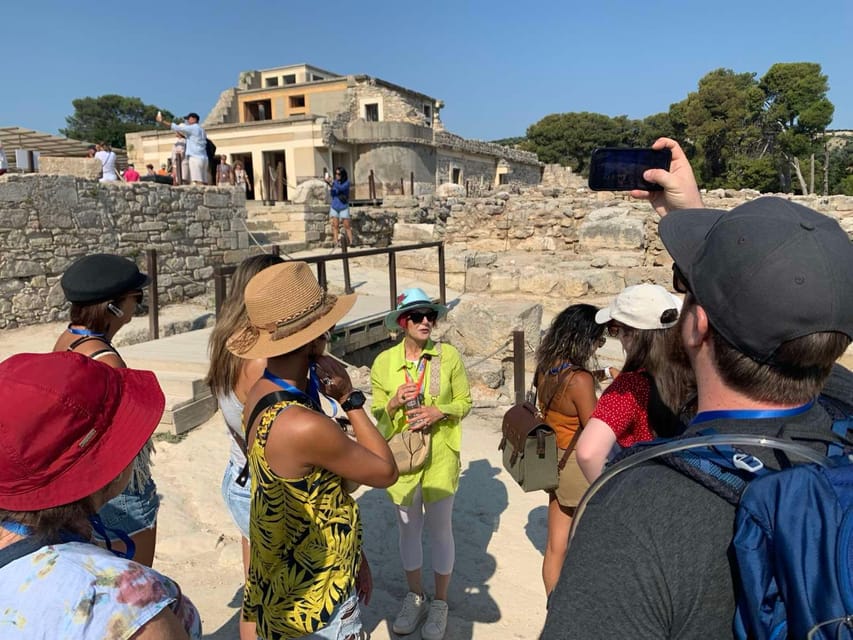
Knossos was the center of Minoan civilization during the Bronze Age. The first palace was built soon after 2000 BC, then destroyed by a major earthquake around 1700 BC. A new palace rose almost immediately, larger and more ambitious, and remained a major center of power for more than 300 years.
That timeline matters because the remains you see are not from one single moment. Knossos was built, damaged, rebuilt, expanded, and used for many purposes over generations. A guide helps you sort out that long story while you are looking at the walls and rooms.
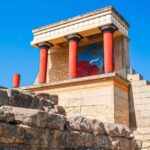
The palace complex covered roughly 20,000 square meters. It had four storeys, large courts, storage rooms, workshops, shrines, ceremonial areas, and domestic quarters. With more than 1,500 rooms connected in a complicated plan, it is easy to understand why later generations connected Knossos with the Labyrinth.
I like this combination of fact and legend. The Minotaur story gives the place an instant hook, but the practical evidence is just as interesting. When you see drainage channels, cleansing rooms, toilets, and bathing areas, you get a better sense of a society that planned for daily life on a large scale.
You can also read our reviews of more walking tours in Heraklion


Meeting your guide beside the entrance
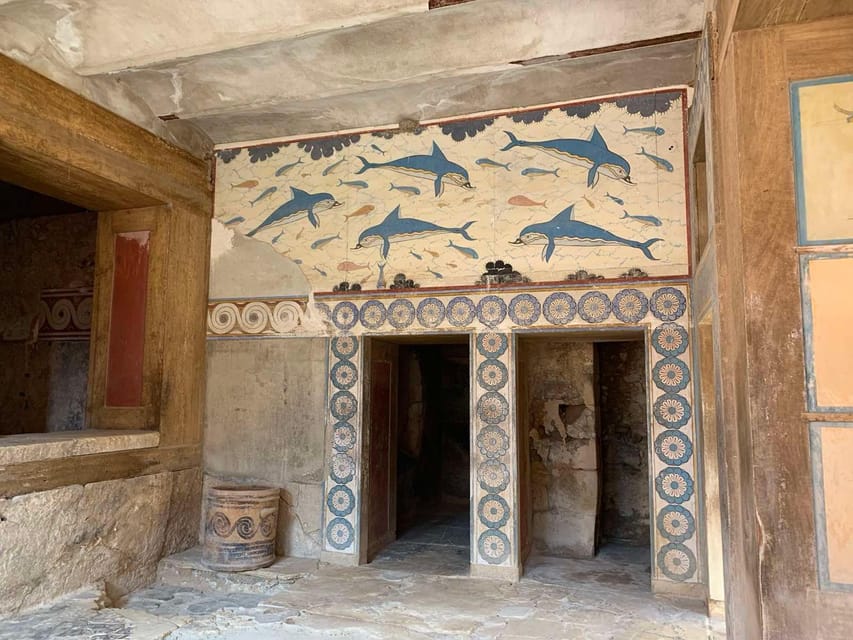
You meet the guide at the main entrance to the archaeological site, in front of the ticket office. Look for a sign marked with the Meeting Point, WeGuide logo. Check-in begins 20 minutes before the tour starts, and that early arrival is worth taking seriously.
The starting time is strict. Your ticket is valid for the selected time slot, and arriving outside the allowed window can mean denied entry and the need to buy another ticket. Knossos is not the place to gamble on a late taxi, a slow lunch, or a last-minute search for the entrance.
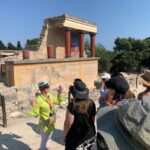
The ticket office meeting point is useful because you do not need to hunt through the ruins for a guide. You receive your entry ticket there and then join the small-group walk. If your group has more than six people, and up to 16, a headset is provided so you can hear the guide more clearly.
That headset detail matters. Knossos can be an open, exposed site, and people spread out quickly when there is something worth looking at. A headset lets you keep your eyes on the ruins instead of constantly edging closer to the guide.
The first palace and the great rebuilding
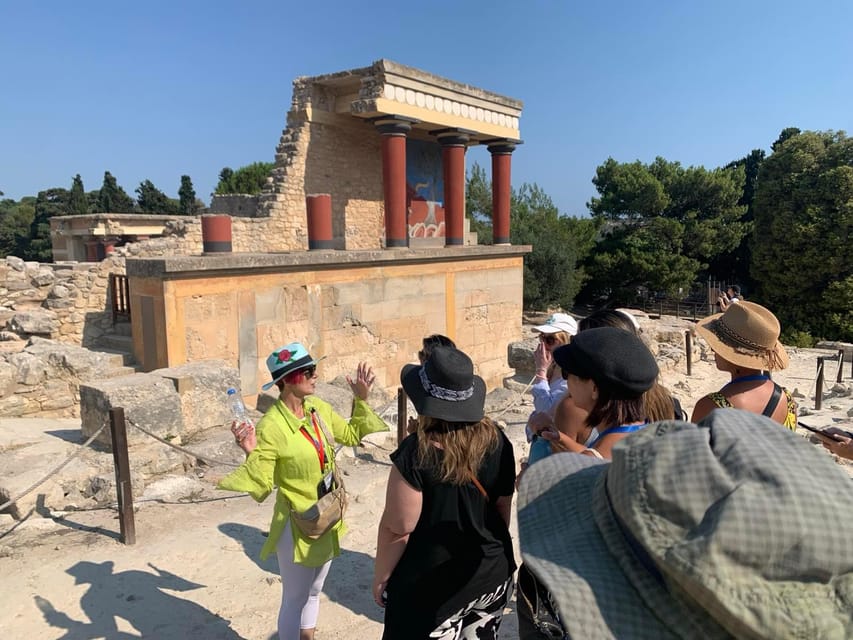
Early in the walk, the guide sets out the basic story of Knossos. The first palace appeared soon after 2000 BC, a period when Minoan Crete was developing large centers of power and trade. Around 1700 BC, an earthquake destroyed it.
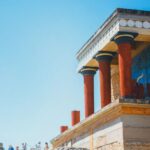
The replacement palace was not a modest repair job. It became the most important and monumental version of Knossos, with spacious courts, specialized work areas, impressive storage rooms, and rooms spread across four levels. For more than three centuries, it served as the leading center of power in Bronze Age Crete.
You will not experience this as a simple chronological lecture. The value of the guide is in linking the dates to the physical layout. A storeroom suggests administration and supply. A workshop points to skilled production. A court suggests ceremony, gathering, or public display.
The site has been shaped by excavation and reconstruction, so it can be difficult to know which surfaces are ancient and which were restored. A guided visit is useful here because you can ask questions about what you are seeing rather than treating every wall as equally original.
The throne room and the oldest drainage systems
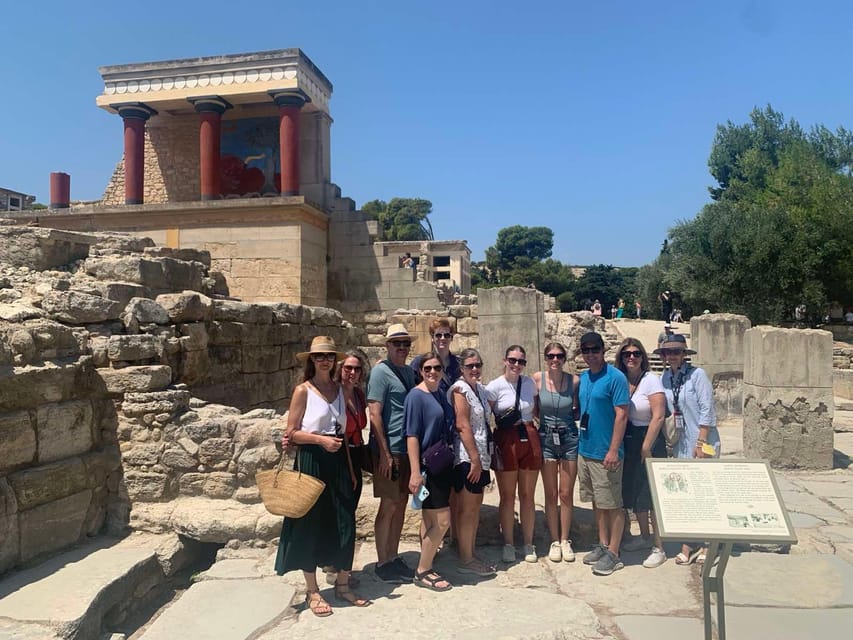
The throne is one of the tour’s headline sights. It is described as the oldest throne in Europe, and the room gives the palace story a human focus. Instead of looking only at broad walls and foundations, you are shown a place associated with authority and ceremony.
The throne itself is not a grand modern chair. Its importance comes from its age, setting, and connection with the ruler of the palace. The guide explains the role of King Minos in both the archaeological story and the later myths, helping you separate what is known from what belongs to legend.
Knossos also offers a surprising lesson in public works. The drainage and water-management systems are among the site’s most striking features, with some described as the oldest of their kind in the world. Toilets, bathing rooms, and cleansing areas show that the builders were thinking about water, waste, and hygiene.
This is where the tour moves beyond the familiar Minotaur tale. I especially like that the visit pays attention to these plain but revealing features. Royal rooms may attract the eye, but drainage channels tell you how the complex functioned day after day.
Courts, workshops, shrines, and storage rooms
The palace was not simply a residence for a king and his family. You will pass areas connected with cult activity, temples, shrines, workshops, and storage. Together, these spaces show a center that handled religion, food, craft production, political authority, and ceremonial gatherings.
The storage rooms are important because they point to planning and administration. Large palace centers need food and supplies, and Knossos had the rooms to hold them. The guide helps you imagine the palace as an organized institution with people working behind the scenes.
Workshops offer another useful angle. The Minoans are remembered for their art and architecture, but the site also shows the skills required to build, maintain, and supply such a large complex. You will hear about the technological ability behind the rooms, frescoes, courts, and water systems.
Shrines and temples bring the spiritual side into view. The tour does not treat Knossos as one uniform building. It presents a collection of spaces with different roles, which makes the palace feel more like a small city than a single royal home.
A few more Heraklion tours and experiences worth a look
The theater and the public side of Knossos
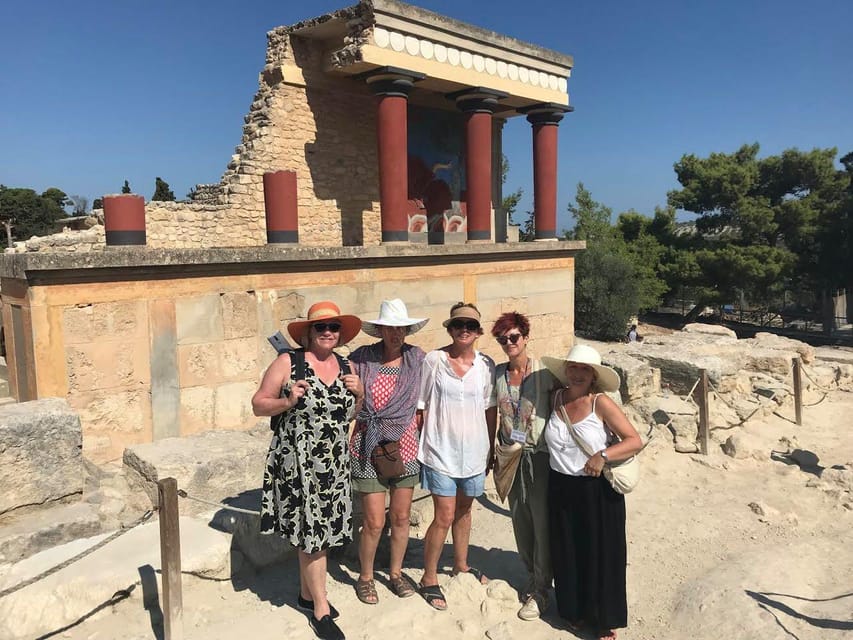
The theater is another major stop. It is described as the oldest theater in Europe, giving you a clear sign that Knossos was built for public activity as well as private power.
A theater area raises useful questions about Minoan society. Who gathered here? What ceremonies or performances took place? How did the court use public space to bring people together? Your guide supplies the historical setting while the layout lets you think about how the space may have worked.
The theater is also a welcome change of scale. Much of Knossos can feel like a maze of rooms and corridors. A public court or theater shows how the palace opened outward for events, ceremonies, and shared occasions.
Do not expect a complete theater building in the modern sense. You are visiting an archaeological site, and the remains require some imagination. That is another reason the live explanation earns its place in the tour price.
Ariadne, the Minotaur, and the Labyrinth
The myth of the Labyrinth is inseparable from Knossos. Your guide tells the story of King Minos, Princess Ariadne, the Minotaur, and the maze built to contain it. Hearing the tale while walking through a complex of more than 1,500 connected rooms makes the legend feel unusually well matched to the setting.
Still, you should treat the story as mythology rather than a literal guidebook to the ruins. The tour works best when it lets the legend add atmosphere without replacing archaeology. You can enjoy the drama of Theseus and the Minotaur while also looking closely at storage rooms, drainage, workshops, and ceremonial spaces.
The palace’s confusing layout probably helped later audiences imagine a maze. Multiple levels, interlocking rooms, courts, and passages would have made the complex hard to understand at a glance. The guide connects that physical confusion with the myth in a way that is easy to follow.
I like this balance because Knossos can otherwise become either too academic or too fanciful. The story gives children and first-time visitors a way in, while the architecture and engineering give adults plenty to think about.
How much can you see in 90 minutes?
The scheduled visit lasts 1.5 hours. That is long enough for a structured route through the principal highlights, but not enough for a slow, independent study of the entire complex.
You should expect a brisk pace with regular stops for explanation. The guide’s job is to choose the most useful parts of the site and explain what they mean. If you like a clear story and prefer not to spend time wondering which ruins matter most, this format works well.
If you are an archaeology enthusiast who wants to linger over every wall, inscription, or architectural detail, the time limit may feel tight. You can still use the tour as an orientation, then ask about any remaining time for independent exploration, but the supplied details do not promise a separate free period.
Comfortable shoes are essential. The site involves significant walking, and the ruins do not offer an easy, flat indoor route. Bring water, sunscreen, and a sun hat. Food and drinks are not permitted inside the palace, so plan to eat before or after the visit.
What the $104 price includes
The listed price is $104 per person. It includes the general Knossos admission fee, stated as €20, plus skip-the-ticket-line service, a licensed guide, applicable VAT, and the guided small-group experience.
That makes the price easier to assess. You are not paying only for entry to the ruins. You are also paying for a guide who organizes the site’s complex history, helps you find the main sights, and explains details that are easy to miss on your own.
The price is strongest for people who value time and context. If you are already in Heraklion and comfortable reading site information independently, you may prefer to buy admission alone. If you want to understand what you are seeing and avoid the ticket queue, the added cost has a practical purpose.
Transfers are not part of the standard price. Pickup and return from the Heraklion city-center area can be selected as an add-on for an extra charge. That may simplify the visit if you do not want to arrange your own transport, but check that option carefully when booking.
Who should book this Knossos walk?
This tour suits first-time visitors to Knossos, history fans who want a clear introduction, and anyone who prefers a guide to a self-led visit. It is also a good choice if your Crete schedule is tight and you want the main story in a fixed 90-minute window.
Families may appreciate the Minotaur and Labyrinth angle, though the walking, heat, and archaeological setting still require preparation. Bring water and sun protection, and do not count on buying food inside the palace.
The tour is not suitable for pregnant women, people with mobility impairments, or wheelchair users. Smoking is not allowed on the premises. If you have difficulty walking over uneven archaeological ground, this is not a sensible booking.
The tour is conducted in English. A headset is supplied when the group reaches more than six people, with group sizes listed up to 16. That is small enough to keep the route organized without promising a private visit.
My verdict: a strong first look at Minoan Crete
I would book this tour if I wanted a focused introduction to Knossos and did not want to lose time at the ticket counter. The strongest parts are the guide’s explanation of the palace layout, the mix of famous sights and everyday systems, and the way the Minotaur legend is tied to the actual ruins.
I would think twice if I wanted a long, leisurely archaeological study or needed an accessible route. Ninety minutes goes quickly at a site this large, and the walk can be demanding in the sun.
For most first-time visitors staying in or near Heraklion, the package offers a useful balance of entry, structure, and interpretation. Arrive 20 minutes early, wear sturdy shoes, and choose the optional transfer only if it genuinely makes your day easier.
FAQ
How long does the Knossos tour last?
The guided walking tour lasts 1.5 hours.
Where do I meet the guide?
Meet next to the entrance of the archaeological site, in front of the ticket office. The guide will hold a sign with the Meeting Point, WeGuide logo.
How early should I arrive?
Check-in begins 20 minutes before the scheduled start time. Arrive on time because entry is tied to the selected time slot.
What happens if I arrive late?
Arriving outside the permitted time window can result in denied entry. You may then need to purchase a new entry ticket.
Is the Knossos entry ticket included?
Yes. General admission to Knossos Palace is included, listed as a €20 ticket.
Is skip-the-line entry included?
Yes. The tour includes a skip-the-ticket-line service, so you avoid the queue at the ticket counter.
What language is the tour in?
The live guided tour is conducted in English.
Is hotel pickup included?
Hotel pickup and return are not part of the standard tour. A transfer from or to the Heraklion city-center area is available as an extra-cost add-on if selected.
Are food and drinks allowed inside Knossos Palace?
No. Food and drinks are not permitted inside the archaeological site.
Is the tour suitable for wheelchair users?
No. The experience is not suitable for wheelchair users, people with mobility impairments, or pregnant women. Comfortable shoes are required because the visit involves significant walking.