REVIEW · NAFPLIO
Private Walking Tour with a Local Tour Guide in Nafplio
Book on Viator →Bookable on Viator
Nafplio is best understood on foot. I love how this tour turns architecture you can see into a clear story of Venetian and Ottoman rule and Greek independence, and I also love the pacing that keeps you comfortable as you move from square to square. One thing to consider: it’s a walking tour where you mainly look at major sights from the outside, so it’s not built around going deep inside every ticketed museum or fortress.
This is a private experience for your group only, offered in English (and Greek), with hotel pickup available within Nafplio. Expect about 2 to 3 hours, a mobile ticket, and a satisfying mix of history, viewpoints, and a couple of treats along the way.
In This Review
- Key Highlights You’ll Actually Feel
- Entering Nafplio’s Story: What This Private Walk Really Does
- Land Gate and Agios Spyridonas: The Start of the City’s Control-and-Conflict
- Trianon Mosque and the Venetian Warehouse: When Styles Don’t Match the Timeline
- Syntagma Square and Vouleftiko: A Square Where Power Kept Changing Its Name
- Filellinon Square, Bourtzi, and the Five Brothers: Harbor Views Without the Detour
- Akronafplia Fortress: A Viewpoint With Prison History Attached
- Nafplio City Buildings and Kapodistrias Square: Revolution Landmarks in Everyday Form
- Church of Panaghia and the Otto-Era Mansion: Faith and Power Side by Side
- Kolokotronis Park Finale: One Statue That Teaches the Whole Revolution
- What’s Included, What You Skip, and Why That Choice Can Be Good
- Price and Value: Is $84.11 Worth It?
- Should You Book This Nafplio Private Walking Tour?
- FAQ
- How long is the private walking tour in Nafplio?
- Is this tour private or shared?
- What languages are offered by the guide?
- Where does the tour start and end?
- Is pickup included?
- What’s included during the tour?
- Are entrance tickets included for museums and castles?
- Is breakfast included?
- What are the operating days and times?
- What is the cancellation policy?
Key Highlights You’ll Actually Feel
- Land Gate details that explain how Nafplio controlled entry by land
- The Agios Spyridonas story tied to the assassination of Ioannis Kapodistrias
- Trianon and Venetian building facades that show layered cultures at street level
- Syntagma Square name-changes that map political shifts over centuries
- Harbor and fortress views without needing a full boat stop
- Refreshments included, including bottled water, snacks, and ice cream
Entering Nafplio’s Story: What This Private Walk Really Does
If you’ve ever visited a historic town and thought, I see buildings, but I don’t get the logic—this is the fix. The route is set up so you don’t just read about Nafplio’s past. You walk through it.
You’ll move from the city’s old defenses to the squares where power was staged, then up toward the forts where control mattered. Along the way, the guide connects big events to very specific places—so the assassination at Agios Spyridon isn’t just a date, and the Ottoman-era structures aren’t just pretty walls. They become part of a timeline you can hold in your head.
This also works well for first-time visitors. Many people book it early because it helps you understand how Nafplio is laid out. The center makes sense, the waterfront makes sense, and the hilltop fort makes sense—before you start wandering on your own.
You can also read our reviews of more walking tours in Nafplio

Land Gate and Agios Spyridonas: The Start of the City’s Control-and-Conflict
The tour begins at the Land Gate, built in 1708 by a French engineer. That date matters less than what the gate tells you about how Nafplio functioned. It was essentially the city’s only land entrance, and it would close at sunset. If you missed the closing time, you weren’t passing through—you were forced to spend the night outside the walls, usually in Pronia.
Even the details around the gate are part of the lesson:
- a moat filled with seawater ran along the eastern wall
- access involved a wooden drawbridge
From there, you shift to a darker chapter at the Church of Agios Spyridonas. On September 27, 1831, Ioannis Kapodistrias—first Governor of liberated Greece—was shot dead near the church entrance after arriving for Mass. The attackers were the Mavromichali brothers, Konstantinos with a pistol and Georgios with a knife.
This stop is emotionally heavier than the others on the walk, but it’s also useful. You’ll see how Nafplio sits inside modern Greek history, not just ancient or medieval romance. And you’ll understand why people still speak about this city as more than a postcard stop.
Trianon Mosque and the Venetian Warehouse: When Styles Don’t Match the Timeline

One of the tour’s smartest moves is using architecture as a shortcut to history. In Nafplio, the city layers don’t line up neatly, so you need guidance to read what you’re seeing.
You’ll get that at the building known today as the Trianon, named after a cinema that used to be housed there. This structure is described as the oldest mosque still surviving in the city, strongly influenced by Byzantine church architecture. It dates from the first Turkish occupation era (likely the second half of the 16th century), and it’s possibly the only surviving building from that period.
Then you continue to another key Venetian marker: the building that houses the Archaeological Museum. Even without going inside on this tour, you’ll learn what matters on the outside. The façade includes a Latin inscription stating it was constructed in 1713 by Agostino Sagredo, Venetian Superintendent of the Fleet, originally as a warehouse for the fleet. So you’re not just looking at a museum building—you’re standing in a past commercial and maritime function.
What I like here is that it teaches you a method. After this, when you spot Venetian or Ottoman elements later in town, you’ll know what questions to ask:
- Who controlled this place at the time?
- What did they need it for?
- Why would the architecture look the way it does?
Syntagma Square and Vouleftiko: A Square Where Power Kept Changing Its Name
Next up is Syntagma Square, Nafplio’s main historic center. It’s one of those places where the present is meaningful, but the past keeps interrupting.
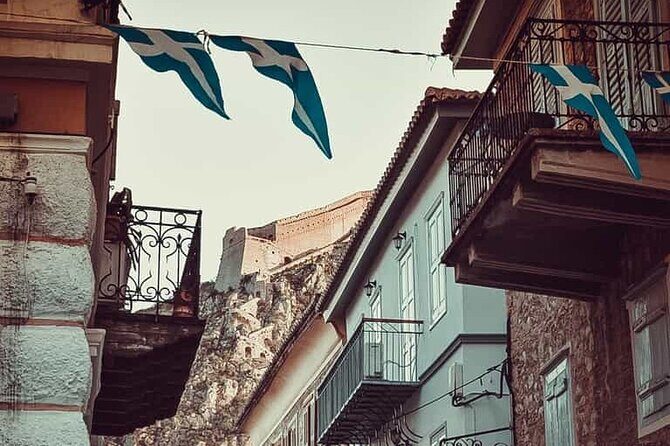
You’ll hear that the Turkish commander of the Peloponnese, Mora-Pasha, is assumed to have had his seraglio there from around 1540, during the first Turkish occupation. After that, the square keeps changing identity through the centuries. In the 19th century it was known as Platanos Square (after the plane tree), then Ludwig Square, and later Syntagma Square after the 3 September 1843 revolution when Greeks demanded a constitution. It even picked up other names connected to political shifts.
Then you move to Vouleftiko (Old State House) at the south-west sector of Syntagma Square. It’s tied to Greek political history, and it also preserves an earlier purpose: dating from 1730, it was originally built as a mosque during the second Turkish occupation, and later served as the place where the parliament of rebellious Greeks met.
This part of the tour is valuable because it makes politics feel physical. It’s one thing to say, Greece fought for control. It’s another to stand in a building that switched function as the rulers switched.
Filellinon Square, Bourtzi, and the Five Brothers: Harbor Views Without the Detour

At Filellinon Square, you’ll take in the atmosphere of an old customs area dating from 1830. The emphasis here is visual and situational—how the street patterns and building types create the feel of a trading town that grew around sea access.
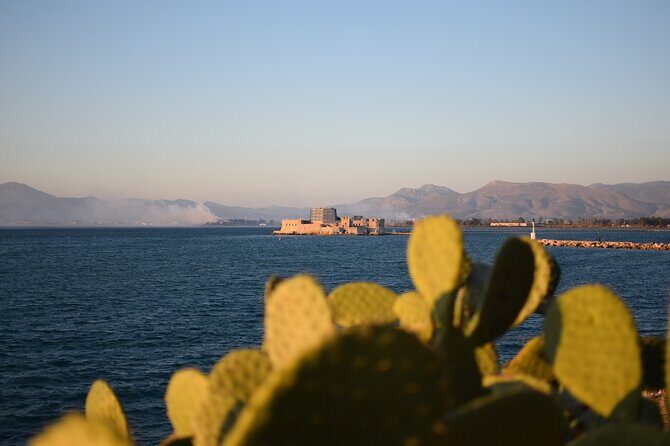
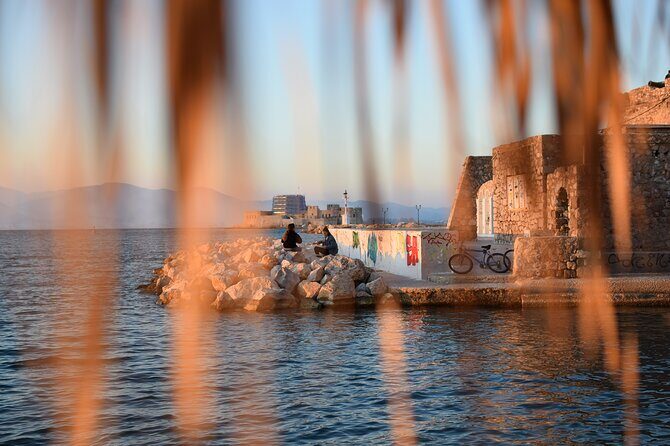
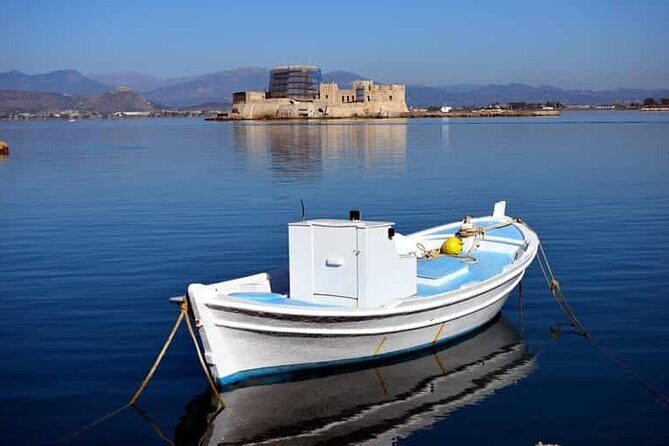
Then comes a harbor moment: Bourtzi. In this tour you admire it and talk about it, but you don’t actually visit the islet. The Venetian castle name Castello dello Soglio is part of the story, along with its mixed uses over time (prison, hotel, concert venue are mentioned). Even without setting foot there, you get the key takeaway: Nafplio’s maritime defenses shaped the skyline.
Next you’ll see Five Brothers, the Venetian bastion cannons that protected the western side of the town and the harbor entrance. The tour highlights that this bastion is the only Venetian one that escaped destruction. Standing near it, you can connect the dots back to the Land Gate at the start: Nafplio controlled land entry and sea entry differently, but the goal was the same—control who came in, and when.
You can also read our reviews of more guided tours in Nafplio

Akronafplia Fortress: A Viewpoint With Prison History Attached
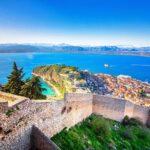
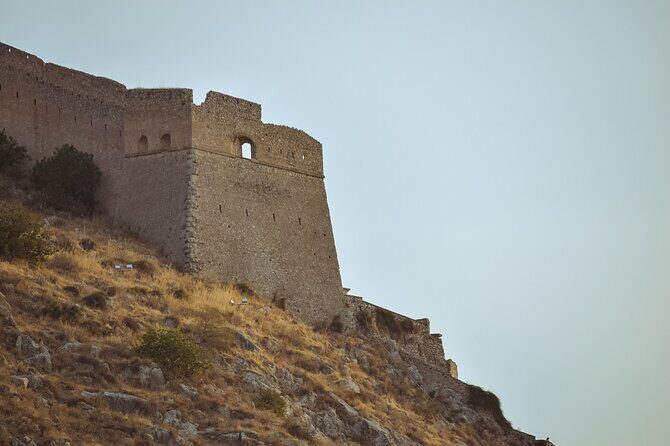
One of the most memorable parts of the route is Akronafplia Fortress, the oldest of Nafplio’s three castles. It’s described as originally built by Romans and Byzantines, then associated with the Turkish name Ich-Kale meaning inner castle.
Here’s why this stop works: you get both the “why” and the “so what.”
- It once limited the town to people who could be inside the walls
- It later functioned as a Greek political prison from 1936 to 1956
Then you reach one of the best payoff moments: a panoramic viewpoint where the city and Argolic Gulf open up in one sweep. You’ll notice details like prickly pear cacti adding that unmistakably Mediterranean texture. It’s the kind of view you remember because it feels slightly out of reach—like you had to earn it by walking upward.
Also, note the pace here matters. The route is built for strolling, but fortress areas can mean uneven stone and a bit of elevation. If your legs are less cooperative, bring your time and take pauses when the guide offers them.
Nafplio City Buildings and Kapodistrias Square: Revolution Landmarks in Everyday Form

As the walk continues, it threads from monuments into civic life.
At Dimarchio Nafpliou, you’ll recognize the cluster of important public buildings around Three Admirals Square—like the first high school and the town hall—and how Grand Street (King Constantine) runs past it as a main, tour-friendly artery.
Then you head to Platia Kapodistria, where the tour centers on Ioannis Kapodistrias again—this time with a lighter moment. The plan includes ice cream in connection with Kolokotronis Park, so you get a break between heavy history and the final monument stop.
This is practical tour design. If you’ve ever done long walks that feel nonstop in tone, this one uses contrast on purpose: gravity, then sweetness, then sculpture.
Church of Panaghia and the Otto-Era Mansion: Faith and Power Side by Side
Near the end, the tour shifts from squares and fortifications into places of worship and the homes of people who shaped policy.
Church of Panaghia is described as one of the oldest and most beautiful churches in the city. You’ll learn how it changed shape across occupations:
- the original dates from the 15th century around the first Venetian occupation
- around 1700, during the second Venetian occupation, it took its current form as a three-aisled basilica
- the interior includes a wooden chancel in the eptanisian style created in the 19th century
- the pulpit and bishop’s throne match that style
- the bell tower dates from 1907
You also connect it to local patron traditions. The church celebrates Aghios Anastasios, patron saint of the city, and notes the yearly procession of the icon on February 1.
Then you pass by an Otto-era mansion tied to Count Joseph Ludwig von Armansperg, president of the regency in Nafplio during 1833 and 1834. This building dates originally from the second Venetian occupation, was rebuilt in 1831, and had a second-floor addition. The story doesn’t shy away from controversy: witnesses described Armansperg’s policies as autocratic and conspiratorial in nature. But the mansion’s social role is also part of the interest—hosting receptions and balls with piano accompaniment is mentioned.
Even if you don’t know the names yet, this stop helps you understand a key point about Nafplio: the city’s history isn’t only battles and dates. It’s also rooms where decisions were discussed and status was performed.
Kolokotronis Park Finale: One Statue That Teaches the Whole Revolution
The tour ends at Kolokotronis Park, dominated by the monumental statue on horseback of Theodoros Kolokotronis, the hero of the Greek revolution. The guide shares a lot that turns the sculpture into a story you can read visually.
You’ll learn:
- the sculptor was Lazaros Sochos, from Tinos, created in Paris
- the statue is a copper alloy placed on a monumental stone pedestal
- Kolokotronis is shown holding the reins with his left hand and indicating forward with his right
The tour also mentions the high cost for acquiring the statue and that a nationwide appeal was necessary to raise funds. That detail matters because it explains why public monuments like this are never just decoration. They’re meant to define identity—and to keep doing that long after the revolution-era figures are gone.
By the time you finish here, you’ve seen a full loop: city defenses, political flashpoints, layered occupations, and a final symbol of national pride.
What’s Included, What You Skip, and Why That Choice Can Be Good
This tour includes bottled water, snacks, ice cream, live guide language in English or Greek, and a surprise gift.
One practical point that shapes your expectations: it’s a walking route where you do not enter sights with admission fees. The plan specifically says it does not enter the Archaeological Museum, Bourtzi Castle, or the War Museum. You do enter the other sights (unless closed).
That can be a drawback if you came expecting museum time. But it can also be a benefit if you want a guided overview and maximum street-level context. You’ll still get a strong sense of what you should return to later with a ticket if something truly hooks you.
It’s also worth knowing the walking tour format means you’re not stuck waiting in lines. Given the route covers many landmarks, that matters.
Price and Value: Is $84.11 Worth It?
At $84.11 per person for roughly 2 to 3 hours, the value depends on how you travel.
If you’re the type who likes to understand what you’re looking at—why things were built, who controlled them, how the city worked—this kind of private guide experience tends to pay off fast. You’re not just seeing Nafplio. You’re being taught how to read Nafplio.
If you only want casual sightseeing with minimal talking, the price might feel steep for a walk. But this isn’t a random stroll. It’s designed as a connected route, and the guide’s role is central.
A nice sign: it has a high overall rating (4.9) and a strong recommendation rate. And multiple guides are described as teachers—clear, story-driven, and willing to adjust pacing. That matters most for people who want the city without feeling rushed.
Should You Book This Nafplio Private Walking Tour?
Book it if you want the fastest way to get your bearings in Nafplio and you enjoy history that connects directly to buildings and street corners. This is especially great for a first day, for couples, and for anyone who likes guided interpretation more than solo wandering.
Skip it (or pair it with extra museum time) if you mainly want ticketed interiors like big museums or fortress visits, because this route focuses on seeing and understanding rather than spending extra hours inside venues.
If you do book, a simple strategy will help: wear comfy shoes, plan for a bit of uphill walking at the fortress, and come ready for both lighter views and the heavier story tied to Kapodistrias. That mix is what makes Nafplio feel like more than a pretty harbor town.
FAQ
How long is the private walking tour in Nafplio?
It runs about 2 to 3 hours.
Is this tour private or shared?
It’s private. Only your group participates.
What languages are offered by the guide?
The live guide language is available in English and Greek.
Where does the tour start and end?
It starts at Land Gate (Unnamed Road, Nafplio 211 00, Greece) and ends back at the meeting point.
Is pickup included?
Pickup is offered from your hotel inside the city of Nafplion, the Port, or the central meeting point at Land Gate.
What’s included during the tour?
Included items are bottled water, snacks, ice cream, and a surprise gift.
Are entrance tickets included for museums and castles?
No. This is a walking tour and it does not enter sights with admission fees, including the Archaeological Museum, Bourtzi Castle, and the War Museum. The tour does enter other sights if they are open.
Is breakfast included?
No, breakfast is not included.
What are the operating days and times?
It’s listed as running Monday to Tuesday from 2:00 PM to 10:00 PM, within the date range 09/01/2025 to 06/19/2026.
What is the cancellation policy?
You can cancel for a full refund up to 24 hours in advance of the experience start time. If you cancel less than 24 hours before, the amount paid isn’t refunded.