REVIEW · ATHENS
Acropolis Group Tour in German or Dutch
Book on Viator →Operated by Little Owl Tours · Bookable on Viator
The most memorable part of this Acropolis tour is its storytelling. Instead of simply naming temples, the guide connects them to Athena, Poseidon, Dionysus, ancient theater, Roman Athens, and the strange visual tricks built into Greek architecture. You finish on the hilltop with a 360-degree view across Athens.
I like the German or Dutch-language choice, especially if you want more than a quick English overview. I also like the small-group limit of 20, which makes it easier to hear the guide and ask a question. The main catch is price: the advertised $46.26 covers the guide, while the €30 adult entrance fee is extra.
In This Review
- Key details at a glance
- Why the Acropolis works best with a guide
- Meeting at the Acropoli metro station
- Theatre of Dionysus and the beginning of Greek theater
- Temple of Athena Nike, a small monument with a modern link
- Passing through the Propylaea
- The Parthenon and its clever curves
- The Erechtheion and the six Caryatids
- Herod Atticus Odeon and the final view
- What the €46.26 price really covers
- Is this a good choice for families?
- Weather, cancellation, and practical limits
- Who should book this Acropolis tour?
- FAQ
- What language is the Acropolis tour conducted in?
- How long does the Acropolis tour last?
- How large is the tour group?
- Is the Acropolis entrance fee included?
- Where does the tour begin?
- Where does the tour end?
- Is hotel pickup included?
- Are food and drinks included?
- What happens if the tour is canceled because of bad weather?
- Should you book it?
Key details at a glance
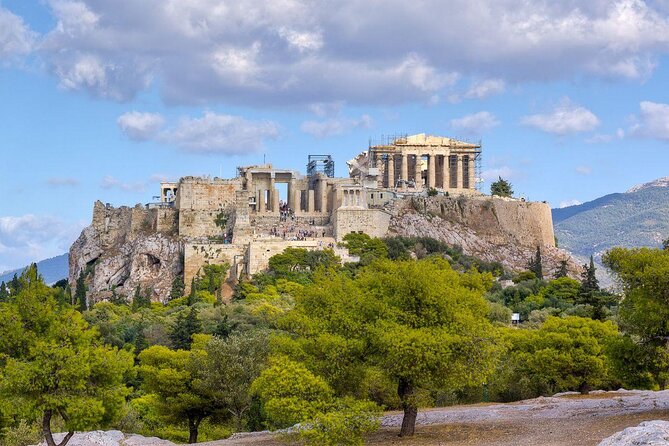
- German or Dutch commentary: Choose the language that lets you follow the myths, architectural details, and historical explanations most easily.
- A 90-minute route: The visit covers the Acropolis and several major monuments without taking up your entire day.
- Small groups of up to 20: This is more manageable than a large crowd around the guide.
- A licensed guide: You receive guided interpretation rather than simply walking through the site alone.
- The entrance fee is separate: Adults pay €30 for admission, arranged through the tour, in addition to the advertised tour price.
- A family-friendly guide style: Jessica is specifically praised for being patient with children and telling interesting stories.
Why the Acropolis works best with a guide
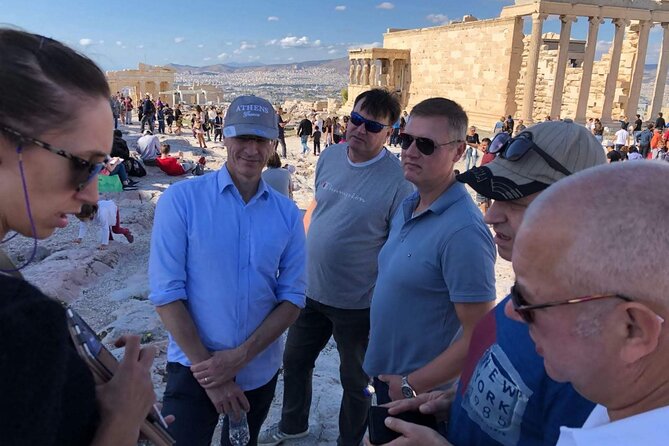
The Acropolis is famous enough that you can recognize the Parthenon from a distance. The harder part is understanding what you are seeing once you reach the top. Several temples share the same pale marble, and the ruins can look like a collection of columns unless someone points out the design choices and the stories behind them.
That is where this tour earns its place. The guide gives you a clear route from the meeting point near the Acropoli metro station to the site entrance, then explains the monuments in German or Dutch. The goal is not just to identify each building, but to show how religion, politics, theater, mythology, and Roman-era wealth shaped the hill.
The group size matters here. With no more than 20 participants, you are still part of a group, but you are less likely to lose the guide in the crowd. You can also hear explanations at busy stops such as the Parthenon and Erechtheion.
The tour lasts about 1 hour and 30 minutes. That is enough time for a focused introduction, but not enough for a slow archaeological study. I would treat it as a strong first visit to the Acropolis, then return on your own if you want longer looks at the stones, museum displays, or views.
You can also read our reviews of more tours and experiences in Athens.


Meeting at the Acropoli metro station
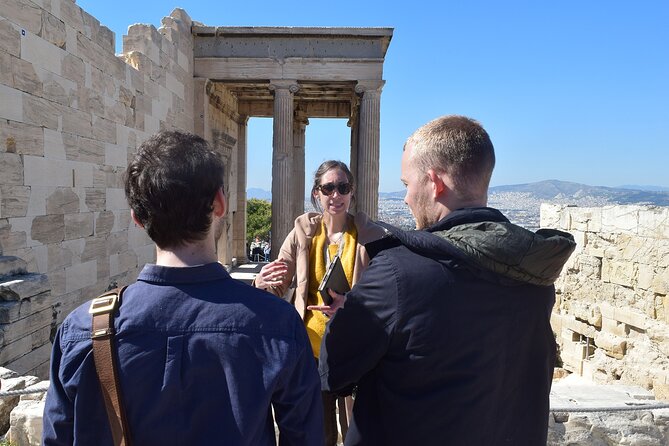
The guide meets you at the exit of Acropoli metro station marked Makriyianni or Dionysiou Areopagitou. This is a useful starting point because the route begins near the pedestrian approach to the Acropolis rather than at your hotel.
You should arrive with the meeting point clearly saved on your phone. The tour ends on top of the Acropolis Hill, so it is not a round-trip activity and does not include hotel pickup or drop-off. That open-ended finish can be useful: you can continue looking around the summit, visit another nearby sight, or make your own way onward.
Food and drinks are not included. Bring a bottle of water, which is particularly sensible for a sunny walk over exposed stone. The tour information specifically recommends water, and the Acropolis is not a place where you want to discover that you forgot it halfway up.
Theatre of Dionysus and the beginning of Greek theater
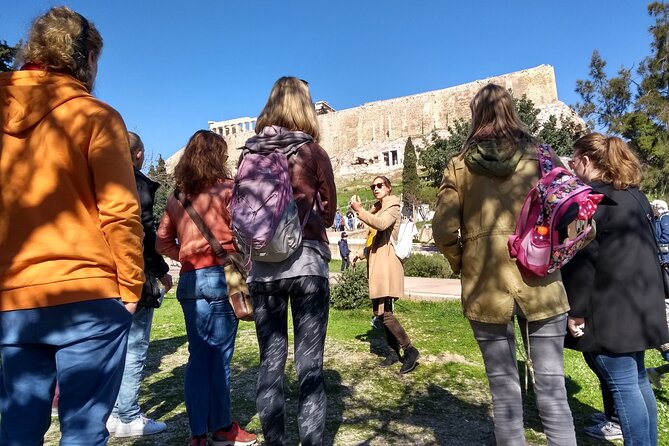
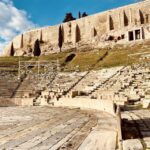
The Theatre of Dionysus Eleuthereus is one of the first important stops. The visit gives you a chance to connect the physical seats and stage area with the origins of ancient Greek theater.
The guide explains how theater developed from the worship of Dionysus, the god of wine. That detail gives the site a human angle. This was not only a formal religious space, but also a place where performance grew from ceremony into drama.
Look closely at the marble seats. Some have names cut into them, a small detail that makes the ancient setting feel more personal. The planned stop lasts about 15 minutes, enough for the basic story and a look at the surviving structure.
The admission fee is not included at this stop or any other point on the route. You pay the site entrance separately, with the adult cost listed as €30.
Temple of Athena Nike, a small monument with a modern link
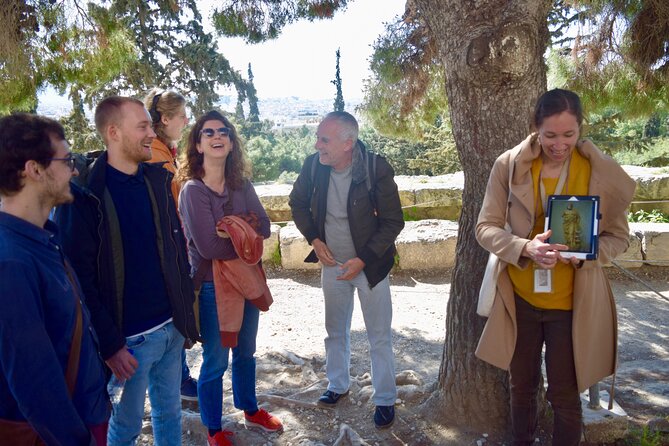
The Temple of Athena Nike receives about five minutes, but its size makes it easy to remember. It is the smallest temple on top of the Acropolis and was dedicated to Nike, the goddess of victory.
The guide also explains how the name Nike inspired a well-known sports brand. It is a quick modern connection, but a useful one for families and younger participants because it ties a familiar name to an ancient religious figure.
The short stop reflects the monument’s scale. You should not expect a long independent visit here, but you will get the key point: this compact temple held an important idea for the ancient city, victory under the protection of a goddess.
Passing through the Propylaea
The Propylaea is the monumental entrance gate to the Acropolis. The planned explanation takes about five minutes, yet this is an important transition in the visit because you pass through it on the way to the summit.
The guide points out the huge marble blocks as you move through the entrance. Seeing those stones close up helps you grasp the practical challenge of building on the hill, even before you reach the Parthenon.
This is also where the tour’s route becomes especially clear. You are not jumping randomly between ruins. You move through the ceremonial gateway and into the main collection of temples at the top.
- All Day Cruise -3 Islands to Agistri,Moni, Aegina with lunch and drinks included
★ 5.0 · 4,958 reviews


The Parthenon and its clever curves
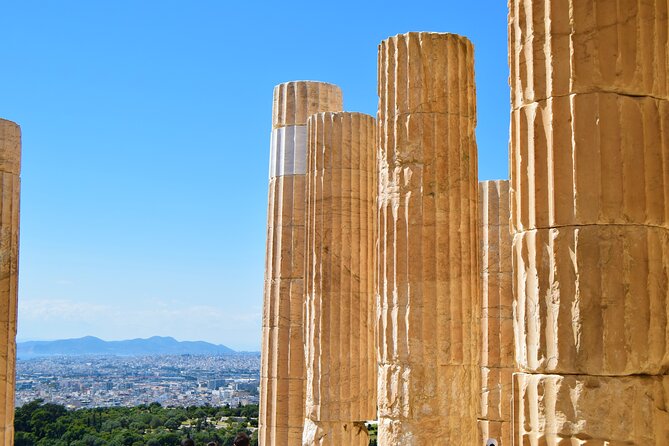
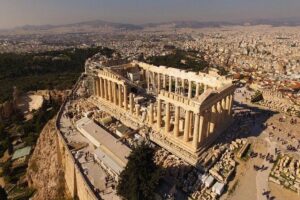
The Parthenon gets the longest single explanation, about 20 minutes. Dedicated to Athena, it is the largest temple on the Acropolis and the building most people have come to see.
The useful surprise is that the Parthenon does not rely on perfectly straight lines. The guide explains its subtle architectural adjustments, which helped create the appearance of balance and precision. This is the kind of detail easy to miss when you only take photographs from a distance.
The temple also influenced architecture around the world. A good guide can help you look past the familiar outline and notice why the building became such a lasting model.
Twenty minutes is enough to cover the central ideas, but the Parthenon deserves patience. If you want time for a careful circuit, close study of the surviving decoration, or extensive photographs, you may need to remain after the guided portion ends.
The Erechtheion and the six Caryatids
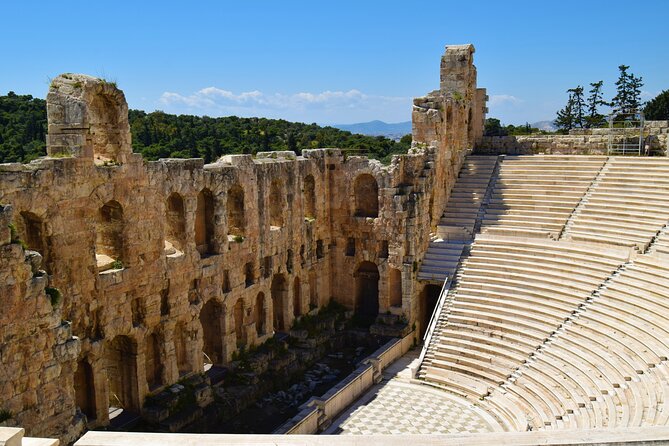
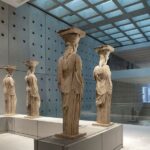
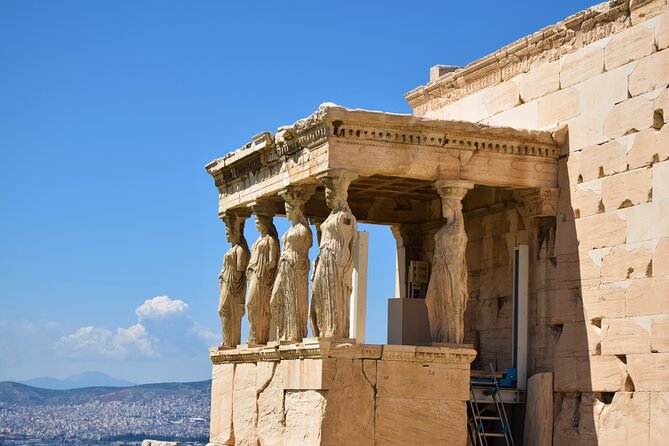
The Erechtheion offers a different mood from the Parthenon. Its most famous feature is the porch supported by the Caryatids, female figures used as columns.
The guide explains what happened to one of the six columns and where it is today. This gives you a specific story to remember, rather than a general description of an ancient temple.
You also hear the myth of Athena’s contest with Poseidon. Their battle helps explain why this part of the Acropolis carries such strong links to the city’s identity and patron goddess.
The stop lasts about 10 minutes. That is enough for the Caryatids, the Athena and Poseidon story, and the missing figure’s history, though again, you may want extra time afterward if you enjoy architectural details.
Herod Atticus Odeon and the final view
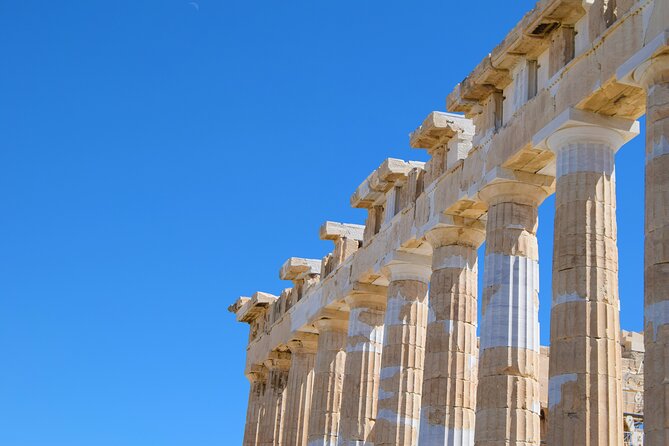
The Herod Atticus Odeon is a restored Roman concert hall built in AD 161 by the wealthy Roman Herodes Atticus in memory of his wife, Regilla. Its presence adds an important later chapter to the Acropolis. The hill was not frozen in the age of classical Athens; it continued to matter during Roman rule.
The guide points out that the venue still hosts major summer performances, including artists such as Sting and Patti Smith. That link between ancient stone and modern music makes the site feel active rather than purely archaeological.
The planned explanation takes about 10 minutes. Depending on the exact flow of the visit, this stop helps round out the historical picture before you finish on the hilltop.
The final reward is the view. From the top, you get a 360-degree panorama over Athens. The view is one reason this tour works well early in your stay: it helps you understand the city’s scale and position before you explore its neighborhoods.
What the €46.26 price really covers
The listed price is $46.26 per person, but you need to add the €30 adult entrance fee. The tour provider arranges the entrance fees, yet admission is still not part of the advertised price.
That makes the total cost higher than the first figure suggests. In return, you receive a licensed guide, a planned route, and language-specific commentary for about 90 minutes. The value depends on how much you want interpretation.
If you already know the Acropolis well and prefer to move at your own pace, the extra guide cost may not suit you. If mythology, architecture, and historical context are central to your visit, the guide can make the admission fee work harder.
The German or Dutch option is also important. A tour in the language you understand best is more useful than a cheaper tour where you miss the explanation. This is especially true for the Parthenon’s design details and the connected myths around Athena, Poseidon, and Dionysus.
The tour is booked an average of 63 days ahead, which suggests you should not leave it until the last minute if you need a particular date or language. Confirmation arrives at booking.
Is this a good choice for families?
The strongest family detail is the praise for Jessica, who was described as kind, interesting, and patient with children. That gives you a useful clue about the tone of at least one guide associated with the experience.
The subject matter also suits families because the guide uses colorful myths: gods competing for Athens, the origin of theater, the goddess of victory, and the Caryatids. Children often remember these stories more easily than a list of dates.
Still, the Acropolis is an outdoor archaeological site with marble surfaces and a hilltop route. The tour takes about 90 minutes, and you should bring water. The information says most participants can take part and that service animals are allowed, but it does not provide detailed route information for every mobility need.
Weather, cancellation, and practical limits
The experience requires good weather. If poor weather cancels the tour, you are offered another date or a full refund. It also requires a minimum number of participants, so a cancellation for that reason brings the choice of another date or experience, or a full refund.
You can cancel for a full refund up to 24 hours before the start time. Changes or cancellations made less than 24 hours before the local start time are not accepted for a refund.
Public transportation is nearby, which makes the Acropoli metro station meeting point practical. There is no hotel pickup or drop-off, so plan your route to the station and remember that the tour finishes at the top of the hill.
Who should book this Acropolis tour?
I would choose this tour if you want a compact introduction, need German or Dutch, or prefer myths and explanations to a silent walk among ruins. The 20-person limit is a sensible middle ground: small enough for a personal feel, but usually less costly than a private tour.
It is also a good fit for families who want a guide able to keep children interested. The specific praise for Jessica’s patience is encouraging, though guide assignment may vary.
I would look elsewhere if you want a long, unhurried archaeological visit, a private guide, included admission, or hotel transportation. The 90-minute format is focused, not exhaustive, and the €30 entrance fee must be added to the advertised price.
FAQ
What language is the Acropolis tour conducted in?
The tour is offered in German or Dutch. You should select the language you prefer when booking.
How long does the Acropolis tour last?
The tour lasts approximately 1 hour and 30 minutes.
How large is the tour group?
The maximum group size is 20 participants.
Is the Acropolis entrance fee included?
No. The advertised price does not include admission. The listed adult entrance fee is €30, and the tour provider arranges the entrance fees.
Where does the tour begin?
The guide meets you at the exit of the Acropoli metro station marked Makriyianni or Dionysiou Areopagitou.
Where does the tour end?
The tour ends on top of the Acropolis Hill.
Is hotel pickup included?
No. Hotel pickup and drop-off are not included.
Are food and drinks included?
No. Food and drinks are not included. A bottle of water is highly recommended.
What happens if the tour is canceled because of bad weather?
You will be offered a different date or a full refund. The same options apply if the minimum number of participants is not met.
Should you book it?
Book this tour if you want the Acropolis explained in German or Dutch, with a licensed guide, a clear 90-minute route, and stories that give the temples meaning. The Parthenon’s curved design, the Caryatids, the Theatre of Dionysus, and the final Athens view give you plenty to remember.
Before booking, budget for the extra €30 admission fee and plan to bring water. If those points work for you, this is a practical way to see the Acropolis without giving up the myths and architectural details that make the hill more than a famous photo stop.