REVIEW · ATHENS
Athens: Acropolis Guided Private Tour without Entry Ticket
Book on GetYourGuide →Operated by Secrets of Greece IKE · Bookable on GetYourGuide
The Acropolis is more than a photograph of the Parthenon. This two-hour private walk takes you through the citadel’s gateway, temples, theaters, and myth-filled ruins, with a Spanish-speaking guide explaining how the stones connect to ancient Athens.
I like the small private format, since you can ask questions without competing with a large crowd. I also like the focus on both famous monuments and less obvious places, including the Theater of Dionysus, the Temple of Athena Nike, and the Caryatids. The main catch is important: your Acropolis entry ticket is not included, and the uphill route runs over uneven ground.
In This Review
- Key points to know before booking
- What this private Acropolis tour actually gives you
- Meeting at the Acropolis Metro station
- Walking through the Propylaea
- Seeing the Parthenon and Athena’s sacred hill
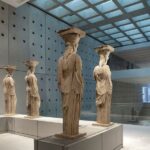
- The Erechtheion and its famous Caryatids
- The small Temple of Athena Nike
- The Theater of Dionysus and ancient public life
- The Odeon of Herodes Atticus
- Mythology makes the stones easier to read
- Ticket planning is the key practical issue
- Is $292 a good value for three people?
- Who should book this Acropolis experience?
- Should you book it?
- FAQ
- How long does the Acropolis guided tour last?
- Is the Acropolis entry ticket included?
- Where do I meet the guide?
- Where does the activity end?
- What language is the tour offered in?
- Is this a shared group tour?
- What happens if I have not bought my ticket?
- Which ticket time should I select in low season?
- Which ticket time should I select in high season?
- Is the tour suitable for wheelchairs or strollers?
- Can I cancel the booking?
- Do I have to pay when I reserve?
Key points to know before booking
- Private group for up to three people: You get a personal guide rather than a large shared group.
- Spanish-speaking guide: Sara and Amancio are named guides associated with the experience.
- Two hours inside the Acropolis: The route covers major temples, theaters, gateways, and viewpoints.
- Entry ticket sold separately: Buy your Acropolis ticket before the tour, or arrive early enough to wait at the South Entrance ticket office.
- Morning ticket windows matter: Choose 9:00 to 10:00 in low season and 8:00 to 9:00 in high season.
- Uneven uphill walking: Strollers and several types of wheelchairs are not allowed.
What this private Acropolis tour actually gives you

This is a guided walking tour of Athens’ Acropolis, not a transport service and not a ticket package. You meet your guide at street level by the Acropolis Metro station, then walk toward the archaeological site and begin the climb.
The group is private and limited to three people. That makes the price easier to judge if you are a couple, a family of three, or a small party willing to share the cost. At $292 per group, the cost is not cheap for a two-hour activity, but it is a very different product from a large group tour. You are paying for a licensed guide’s time and the chance to shape the conversation around your own questions.
The tour is offered in Spanish. That detail is central, not minor. If Spanish is your preferred language, a private explanation of the myths, buildings, and ruins can make the site easier to follow. If you need an English-language tour, this is not the right choice based on the information provided.
The available feedback is brief but very positive. Sara is praised by name, and Amancio is described as an excellent guide in Spanish. The experience has a five-star rating from three reviews, with the strongest theme being the quality of the guiding. That is exactly where this tour needs to earn its price.
A few more Athens tours and experiences worth a look


Meeting at the Acropolis Metro station
The meeting point is at the entrance of the Acropolis Metro station, at street level. This is practical if you are already moving around central Athens, but remember that the activity does not include hotel pickup or drop-off.
You should arrive with your entry arrangements settled. The meeting point is less than two minutes on foot from the South Entrance ticket office, but that short distance does not mean you can leave ticket buying until the last second.
If you do not already have a ticket, the instructions say to go to the South Entrance ticket office 30 minutes before the tour time. You then wait in line, buy the ticket, and walk to the meeting point. That plan has a built-in risk: a long line could make the schedule tight. I would buy online in advance whenever availability allows.
The ticket timing also requires care. From April 1 through October 31, select the 8:00 to 9:00 entry window. From November 1 through March 31, select the 9:00 to 10:00 window. These instructions are easy to miss during booking, so check the season dates before choosing your ticket.
Walking through the Propylaea
The Propylaea is the monumental gateway into the Acropolis. It is your first major architectural statement on the climb, and it sets the tone for the rest of the visit.
A guide adds value here because the gateway is not simply an entrance to walk through quickly. Its scale helps you understand that the Acropolis was designed as a sacred center, not just a fortified hilltop with one famous temple.
The route requires uphill walking and uneven surfaces. You will want sensible shoes and a pace that suits your group. This is a short tour by sightseeing standards, but the ground can still make the walk tiring, especially if you are visiting Athens during a hot period.
The private format helps at this point. You can pause for an explanation or ask why a particular structure matters without worrying about holding up a large crowd. Your guide can also keep the tour moving if your group wants more time at the Parthenon later.
Seeing the Parthenon and Athena’s sacred hill
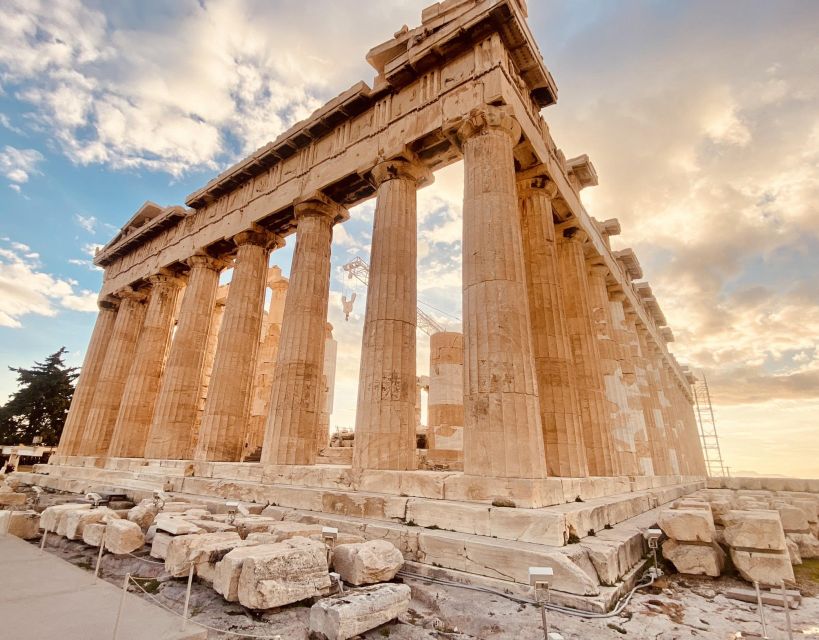
The Parthenon is the visual center of the Acropolis and one of the main reasons people book this experience. The temple was dedicated to Athena, the goddess who protected Athens, and the guide connects the monument with the city’s religious life and mythology.
You will not simply be shown the building and sent onward. The tour is designed to explain the myths tied to the site and the role of the Acropolis in ancient religious festivals. That context matters because many visitors see columns and marble without understanding how the hill functioned for the people who worshiped there.
The tour description promises a view of the Parthenon and the Acropolis dedicated to Athena. It does not promise a particular interior access route or a special entry privilege, so you should think of this as a guided exterior visit through the archaeological site.
Your free time after the guided portion is useful here. Once the two-hour walk ends, you can remain at the site and look around at your own pace. That gives you a clear choice: stay longer with the parts that caught your attention, or leave when your energy runs low.
The Erechtheion and its famous Caryatids
The Erechtheion is one of the most distinctive buildings on the Acropolis. It is named after Erechtheus, a figure described here as a demi-god, and it has a different character from the broad, formal shape of the Parthenon.
The Caryatids are the feature most people remember. These carved female figures serve as architectural supports, giving the porch an unusual combination of strength and grace. A guide can help you look beyond the famous silhouette and understand why the building belongs to a group of sacred structures rather than treating every ruin as part of one single temple.
I like that the itinerary includes the Caryatids specifically. They are easy to photograph, but a short explanation makes the stop more meaningful. In a private group, you can ask about the carvings, the building’s name, and the relationship between art, architecture, and worship.
The description does not state how long you stay at each monument. Expect the guide to balance several major stops within two hours, then use the free time afterward for closer looking.
You can also read our reviews of more guided tours in Athens





The small Temple of Athena Nike
The Temple of Athena Nike is identified as the smallest temple on the route. Its compact size makes it a useful contrast to the Parthenon and the Propylaea.
The temple was dedicated to Athena Nike, a form of Athena connected with victory. It occupies a prominent location near the entrance, so you encounter it as part of the approach to the main citadel rather than as a distant side trip.
This is the sort of stop that can disappear in a large group tour. A guide can point out why a smaller monument still deserves attention and how the site’s religious buildings served different purposes.
Do not expect a long independent visit at every monument during the guided section. The tour covers a lot in two hours. If this temple interests you, note it during the walk and return during your free time.
The Theater of Dionysus and ancient public life
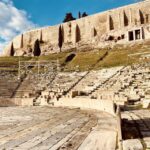
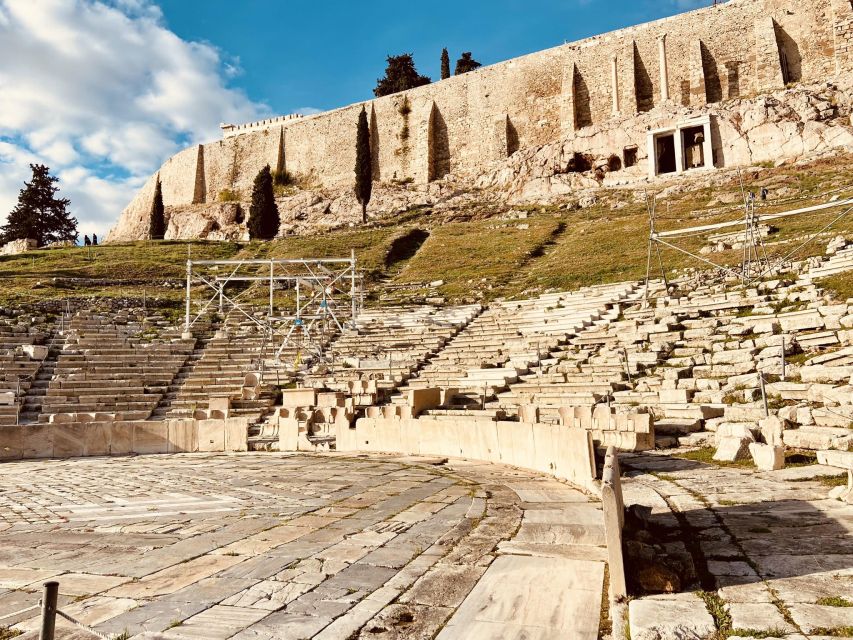
The Theater of Dionysus holds 17,000 spectators, according to the tour information. That figure gives you a sense of the scale of public events in ancient Athens.
The theater was used for festivals honoring Dionysus, the Greek god associated with the festival tradition described in the tour. Here, the Acropolis experience shifts from temples and sacred buildings to performance and communal life.
This stop is valuable because it widens your view of ancient Athens. The Acropolis was not only a place for religious monuments. The surrounding structures also connected to drama, public gatherings, and major festivals.
The theater’s scale can be hard to grasp when you are looking at stone seats and worn ruins. Listen for the guide’s explanation, then take a moment to look across the seating area and imagine the physical size of the audience. The tour does not promise a performance or special access, of course. You are seeing an archaeological site, with the guide bringing its purpose back into focus.
The Odeon of Herodes Atticus
The Odeon of Herodes Atticus is described as a giant stone theater. It is one of the route’s most impressive structures and another reminder that the Acropolis area was built for more than quiet worship.
The theater’s size and stone construction make it an easy place to pause. A guide can explain its place in the site’s story and help you distinguish it from the Theater of Dionysus, which is also part of the visit.
Having both theaters in one short route is a strong feature. You get a better sense of how ancient Athens used performance spaces for different purposes, rather than seeing one theater as an isolated ruin.
The tour information does not specify whether you enter every theater area or view some sections from designated paths. Follow your guide’s instructions and stay within permitted routes. Archaeological sites are working historic places, not free-form climbing areas.
Mythology makes the stones easier to read
The guide’s commentary focuses on ancient Greek myths connected with the ruins. That approach suits the Acropolis, where nearly every major building links to a god, hero, king, or sacred story.
Mythology can also become confusing when several names and versions overlap. A private Spanish-speaking guide gives you room to stop and ask for clarification. You can ask about Athena, Erechtheus, Dionysus, or the meaning behind a particular temple instead of trying to follow a rehearsed speech from the back of a large group.
The value here is not just entertainment. Myths explain why particular buildings mattered to ancient Athenians and why the Acropolis became such an important religious center. The guide also discusses the long history of Athens, linking the ancient citadel with the capital you see today.
The available comments specifically praise Sara and Amancio. Since the tour depends so much on live explanation, those names are useful when you are comparing guide options. Guide assignment may depend on availability, so check the booking details if a particular person matters to you.
Ticket planning is the key practical issue
The biggest drawback is that the Acropolis ticket is separate. The $292 price covers the licensed guide and guided tour, not admission to the archaeological site.
That arrangement gives you some control, since you can arrange your own ticket, but it also creates another task. If tickets are sold out online, the instructions say the operator will help. Still, you should not treat that as a reason to wait. Availability can affect your schedule, and an uncertain ticket plan makes the start of a timed tour less relaxed.
If you must buy at the ticket office, arrive 30 minutes before the tour time at the South Entrance. The office location and meeting point are close together, but you need enough time for the line, purchase, and walk to your guide.
The specified seasonal windows are especially important:
- For November 1 through March 31, choose the 9:00 to 10:00 ticket window.
- For April 1 through October 31, choose the 8:00 to 9:00 ticket window.
Check availability for the actual tour starting time. The activity lasts two hours, but the information does not provide one fixed departure time.
Is $292 a good value for three people?
At first glance, $292 for two hours sounds high. The calculation changes if three people share the booking. You are paying about $97 per person before adding the separate Acropolis tickets.
For a couple, the per-person cost is higher. In return, you get a private group, a licensed guide, and the freedom to ask questions. A family of three may find the price easier to justify, especially if the children need explanations or a flexible pace.
The tour makes less financial sense if you only want a quick look at the Parthenon and do not care about mythology or historical context. You are paying for interpretation, not just entry. It also may not suit someone who wants a full-day archaeological tour, since the guided portion is limited to two hours.
The free time after the tour improves the value. You receive a focused introduction, then can stay longer and explore independently. That combination works well if you want guidance at the beginning but do not want to spend the entire visit in a group.
Who should book this Acropolis experience?
I would consider this tour for three kinds of visitors. First, it suits Spanish-speaking couples or small families who want a private explanation of the Acropolis. Second, it works for people who prefer asking questions rather than listening quietly in a large group. Third, it is a good fit if you want a structured two-hour visit with time afterward to continue alone.
You should think twice if you need hotel transportation, an English-language guide, wheelchair access, or a stroller-friendly route. Baby strollers, non-folding wheelchairs, and electric wheelchairs are not allowed, and the walk is uphill over uneven ground.
The short duration is both a strength and a limit. Two hours gives you a clear introduction without taking over your day. It does not allow endless time at every temple, so plan to use the post-tour free time if you want a slower look.
Free cancellation up to 24 hours before the activity and the reserve-now, pay-later option add useful flexibility. They do not remove the need to secure your separate Acropolis ticket.
Should you book it?
Book this experience if you want a private Spanish-language introduction to Athens’ most important archaeological site and value a guide who can connect the Parthenon, Caryatids, theaters, and myths into one story.
I would skip it if you want the lowest possible cost, need transportation, or prefer to explore entirely on your own. For a small group of up to three, the price can be reasonable when personal attention matters. Just handle the entry ticket early, wear shoes suited to uneven uphill ground, and leave time after the tour to revisit the places that interest you most.
FAQ
How long does the Acropolis guided tour last?
The guided tour lasts two hours. Afterward, you have free time to remain at the Acropolis and explore at your own pace.
Is the Acropolis entry ticket included?
No. The Acropolis entry ticket is not included and must be purchased separately before the activity begins.
Where do I meet the guide?
Meet the guide at street level by the entrance of the Acropolis Metro station.
Where does the activity end?
The activity ends back at the meeting point.
What language is the tour offered in?
The live tour guide service is offered in Spanish.
Is this a shared group tour?
No. It is a private group experience for up to three people.
What happens if I have not bought my ticket?
You should go to the South Entrance ticket office 30 minutes before the tour time so you have time to wait in line and buy the ticket. The meeting point is less than two minutes from the ticket office.
Which ticket time should I select in low season?
For November 1 through March 31, select the 9:00 to 10:00 ticket window.
Which ticket time should I select in high season?
For April 1 through October 31, select the 8:00 to 9:00 ticket window.
Is the tour suitable for wheelchairs or strollers?
Baby strollers, non-folding wheelchairs, and electric wheelchairs are not allowed. The route also includes uphill walking and uneven surfaces.
Can I cancel the booking?
Yes. You can cancel up to 24 hours in advance for a full refund.
Do I have to pay when I reserve?
No. The reserve-now, pay-later option lets you hold your place without paying at the time of booking.