REVIEW · ATHENS
Athens to Meteora, Day Trip with Local Guide,up to 9 people
Book on GetYourGuide →Operated by VIP Meteora Tours · Bookable on GetYourGuide
Meteora is one of Greece’s great surprises: six monasteries perched on towering rock pillars above the Thessalian plain. This 14-hour Athens day trip gives you the broad view, three monastery visits, Hermit Caves, and plenty of photo stops without making you arrange the complicated transport yourself.
I like the small-group format, with space for roughly eight to nine people, and I like having a guide who can turn the scenery into a story. George is quick with communication, while Vagelis has been praised for his relaxed explanations and personal attention. The main drawback is simple: this is a very long day, with about four hours of travel each way and plenty of walking and stairs.
In This Review
- Key points to know
- Why Meteora is worth the long ride from Athens
- Leaving Athens before the city wakes up
- Meeting your local guide in Kalambaka
- Seeing all six monasteries from the road
- Entering three monasteries
- The Hermit Caves and Meteora’s quieter story
- Four hours back to Athens
- What the $128 price really buys you
- Who should book this Meteora day trip?
- Final call: a strong introduction with a very long tail
- FAQ
- How long does the Athens to Meteora trip last?
- Does the tour currently travel all the way by train?
- How many monasteries will I see?
- Are monastery entrance fees included?
- Is food included?
- What language does the guide speak?
- Is the tour suitable for wheelchair users or people with mobility problems?
Key points to know
- Six monasteries in one day: You see all six from close viewpoints and enter three of them.
- Rail replacement transport: Train service is currently suspended on part of the route because of rail repairs, so an air-conditioned bus completes the journey.
- A guide-led Meteora circuit: Your local English-speaking tour leader explains the area’s history, legends, monasteries, and changing religious life.
- Excellent photo opportunities: The route includes panoramic stops and views of the Hermit Caves.
- Real out-of-pocket costs: Monastery admission is €5 per person at each of the three interiors you visit.
- A demanding schedule: The outing lasts 14 hours and is not suited to people with mobility, heart, or back problems.
Why Meteora is worth the long ride from Athens
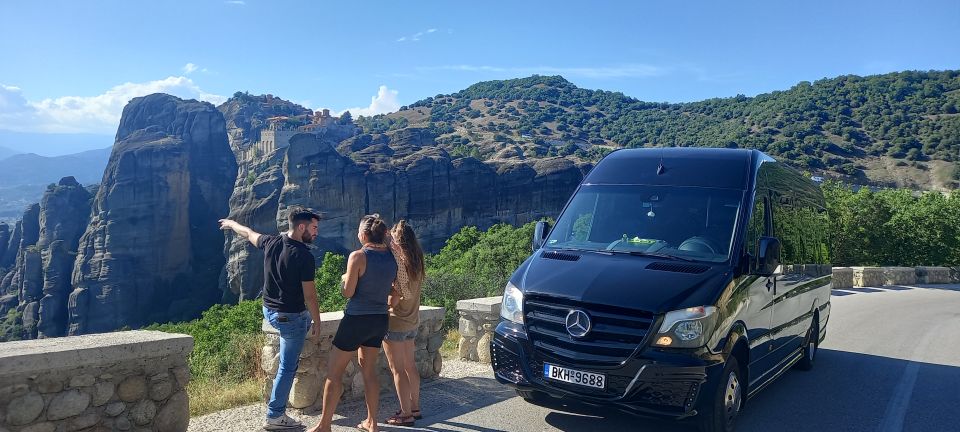
Meteora feels unlike almost anywhere else in Greece. Huge sandstone pillars rise from the plain, and monasteries sit high on their tops as if placed there by hand. The setting is dramatic before you learn a word about the monks who built and used these remote sanctuaries.
The appeal is not just the view. Meteora brings together geology, Orthodox Christianity, medieval history, and everyday Greek scenery in one compact area. From Athens, you trade the city for fertile plains, rough hills, and the changing outline of central Greece outside your window.
The price is $128 per person. That is not a cheap add-on to an Athens holiday, but it covers round-trip transport, the local tour leader, the Meteora vehicle, bottled water, Wi-Fi, and the circuit of all six monasteries. You still pay €5 for each monastery interior, and food is extra.
For someone with only a few days in Greece, the value comes from saving the trouble of arranging Athens to Kalambaka transport, local transfers, and the monastery route. You pay for a very full day, not a slow visit. If you want time to sit quietly at one monastery or explore Kalambaka at leisure, an overnight stay would serve you better.
You can also read our reviews of more guided tours in Athens

Leaving Athens before the city wakes up
Your starting point is St. Larissis railway station in Athens. You make your own way there early in the morning, then board the service toward Kalambaka using the tickets sent to you before the trip. Your seats are assigned, so keep the ticket details handy and check your email, including the spam folder, for the final meeting instructions.
The first rail section takes about 2 hours and 50 minutes. It is a useful transition from Athens to central Greece, with views changing from city streets to open farmland and hill country. You are not simply losing time on the way to Meteora. The changing scenery helps you understand how different northern and central Greece can feel from the capital.
There is an important transport change at present. Rail service all the way to Meteora has been halted during repairs, so you leave the train partway through the journey and board a modern, air-conditioned 35-seat bus with the same ticket. The bus portion takes about 80 minutes. On the return, you reverse the process.
This arrangement is less romantic than a single train ride, but it is practical. The bus is air-conditioned, and the total travel time is described as the same. Do not arrive expecting a continuous rail journey. Read the instructions carefully so the transfer feels like a normal part of the route rather than a surprise.
Meeting your local guide in Kalambaka
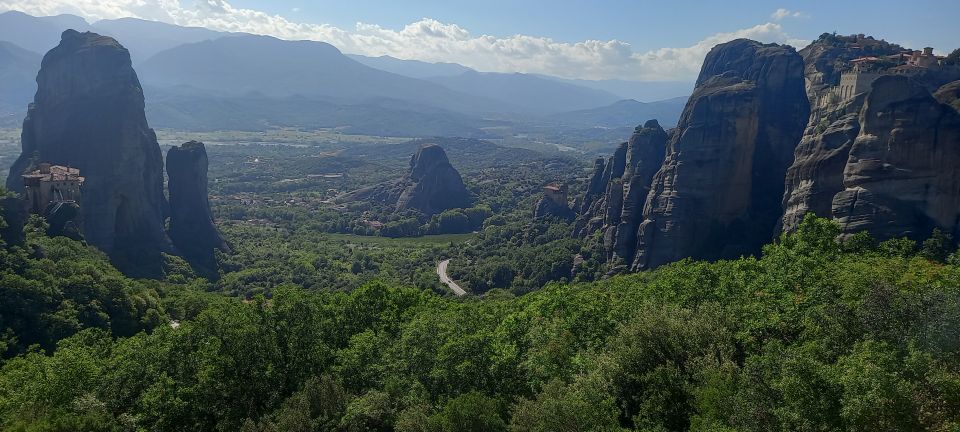
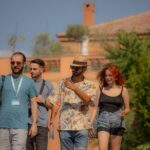
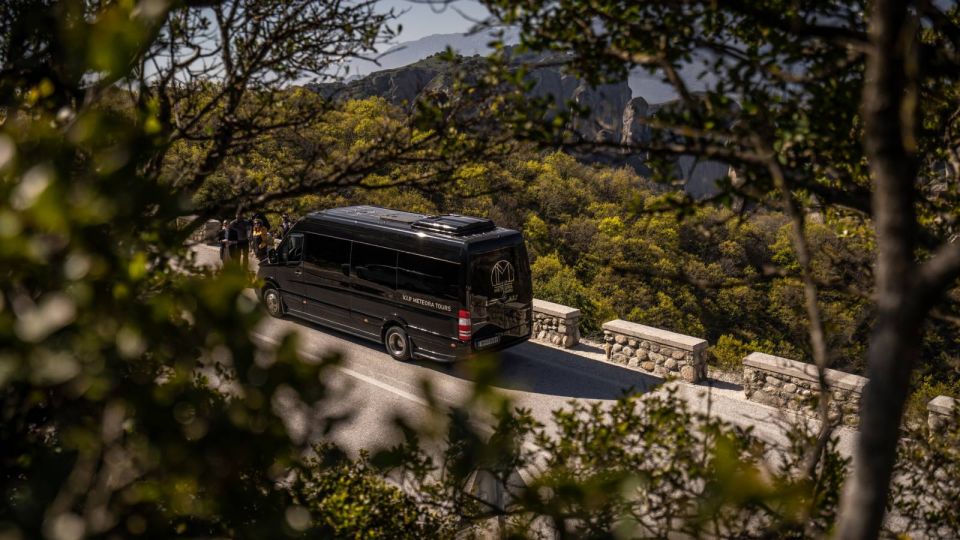
At Kalambaka railway station, your local tour leader meets you. This is where the day changes from a long-distance transfer into a guided Meteora circuit. A vehicle collects you at the station, and you begin moving between the rock towers, monastery entrances, and viewpoints.
The tour is sold as a small-group experience, with a maximum of nine people and another activity description listing a limit of eight participants. In practice, you should expect a compact group rather than a large coach tour. That matters at viewpoints, where a smaller party is easier to gather, and during explanations, where you can hear the guide without standing in a crowd.
The guide is a major part of the experience. George has handled the tour for some groups, and Vagelis has been praised for combining detailed Greek history with an easy, informal style. One particularly personal version of the day involved Vagelis driving a comfortable Mercedes sedan because only two people had booked. That level of flexibility cannot be guaranteed, but the small-group design leaves more room for individual attention than a standard bus excursion.
Your guide explains the stories and legends linked to Meteora, then adds context about how the monasteries changed across different periods. You will get more from the visit if you ask questions. The rocks are impressive on their own, but the human story gives the place its purpose.
Seeing all six monasteries from the road
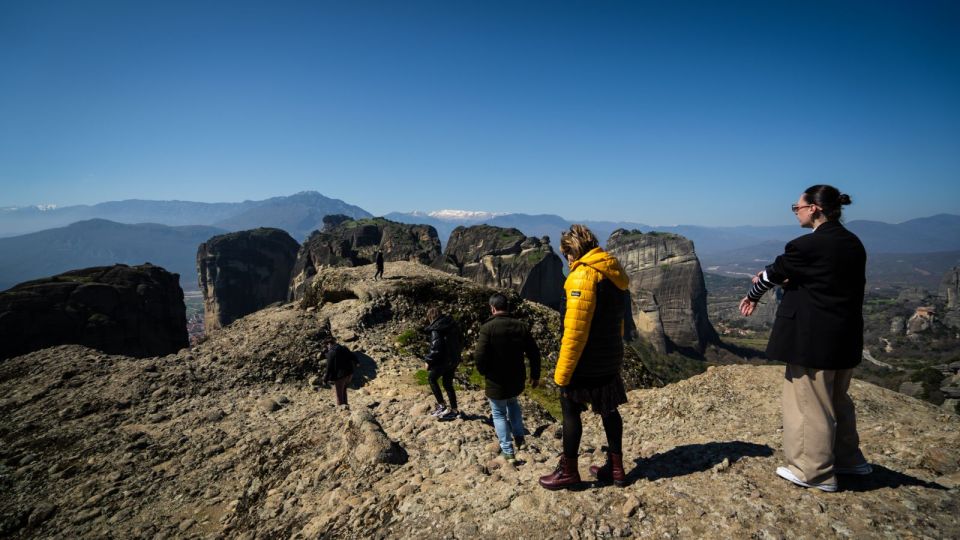
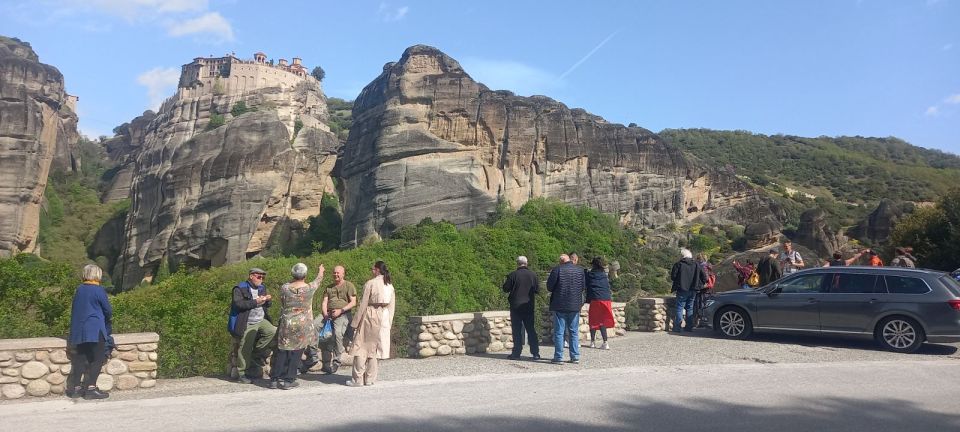
The route is designed to show you all six surviving monasteries from close viewpoints. You do not enter all six, but you get different angles on each one as the vehicle winds through the area.
This distinction matters. The monasteries are not identical boxes placed on six rocks. Their positions, approaches, walls, and views differ. Some appear isolated above the plain, while others feel tied to the cliffs around them. Seeing the full group helps you understand Meteora as a whole rather than as one famous building.
The road circuit also keeps the day moving. You stop for photographs at the most panoramic points, then continue to another angle or entrance. A good guide can point out details you might otherwise miss, including the hidden Hermit Caves and the way early religious communities used the rock shelters.
The pace is brisk. You should expect a sequence of short stops, walks, explanations, and monastery visits rather than long stretches of free time. That is the tradeoff for covering all six in a single day from Athens.
Bring a camera, but do not spend the entire visit looking through it. Meteora’s scale is difficult to capture in one frame. Take your main pictures at the viewpoints, then put the camera away inside the monasteries and give the setting your full attention.
Entering three monasteries
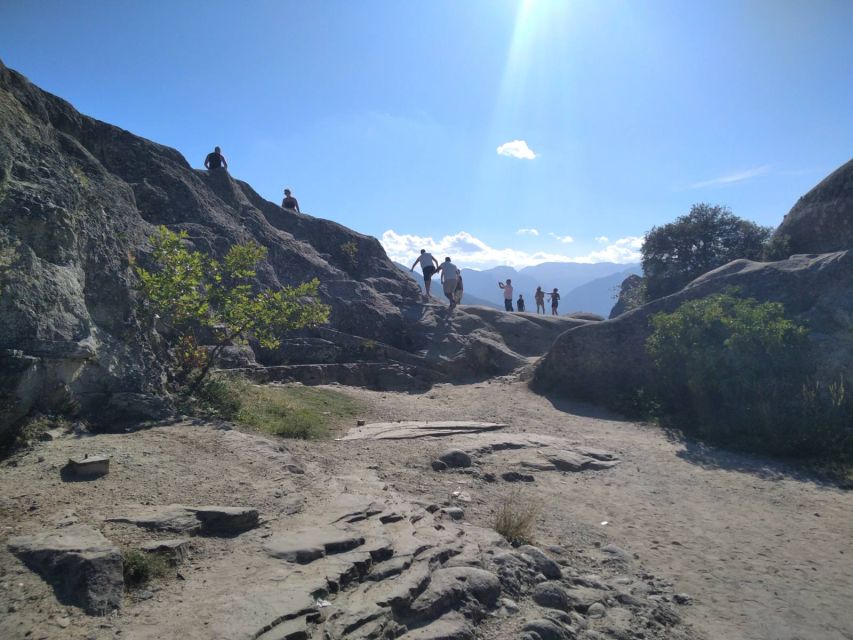
The tour includes visits inside three monasteries. This is enough to give you a sense of Orthodox religious spaces, painted decoration, sacred objects, courtyards, and the practical challenges of building on a cliff. The interiors can feel similar in some ways, so choosing three rather than trying to enter all six makes sense on a one-day schedule.
At each stop, you pay a separate entrance fee of €5 per person. The three visits therefore add €15 to the advertised tour price. Carry cash, as it is specifically listed among the things to bring.
There is no state-licensed guide included inside the monasteries. Your local tour leader provides explanations during the wider circuit, but you should not expect a formal licensed guide for every interior room. That is worth knowing if you want detailed interpretation of icons, frescoes, or religious practice.
Dress for a working religious site. Comfortable clothes and shoes are listed as essentials, and modest clothing is the sensible choice for monastery visits. The tour information does not give a detailed dress code, so you should avoid treating the interiors like ordinary sightseeing stops.
The monastery visits also involve walking and stairs. This is not a suitable outing for wheelchair users or people with mobility impairments, recent surgeries, serious back problems, or heart problems. Even if you are generally fit, pace yourself. The day combines transport fatigue with uneven surfaces and repeated stops.
A few more Athens tours and experiences worth a look



The Hermit Caves and Meteora’s quieter story
The Hermit Caves offer a different view of Meteora. The great monasteries are the headline attraction, but these less obvious shelters point to the solitary religious life that came before or alongside the larger communities.
You see the caves as part of the guided route rather than taking a separate expedition. Their value is in the contrast. The monasteries show organized religious life, while the caves help you picture individuals seeking isolation in the cliffs.
This is also where a local guide earns the fee. A quick photo stop can leave you with a striking rock formation but little sense of why people chose such difficult places. Explanations about the area’s changing history and religious use make the caves more than a backdrop.
Do not expect a long independent walk into every cave. The day is structured around viewpoints, vehicle access, and selected visits. You see the hidden hermitages as part of a broad introduction to Meteora.
Four hours back to Athens
After the Meteora circuit, you return to Kalambaka station for the trip south. The route again uses the bus and train combination, with about 80 minutes by coach and close to three hours on the train.
This is the least glamorous part of the experience, but it gives you time to rest and sort through photographs. Carry snacks and water for the journey. Bottled water is included, while meals, snacks, and soft drinks are not.
A quick lunch may be possible during the Meteora portion, but it is not included in the tour. One version of the day included help ordering a fast lunch on arrival, which is useful because the schedule is tight. Still, you should not plan a long restaurant meal. Bring something portable if you know you get hungry during full-day excursions.
You arrive back at St. Larissis after roughly 14 hours. That makes this a demanding Athens side trip. If you have an early flight the following morning, leave a comfortable margin and do not count on feeling fresh after reaching the city.
What the $128 price really buys you
At $128 per person, the experience is best understood as a transport-and-guidance package. The included pieces are substantial:
- Round-trip Athens to Meteora tickets
- The train and replacement bus connections
- Pickup and drop-off at Kalambaka station
- An air-conditioned vehicle for the Meteora route
- A local English-speaking tour leader
- Visits to all six monasteries from close viewpoints
- Entry to three monastery interiors, excluding admission fees
- Bottled water and Wi-Fi
- A small group of roughly eight to nine people
The strongest value is convenience. Meteora is possible without a tour, but a same-day visit requires careful coordination between long-distance transport, station transfers, monastery opening arrangements, and local roads. Here, you can focus on the site while someone else handles the route after you reach Kalambaka.
The weak point is that the day costs more than the headline price. Add €15 for three monastery admissions, plus food and any personal expenses. There is no travel insurance included.
The price makes most sense for you if Meteora is a top priority and you cannot spare a night away from Athens. It makes less sense if you are on a very tight budget or prefer to set your own pace. In that case, compare the cost of spending a night in Kalambaka with the value of not spending eight hours in transit on one day.
Who should book this Meteora day trip?
I would choose this outing if you want a strong first look at Meteora and need to return to Athens the same evening. It suits people who value a local explanation, want to see all six monasteries, and prefer not to manage the rail and local transport changes themselves.
It is also a good fit for photographers. The route includes several panoramic stops, and the guide knows where to pause for broad views. The surrounding Greek scenery changes throughout the day, giving you more than a single monastery photograph.
You should think twice if you dislike early starts, long rides, or tightly planned sightseeing. This is not a restful country excursion. It packs monastery interiors, exterior viewpoints, caves, and transport into one day.
The activity is also a poor match for anyone with serious mobility limits, heart problems, back problems, or a recent operation. Wheelchair users cannot be accommodated. Comfortable shoes are not optional.
Free cancellation is available up to 24 hours before departure, and you can reserve now and pay later. Those policies help if your Athens schedule is still shifting, but they do not change the physical demands of the day.
Final call: a strong introduction with a very long tail
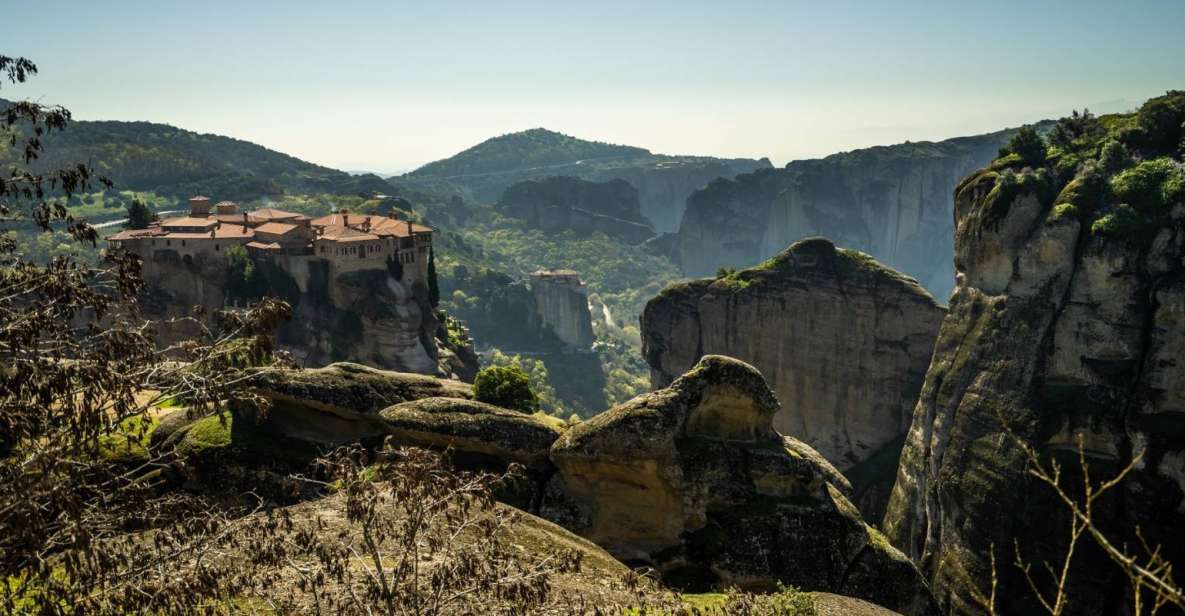
You should book this tour if seeing Meteora is one of your main Greece goals and your schedule leaves only one day. The combination of six monastery views, three interior visits, Hermit Caves, photo stops, and a local guide gives you a serious introduction rather than a quick photograph from the road.
The best features are the guide-led storytelling, the small group, and the careful use of viewpoints. The biggest cost is time. You will spend much of the day in transit, then walk and climb through a packed Meteora program.
If you can stay overnight, that would be the calmer choice. If you cannot, this is a well-organized way to make the Athens to Meteora trip work, provided you accept the early start, extra monastery fees, and return journey.
FAQ
How long does the Athens to Meteora trip last?
The full activity lasts about 14 hours, including the outbound and return journeys between Athens and Kalambaka and the Meteora visit.
Does the tour currently travel all the way by train?
No. Rail service on part of the route is currently suspended because of restoration work. You travel by train to a certain point, then board an air-conditioned bus using the same ticket provided for the trip.
How many monasteries will I see?
You see all six Meteora monasteries from close viewpoints and visit three of them inside.
Are monastery entrance fees included?
No. Admission costs €5 per person per monastery. Visiting three monasteries therefore requires €15 per person in additional entrance fees.
Is food included?
No. Meals, snacks, and soft drinks are not included. Bottled water is provided, and you should bring cash and consider carrying a snack.
What language does the guide speak?
The local tour leader provides live guiding in English.
Is the tour suitable for wheelchair users or people with mobility problems?
No. The activity is not suitable for wheelchair users or people with mobility impairments, serious back or heart problems, or recent surgeries. Comfortable shoes are required.