REVIEW · ATHENS
Biblical Corinth: St. Paul and His Letters to the Corinthians
Book on Viator →Operated by My Athens Transfers · Bookable on Viator
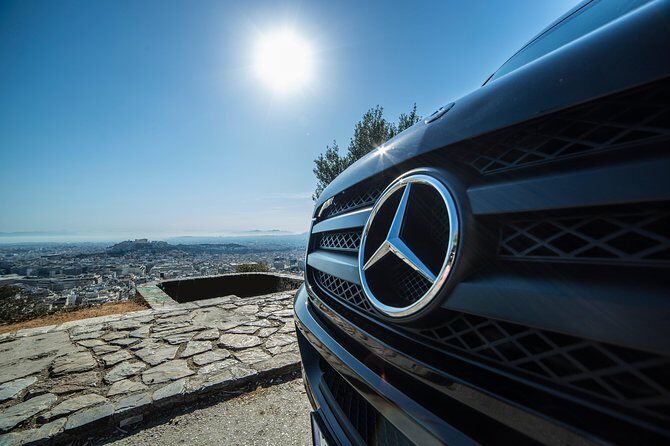
Mars Hill makes Paul feel close. This private day links St. Paul’s letters to the exact places in Athens and the Corinth region, with a personal driver who keeps the story straight as you move between sites. It’s also a smart way to cover a lot without being herded—you set the pace.
Two things I really like: first, you get the stand-still moment at Mars Hill (Areopagus Hill), where Paul spoke about the Unknown God to the Athenians. Second, the day stays practical—onboard Wi‑Fi, bottled water, and a driver who can explain what you’re seeing as you go (with plenty of time to look for yourself).
One possible drawback: this is not a licensed guide-led museum/ruins tour. Your driver is there for commentary, but they generally won’t enter the archaeological sites with you, and you’ll pay entry fees for Ancient Corinth and the Museum of Isthmia (about €15 per person).
In This Review
- Key highlights to look for
- Walking from Mars Hill to Letters to the Corinthians
- Private driver day vs licensed site guide: how your experience will feel
- What $218.43 buys you (and why it can be good value)
- Areopagus Hill (Mars Hill): the Unknown God moment in Athens
- Corinth Canal + the Diolkos: maritime engineering that sets the stage
- Isthmia: Poseidon’s Games and Paul meeting crowd energy
- The Museum of Isthmia: artifacts that make the crowds feel specific
- Ancient Corinth (Archaia Korinthos): where letters grew out of real life
- Lunch in Corinth: fuel without breaking the schedule
- Kechries (Cenchreae): the port side of Paul’s second journey
- Apostolou Pavlou church and Akrokorinthos: faith now, views then
- The “best day” details I’d look for on this tour
- Should you book this Paul’s letters day trip?
- FAQ
- How long is the tour?
- Is this tour private or shared?
- Do I get pickup from my hotel or the port?
- Is Wi‑Fi available during the tour?
- Is lunch included?
- Are entrance fees included for Ancient Corinth and the Museum of Isthmia?
- Will the driver take me inside the archaeological sites?
Key highlights to look for
- Mars Hill (Areopagus Hill): Paul’s Unknown God sermon setting in Athens
- Engineering stops: Corinth Canal views plus the ancient Diolkos ship-transport route
- Isthmia and the Games: Poseidon festivals that match the kind of crowds Paul worked with
- Ancient Corinth essentials: the Bema area (Gallio scene) and the Temple of Apollo skyline moment
- Kenchreae (Cenchreae/Cenchreai): the port linked to Paul’s departure to Syria
- Akrokorinthos viewpoints: the fortress above Corinth, for scale and perspective
Walking from Mars Hill to Letters to the Corinthians
This is the kind of trip that makes scripture feel less like text and more like geography. You start in Athens at Areopagus Hill—aka Mars Hill—and you finish in the Corinth region where Paul built community and wrote letters that still shape Christian teaching.
The format is also a big deal for value. It’s private, meaning it’s just your group, and you can linger at the spots that click for you. That matters because some people want photos, some want context, and some just want quiet time to absorb what they’re standing in.
You can also read our reviews of more tours and experiences in Athens.
Private driver day vs licensed site guide: how your experience will feel
Here’s the deal you should plan around. You’ll have a knowledgeable driver who explains the history while you’re traveling and at pick-up/drop-off areas, but the company notes the drivers are not official licensed tour guides for entering archaeological sites.
In plain terms: you’ll get great commentary, but you may still want to read on your own or grab a licensed guide at Ancient Corinth and Isthmia if you want that “live” narration inside the ruins and museums.
This is also why the best part of this tour is often the person behind the wheel. In the feedback for this tour style, guides such as Alex and George come up again and again for clear explanations and a relaxed rhythm—never rushing you out the door. You’ll also see mentions of practical care: water provided, patience with questions, and stops planned so the day doesn’t feel like a sprint.
What $218.43 buys you (and why it can be good value)
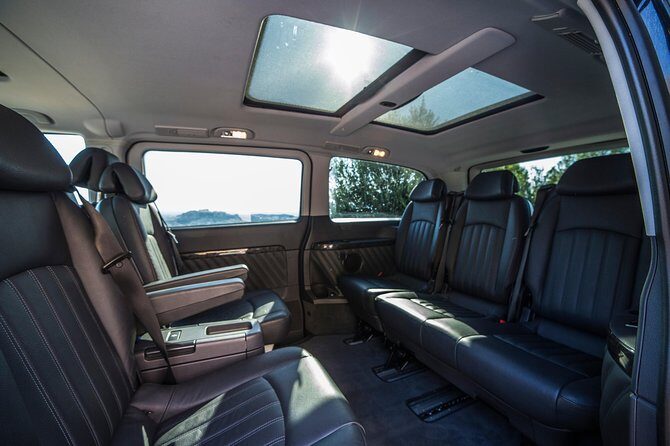
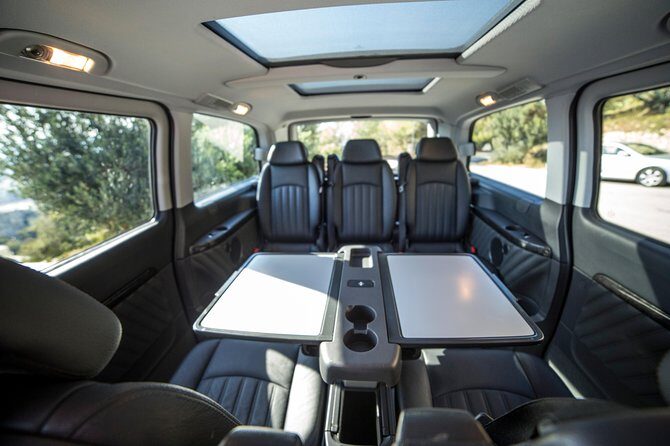
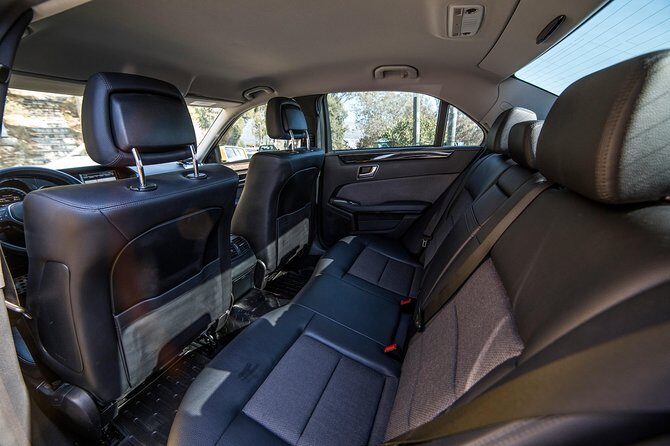
The price is for a full day of private transportation from Athens into the Corinth area, with pick-up and drop-off at your hotel or port and an air-conditioned vehicle. You also get onboard Wi‑Fi and bottled water, plus a lunch option if you choose the Greek traditional food meal.
On top of that, the itinerary is packed with mostly free-entry stops—Areopagus Hill, Corinth Canal, Diolkos remnants, Isthmia-area viewpoints, Temple of Apollo, Kechreae, and churches. The main extra cost to budget is admission for Ancient Corinth and the Archaeological Museum of Isthmia (listed as about €15 per person), which you can purchase on-site.
If you’d otherwise rent a car, coordinate entry tickets, and lose time figuring out where to stand and why, this private format often ends up feeling less like “a transfer” and more like a guided route that saves your brain for the sites.
Areopagus Hill (Mars Hill): the Unknown God moment in Athens
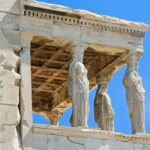
Areopagus Hill is one of those places where your imagination does real work for you. You’ll walk through the sacred ground of the Acropolis area and then spend time specifically at Areopagus Hill—the traditional Mars Hill site—connected to Paul’s sermon in Athens.
What makes this stop work on a practical level is the contrast. Athens was the intellectual center of the ancient world. Paul’s speech, as it’s remembered, directly challenges the city’s assumptions and points people to a different understanding of God. Standing here helps you see why this wasn’t just “another talk”—it was a clash of worldviews in a place that prized philosophy.
Time is short by design (about 20 minutes), so don’t expect a long, museum-like explanation. Treat it like a meaningful launch pad: you’re setting the mindset for the day—Paul as a messenger entering the heart of ancient thinking.
Corinth Canal + the Diolkos: maritime engineering that sets the stage
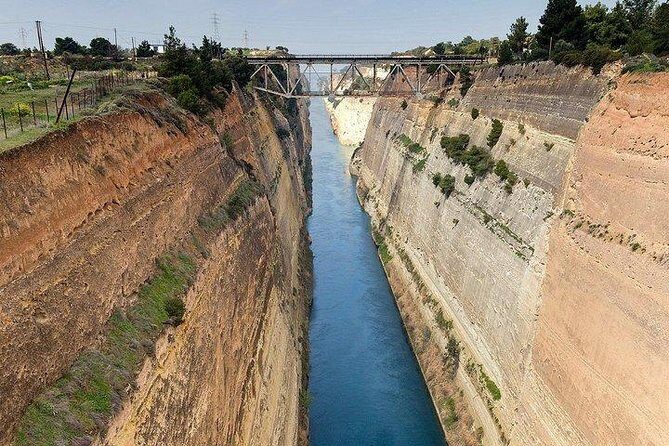
After Athens, the day shifts from ideas to movement—ships, goods, and routes. At the Corinth Canal, you’ll get a high-up view where you can look down into the channel. It’s a dramatic separation between the Peloponnese and the Greek mainland, cutting through the narrow isthmus.
You’ll hear the key engineering facts as you look:
- It connects the Gulf of Corinth (Ionian Sea side) to the Saronic Gulf (Aegean Sea side).
- No locks.
- The canal is only about 6.4 km long and around 21.4 m wide at its base, so many modern ships can’t pass.
Then comes the Diolkos, an ancient ship-transport track across the isthmus. Even without the canal, this route let vessels move overland long before the modern canal existed. You’ll walk among remnants and get a sense of how merchants and sailors would have used this choke point.
For Paul’s story, it matters because the Corinth region was not “off to the side.” It was an international crossroads where travel and trade made people, rumors, and ideas travel too—exactly the kind of setting where a letter-writer could reach a spread-out community.
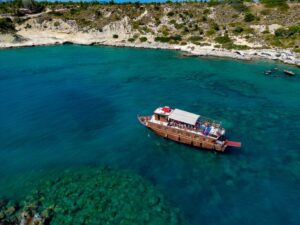
- All Day Cruise -3 Islands to Agistri,Moni, Aegina with lunch and drinks included
★ 5.0 · 4,958 reviews


Isthmia: Poseidon’s Games and Paul meeting crowd energy
This tour spends real time in Isthmia, and that’s more than just sightseeing. Isthmia was known for the Isthmian Games—athletic and cultural festivals second in importance to the Olympic Games—and they drew participants and spectators across the Greek world.
If you’re connecting this to Paul, the logic is strong: the region was a magnet for crowds, and the Bible notes Paul’s time in the broader Corinth area as a tentmaker. Isthmia’s festival atmosphere gives you a human-scale picture of what that kind of work and outreach could look like—around events where people gathered in large numbers and traveled through.
You’ll visit the sanctuary area and the archaeological site, including the Temple of Poseidon (rebuilt across centuries) and the stadium space where the Games happened. The tour also references the Sanctuary of Palaimon, devoted to a patron of sailors, which adds another layer: in this part of the world, faith was public, and different gods mapped onto different needs—athletics, travel, protection.
One more thing I’d plan for: this area isn’t always “one flat stop.” You may walk across uneven ground and move between different parts of the site complex. Wear shoes you trust, especially if your schedule includes more steps later at Akrokorinthos.
The Museum of Isthmia: artifacts that make the crowds feel specific
If you want the day to stop being only symbolic and start being concrete, this museum helps. The Archaeological Museum of Isthmia (about 30 minutes) focuses on the cultural and religious setting tied to Poseidon and the Games.
One detail that stands out is that the museum includes glass panels from Kenchreai, the port linked with Paul’s departure by sea. You also see artifacts like votive items, statues, and burial-related pieces—small things that make a region feel lived-in rather than staged.
Budget note: museum entry isn’t included in the base price. The tour lists an on-site ticket cost for the museum, so keep a little extra cash or card ready.
Ancient Corinth (Archaia Korinthos): where letters grew out of real life
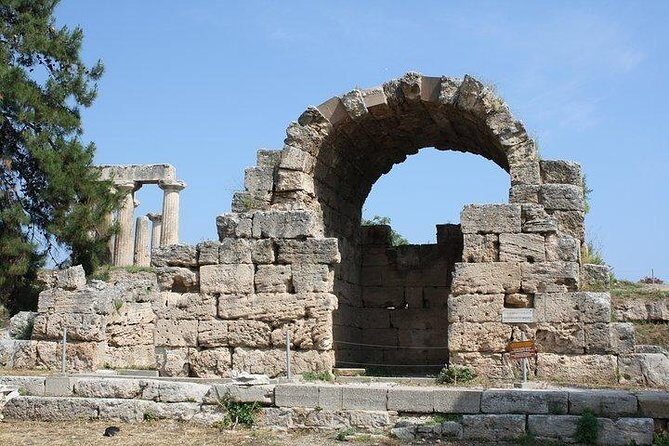
This is the main event: Ancient Corinth, where Paul spent more than 18 months and where the letters tied to the Corinthian church connect to moral and spiritual challenges people actually faced.
You’ll explore the archaeological site, and a key moment is the Bema—the judgment seat area connected to Paul being brought before Roman authority under Gallio in Acts. Standing here is powerful because you get to see how Paul’s message had public consequences, not just private conversations.
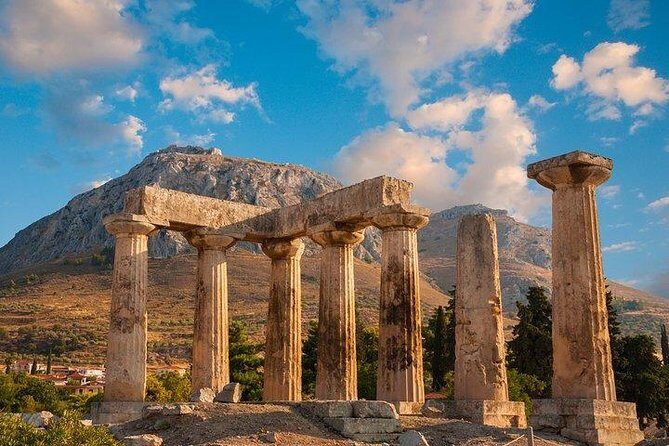
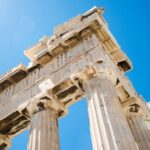
There’s also the Temple of Apollo visit, which is almost like a skyline rewind. You’ll see the impressive Doric architecture dating to around 560 BC, with massive columns that would have dominated the ancient city view when Paul arrived. It’s a visual reminder that Paul preached in a polytheistic world where old civic religion still ruled public space.
Practical downside to keep in mind: since the driver is not entering the ruins as a licensed guide, don’t expect a full “inside the site” guided lecture. You’ll likely do better if you:
- read posted site info panels at your own pace, and/or
- consider adding a licensed guide at Ancient Corinth if you want deeper commentary in the ruins.
Lunch in Corinth: fuel without breaking the schedule
After the major ruins focus, you’ll shift to a traditional seaside Greek taverna for lunch (about 1 hour). If you selected the “With Greek traditional food” option, lunch is already included in the tour price.
This is also one of the smartest timing choices of the day. You’ll have enough walking and standing to make the meal feel like a recovery break, not a distraction. And because it’s private, you’re less likely to lose time waiting behind a crowd.
Kechries (Cenchreae): the port side of Paul’s second journey
Then you move to Kechries, the area of ancient Cenchreae, Paul’s eastern port. This stop ties directly to Acts and Paul’s sea journey. The tour notes Paul cut his hair to fulfill a vow before departing for Syria with Priscilla and Aquila.
This is a different kind of biblical geography than the ruins: it’s the shoreline logic. Ports mean departures and new chapters, and they also mean the kinds of people and networks Paul relied on. You’ll also connect it to early Christian community life through references like Phoebe in Paul’s letter to the Romans.
Even if you’re not a “sea person,” this stop helps you see that Paul’s mission wasn’t trapped in one city. It moved through routes.
Apostolou Pavlou church and Akrokorinthos: faith now, views then
Near the end, you’ll visit Apostolou Pavlou, a church honoring Apostle Paul and his time in Corinth around 51–52 AD. It’s a modern place, but it keeps your focus on the idea that Paul’s work left a mark that later generations remembered with brick and dedication.
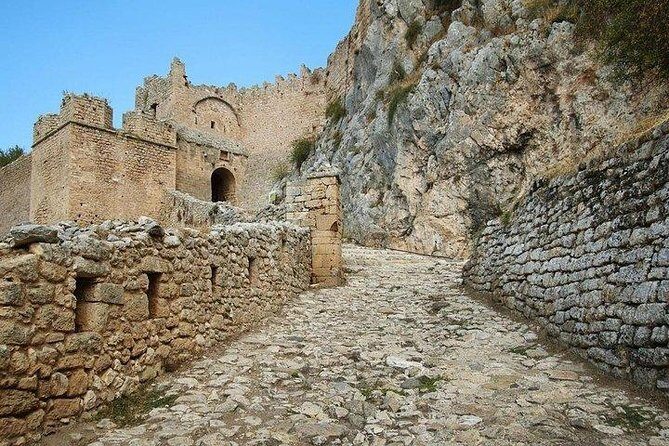
Then comes Akrokorinthos, the fortress overlooking the ancient city. Expect an actual climb and real steps. This is one of the stops where some people are surprised by how steep or long it feels, but the payoff is the panoramic viewpoint over the Corinth area.
Use this time to put everything together:
- canal and transport routes below,
- ancient Corinth where Paul built a community,
- and the port area where journeys continued.
This is where the day stops feeling like separate checkpoints and starts feeling like a connected story.
The “best day” details I’d look for on this tour
A Paul-focused route is only half the equation. The other half is how you experience the day—pace, clarity, and comfort.
Here’s what tends to make the difference with this tour style:
- A relaxed schedule: many feedback comments emphasize that the itinerary doesn’t feel rushed, and questions are welcomed.
- Comfort and audio: at least some drivers use a speaker so you can hear them clearly while traveling.
- Small care moments: you may get helpful planning for breaks, including coffee and bathroom pauses away from heavy crowds.
- Real flexibility: since it’s private, the driver can adjust timing if your group wants extra minutes somewhere (or needs a breather).
These aren’t just nice extras. They’re what keeps you from spending your day counting minutes instead of noticing what matters.
Should you book this Paul’s letters day trip?
Book it if you want a structured route that matches Paul’s story to physical places across Athens and the Corinth region, and you like the idea of a private driver who can explain what you’re seeing. It’s also a strong choice if you’re traveling with family or friends who want time to roam on their own without a big-group pace.
Skip it—or plan differently—if you’re expecting a licensed guide to go inside every major site and do a full narration at each stop. Since the driver doesn’t enter archaeological areas as a licensed tour guide, you may prefer to add that type of guide service at Ancient Corinth and the Museum of Isthmia for deeper interpretation.
FAQ
How long is the tour?
It runs about 8 to 9 hours.
Is this tour private or shared?
It’s private. Only your group participates.
Do I get pickup from my hotel or the port?
Yes. Hotel or port pick-up and drop-off are included, and your driver meets you at your chosen pick-up point.
Is Wi‑Fi available during the tour?
Yes. Wi‑Fi is offered onboard, and bottled water is also provided.
Is lunch included?
Lunch is included if you choose the With Greek traditional food option.
Are entrance fees included for Ancient Corinth and the Museum of Isthmia?
No. Entrance fees are not included for Ancient Corinth and the Archaeological Museum of Isthmia (listed at about €15 per person). You can purchase tickets on-site.
Will the driver take me inside the archaeological sites?
Your driver is knowledgeable but is not described as a licensed tour guide for entering the archaeological sites. A licensed tour guide may be available upon request and depending on availability.