REVIEW · DELPHI
Delphi Self-Guided Tour with 3D Models & Audio (No Ticket)
Book on GetYourGuide →Operated by Culture App · Bookable on GetYourGuide
Delphi feels huge when your phone can rewind time. This self-guided 3D-and-audio experience brings Apollo’s world—temple, oracle, and the bay-leaf divination—into focus, and it works offline after you download the content.
I love the 3D reconstructions and 360° views that make famous finds like the Charioteer of Delphi and the Sphinx of Naxos easier to understand in context. I also like the audio narration with on-screen text in multiple languages, so you can get the why, not just the what.
One drawback: the archaeological site entrance ticket isn’t included, so you’ll still need to buy access separately on site or online, and you’ll want your phone fully charged (plus headphones).
In This Review
- Key highlights worth your attention
- What this Delphi tour really gives you (and what it doesn’t)
- Price and value: $8 for the guide, not the entrance
- Getting to Delphi: reach the site near Livadia
- Set up your phone before you go: the offline plan
- How the tour works on site: 3D, 360° and audio narration
- Apollo’s temple and Pythia: the story behind the oracle
- Making sense of Delphi’s famous art: Charioteer and Sphinx of Naxos
- The Pythian Games: why Delphi mattered beyond worship
- A good day-by-day way to pace a self-guided Delphi visit
- Crowd control, without the stress of fixed schedules
- Languages: pick what helps you think, not just what you can survive
- What to bring (so your phone guide doesn’t turn into a burden)
- Where you might want extra help (and why YouTube can work)
- Should you book this Delphi self-guided audio tour?
- FAQ
- Is the archaeological site ticket included?
- How long is the tour?
- Does the tour work offline?
- How much storage does the app need?
- What languages are included?
- What phones does it support?
- Do I need headphones?
- What should I bring besides my phone?
- When will I get download instructions?
- Is it refundable?
Key highlights worth your attention

- Offline-first design so you can roam Delphi without data or roaming stress
- 3D models and 360° views to visualize what’s missing from ruins
- Audio narration with scene-like storytelling, including Pythia’s bay leaves
- Museum-famous sculptures in context, like the Charioteer of Delphi and Sphinx of Naxos
- The Pythian Games explained, tying Delphi to one of antiquity’s biggest Greek festivals
What this Delphi tour really gives you (and what it doesn’t)
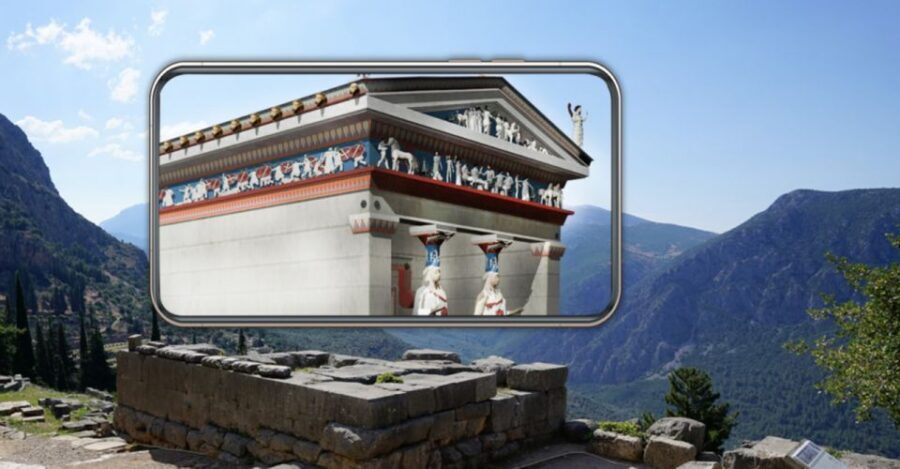
Delphi is the kind of place that can feel confusing fast. You see stones, columns, and scattered remains. Your brain tries to rebuild what stood there 2,500+ years ago. This tour helps with that mental jump. You don’t just read about the site. You get 3D representations, 360° views, and short videos paired with audio narration.
What it doesn’t do is replace your ticket. The app is the guide, but it’s not the admission. You’ll still handle the site entry separately, and you’ll need a working smartphone setup (download done ahead of time, storage space available, headphones ready).
A few more Delphi tours and experiences worth a look



Price and value: $8 for the guide, not the entrance
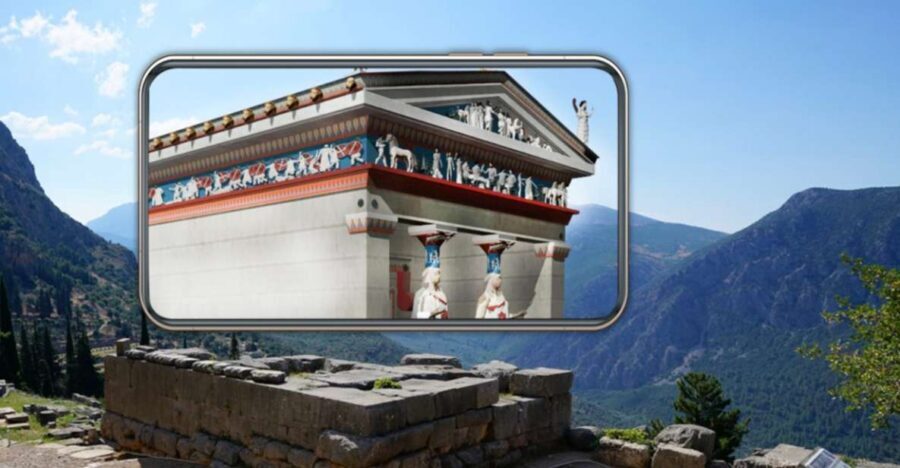
At about $8 per person, the value is really about what you’re buying: the app content. You’re not paying for a staff-led tour. You’re buying a structured, story-driven way to experience Delphi at your pace.
The site ticket is separate. The full entrance price is 20€, reduced is 10€. Add that in and the total cost becomes more like a normal museum outing. Still, $8 is a small price to pay for audio narration, multi-language text, and 3D visuals that can make the ruins click.
If you’re the type who likes to wander, pause, and replay key moments, the price-to-flexibility ratio is strong. If you want someone physically guiding you step-by-step, you’ll likely prefer a guided option instead.
Getting to Delphi: reach the site near Livadia

Delphi’s archaeological area is easiest by car or taxi. Follow the Athens–Thessaloniki motorway and take the exit to Livadia. From there, maps and GPS will point you to the best local approach.
Public transport is an option too (there are bus routes indicated on maps). For a self-guided tour, your main goal is simple: arrive with enough time to download content (if you haven’t yet) and to walk comfortably once you’re on site.
Set up your phone before you go: the offline plan

This tour is built around offline use. After you download the content, you can run it on site with no internet and no roaming fees. That’s a big deal in Greece if you don’t want to burn data wandering between stops.
Here’s how to make it smooth:
- Download the tour content while on Wi‑Fi before your visit (unless you already have enough data).
- Plan for about 200MB of storage space.
- Bring a charged smartphone.
- Pack headphones/earphones so you can actually hear the narration.
Your device matters too. The app needs iOS 11.0+ or Android 5.1+. If you’re traveling with an older phone, double-check before you get your hopes up.
After booking, you’ll receive an email from Culture App with instructions to download the content. Check spam if it doesn’t show up.
How the tour works on site: 3D, 360° and audio narration

Once you’re ready, the app becomes your handheld guide. You get:
- 3D reconstructions (the big help when ruins don’t look like much at first)
- 360° views (useful for understanding sight lines and how spaces might have felt)
- Short videos and info panels
- Audio narration with matching text
The trick is not to rush. Use the 3D models to build an image of the structure, then look back at the real stones nearby. That back-and-forth is where it clicks.
Audio is available in English, Spanish, Greek, German, Italian, Dutch, French, and Chinese, so you can pick what feels easiest. For solo wandering, that’s great. You avoid the compromise of “I’ll guess what the guide said in English.”
You can also read our reviews of more guided tours in Delphi





Apollo’s temple and Pythia: the story behind the oracle

The heart of Delphi is the oracle connected to Apollo, and the tour is designed to tell that story in a way that matches the site. You’ll be guided through Apollo’s temple area and the meaning of the oracle tradition.
One of the standout parts is the narration about Pythia, the seeress, and the bay leaves used in the process of divination. Instead of treating this as a vague legend, the app frames it as something people followed for centuries—ritual, questions, and belief tied to decisions that mattered.
Practical tip: don’t treat the oracle chapter like a quick listen. Pause. Stand where the structure would likely have framed the ritual. Then let the audio finish before moving on. The bay-leaf detail is short, but it makes the moment feel concrete.
Making sense of Delphi’s famous art: Charioteer and Sphinx of Naxos

Ruins are visual puzzles. The tour helps solve them using well-known masterpieces. Two highlights you’ll learn about through the app’s 3D representations are the Charioteer of Delphi and the Sphinx of Naxos.
Why this matters: sculpture is often where you feel how advanced Greek craftsmanship was, even when the temple stones are worn down. When you can see the forms clearly through 3D and compare that to what you observe on site, the art stops being an abstract “important thing” and becomes a readable cultural signal—wealth, power, devotion, and competition.
The Sphinx of Naxos also gives you a way to understand Delphi as more than one temple. It was a stage for offerings and statement-making. Even if some originals are not in the open air where you stand, the app fills in the visual gaps so you can keep the story straight.
The Pythian Games: why Delphi mattered beyond worship

Delphi wasn’t just a religious stop. It was part of a major panhellenic world through the Pythian Games—one of the biggest Greek festivals in antiquity. The tour includes that context, so you can connect the oracle to competition, celebration, and reputation.
This is where a self-guided approach works well. You can spend longer on the parts that match your interests:
- If you like religion and ritual, linger on Apollo and Pythia.
- If you like sports history and cultural festivals, make time for the games section.
- If you want art and political signaling, focus on the sculpture chapters.
When you understand the Games angle, Delphi feels less like a single “mystery site” and more like a hub where Greeks gathered to compete and seek meaning at the same time.
A good day-by-day way to pace a self-guided Delphi visit

The tour is flexible and self-guided, and your booking window is listed as 5 days. You can use that in a smart way, especially if you’re also visiting nearby places.
A simple approach:
- Day 1: Do the oracle-heavy route first (Apollo temple + Pythia audio). Use 3D models to rebuild what the sanctuary would have looked like.
- Day 2: Spend time on the art chapters (Charioteer of Delphi, Sphinx of Naxos, and other sculpture stories referenced in the app). Pause when you see a detail in 3D that you can later hunt for in the real site.
- Day 3: Focus on Delphi as a festival center (Pythian Games). Let that context guide how you interpret the rest.
Even if you only have one full day, you can still get a meaningful experience by choosing two themes and not trying to do everything at once. Delphi rewards slower pacing more than check-box speed.
Crowd control, without the stress of fixed schedules
One underrated benefit of self-guided tours is the freedom to follow your own tempo. The tour is built to help you learn without a strict group schedule. That matters at Delphi, where you can find yourself stuck behind other people if you show up with a “power through everything” plan.
With this app, you can:
- pause for audio without worrying about the person behind you
- replay a section when you want to match the narration to what you’re seeing
- take breaks when the sun and the stairs start to do their thing
If you’re planning around crowds, going earlier in the day or later can help your experience feel calmer. Use the app as your anchor, not the clock.
Languages: pick what helps you think, not just what you can survive
The app includes audio and text in English, Spanish, Greek, German, Italian, Dutch, French, and Chinese. That’s a lot of options for a site like Delphi.
My advice: choose the language you can follow easily without mental translation. If audio requires effort, you’ll miss details like the bay leaves and ritual context—those are the moments that make Delphi more than ruins.
What to bring (so your phone guide doesn’t turn into a burden)
This is a smartphone-based experience, so practical prep matters. Bring:
- a charged smartphone
- earphones/headphones
- sun hat
- water
- comfortable shoes
Also, remember the storage number: around 200MB. If your phone is full of photos, download will fail right when you need it most. Make room before you arrive.
Where you might want extra help (and why YouTube can work)
Audio and 3D models are excellent for making the big picture feel real. Still, you may want an extra source for themes you care about most.
One useful strategy: use the app for on-site structure and story, then add a bit of outside reading or video afterward. It’s a clean two-step combo: app gives you context while you’re standing there; outside material helps you go deeper at home.
Should you book this Delphi self-guided audio tour?
Book it if you want:
- offline access so you can wander without data stress
- 3D models and 360° views to interpret ruins
- audio narration that brings Delphi’s oracle tradition, Pythia, and the bay-leaf detail into clear focus
- flexibility to move at your own pace without a group schedule
Skip it (or rethink) if:
- you prefer a live guide with answers in real time
- you don’t want to rely on a smartphone and headphones
- you’re hoping the app price includes the archaeological entrance ticket (it doesn’t)
If you’re deciding between paying for admission and also bringing a way to understand what you’re seeing, this app is a smart add-on. It won’t replace the site fee—but it can turn a pile of stones into a story you can actually follow.
FAQ
Is the archaeological site ticket included?
No. Entrance tickets are not included and must be purchased separately at the site or online (full 20€, reduced 10€).
How long is the tour?
The experience is listed as a 5-day duration, with availability and starting times shown when you check booking options.
Does the tour work offline?
Yes. After you download the content, the app works fully offline on site with no internet or roaming needed.
How much storage does the app need?
You need approximately 200MB of storage space on your phone.
What languages are included?
Audio narration and text are available in English, Spanish, Greek, German, Italian, Dutch, French, and Chinese.
What phones does it support?
It requires iOS 11.0 or later or Android 5.1 or later.
Do I need headphones?
Yes, bring earphones/headphones so you can hear the audio narration.
What should I bring besides my phone?
Bring a charged smartphone, sun hat, water, and comfortable shoes.
When will I get download instructions?
After booking, you’ll receive an email from Culture App with instructions. Check your spam folder if you don’t see it.
Is it refundable?
Free cancellation is offered up to 24 hours in advance for a full refund. After downloading and using the paid price, the paid price is not refundable.