REVIEW · DELPHI
Delphi Skip-The-Line Private Tour – Expert Guide
Book on GetYourGuide →Operated by WARMPENGUIN · Bookable on GetYourGuide
Delphi feels far more meaningful when someone explains what you are seeing. This private tour connects the Oracle of Apollo with the treasuries, sculptures, Temple of Apollo, and Pythian Games, so the ruins become more than handsome stones on a mountainside. Guide Georgia, an archaeologist, is specifically named as the guide for some departures.
I like the tidy two-part format: 50 minutes in the museum, followed by 50 minutes at the archaeological site. I also like the private-group setting, which gives you a better chance to ask questions than a large coach tour. The main drawback is the brisk two-hour schedule and the uneven ground, which makes this a poor fit for wheelchair users or anyone with serious mobility limits.
In This Review
- Key points to know before booking
- Why Delphi is better with a guide
- Starting at the Delphi Archaeological Museum
- Following the path toward Apollo’s sanctuary
- The Oracle, pilgrims, and the Pythian Games
- What two hours really gives you
- Is $202 per person good value?
- Who will enjoy this Delphi tour most
- Practical advice for a smoother visit
- Should you book it?
- FAQ
- Where does the Delphi private tour begin?
- How long does the experience last?
- What places are included in the tour?
- Is this a private tour?
- Which languages are available?
- Are entrance tickets included in the price?
- Is the tour suitable for wheelchair users?
Key points to know before booking
- Georgia brings an archaeologist’s eye: Her explanations cover what it meant to visit Apollo’s sanctuary, consult the Oracle, or compete in the Pythian Games.
- The museum comes first: You see major sculpture and art before walking among the ruins, giving the outdoor remains more meaning.
- The Temple of Apollo is included: The route follows the path toward Delphi’s central sanctuary and its famous treasuries.
- The giant Naxos Sphinx is a major highlight: It gives you a striking link between political power, religion, and public display in ancient Greece.
- The tour lasts two hours: Expect a focused introduction rather than a leisurely full-day exploration of every corner.
- The ground is uneven: Bring water, sunscreen, a hat, and firm walking shoes. The site is not suitable for wheelchair users.
Why Delphi is better with a guide
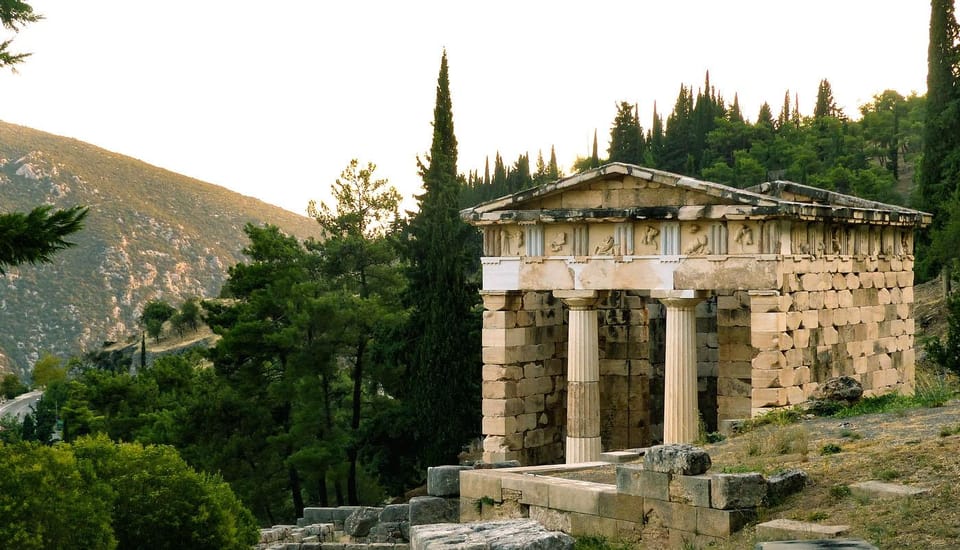
Delphi was regarded as the center of the ancient world, and its appeal is not limited to the surviving columns. The site worked as a religious center, a place of consultation, and a meeting point for Greek city-states. Without context, it can be hard to understand why so many cities built treasuries here or why pilgrims traveled to ask Apollo for guidance.
A guide gives you the missing connections. You hear about the famous prophecies of the Oracle, then see the buildings and sculptures that helped give Delphi its authority. You also learn about the ancient Olympic Games, along with the Pythian Games held at Delphi. That wider story helps you picture the site as an active center of worship and competition, not simply an archaeological park.
I especially like the way this tour links human questions to physical remains. Kings and ordinary pilgrims came seeking answers. City-states displayed their wealth through treasuries. Athletes competed in sacred games. The stones still matter, but the stories explain why they were placed there.
Because the group is private, you can ask for more detail on the subjects that interest you most. If you care about mythology, you can focus on Apollo and the Oracle. If sculpture is your priority, you can spend more of your museum time discussing the surviving masterpieces. The supplied information does not promise a custom route or a specific group size, but private format generally gives the guide more room to respond to your questions.
You can also read our reviews of more guided tours in Delphi
Starting at the Delphi Archaeological Museum
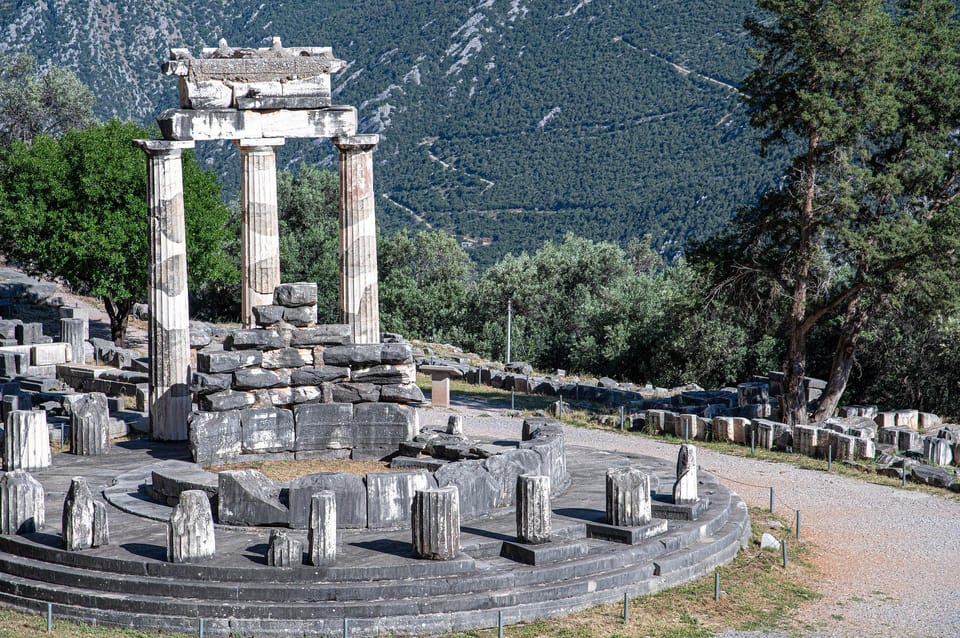
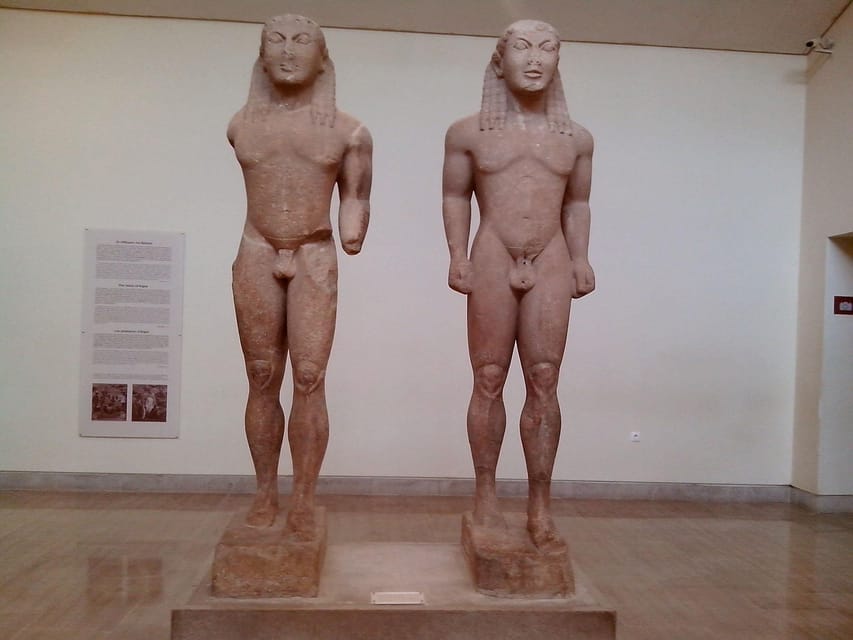
The meeting point is the Delphi Archaeological Museum, at the museum ticket office on the first floor. This is a useful starting place because the museum gives you the visual vocabulary for the outdoor site before you walk uphill among the remains.
Your guided museum visit lasts about 50 minutes. That is enough time for a clear introduction to important sculpture and art, but it is not enough for a slow look at every object. You will need to accept a selective visit. The benefit is focus: your guide can explain why particular pieces matter and how they relate to the sanctuary.
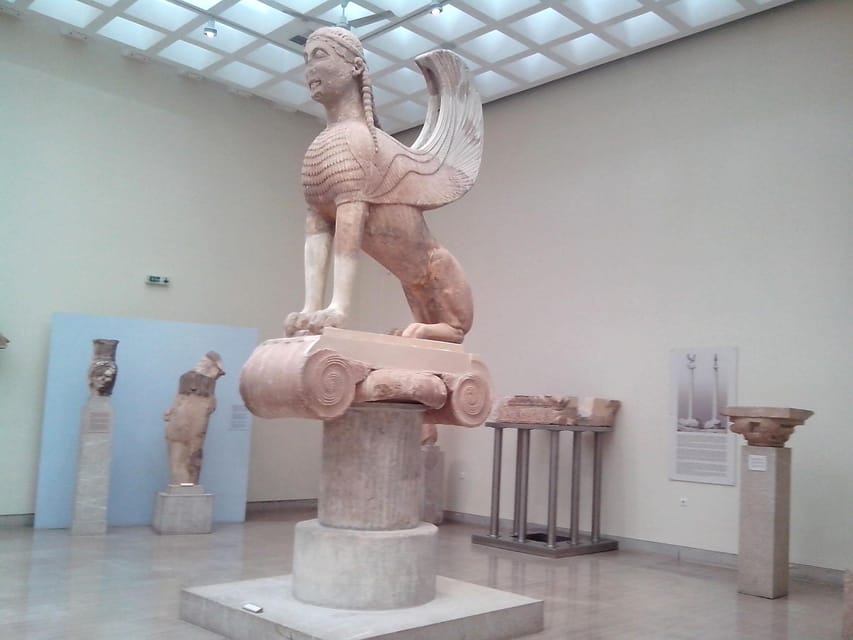
The giant Naxos Sphinx is one of the objects to watch for. Its size and presence help explain how city-states used grand dedications to make their mark at Delphi. It is also an excellent reminder that the sanctuary was not an isolated religious spot. It was a public stage where political communities showed their importance.
The museum portion also prepares you for the ruins. A column fragment or carved figure outdoors can be hard to read by itself. After seeing sculpture and learning the basic story of the sanctuary, you are better equipped to recognize what you are looking at when you step outside.
Flash photography is not allowed inside the museum. Bring a camera if you like, but be ready to enjoy the collection without using flash. A hat, sunscreen, and water are more important outdoors, especially since the ancient site offers little comfort from the sun.
Following the path toward Apollo’s sanctuary
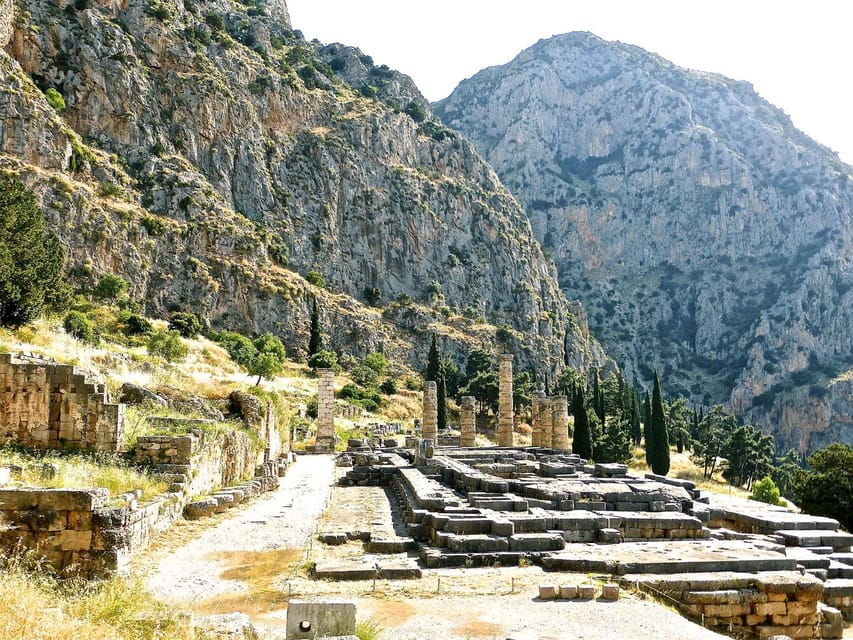
After the museum, you spend about 50 minutes at the Delphi Archaeological Site. The tour includes entrance to the archaeological site and the Temple of Apollo, though the booking information also says admission tickets may be purchased on request after booking. That wording is worth clarifying before you pay, since the listed price is $202 per person and ticket handling appears to be separate or dependent on the arrangement.
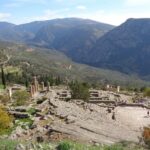
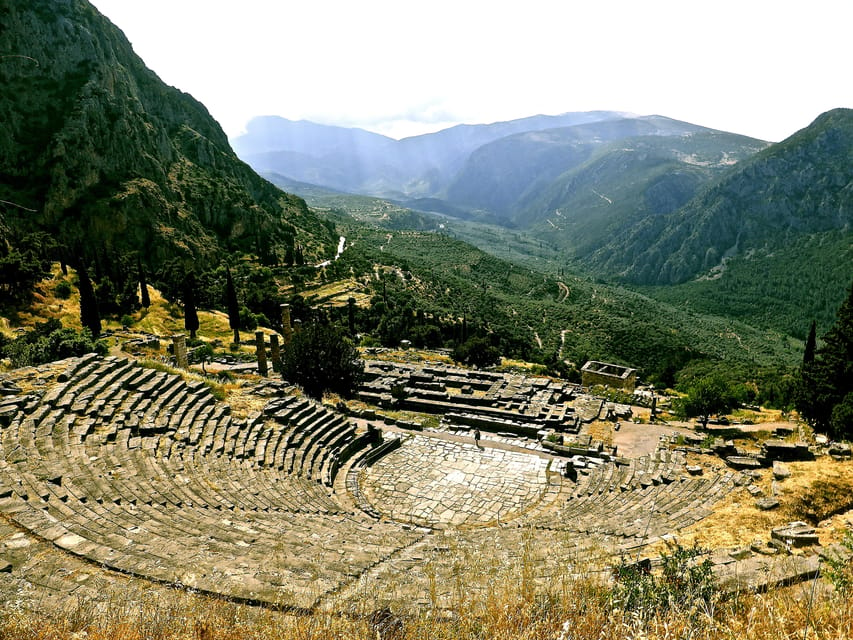
The outdoor route takes you along the path used by ancient visitors as they approached Apollo’s sanctuary. Your guide explains the treasuries built by different cities and the role they played at Delphi. These structures were not just storage rooms. They were public statements, placed where pilgrims and rival communities could see them.
This is one of the places where a guide earns the fee. Ruins rarely explain their purpose on their own. A row of foundations may look plain until you understand which city built it, what it dedicated, and how the building fit into the religious life of the sanctuary.
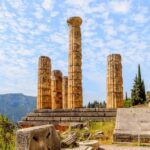
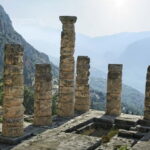
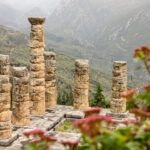
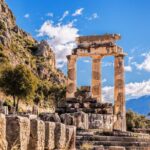
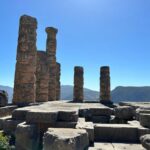
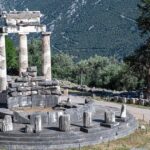
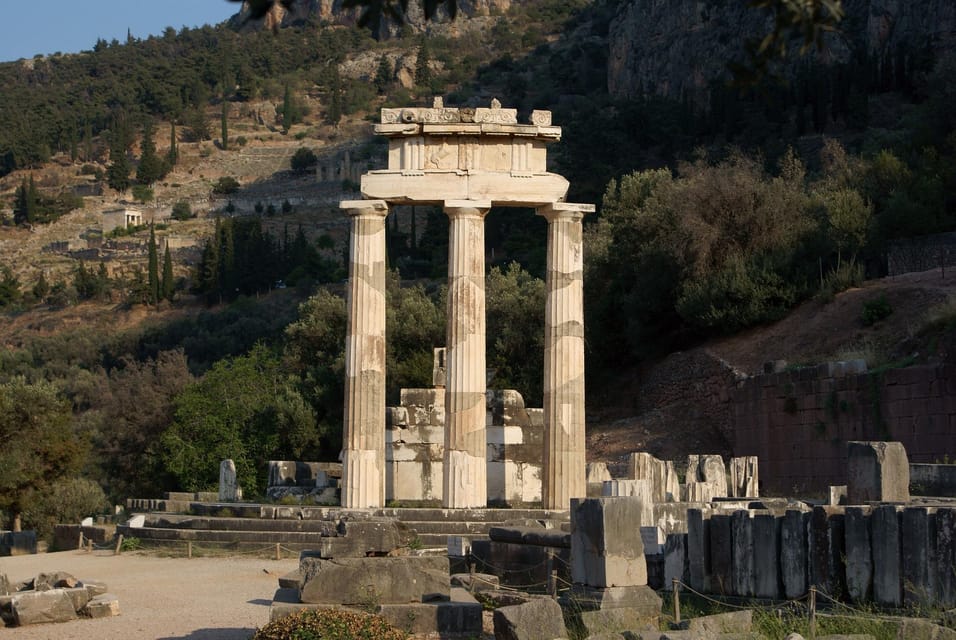
The Temple of Apollo is the emotional center of the visit. It is tied to the Oracle, whose prophecies made Delphi famous across the ancient Greek world. You will not see the temple as an intact building, so the guide’s explanation matters. The remaining columns and foundations gain meaning when you understand the rituals and expectations that once drew people here.
The archaeological site has uneven terrain. You should expect walking over irregular surfaces, and comfortable shoes are essential. The experience is not suitable for wheelchair users or people with mobility impairments. Even visitors who walk easily should bring water and use sun protection.
The Oracle, pilgrims, and the Pythian Games
The Oracle gives Delphi its strongest sense of mystery, but the tour presents it as part of a larger religious system. You learn about the prophecies associated with Apollo and the people who came to seek answers. The guide also helps you consider Delphi from the point of view of a pilgrim, rather than only from the viewpoint of a modern sightseer.
That change in perspective is useful. You can imagine the long journey, the arrival at the sanctuary, and the importance of public dedications along the sacred route. The experience becomes less about checking off a temple and more about understanding why the site commanded attention for centuries.
The Pythian Games add another side to Delphi. Many people know of the Olympic Games, but the games at Delphi show how athletic competition was tied to religious life. Learning about competitors and sacred festivals gives the ruins a more human scale. You can picture athletes, officials, pilgrims, and city representatives sharing the same sanctuary.
Georgia’s background as an archaeologist is particularly valuable here. The details attributed to her tour include what it would have been like to visit Apollo and the Oracle, as well as what it meant to compete in the Pythian Games. That approach goes beyond memorizing dates. It helps you picture how the site functioned.
The information provided names Georgia but does not guarantee that she will lead every departure. If having her specifically matters to you, ask when booking. The tour is offered in English, French, and Italian, so confirm your preferred language and guide availability in advance.
What two hours really gives you
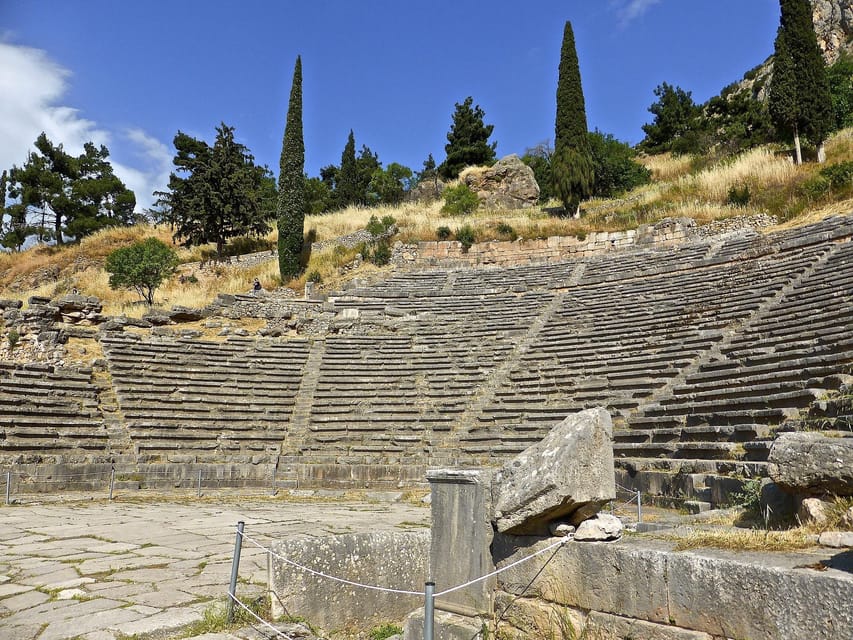
Two hours is a sensible length for a first look at Delphi, especially if you are fitting the site into a wider trip through Central Greece. The museum and archaeological site each receive about 50 minutes, leaving a small margin for movement between them. You get the main story without committing half a day to a single guided walk.
The trade-off is pace. You will not have unlimited time to linger over each sculpture or wander every section of the ruins. If you are an archaeology enthusiast who likes to read every label and photograph every detail, you may want extra time before or after the tour.
The private format helps compensate for the short duration. A guide can keep the route moving while answering relevant questions. You avoid the slow roll call and repeated explanations that often come with a large group. Still, do not book this expecting a slow, unstructured morning.
The tour returns to the Delphi Archaeological Museum, where it began. This makes the meeting point easy to understand, but it does not include hotel pickup or drop-off. You need to arrange your own way to the museum and plan around the tour’s available starting times.
You can also read our reviews of more private tours in Delphi


Is $202 per person good value?
At $202 per person, this is not a cheap way to see Delphi. The value depends on what you want from the visit. You are paying for a private guided experience with a licensed guide, a museum tour, an archaeological-site tour, and attention to the Oracle, Temple of Apollo, treasuries, sculpture, and ancient games.
That can be worthwhile if you care about interpretation and have limited time. A self-guided visit costs less, but you must provide the structure and background yourself. At Delphi, that background makes a real difference. The ruins are impressive, yet many of the most important ideas are invisible: the authority of Apollo, the purpose of the treasuries, and the role of the sanctuary in Greek public life.
The price needs careful checking because the information says admission tickets may be purchased on request after booking, even though entrance to the site, museum, and Temple of Apollo is listed among the inclusions. Ask exactly what the $202 covers and how tickets will be handled before finalizing your plans.
Food, drinks, hotel transfers, and transportation are not included. This is a meet-at-the-museum activity, not a complete day trip from Athens or another Greek city. If you need transport, you will have to arrange it separately.
Who will enjoy this Delphi tour most
I would choose this tour if you want a clear, well-shaped introduction to Delphi and do not want to study the site alone. It suits couples, families, and private groups with mixed levels of interest in archaeology because the guide can explain the big ideas without requiring specialist knowledge.
It is also a good match for anyone drawn to mythology. The Oracle, Apollo, pilgrims, and sacred games are central themes, and the guide brings them together with the physical remains.
Families may appreciate the storytelling approach. Children can usually follow the basic questions: Why did people come here? What did the Oracle do? Why did cities build treasuries? How did athletes compete at a religious sanctuary? The two-hour length also keeps the visit from becoming an endurance test.
You should think twice if you dislike guided pacing or want a long, quiet exploration. You also need to be comfortable walking on uneven ground. Wheelchair users and people with mobility impairments should not book this activity because the archaeological site is specifically listed as inaccessible for them.
Practical advice for a smoother visit
Wear shoes with good support. The site requires walking over uneven terrain, and flimsy footwear will make the route less enjoyable.
Bring water, a hat, and sunscreen. These are not optional extras for a sunny outdoor visit. The museum offers shelter, but the archaeological site is exposed.
Keep your camera ready outdoors, but do not use flash in the museum. The Naxos Sphinx and the Temple of Apollo are among the most memorable subjects, yet the guide’s explanation is more important than collecting photographs.
Arrive at the museum ticket office on the first floor with enough time to find the meeting point. Since the experience does not include hotel pickup, allow for your own transport and check the starting time when you book.
The activity offers free cancellation up to 24 hours before the start, and you can reserve now and pay later. Those terms help if your Central Greece plans are still moving, but they do not remove the need to confirm ticket costs and language availability.
Should you book it?
Book this Delphi tour if you want the sanctuary explained rather than simply photographed. The strongest reasons are the private format, the museum-first route, and the chance to learn from an archaeologist such as Georgia about the Oracle, pilgrims, treasuries, and Pythian Games.
Skip it if $202 per person feels too high for a two-hour visit, if you prefer to explore alone, or if uneven ground is a serious problem. Before booking, confirm whether admission tickets are included in your final price, then bring water and good shoes. For a focused first visit with strong historical storytelling, this is a sound choice.
FAQ
Where does the Delphi private tour begin?
The meeting point is the Delphi Archaeological Museum, at the museum ticket office on the first floor.
How long does the experience last?
The tour lasts two hours. About 50 minutes are spent in the museum and about 50 minutes at the archaeological site.
What places are included in the tour?
The experience includes the Delphi Archaeological Museum, the archaeological site, and the Temple of Apollo.
Is this a private tour?
Yes. The activity is offered for a private group.
Which languages are available?
Live guiding is available in English, French, and Italian.
Are entrance tickets included in the price?
The inclusions list entrance to the Temple of Apollo, the archaeological site, and the museum, but the information also says admission tickets may be purchased on request after booking. Confirm the exact ticket arrangement before payment.
Is the tour suitable for wheelchair users?
No. The archaeological site is not accessible for wheelchair users or people with mobility impairments, and the ground is uneven.