REVIEW · ATHENS
Full Day Private Tour in Athens
Book on Viator →Operated by Dionysis Athens tourist guide · Bookable on Viator
Athens makes the most sense when its monuments are linked to the people who built and used them. This private tour connects the Acropolis, museum, Agora, and Plaka in one long morning and afternoon, moving from sacred temples to public life and then into the old city streets.
I like the private format, since your group of up to six can ask questions and keep the discussion focused. I also like the guide’s broad teaching style. Dionysis is described as energetic, strategic, cultured, and strong at explaining difficult subjects, not just archaeology. The main drawback is the pace: six to seven hours on foot, with summer heat at the Acropolis and entrance fees of €45 per person paid separately.
In This Review
- Key points at a glance
- Why this Athens day works
- Starting at the Acropolis at 8:30
- The Acropolis Museum puts the stones back together
- The Ancient Agora explains how democracy worked
- Plaka gives the day a later chapter
- What the private price really buys
- Timing, walking, and weather
- Who should book this private Athens tour
- Cancellation and booking details
- Should you book it?
- FAQ
- How long does the private Athens tour last?
- What time does the tour start?
- Where does the tour begin?
- Where does the tour end?
- How many people can join the private tour?
- Are entrance tickets included?
- How much are the listed entrance fees?
- Is the tour suitable for anyone with limited fitness?
- What is the cancellation policy?
Key points at a glance
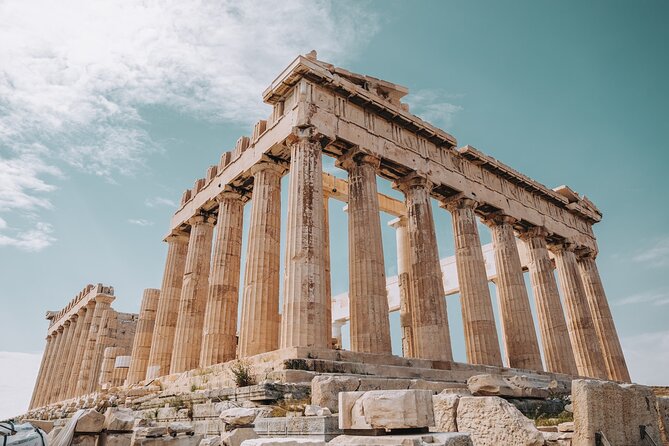
- Three major paid sights: The Acropolis, Acropolis Museum, and Ancient Agora are all included in one carefully connected day.
- Dionysis leads the tour: Expect attention to archaeology, religion, politics, and daily life rather than a quick monument checklist.
- Private group of up to six: Your party travels alone, making questions and adjustments easier.
- A useful historical sequence: The Acropolis explains religion, the museum explains the surviving art, and the Agora explains democracy and ordinary life.
- Plaka adds later Athens: The final walk shows how the city changed through Roman, Byzantine, and Ottoman periods.
- Budget for admissions: The listed entrance costs total €45 per person, separate from the $463.04 group price.
Why this Athens day works
Many Athens tours stop at the Parthenon, point out a few broken columns, and move on. This one has a clearer purpose. It asks how Athens was built, why its temples mattered, how religious festivals shaped public life, and how democracy grew from the city’s political system.
That structure is especially useful if you are seeing ancient Athens for the first time. You begin at the Acropolis, where religion and civic identity meet. You then see the original sculptures and archaeological finds in the Acropolis Museum. At the Ancient Agora, the focus shifts to courts, public buildings, politics, and daily routines.
I like that the day does not end at the ancient sites. The walk through Plaka gives you a simple way to see Athens as a city that kept changing long after classical Greece. You will not get an exhaustive tour of every period, but the Roman, Byzantine, and Ottoman references help place the modern streets in a longer story.
The private setup matters here. A group of six has room for conversation without the feel of a large coach excursion. Dionysis can address questions about archaeology, religion, politics, or broader culture, and the supplied description of his work points to a guide who teaches rather than simply recites dates.
You can also read our reviews of more private tours in Athens


Starting at the Acropolis at 8:30
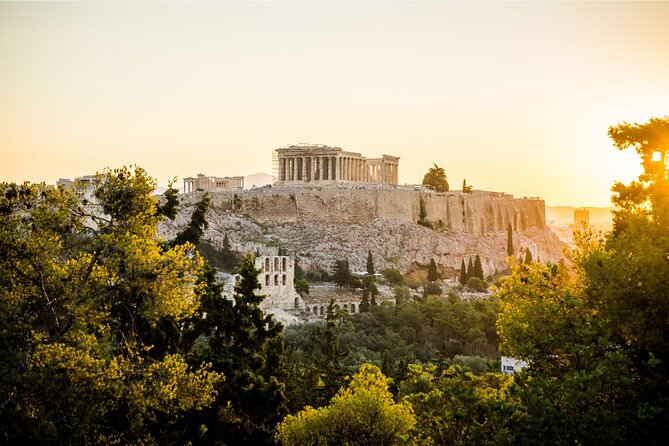
The tour starts at 8:30 a.m. at Makrigianni 4, near the Acropolis area. That early start is sensible. The Acropolis is exposed, and one Spanish-language account of a July visit specifically points to intense heat at the site. An early arrival gives you a better chance of doing the steep, open-air portion before the strongest sun.
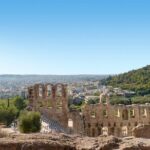
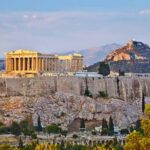
Allow about two hours for the Acropolis. The main focus is the hill’s famous monuments:
- The Parthenon, the great temple dedicated to Athena
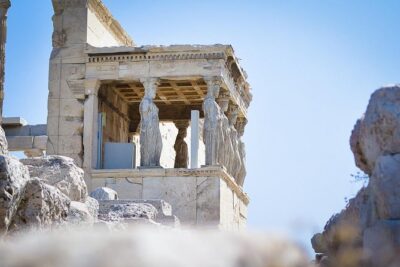
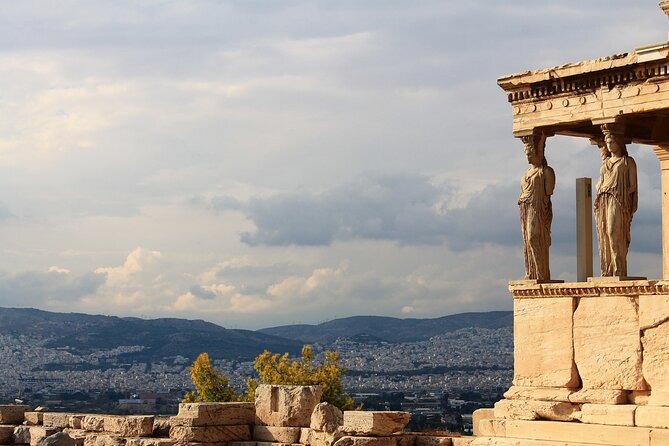
- The Erechtheion, known for its unusual design and sacred associations
- The Propylaea, the monumental entrance to the hill
- The Sanctuary of Dionysos
- The Sanctuary of Asclepios
The value of having these sanctuaries included is easy to miss. The Acropolis was not just a scenic platform for the Parthenon. It was part of a wider religious setting, and the sanctuaries below the main monuments help show how worship, healing, drama, and festivals fit into Athenian life.
Dionysos is tied to the religious world of ancient Athens and to the festivals that shaped public culture. Asclepios brings another side of worship into view, with attention to healing. These places help you see the Acropolis area as an active religious center, not a group of isolated ruins.
The Parthenon remains the star, of course, but the explanation around it is what gives the visit value. You will learn how the temples of Athena were constructed and what their functions were. That is more useful than hearing only that the building is old, famous, and visually impressive.
Admission to the Acropolis is €20 per person and is not included in the tour price. Keep that separate when comparing the cost with other private options. The physical demand is moderate, but you should still expect walking and uneven ancient surfaces. The tour asks for a moderate fitness level, and the heat can make the Acropolis feel harder than the schedule suggests.
The Acropolis Museum puts the stones back together
The next major stop is the Acropolis Museum, with about 90 minutes inside. Admission is €15 per person, also paid separately.
This is where the morning’s ruins become easier to understand. The museum holds artifacts found in the Acropolis area during excavations in the 19th and 20th centuries. You will also see the Parthenon’s sculptural decoration, which helps explain what the temple looked like as a complete work of art rather than the weathered structure visible on the hill.
I like the order of these two visits. Seeing the Acropolis first gives the museum displays a physical reference. Then, inside the museum, you can think about the sculpture, decoration, and objects with a better idea of where they belonged.
The museum portion also gives you a break from the sun. That matters after two hours on the hill, especially in July. It is still an information-heavy stop, so the guide’s teaching ability becomes important. The available description of Dionysis emphasizes clear instruction and wide cultural knowledge, with a focus that goes beyond archaeology alone.
The museum visit is not a quick add-on. At an hour and a half, it has enough time for a real explanation of the site’s art and artifacts. If you prefer to spend every possible minute photographing the Parthenon, this may feel like a tradeoff. If you want to understand what you saw on the hill, it is time well used.
The Ancient Agora explains how democracy worked
The Ancient Agora receives another 90 minutes. Admission costs €10 per person and is not included.
The Agora was the center of the ancient city’s public life. Here, you will look at public buildings, temples, and ancient courthouses while discussing the conditions that gave rise to democracy. The subject is more practical than the modern word sometimes suggests. The guide will address how the political system functioned, rather than presenting democracy as a simple invention with no limits or complications.
This stop gives the day a welcome change of subject. At the Acropolis, the central questions concern gods, temples, rituals, and sacred art. At the Agora, you shift toward decisions, courts, public business, and the routines of urban life.
You will also talk about daily life in the ancient city. That can include the ordinary social world behind the grand monuments, though the precise balance depends on the guide and your questions. Since the tour is private, you can ask Dionysis to spend more time on politics, archaeology, religion, or daily life as your interests develop.
The Agora is also a good reason to choose this tour over an Acropolis-only experience. You see Athens not just as a religious center but as a functioning city. The temples matter, but so do the buildings where public affairs took place and the spaces where people handled the business of living together.
The €10 admission is modest compared with the other two sites, but it still raises the total cost. For one person, the three listed admissions come to €45. For a group of six, they come to €270, before the tour price and any currency conversion. Check the current entrance prices when booking, since the supplied figures are the prices attached to this experience.
Plaka gives the day a later chapter
The final two hours are spent walking through Plaka. There is no separate admission charge.
Plaka is not presented as a major archaeological site. Its role is different. The walk shows how Athens developed through the Roman, Byzantine, and Ottoman eras, giving you a later historical frame after the ancient monuments.
Ending in Plaka also makes practical sense. The tour finishes in Monastiraki Square, directly in front of the entrance to the flea market. You end in one of central Athens’s useful locations rather than returning to the morning meeting point. From there, you can continue exploring on your own, though the tour information does not specify onward transportation or a hotel drop-off.
The two-hour Plaka walk may suit you if you like context and street-level history. It may feel long if your main goal is only the classical sites. After several hours of ruins and museum displays, some people will welcome a slower walk through the old part of town. Others may prefer a shorter neighborhood visit and more time at the Acropolis Museum.
I would treat Plaka as a flexible part of the day. Since the tour is private, ask Dionysis to shape the discussion around the periods or streets that interest you most. The stated focus is how the city evolved, not shopping, food, or nightlife, so do not book this expecting a dedicated culinary or market tour.
A few more Athens tours and experiences worth a look
- All Day Cruise -3 Islands to Agistri,Moni, Aegina with lunch and drinks included
★ 5.0 · 4,958 reviews



What the private price really buys
The price is $463.04 per group of up to six. That means the cost per person changes sharply with group size. At six people, the tour fee works out to about $77 per person before admissions. At two people, it is about $231 per person, again before the €45 in listed admissions.
That is not a budget sightseeing tour. It is a private guide fee for a full 6 to 7-hour day, and the value depends on how much you want explanation and control over the pace. A couple who mainly wants quick photographs may find the price hard to justify. A family or group of friends who would otherwise need several separate tickets and a large shared tour may find the cost easier to accept.
The fee includes all fees and taxes connected with the service, but it does not include admission to the three paid stops. That distinction is important. Your likely minimum site cost is €45 per person based on the stated prices, so include that in your planning.
The private format is the strongest reason to pay more. You are not sharing the activity with anyone outside your party, and the group limit is six. Questions can stay focused, and the day can have a more natural conversation than a large group tour allows.
The guide is Dionysis Athens tourist guide, and Dionysis is the named guide associated with the experience. The available account of his work describes him guiding a 22-person Road Scholars group through Athens, Mykonos, Santorini, Crete, and back to Athens over 14 days. That does not describe this exact private outing, but it does point to experience handling both archaeology and wider Greek culture.
A second account, written in Spanish, describes Dionysis as kind, energetic, strategic, cultured, and skilled at teaching. It also warns that the Acropolis in July was very hot. I would give both details weight: expect an active guide with a broad subject range, and take heat planning seriously.
Timing, walking, and weather
The scheduled stops total about 6.5 hours: two hours at the Acropolis, 90 minutes at the museum, 90 minutes at the Agora, and two hours in Plaka. That fits the stated six to seven-hour duration, although actual timing can shift with walking speed, questions, and site conditions.
You should have moderate physical fitness. The day combines the Acropolis hill, archaeological ground, museum walking, the Agora, and an extended neighborhood walk. The tour information does not give a detailed accessibility description, so you should ask the provider directly if your group has specific mobility needs.
Start at 8:30 a.m. and plan clothing around the weather. The tour requires good weather and may be moved or canceled if conditions are poor. If that happens, you are offered another date or a full refund.
A mobile ticket is provided, and the meeting point is near public transportation. The start address is Makrigianni 4, Athens 117 42. The end point is Monastiraki Square, in front of the flea market entrance. Those fixed points make the tour easy to combine with a hotel stay or another central Athens plan, but the information does not promise pickup or drop-off.
The biggest practical mistake would be treating this as a light sightseeing stroll. The Plaka segment is easy to imagine as relaxed, but it comes after several hours at major sites. Good shoes, water, and sun protection are sensible choices, especially during hot weather. The tour details do not state that these items are supplied, so plan to bring your own.
Who should book this private Athens tour
I would recommend it most strongly to a group that wants one guide for the main classical sights and prefers explanation over speed. It suits families, couples traveling with friends, and small groups with mixed interests, since the discussion can move from temple construction to democracy and daily life.
It is also a good choice if you want the Acropolis Museum included in the same historical sequence. The combination of the hill and the museum gives you both the buildings and the objects found around them. The Agora then adds the political and social side of the city.
Students of ancient history, archaeology, religion, or political development may get especially good value from the subject range. Dionysis’s reported ability to discuss more than archaeology is useful here, since the day covers art, worship, festivals, healing, law, government, and later urban history.
I would be more cautious if you dislike long walking days, have a tight schedule, or want a tour built around food and shopping. Plaka is a historical walk, not a dedicated food tour, and the day has no stated hotel transportation.
The rating information is based on only two entries, so I would not treat it as a broad statistical verdict. Still, both available accounts give Dionysis strong personal emphasis, with particular attention to his energy, culture, and teaching. That is the most useful signal here: the quality of your day will depend heavily on how much you value a guide-led conversation.
Cancellation and booking details
Confirmation is provided at booking. You can cancel up to 24 hours before the 8:30 a.m. start for a full refund. Cancellations or changes made within 24 hours are not accepted and are not refunded.
The cut-off uses local Athens time. Since good weather is required, a provider cancellation for poor conditions brings either a different date or a full refund. Keep the weather rule in mind when placing this tour early in your trip, since a change of date is easier if you have spare days.
Should you book it?
Book this tour if you want Athens explained as a living ancient city, not reduced to a few famous stones. The Acropolis, museum, Agora, and Plaka form a sensible chain, and the private format gives Dionysis room to connect religion, art, politics, and daily life.
Skip it if you want the cheapest way to see the Parthenon, or if your group will not enjoy six to seven hours of walking and discussion. Also price in the €45 per-person admission cost before deciding.
For a small group that values a serious guide and a full historical picture, this is a well-focused day. Start early, prepare for heat, and use the private format to ask for the subjects you care about most.
FAQ
How long does the private Athens tour last?
The tour lasts approximately 6 to 7 hours.
What time does the tour start?
It starts at 8:30 a.m. local time.
Where does the tour begin?
The meeting point is Makrigianni 4, Athens 117 42, Greece.
Where does the tour end?
It ends in the middle of Monastiraki Square, in front of the entrance to the flea market.
How many people can join the private tour?
The private activity is for your group only, with up to six people.
Are entrance tickets included?
No. Admission tickets to the Acropolis, Acropolis Museum, and Ancient Agora are not included.
How much are the listed entrance fees?
The listed prices are €20 per person for the Acropolis, €15 per person for the Acropolis Museum, and €10 per person for the Ancient Agora.
Is the tour suitable for anyone with limited fitness?
The tour requires a moderate level of physical fitness. The provided information does not give a detailed accessibility description.
What is the cancellation policy?
You can cancel at least 24 hours before the start time for a full refund. Cancellations or changes made less than 24 hours before the start are not refunded or accepted. If poor weather causes the provider to cancel, you will be offered another date or a full refund.