REVIEW · ATHENS
Greek Mythological Walking Tour
Book on GetYourGuide →Operated by MagicAthens · Bookable on GetYourGuide
Athens makes a fine stage for mythology because the old stories are tied to real streets, temples, gardens, and monuments. On this two-hour walking tour, you follow a route from the National Library past grand neoclassical buildings, the Parliament, National Gardens, the Temple of Olympian Zeus, and views of the Acropolis.
I like the way the tour links myth, philosophy, and city history instead of treating Greek mythology as a list of gods to memorize. I also like the flexible language choice, with tours offered in English, Spanish, Italian, French, and Portuguese. The main consideration is pace: two hours covers a lot of ground, and the tour appears to end near the Acropolis Museum, though the meeting details also say it ends back at the starting point. Confirm the finish location before you book.
In This Review
- Key points at a glance
- A mythological route through central Athens
- The National Library and Athens neoclassical center
- Parliament, ceremony, and the National Gardens
- Zeus, Athena, and Apollo in the streets of Athens
- The Temple of Olympian Zeus and Hadrian’s Arch
- Acropolis views and the finish near the museum
- What the $51 price gets you
- Languages, guide style, and group expectations
- Who will enjoy this Athens walk
- Should you book the Greek Mythological Walking Tour?
- FAQ
- Where does the Greek Mythological Walking Tour start?
- How long does the tour last?
- Where does the tour finish?
- What languages are available?
- Does the tour enter the Acropolis?
- Is the Acropolis Museum ticket included?
- Where should I meet the guide?
- How early should I arrive?
- Who operates the tour?
- Can I cancel the booking?
Key points at a glance
- Starts at the National Library: Meet on the grand staircase at 32 Panepistimiou Street, opposite Book Plus bookstore.
- A city walk, not simply an Acropolis visit: The route connects central Athens with the Temple of Olympian Zeus and Hadrian’s Arch.
- Myths tied to real places: Stories of Zeus, Athena, and Apollo are told while you walk through Athens.
- See the changing of the guard: The route passes the Hellenic Parliament and includes a view of this symbolic ceremony.
- Guides speak five languages: Choose English, Spanish, Italian, French, or Portuguese when available.
- Good value for a mythology-focused introduction: The $51 price pays for a guide-led two-hour walk, but admission to the Acropolis or museum is not listed as included.
A mythological route through central Athens
This experience is best understood as a guided introduction to Athens rather than a standard monument-by-monument sightseeing walk. The guide uses the city as a classroom, showing you where ancient beliefs, later political power, philosophy, and modern Greek identity meet.
That approach matters in Athens. You can look at a temple and see only weathered marble, or you can learn why Zeus mattered, how Athena became linked to the city, and how old religious stories continued to shape art and public life. The tour aims to give you that second view.
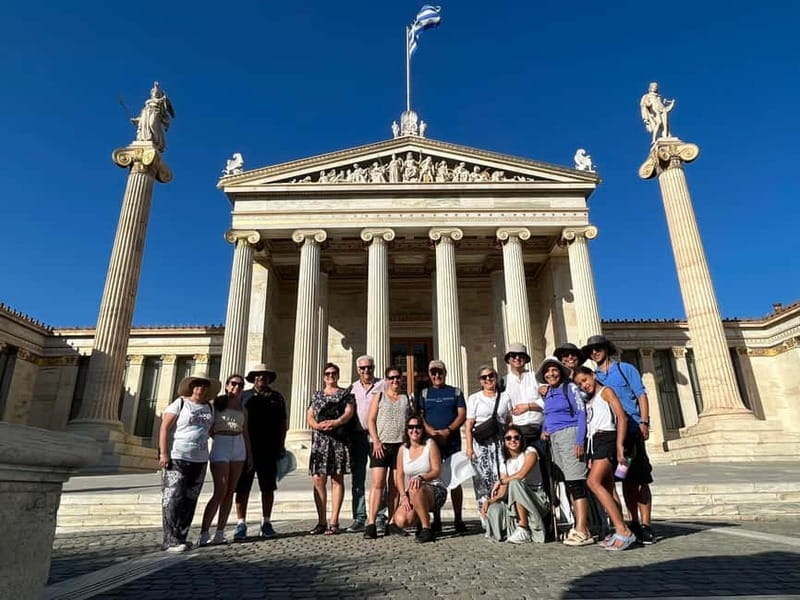
The route begins at Panepistimiou 32, outside the National Library of Greece. You should arrive a few minutes early and look for the guide on the large front staircase. Book Plus bookstore is directly across the street, which gives you a useful landmark if you are finding the meeting point in central Athens.
From there, you set out on foot. There is no coach and no transfer between sights, so the tour keeps you close to the city and lets the route unfold at street level. You should wear comfortable shoes and be prepared for a steady walk, though the supplied details do not give an exact distance or describe the amount of uphill walking.
You can also read our reviews of more walking tours in Athens


The National Library and Athens neoclassical center
The National Library is a fitting starting point. Its grand exterior immediately places you in a more formal, monumental Athens, far from the narrow lanes and busy commercial streets that many people first picture.
The nearby Academy of Athens adds another layer. Its neoclassical design refers back to ancient Greek ideals, so it gives the guide a natural opening for discussing how modern Greece presented itself through classical symbols. You are not simply looking at an attractive facade. You are seeing a later city consciously connected to its ancient past.
The Museum of Numismatics is another interesting stop along the way. It occupies the former home of Heinrich Schliemann, the archaeologist associated with excavations at Troy and Mycenae. The building brings together archaeology, wealth, collecting, and the nineteenth-century fascination with ancient Greece.
You may not enter the museum during this walk. Its value here is as a story point and a chance to consider how modern figures helped shape the way the ancient world was studied and displayed. If you want a full museum visit, plan that separately.
Parliament, ceremony, and the National Gardens
The route continues past the Hellenic Parliament. This gives the tour a useful modern counterpoint. Athens is not only a city of gods and temples. It is also the capital of present-day Greece, and Parliament places the ancient stories within the country’s current civic life.
You also get to witness the symbolic changing of the guard. The tour does not promise a special viewing position or a full explanation of the ceremony, so treat it as part of the walk rather than the main event. Still, it is a worthwhile pause. The formal ritual, uniforms, and setting offer a clear connection between national identity and public tradition.
From Parliament, the walk moves into the National Gardens and the Zappeion gardens. This is one of the more pleasant changes of pace on the route. After grand buildings and busy central streets, the gardens offer quieter paths and shade, at least in spirit, while the guide turns toward the gods and heroes connected with Athens.
The garden setting helps the stories breathe. Tales of Zeus, Athena, and Apollo can feel abstract when presented in a classroom or on a page. Hearing them outdoors, while moving through the city that has carried these stories for thousands of years, gives them a more immediate quality.
Zeus, Athena, and Apollo in the streets of Athens
The tour’s main appeal is the way it makes mythology feel connected to place. You will hear stories involving gods and mortals, including love, tragedy, madness, and ambition. The stated aim is not only entertainment. It is to show how Greek mythology helped shape the cultural inheritance of the Western world.
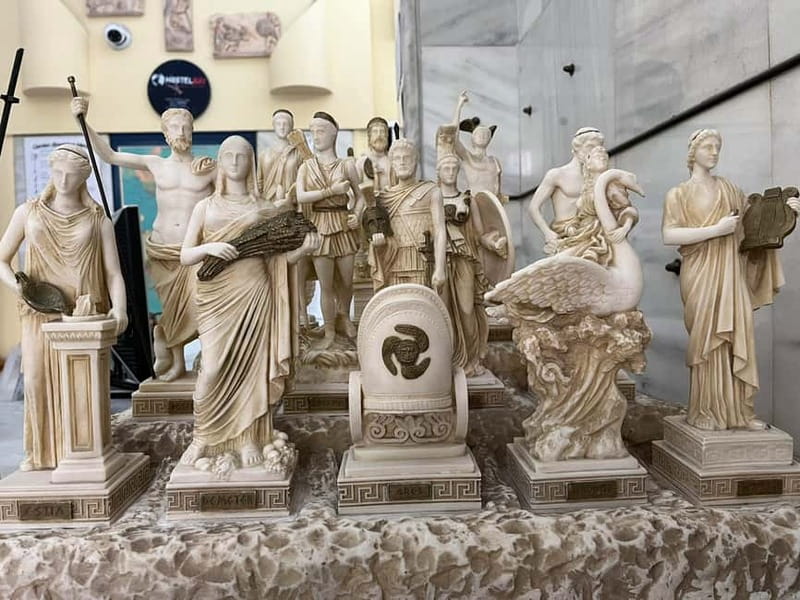
Athena is especially important for understanding Athens. Zeus helps explain the wider order of the Greek gods, while Apollo opens the door to ideas of beauty, prophecy, music, and reason. The guide may connect these figures to philosophy, poetry, and the city’s monuments, giving you several ways to understand the myths beyond their family relationships.
The presentation is designed to be fun and educational. That balance should suit you if you want something more lively than a dry lecture but more substantial than a string of dramatic anecdotes. The tour’s strongest reported praise concerns the guide’s storytelling and patience with questions. Mohamed is specifically named as a guide who told the myths with passion and took time to answer questions.
That detail is useful because a mythology tour depends heavily on the person leading it. The same route can feel flat with a rushed guide and memorable with someone who knows how to tell a story. The available feedback is very limited, only two ratings, so I would not treat it as a broad measure of every guide or departure. Still, Mohamed’s mention suggests that thoughtful questions are welcome.
The Temple of Olympian Zeus and Hadrian’s Arch
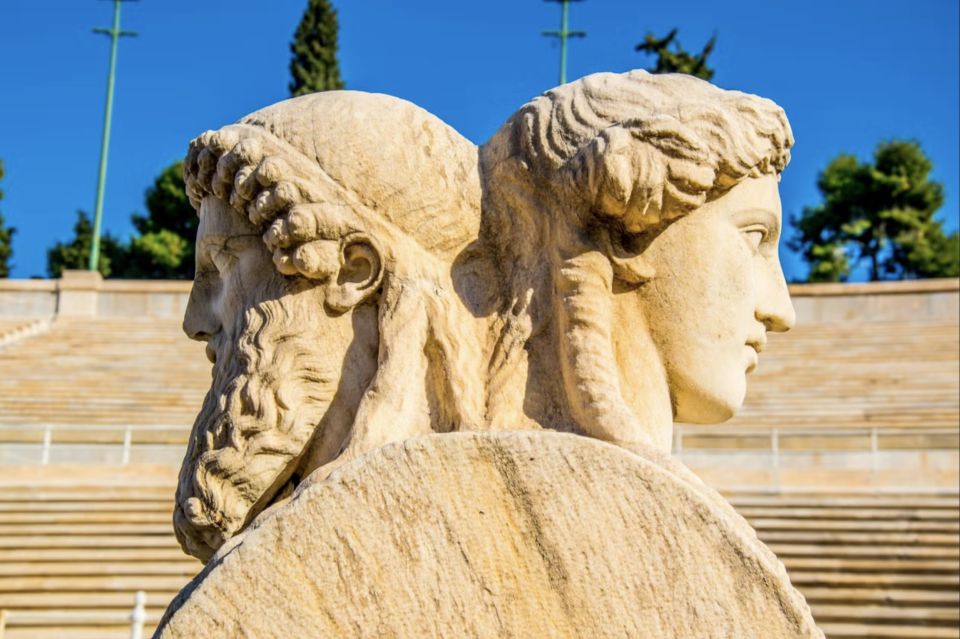
The route’s major ancient monument is the Temple of Olympian Zeus. Even if you do not enter the archaeological site, seeing the surviving columns from the street gives you a strong sense of scale. The temple was dedicated to Zeus, the chief god of the Greek pantheon, and its size reflects the ambition attached to his worship.
This is also where the tour can explain the relationship between mythology and political power. A temple to Zeus was not only a religious structure. Monumental building projects required money, organization, and rulers who wanted to link themselves with the gods and the heroic past.
Nearby, Hadrian’s Arch adds an important Roman layer. It marks the point where ancient Athens met the city expanded under the Roman emperor Hadrian. The juxtaposition is one of the best parts of the route: Greek myth, Athenian identity, and Roman imperial authority occupy the same view.
You should not expect a detailed archaeological tour of every stone. The walk is built around interpretation and storytelling, with monuments serving as evidence for a larger story. If your main goal is close study of architecture, inscriptions, or excavation layers, a specialist archaeology tour would be a better match.






Acropolis views and the finish near the museum
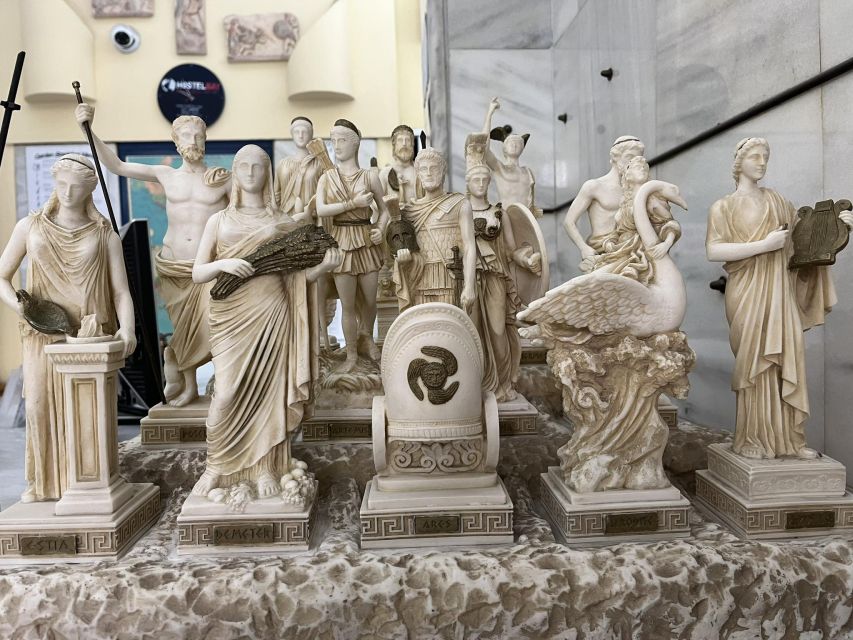
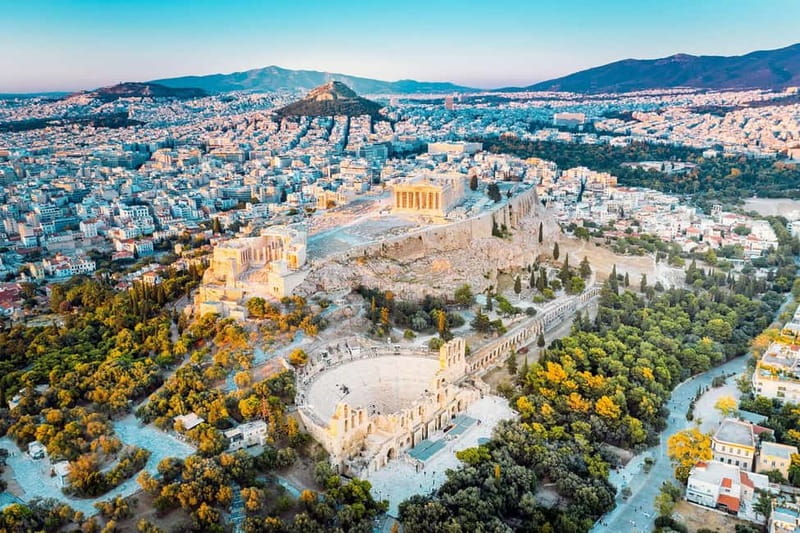
The walk culminates with views of the Acropolis and concludes, according to the route description, outside the Acropolis Museum. This is a strong ending because the Acropolis is the image most closely associated with Athens, yet you reach it after seeing the city’s wider network of monuments and stories.
The view is not the same as entering the Acropolis. Admission to the Acropolis and the Acropolis Museum is not listed among the inclusions, so you should plan and pay for those visits separately if they are part of your Athens schedule.
The finish also gives you a useful chance to continue sightseeing. You can visit the Acropolis Museum on your own, arrange an Acropolis visit for another time, or stop in the area for food and a break. However, the meeting-point information says the activity ends back at the original meeting point. That conflicts with the stated finish near the museum. Ask MagicAthens to confirm the actual end point and whether the guide returns the group to Panepistimiou 32.
What the $51 price gets you
At $51 per person, this is not the cheapest way to walk around Athens. You can see many of these exterior sights independently at no charge. The value comes from having a guide connect them through one clear theme.
I would consider the price reasonable if mythology is a major reason you are visiting Greece, or if you want help making sense of Athens before visiting its museums and archaeological sites. The guide can save you from reading disconnected facts and can show how the city’s ancient and modern identities fit together.
The value is weaker if you only want photographs of the Acropolis or a basic orientation walk. The tour does not list entrance tickets, food, transport, or museum admission as included. You are paying for the guided interpretation and the structure of the route.
The two-hour length is another part of the value equation. It is short enough to fit into a busy Athens day, but long enough to cover several major areas. Since the walk includes central streets, gardens, and ancient monuments, you should expect a full sightseeing outing rather than a quick stroll.
You can reserve now and pay later, which helps if your plans are still changing. Free cancellation is available up to 24 hours before the activity for a full refund. Those terms are practical, but check the current booking conditions at the time you reserve.
Languages, guide style, and group expectations
The tour is offered in English, Spanish, Italian, French, and Portuguese. Select your language carefully when booking, since the quality of a mythology tour depends on following names, relationships, and complicated stories without strain.
The supplied details do not give a group-size limit. You should not assume a private tour or a small group. If that matters to you, ask the provider before reserving.
The guide’s role is central. The experience promises an engaging explanation of mythology, history, poetry, and cultural inheritance. The specific praise for Mohamed focuses on kindness, helpful answers, and passionate storytelling, which are exactly the traits you want on a subject that can become confusing quickly.
I would bring water, sun protection, and comfortable walking shoes. These are practical suggestions for any two-hour walk in Athens, not claims about special equipment required by the operator. The meeting instructions ask you to arrive a few minutes early so the group can leave on time.
Who will enjoy this Athens walk
This tour suits first-time visitors who want a clear introduction to the city before tackling the Acropolis or the museums. It also works well for families and curious adults who prefer stories and questions to a formal lecture.
You will get the most from it if you enjoy connections. The guide moves from ancient gods to public buildings, from gardens to imperial monuments, and from myth to philosophy. That broad approach gives you a stronger sense of Athens as a living city rather than a collection of isolated ruins.
It may not suit you if you want extensive time inside monuments. The route is primarily outdoors, and the available details do not say that it includes entry to the Acropolis, the Acropolis Museum, the National Library, the Museum of Numismatics, or the Temple of Olympian Zeus.
It is also less suitable if you need a fully detailed accessibility plan. The information provided does not specify pavement conditions, step-free access, rest stops, or the exact walking distance. Contact the provider with those questions before booking.
Should you book the Greek Mythological Walking Tour?
Book it if you want Athens explained through its myths and you like moving between famous landmarks and less obvious story points. The route offers a useful mix: the National Library and Academy, Parliament and the changing of the guard, the National Gardens, the Temple of Olympian Zeus, Hadrian’s Arch, and Acropolis views.
I especially like it as a first or second-day activity. It can give you the story framework you need before visiting the Acropolis Museum, where many statues and myths will make more sense. The guide’s ability to answer questions is important, and Mohamed receives particularly strong praise for that part of the experience.
Skip it if your priority is entering the Acropolis, spending time in museums, or studying ancient architecture in detail. At $51, the tour is worthwhile for interpretation, not for included admissions. Also confirm the final meeting point, since the route description and meeting information give different endings.
FAQ
Where does the Greek Mythological Walking Tour start?
It starts at the main entrance of the National Library of Greece at 32 Panepistamiou Street. Meet on the grand staircase at the front of the building, with Book Plus bookstore across the street as a reference point.
How long does the tour last?
The walking tour lasts two hours.
Where does the tour finish?
The route description says it concludes outside the Acropolis Museum. The meeting information also says the activity ends back at the meeting point, so confirm the final location with MagicAthens before booking.
What languages are available?
The tour is offered in English, Spanish, Italian, French, and Portuguese.
Does the tour enter the Acropolis?
The supplied details describe a walk through Athens with views of the Acropolis, but they do not list Acropolis admission as included.
Is the Acropolis Museum ticket included?
No museum ticket is listed among the inclusions. The route finishes near the Acropolis Museum, according to the tour description.
Where should I meet the guide?
Meet at the main entrance of the National Library of Greece, on the large staircase at 32 Panepistamiou Street.
How early should I arrive?
You are asked to arrive a few minutes early so the tour can begin on time.
Who operates the tour?
The experience is operated by MagicAthens.
Can I cancel the booking?
You can cancel up to 24 hours in advance for a full refund. A reserve-now, pay-later option is also available.