REVIEW · ATHENS
Half Day Ancient Corinth and Canal VR Audio Guided Tour
Book on Viator →Operated by Open Top Bus hellas M.E.P.E. · Bookable on Viator
Corinth is one of Greece’s best “walk-with-the-story” places. This half-day style outing adds a VR audio guided layer while you’re at the archaeological site, plus a quick hit at the Corinth Canal and a photo stop at Kenchreai.
Two things I especially like: you get an air-conditioned bus with multiple central pickup options, and you’re not locked into a rushed walkthrough. At Ancient Corinth, you have about 3 hours to explore with the VR and audio device in your own rhythm, and that makes a real difference when you want to read inscriptions and look closely.
One consideration: the pacing can feel longer than the half-day label (plan for close to 7–8 hours), and the VR device experience depends on the device working smoothly for you. Also, the Ancient Corinth admission ticket is not included (priced separately), so budget for that up front.
In This Review
- Key highlights
- Corinth Canal: a fast stop with giant scale
- Ancient Corinth with VR audio: what the device actually adds
- Museum time and self-paced exploring at the site
- Photo stop at Kenchreai: coastal context in 10 minutes
- Bus comfort, timing, and how to avoid a day-trip mood crash
- Price and value: what you’re paying for, and what to add
- The guide effect: when narration makes the day click
- Who this tour suits best (and who should think twice)
- Should you book this Corinth Canal and Ancient Corinth VR tour?
- FAQ
- How long is the tour?
- What time does the tour start in Athens?
- Where does it run to and from?
- Is the tour in English?
- What’s included in the price?
- Is the Ancient Corinth admission ticket included?
- Are food and drinks included?
- How big is the group?
- Is a mobile ticket used?
- Is free cancellation available?
Key highlights
- Corinth Canal in a short, worthwhile stop: 45 minutes with free time for snacks and photos
- VR + audio while you’re among the ruins: designed to help you “see” what stood there
- Big time at Ancient Corinth: around 3 hours onsite, plus a museum visit option
- Small group size: max 20 travelers, which usually keeps logistics calm
- Convenient Athens pickups and drop-offs: multiple central meeting points, then back to Athens
Corinth Canal: a fast stop with giant scale

The day starts with a ride out from Athens into the Peloponnese, usually around an hour by bus. When you arrive at the Corinth Canal, the first thing that hits you is the geometry: the canal slices through the narrow Isthmus of Corinth and effectively separates the Peloponnese from the Greek mainland.
This isn’t a small canal you just glance at. It connects the Gulf of Corinth with the Saronic Gulf in the Aegean Sea. The project took centuries: it was conceived in the era of Ancient Corinth, begun under the Roman emperor Nero, and completed in the 19th century by the French. The canal is over 6 km long and about 23 m wide, with near-vertical sides rising roughly 90 m above the water. Even in photos, it looks unreal. Up close, it’s even more so.
You get about 45 minutes here. That’s enough time to step off the bus, take in the views, and still grab a snack or use public toilets nearby. Just keep in mind: it is a brief stop. If you love canals, bridges, or industrial engineering, you’ll probably want more time than you get. If you want “worth it, then keep moving,” this timing works.
You can also read our reviews of more guided tours in Athens



Ancient Corinth with VR audio: what the device actually adds
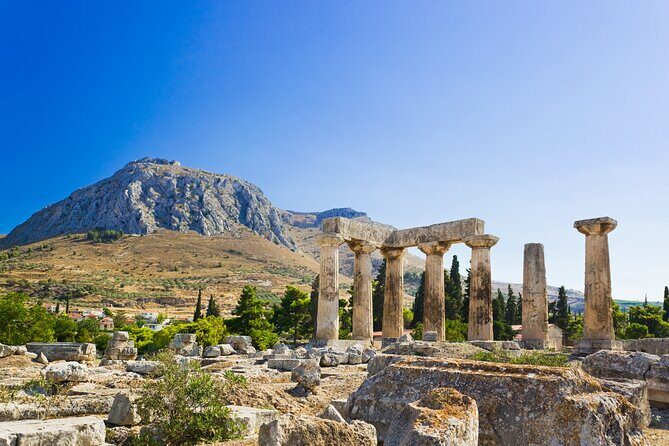
Ancient Corinth is the main event, and it’s where this tour earns its name. After another drive, you reach the site area and spend about 3 hours there. That’s a strong chunk of time for a day trip, especially if you want to slow down and read.
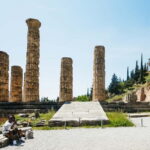
Historically, Corinth was famous for wealth and architecture, and it played a starring role in the Roman era. After Corinth’s final stand against Rome, the Romans leveled much of the city and rebuilt it as a Roman settlement with places like theatres, a forum, and imperial temples. One major landmark survived: the ancient Temple of Apollo.
The tour’s VR audio concept is simple: while you’re walking through the archaeological remains, the device adds reconstructed visuals and audio context so the ruined structures make more sense. It also ties in recognizable names connected to Corinth, including St Paul (who taught there), and figures from mythology and travel writing like Jason of the Argonauts and Pausanias.
A practical tip: don’t treat the VR as something to watch constantly. Use it like a spotlight. Turn it on for the moments where you’re trying to understand scale, building purpose, or what a ruin likely looked like. Then turn it off and just look around. The best experience often comes from switching between device guidance and your own eyes.
Also, make sure you plan for the museum. Some visitors specifically stress that the museum stop is an important part of getting the full picture. Even if you’re mostly there for the ruins, the museum helps you interpret what you’re seeing outside.
Museum time and self-paced exploring at the site
You don’t get forced marching here. The format is built for independent exploring using the included VR application and audio. That can be great when you enjoy architecture, inscriptions, and layered timelines.
In practice, here’s how I’d structure your time inside Ancient Corinth:
- Start with a general loop to get your bearings.
- Use VR/audio in key spots where you want context.
- Save extra time for whatever draws your eye (temple areas, forum spaces, or whichever structures you can clearly imagine in their original form).
- If the museum is open during your visit window, schedule it instead of treating it as optional.
One note from real-world use: some people found the audio isn’t a perfect fit for them, especially if you prefer reading signs and labels. If that’s you, don’t worry. The ruins still work well with plain curiosity and good on-site signage, and you can use the VR/audio only when you feel it helps.
Photo stop at Kenchreai: coastal context in 10 minutes
On the return to Athens, you drive along the coastal road and stop for photos at the ancient port of Kenchreai. The timing is short: about 10 minutes, which is exactly what it sounds like—enough for a few photos and a quick look, not a full exploration.
Kenchreai mattered because Corinth had two key ports that handled different trade directions. Kenchreai served the eastern routes via the Saronic Gulf. By contrast, Lechaion handled routes west toward Italy and the rest of Europe. Even this fast stop helps you understand Corinth as a trading hub, not just a battlefield and ruin field.
If you’re the type who likes landscapes and ports, you might wish for more time here. But for most people, this stop functions well as a “close the loop” moment after Ancient Corinth.
Bus comfort, timing, and how to avoid a day-trip mood crash
This tour runs from an Athens start time of 8:15 am and returns to your meeting point. It’s described at about 6 hours, but in the real world, plan for it to stretch closer to 7–8 hours, especially in summer or with traffic.
That matters because you want to be mentally ready for the travel time. On paper it’s a half-day theme. In practice, it can feel like a real day out.
The good news: the bus ride includes air-conditioning, and the group size is capped at 20. That usually keeps the “waiting around” feeling down. Multiple central meeting points and multiple drop-off points in Athens also help. You’re not forced into one exact curb for the entire experience.
A small practical mindset shift that helps: treat this as a combo day—transport + one main archaeological block + one big view stop + one quick port stop. If you go in expecting three independent sightseeing hours on the ground, you might feel squeezed. If you go in expecting a curated arc of sights, the timing works.
A few more Athens tours and experiences worth a look





Price and value: what you’re paying for, and what to add
The price is $38.10 per person. For that, you get the air-conditioned transport, the English-speaking expert escort, and the VR audio-guided format.
What’s not included is the Ancient Corinth admission ticket, priced separately at €15.00 per person, plus food and drinks. So your real budget should include at least that admission fee and whatever you want to eat in Corinth or the nearby village.
Is it good value? For many visitors, yes, because you’re not paying extra for private transfers or for a full guided lecture inside every ruin area. The VR/audio is meant to do some of the interpretation work while you explore. If you were planning to DIY Ancient Corinth anyway, this tour adds transportation, coordination, and an interpretive tool for a reasonable add-on.
If you already have a personal guide lined up or you strongly prefer to travel without any device-based components, you might compare this to a DIY day. But if you want a structured plan with low effort and a built-in explanation layer, this hits the sweet spot.
The guide effect: when narration makes the day click
One of the most praised parts of this experience is the escort and how clearly they manage pacing. Names that come up include Stephan, Dido, Nancy, Maria, Georgie, Christopher, and Stefanos (among others). The common thread is simple: a good guide helps you make sense of the stops quickly, then gives you enough time to explore without feeling rushed.
If your guide is strong, you’ll notice it in two places:
- How the audio/VR is framed before you start walking
- How they balance explanation with quiet time
You should also feel safe with the logistics handled. People often highlight on-time pickup and a driver who knows how to keep things moving.
That said, one caution shows up: if you get assigned to a device that glitches or resets, you may need to spend a moment getting back into the program. The best counter to this is patience. Bring your “pause and recover” attitude for tech.
Who this tour suits best (and who should think twice)
This tour fits you if you want:
- An organized day from Athens with central pickups and drop-offs
- A VR + audio way to understand what you’re seeing at Ancient Corinth
- Enough time at the main site to go at your pace
- A small group vibe (max 20)
You might think twice if you:
- Plan to spend most of your time only reading signs and prefer no tech at all
- Have very low tolerance for device interruptions
- Need a truly short outing and would feel annoyed if it runs long (many visitors experience it closer to a full day)
Should you book this Corinth Canal and Ancient Corinth VR tour?
If your goal is to see Corinth Canal and Ancient Corinth without the headache of figuring out transportation and timing, I’d book it. The value is strongest when you actually use the VR/audio as a help tool, not a constant distraction, and when you budget for the €15 admission ticket plus your own lunch.
My final advice is simple: pack for a long sightseeing day, bring water and comfortable shoes, and keep your expectations aligned with a transport-plus-site schedule. If you do that, you’ll come away with a clearer sense of why Corinth mattered—and why those ruins feel so alive even when only stones remain.
FAQ
How long is the tour?
It’s listed at approximately 6 hours.
What time does the tour start in Athens?
The start time is 8:15 am.
Where does it run to and from?
It starts from central Athens meeting points and returns to the meeting point at the end.
Is the tour in English?
Yes. The experience is offered in English.
What’s included in the price?
Included are an air-conditioned vehicle, the VR audioguide, and an English-speaking expert escort.
Is the Ancient Corinth admission ticket included?
No. Admission to Ancient Corinth is €15.00 per person and is not included.
Are food and drinks included?
No. Food and drinks are not included.
How big is the group?
The maximum group size is 20 travelers.
Is a mobile ticket used?
Yes. The tour uses a mobile ticket.
Is free cancellation available?
Yes. You can cancel up to 24 hours in advance for a full refund. Service animals are allowed.