REVIEW · THESSALONIKI
Thessaloniki: Greek Cooking Class, Market visit and Lunch
Book on Viator →Operated by Active Thess Holidays · Bookable on Viator
Thessaloniki’s best food lesson begins before you reach the kitchen. You’ll walk through Kapani and Modiano markets, see the ingredients that shape northern Greek cooking, then use those ingredients to prepare lunch with a local chef.
I like two things in particular: the class gives you hands-on practice with dishes such as gemista and dolmadakia, and the market visit connects the food to Thessaloniki’s daily life. The main consideration is time. At three and a half hours, this is a focused food experience, not a full city tour.
In This Review
- Key points
- From Thessaloniki’s markets to your lunch table
- Kapani Market, Thessaloniki’s everyday food center
- Modiano Market and the food of central Thessaloniki
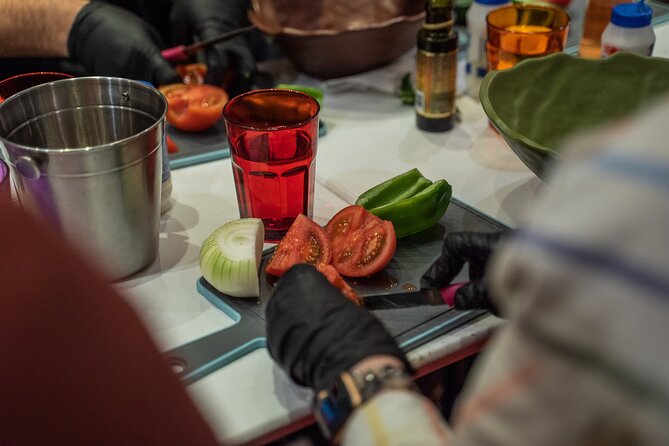
- Preparing five Greek classics by hand
- Tzatziki
- Dolmadakia
- Greek salad
- Gemista
- Chocolate salami, or kormos
- Eating the lunch you helped make
- What the guide adds to the experience
- Is $110.54 a fair price?
- Who should book this class?
- Booking, cancellations, and practical details
- Should you book the Thessaloniki cooking class?
- FAQ
- Where does the Thessaloniki cooking class begin?
- What time does the activity start?
- Where does the activity end?
- Which markets are included?
- What food will I prepare?
- How many people can join the group?
- Is free cancellation available?
Key points
- Two central markets: Visit Kapani, also called Vlali Market, and Modiano Market before cooking.
- A hands-on Greek menu: Prepare tzatziki, dolmadakia, Greek salad, gemista, and chocolate salami.
- Lunch is part of the lesson: You eat the meal you helped prepare at a local taverna.
- Small-group format: The class accepts a maximum of 16 people.
- Local instruction: Guides including Maria, Konstantina, Thelis, and Kostas have led versions of this experience.
- Useful timing: Meet at Electra Palace Thessaloniki at 11:30 a.m. and finish back at the meeting point.
From Thessaloniki’s markets to your lunch table
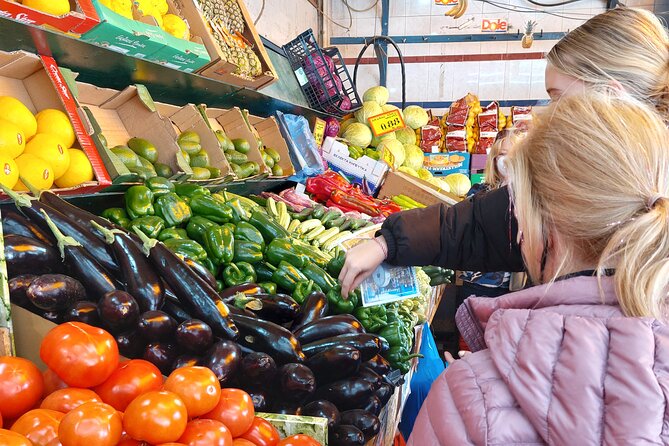
This experience gets the order right: first see the food, then cook it, then eat it. That simple sequence gives you more context than a cooking class held entirely indoors.
You meet at Electra Palace Thessaloniki on Aristotelous Square at 11:30 a.m. From there, the group heads to the central markets. The route includes Kapani Market and Modiano Market, two useful stops for understanding the ingredients behind Greek home cooking.
The class itself takes place at a taverna, where the instructor is also the chef and owner of the restaurant. That matters. You are not simply following a recipe from a printed sheet. You are learning in a working food setting, with the meal prepared for immediate eating.
The group can have up to 16 people. That is small enough for a personal feel, though the experience may be more interactive with fewer people. If you want a private lesson with one-on-one attention, this is not advertised as that kind of class.
You can also read our reviews of more shopping tours in Thessaloniki


Kapani Market, Thessaloniki’s everyday food center
Kapani, also known as Vlali Market, is the first market stop. This is where the experience begins to feel less like a sightseeing activity and more like a practical introduction to local food.
A market visit helps you see ingredients in their normal setting. Instead of encountering feta, herbs, vegetables, and other Greek staples only after they have been arranged on a plate, you see the food as part of the city’s daily trade.
Your guide can also explain how local cooking developed through Thessaloniki’s past and its links with different communities. That context is useful because Greek cuisine is not a single fixed menu. Recipes vary by region, family, season, and city.
The market visit is not presented as a long tasting tour. It is tied to the class, with ingredients selected for the lunch you will prepare. That keeps the outing focused, but it also means you should not expect a full market meal or an extended shopping session.
I like this part because it gives you a better eye for Greek food. Afterward, you can walk into a market or restaurant and recognize the building blocks of dishes instead of seeing them as a blur of unfamiliar items.
Modiano Market and the food of central Thessaloniki
The second stop is Modiano Market. Its location in the center makes it an easy addition to a day spent around Aristotelous Square and the nearby streets.
Together, the two markets give you a broader look at Thessaloniki’s food culture. You get more than one setting, and you can compare the feel of the markets before heading to the cooking table.
This is also where the guides add value. Kostas, Thelis, Maria, and Konstantina have each been associated with versions of the experience, depending on the date and group. The emphasis is on explaining local food and helping you connect the market ingredients with the dishes ahead.
The guide names matter because this is a people-centered class. A good cooking lesson depends on clear demonstrations, easy conversation, and enough help when you are rolling grape leaves or preparing stuffed vegetables. The available information points to a warm, social style, but your exact guide may vary.
Keep your expectations practical. The markets are stops within a three-and-a-half-hour activity, not separate guided tours with long historical talks. If your main goal is food, the balance works well. If you want a detailed architectural or historical tour of central Thessaloniki, book a separate walking tour.
Preparing five Greek classics by hand
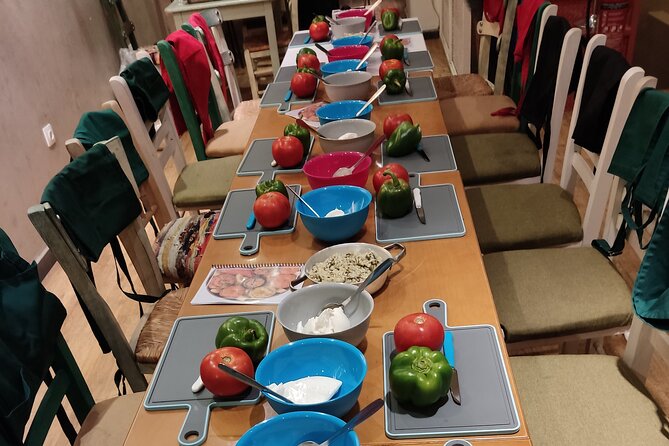
The menu is broad enough to give you a useful introduction to Greek cooking without turning the class into a marathon. You will work with cold mezze, salad, a baked main dish, and dessert.
Tzatziki
Tzatziki is one of the easiest Greek dishes to recognize and one of the most useful to learn. It can be served as a cold appetizer, a side dish, or a sauce for souvlaki and gyros.
In a class, the value is in learning how a few simple ingredients become a balanced sauce. The dish also gives you an early success before the more time-consuming work begins.
You can use what you learn at home with grilled food, bread, vegetables, or sandwiches. That makes tzatziki a practical takeaway, not just the first course of lunch.






Dolmadakia
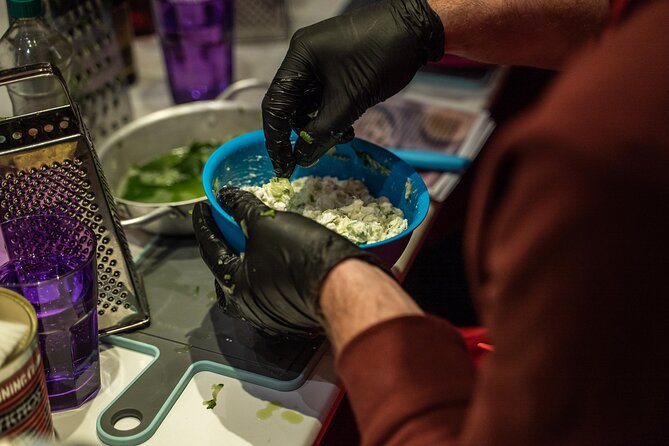
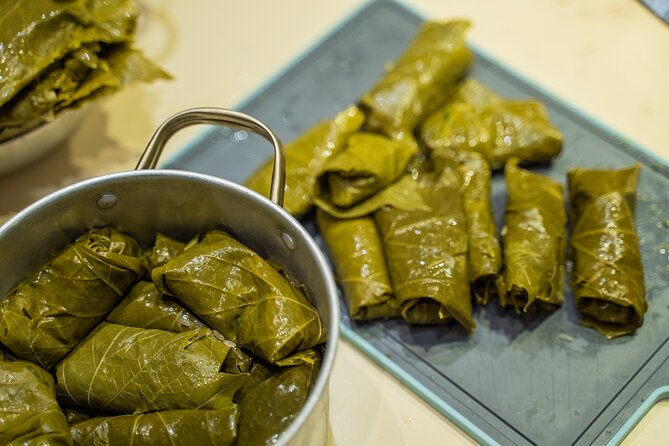
Dolmadakia are stuffed grape leaves filled with rice and herbs. They are a classic Greek food, but they can seem tricky when you first see them on a plate.
Making them yourself gives you a better sense of the work involved. You prepare the filling, handle the leaves, and shape the rolls. The process is hands-on and gives the class one of its most distinctive tasks.
This is also where the class may be especially useful for beginners. One participant described making dolmadakia for the first time and enjoying the new technique. You should not expect every roll to look identical, but that is part of the fun.
Greek salad
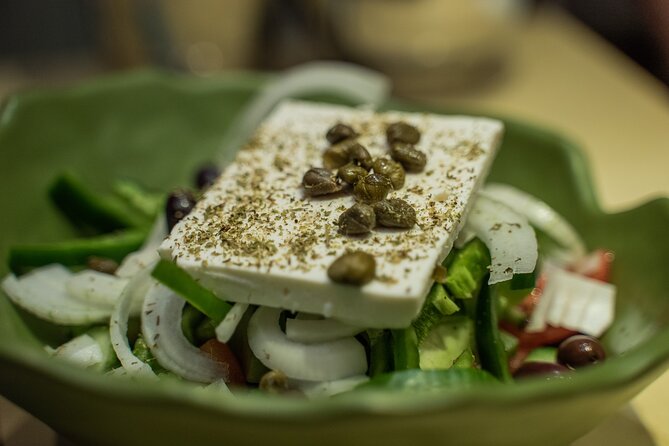
Greek salad needs no complicated method. The traditional version uses tomatoes, cucumber, red onion, olives, and feta with a Greek-style dressing.
The lesson here is less about advanced cooking than about balance and ingredient quality. A simple salad leaves little room to hide tired produce or a heavy dressing, so the market visit gives this course more meaning.
This is a good dish to learn if you want something you can prepare quickly after returning home. It also helps break up the richer foods on the table.
Gemista
Gemista is the main dish and one of the stronger reasons to choose this class. These are vegetables stuffed with rice and herbs, then baked with potatoes and tomato sauce.
The dish takes more work than tzatziki or salad, so the class gives you a chance to understand several parts of Greek home cooking at once: stuffing, seasoning, baking, and building flavor with tomato and herbs.
The cooking is done with a chef who also owns the taverna. That makes gemista more than a demonstration. You are learning a traditional dish in the setting where it will become lunch.
A useful tip from the experience is that the recipe may be simple, but small techniques can make the final result much better. Pay attention to how the chef handles the filling, the herbs, and the sauce. Those details are often more useful than a long list of ingredients.
Chocolate salami, or kormos
Dessert is chocolate salami, also called kormos. In Greek, kormos means tree log, a reference to the dessert’s shape. You may also see similar versions called mosaico or salami.
This is a playful finish to the class and a reminder that Greek sweets are not limited to syrupy pastries. The dessert is shaped like a log and gives you one more recipe to take home in your memory.
The menu has a nice rhythm: cool tzatziki, stuffed grape leaves, crisp salad, baked vegetables, then a chocolate dessert. You are involved in several kinds of preparation without needing a full day in the kitchen.
Eating the lunch you helped make
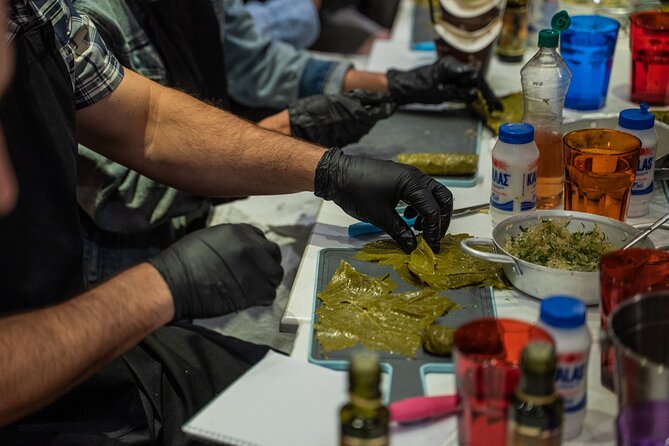
The meal is not an afterthought. You sit down and eat the dishes prepared during the class, including the starters, gemista, and dessert.
That is important for two reasons. First, you see how the separate components work together as a Greek meal. Second, you can taste the results while the techniques are still fresh in your mind.
The lunch also creates room for conversation. The experience is built around food and local people, not a quick demonstration followed by an immediate departure. If you enjoy meeting others over a shared table, this format should suit you.
Still, the social element depends partly on the size and makeup of your group. With up to 16 people, you may cook alongside a lively mix of couples, families, and solo participants. A group of that size can be friendly and fun, but it may not feel intimate at every moment.
What the guide adds to the experience
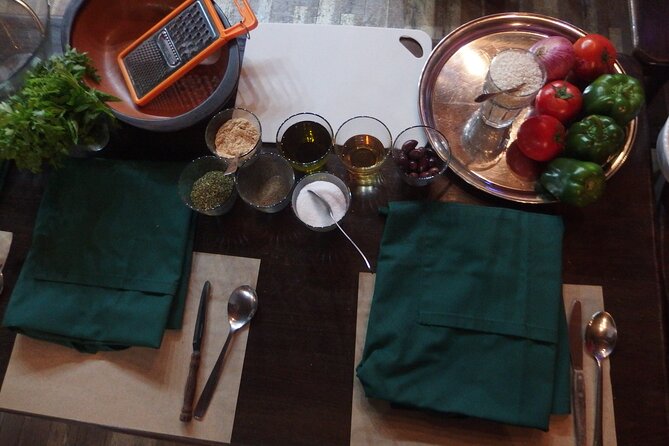
The guides are a major part of the class. Maria has been praised for being personable and fun while also explaining the markets and food. Kostas has led the market and restaurant portions, and Thelis and Konstantina have also been associated with the experience.
You should treat the names as a guide team rather than a promise of one specific host. The booking information identifies English as the operating language, so you can expect the class to be conducted in English.
The best part of the guiding style is the link between food and place. Thelis and Kostas, for example, have explained how the area’s past influenced its cuisine. That gives the dishes more meaning without turning lunch into a lecture.
A good question to ask during the class is what makes the local version different from the Greek food you find elsewhere. You may also want to ask how to adapt the recipes at home, especially gemista and dolmadakia, which require more handling than the salad or tzatziki.
Is $110.54 a fair price?
At $110.54 per person, this is not the cheapest way to eat lunch in Thessaloniki. You can certainly find a less expensive meal in the city.
The price makes more sense when you count what is included: two market visits, an English-speaking guide, hands-on instruction, a multi-course lunch, and access to a local chef and restaurant owner. You are paying for the activity around the meal, not just the food on the plate.
I see the value most clearly if you enjoy cooking or want a food memory with some practical use after the trip. Learning to make gemista and dolmadakia, then eating them immediately, gives you something more lasting than a standard restaurant lunch.
The value is weaker if you dislike group activities, do not want to cook while on holiday, or mainly want to sample food without preparation. In that case, a market food walk may suit you better.
The three-and-a-half-hour length is also fair for the price. It fills a substantial part of the late morning and early afternoon, but it does not consume a full day. You can still plan other sightseeing around it.
Who should book this class?
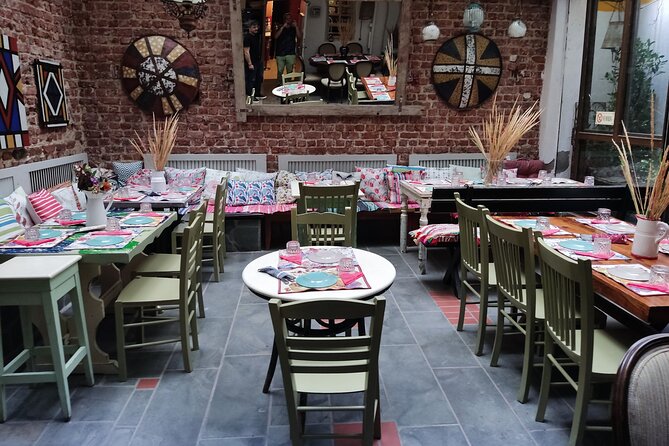
I would recommend it most strongly to you if you enjoy food, local markets, and practical activities. It is also a good fit for a parent, grandparent, or older child who wants something more active than a standard sightseeing walk.
The class has worked well for a grandparent and granddaughter, which points to its broad appeal across ages. The recipes are traditional but not presented as advanced professional cooking.
It also suits first-time visitors who want an introduction to Thessaloniki’s food culture. The market stops give you a useful starting point, while the lunch helps you understand how the ingredients come together.
You may want to skip it if your schedule is tight around 11:30 a.m., since the start time is fixed. It is also less suitable if weather is uncertain, because the activity requires good weather and may be canceled or moved if conditions are poor.
The meeting point is Electra Palace Thessaloniki at Aristotelous 9. The activity ends back there, which makes the logistics simple. It is near public transportation, and service animals are allowed.
Booking, cancellations, and practical details
You receive confirmation when you book, and the experience is offered in English with a mobile ticket. The maximum group size is 16 people.
The activity is often booked well ahead, with an average booking lead time of 41 days. That does not guarantee it will sell out on your dates, but it is a useful sign that you should not leave it until the last minute if the schedule matters.
You can cancel for a full refund up to 24 hours before the 11:30 a.m. start time. Cancellations or changes made less than 24 hours ahead are not accepted for a refund.
Since good weather is required, the provider offers another date or a full refund if conditions force cancellation. Cut-off times follow local time in Thessaloniki.
Should you book the Thessaloniki cooking class?
Book this experience if you want to connect Thessaloniki’s markets with its food and are happy to take part rather than simply watch. The strongest features are the two market stops, the chef-led class, and the chance to eat a traditional meal you helped prepare.
I would choose it over a basic restaurant lunch for the practical value. You leave with a better understanding of tzatziki, dolmadakia, Greek salad, gemista, and kormos, plus a clearer sense of how local ingredients shape the city’s cooking.
Skip it if you want a long historical tour, a private lesson, or a purely food-tasting experience. For everyone else, the three-and-a-half-hour format offers a friendly, useful taste of Thessaloniki at the market, the kitchen, and the lunch table.
FAQ
Where does the Thessaloniki cooking class begin?
The experience begins at Electra Palace Thessaloniki, Aristotelous 9, Thessaloniki 546 24, Greece.
What time does the activity start?
The start time is 11:30 a.m.
Where does the activity end?
The activity ends back at the meeting point at Electra Palace Thessaloniki.
Which markets are included?
The experience visits Kapani Market, also called Vlali Market, and Modiano Market.
What food will I prepare?
The menu includes tzatziki, dolmadakia, Greek salad, gemista, and chocolate salami, also called kormos.
How many people can join the group?
The maximum group size is 16 people.
Is free cancellation available?
Yes. You can cancel up to 24 hours before the start time for a full refund. If poor weather causes the provider to cancel the activity, you will be offered another date or a full refund.