Thessaloniki reveals its past one street at a time, and this small-group walk links Roman triumphs, Byzantine worship, Ottoman rule, and modern Greek life in a single outing. You begin at the White Tower by the sea and finish at Saint Demetrius Church, with the city’s major historic sights between them.
I like the maximum group size of eight, which should make questions and conversation easier than on a large coach tour. I also like the route’s mix of outdoor monuments and indoor stops, especially the chance to pair the Roman Rotunda with the Archaeological Museum’s ancient Macedonian collection.
The main consideration is timing. The tour is advertised at about three hours, but the listed visits add up to roughly three and a half hours, and admission to the White Tower and Archaeological Museum costs extra. Food is praised in some feedback, but tasting is not included in the published tour details, so confirm that point before booking.
In This Review
- Key points to know before booking
- Why this Thessaloniki walk works well
- Starting beside the White Tower
- Reading Roman power at Galerius Arch
- Entering the Rotunda’s changing world
- One hour with ancient Macedonia at the Archaeological Museum
- Finishing at Saint Demetrius Church
- What the $98.90 price really covers
- Timing, walking, and practical planning
- Who will get the most from this walk
- Should you book this Thessaloniki tour?
- FAQ
- Where does the tour begin?
- Where does the tour end?
- How long is the experience?
- What sights are included?
- Are entrance fees included?
- Is transportation provided?
- How large is the group?
- Is the tour suitable for people with limited fitness?
- What happens if the weather is poor?
Key points to know before booking
- Small group of no more than eight: You get a more personal walk and a better chance to ask about Thessaloniki’s complicated past.
- Five major sights in one route: The schedule covers the White Tower, Galerius Arch, Rotunda, Archaeological Museum, and Saint Demetrius Church.
- A walk through several eras: Roman, Byzantine, Ottoman, and modern Greek history all appear during the tour.
- Two admission fees are extra: Entry to the White Tower and Archaeological Museum is not included, while the Arch, Rotunda, and church are listed as free.
- The route crosses the city on foot: You need moderate physical fitness, and private transportation is not provided.
- Friendly local guidance matters here: The guide is praised for clear historical explanations, warmth, and local food knowledge, though food tastings are not formally listed as included.
Why this Thessaloniki walk works well
Thessaloniki is a city where the past is not kept in one tidy historic quarter. Roman ruins appear beside modern shops. Byzantine churches sit along busy streets. The waterfront leads to Ottoman-era symbols, while the city center carries the marks of fire, rebuilding, migration, and daily Greek life.
That makes a guided walk useful. Without context, the Arch of Galerius can look like a fragment of old stone, and the Rotunda can seem like a large round building with an impressive dome. A good guide connects those pieces and explains how Thessaloniki changed hands and faiths over many centuries.
This tour gives you a broad introduction in half a day. You will not see every major church, market, or neighborhood, but you will get a useful framework for exploring on your own afterward.
The group limit is one of the best features. With no more than eight people, the pace should feel less rigid than a large city tour. You can ask about local customs, Macedonia, the city’s food, or the meaning of a carved detail without having to shout across a crowd.
The route is also practical for a first visit because it begins at a landmark that is easy to identify and ends at one of the city’s most important churches. It does not return you to the starting point, so plan your afternoon from the Saint Demetrius Church area.
You can also read our reviews of more historical tours in Thessaloniki


Starting beside the White Tower
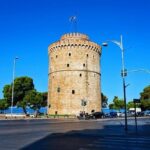
The White Tower is the meeting point and the first major lesson in Thessaloniki’s layered past. It sits on the seafront and is now the city’s best-known symbol.
The tower was once part of the Byzantine defensive system and was rebuilt during the Ottoman period. That detail alone gives your guide a chance to explain how Thessaloniki’s rulers, borders, and military needs changed over time.
You spend about 30 minutes here. The tour begins at the entrance, where the accredited guide greets the group and sets the historical scene before leading you onward.
Admission to the tower is not included. That matters because the stop is listed as an exterior meeting and explanation point, not a guaranteed interior visit. If entering the White Tower is important to you, ask whether the schedule includes time for admission and budget for the separate ticket.
The seafront setting is a pleasant beginning, but it can also be exposed to sun, wind, or poor weather. Wear comfortable shoes and bring water, especially in warmer months. The activity requires a moderate level of physical fitness, although no unusual hiking is described.
Reading Roman power at Galerius Arch
The next stop is the Arch of Galerius, often called Kamara. It was probably built between AD 298 and 305 to celebrate Emperor Galerius’s victory over the Persians.
The original design had eight piers arranged in two parallel rows. Only three survive, and two still carry reliefs showing scenes from the Roman campaigns. This is a good example of how Thessaloniki’s old monuments often survive in partial form, surrounded by the modern city rather than protected in a quiet archaeological park.
The scheduled visit lasts about 30 minutes, and admission is free. Since the arch is an outdoor monument, your guide’s explanation is especially important. The surviving reliefs are not large enough to tell their full story at a glance, and the political purpose of a triumphal arch is easy to miss without some background.
I like this stop because it gives you a direct connection to imperial Rome without requiring a long museum visit. The drawback is that the monument is incomplete, so anyone expecting a fully preserved arch may find it modest. Its value comes from its location, surviving carvings, and the story they represent.
Entering the Rotunda’s changing world
The Rotunda is one of Thessaloniki’s most memorable buildings. This massive circular structure, with its large dome, was built in the early fourth century, at a turning point between pagan worship and Christianity.
Its original purpose is not certain. It may have been a temple for an ancient cult or a mausoleum associated with Constantine the Great. Later, during the early Byzantine period, it became a Christian church.
That change of function is the heart of the visit. The Rotunda is not simply an old Roman building. It shows how the same space could be given a new meaning as political power and religious life shifted.
The building is sometimes compared with the Pantheon in Rome because of its circular plan and domed interior. The tour allows about 30 minutes here, and admission is listed as free.
You will get the most from this stop if you pay attention to the building’s shape and to the way your guide explains its changing role. The Rotunda is not a large complex with many rooms to explore, so the experience depends heavily on interpretation. It is a focused visit rather than a long museum-style stop.
One hour with ancient Macedonia at the Archaeological Museum
The Archaeological Museum of Thessaloniki is the longest stop, with about one hour scheduled. It is one of Greece’s largest museums and the central archaeological museum for northern Greece.
For many people, this will be the intellectual center of the walk. The outdoor monuments show you fragments of Thessaloniki’s past in place. The museum gives you a chance to see ancient objects gathered together and explained in a more organized setting.
The museum’s collections cover ancient artifacts connected with northern Greece and Macedonia. The provided details do not specify individual galleries or objects on the route, so your guide’s choices and explanations will shape this hour.
Admission is not included. Check the current entry price before you go, since the tour fee of $98.90 per person covers the certified professional guide but not this ticket or the White Tower ticket.
One hour is enough for a guided introduction, but not for the entire museum. If you are especially interested in archaeology, you may want to return independently for more time. If museums tire you after an hour, this scheduled visit is still long enough to make the stop worthwhile without taking over the whole day.
The mix of the museum and the outdoor sites also helps younger visitors. One 16-year-old joined the tour with a parent and tried unfamiliar northern Greek foods during the wider experience, finding the regional variety a highlight. That food detail should not be treated as a promise here, since tasting is not listed among the inclusions. Still, it points to a useful question to ask the guide or provider if local cuisine is a priority.




Finishing at Saint Demetrius Church
The walk ends at the Holy Church of Saint Demetrius, on Agiou Dimitriou Street. This is Thessaloniki’s largest church and the main sanctuary dedicated to the city’s patron saint.
The church sits on the presumed site of Saint Demetrius’s martyrdom in AD 306. It is also a UNESCO World Heritage site, giving the final stop major religious and historical importance.
The building was restored after the fire of 1917, following its original architectural plans. Some original features survived, and the church retains details of strong historical and artistic interest.
The scheduled visit is about 30 minutes, and admission is free. Ending here works well because the church brings together several themes from the walk: Roman-era persecution, Byzantine Christianity, later damage, and the careful rebuilding of a major place of worship.
Remember that this is an active church, not simply an archaeological display. Dress and behave respectfully, and be prepared for the possibility that religious activity may affect the visit. The tour ends in front of the church, so you will need to make your own onward plans.
What the $98.90 price really covers
At $98.90 per person, this is not a bargain-priced city stroll. The value depends on how much you want from the guide.
The fee includes a certified professional guide and a small group capped at eight. That is the main reason to consider it. You are paying for historical explanation, route planning, and the convenience of connecting five important sites without working out the order yourself.
You must add the White Tower and Archaeological Museum admission fees. The Arch of Galerius, Rotunda, and Saint Demetrius Church are listed as free. There is no private transportation, so the price does not cover transfers or a vehicle between stops.
For a first visit, the tour can be worthwhile if you prefer a strong overview and personal guidance. If you are comfortable reading plaques, using a guidebook, and walking independently, the cost may feel high, especially since several stops are free.
The food comments deserve a careful note. The guide has been praised for local insight and for helping people try northern Greek foods, including dishes they had not encountered on earlier visits to Greece. But the published inclusions list only the professional guide. Do not book this expecting a formal food tour unless the provider confirms tastings.
Timing, walking, and practical planning
The experience is described as approximately three hours, but the stop durations listed are 30 minutes at the White Tower, 30 minutes at the Arch, 30 minutes at the Rotunda, one hour at the museum, and 30 minutes at Saint Demetrius Church. Together, those visits total about three and a half hours, before allowing for walking between them.
That does not necessarily mean the tour will run long. Some listed times may be approximate, and the route between sites may be handled within the schedule. Still, I would avoid booking a tight lunch reservation, train, ferry, or museum appointment immediately afterward.
You start at the White Tower and finish at Saint Demetrius Church. Since private transportation is not included, you should be ready to cover the route on foot and arrange your own way back or onward.
The tour is near public transportation, which helps at both ends of the outing. Confirmation is provided when you book, and the ticket is mobile, so you do not need to collect paper documents.
The activity requires moderate physical fitness. The information does not give a distance, stair count, or detailed accessibility plan, so ask ahead if walking for several hours or entering historic buildings could be difficult for you.
Service animals are allowed. The tour requires good weather, and if conditions force cancellation, you will be offered another date or a full refund.
Who will get the most from this walk
I would recommend this tour to a first-time visitor who wants the city’s main historic markers explained in plain language. It also fits anyone with only part of a day who wants Roman, Byzantine, Ottoman, and Macedonian context before exploring further alone.
Families may find the short stops easier than one long museum visit, and the small group should help keep questions moving. The food discussion also suggests that the guide can add useful local context, especially for people curious about northern Greek cooking, but confirm whether any tasting is actually planned.
History fans should like the range of periods. The main limitation is depth. Thirty minutes at each monument gives you orientation, not exhaustive study, and one hour at the Archaeological Museum is only an introduction.
I would be more cautious about recommending it to someone seeking a low-cost walk, a food tour, or a fully accessible route with detailed mobility information. The price is aimed at the value of personal guiding, not at bundled admissions or transport.
Should you book this Thessaloniki tour?
Book it if you want a compact, guided introduction to Thessaloniki and prefer a group small enough for real conversation. The route is well chosen, the final church is a strong finish, and the guide’s warmth and historical explanations are central strengths.
Skip it if you plan to explore slowly on your own, want all entrance fees included, or need a tour with a clearly stated food program. Before paying, confirm the actual duration, the two extra admission costs, and whether food tastings form any part of your date.
The flexible cancellation policy helps: cancel at least 24 hours before the local start time for a full refund. Last-minute cancellations or changes are not accepted, so keep that deadline in mind.
FAQ
Where does the tour begin?
It begins at the entrance of the White Tower of Thessaloniki, at Thessaloniki 546 21, Greece.
Where does the tour end?
The tour ends in front of the Holy Church of Saint Demetrius at Ag. Dimitriou 81-83, Thessaloniki 546 33, Greece.
How long is the experience?
It is advertised as approximately three hours. The listed stop times add up to about three and a half hours, so allow some flexibility.
What sights are included?
The route includes the White Tower, Arch of Galerius, Rotunda, Archaeological Museum of Thessaloniki, and Holy Church of Saint Demetrius.
Are entrance fees included?
No. Admission to the White Tower and Archaeological Museum is not included. The Arch of Galerius, Rotunda, and Saint Demetrius Church are listed as free.
Is transportation provided?
No. Private transportation is not included. This is a walking tour, though the route is near public transportation.
How large is the group?
The group can include a maximum of eight people.
Is the tour suitable for people with limited fitness?
The activity requires a moderate level of physical fitness. Specific distance, stair, and accessibility details are not provided.
What happens if the weather is poor?
The experience requires good weather. If it is canceled because of poor conditions, you will be offered a different date or a full refund.