REVIEW · ATHENS
Accessible Tour In Athens, 3 Hours Athens Panorama Shore Excursion
Book on Viator →Operated by Athens Tours Greece · Bookable on Viator
The clever part of this tour is its private accessible minivan. In three hours, you can see Athens from the Acropolis and Plaka to the marble Panathenaic Stadium, Syntagma Square, and the Piraeus waterfront without wrestling with taxis, luggage, or city traffic. It is built for an overview, not a museum-length visit.
I like the hotel or cruise-port pickup, and I like the freedom to set the pace with your own group. Drivers such as Andreas and Michael have been praised for being caring, punctual, and helpful with limited mobility. The main caution is simple: this is mostly a driving tour, and the vehicle does not have a ramp unless you arrange one in advance.
In This Review
- Key points to know before booking
- What this Athens tour is really designed to do
- Starting in Piraeus and along the Saronic Gulf
- Seeing the Acropolis without rushing the climb
- Plaka, Monastiraki, and the old city feel
- Syntagma Square and the modern Greek state
- The neoclassical trilogy and Old Parliament
- Kallimarmaro and the Olympic connection
- Lycabettus Hill and the final city view
- Driver commentary, comfort, and the guide question
- Is $272.33 a fair price for three people?
- Timing, pickup, and practical planning
- Who should book this Athens panorama tour?
- Should you book it?
- FAQ
- Is this tour private?
- Does the tour pick up cruise passengers at Piraeus?
- Can I be picked up at an Athens hotel?
- Is a licensed guide included?
- Are entrance fees included?
- Is the vehicle equipped with a wheelchair ramp?
- Can I cancel for a full refund?
Key points to know before booking
- A private three-hour overview: You get the vehicle and driver to yourselves, with room for up to three people.
- Useful for cruise passengers: Pickup and return at Piraeus can make a short port visit far easier.
- Strong city coverage: The route takes in ancient monuments, central squares, neoclassical buildings, hills, and the Athens Riviera.
- The Acropolis is mainly a viewing stop: The driver can take you to the site and wait, but cannot guide you inside without an added licensed guide.
- Mobility needs require careful planning: No ramp is supplied as standard, and a disabled person must be accompanied by a caregiver.
- Best value comes from flexibility: The price makes more sense when you need private transport, luggage space, or a custom pace.
What this Athens tour is really designed to do
This experience gives you a broad first look at Athens rather than a full archaeological visit. You ride in an air-conditioned Mercedes-Benz vehicle with leather interior, listening to an English-speaking driver explain the city and its sights as you move between stops.
The tour is private for your group, up to three people. That matters in Athens, where traffic, heat, uneven pavement, and steep approaches can turn a simple sightseeing plan into hard work. You can ask for more time at a favorite viewpoint or skip a place that does not suit your group.
The route covers a remarkable amount of ground. It includes the Acropolis, Plaka, the Ancient and Roman Agoras, Monastiraki, Syntagma Square, the Parliament, the neoclassical Academy, University, and National Library, the Panathenaic Stadium, National Gardens, Kolonaki, Lycabettus Hill, Piraeus, Mikrolimano, Marina Zeas, and Trocadero.
That list is best read as a set of views and drive-bys, not nine separate, leisurely sightseeing visits. The published timing gives only a few minutes at several monuments, and traffic can eat into a three-hour outing. If you want to walk through the Acropolis Museum, explore the Ancient Agora, or see every corner of Plaka, choose a longer tour.
A few more Athens tours and experiences worth a look


Starting in Piraeus and along the Saronic Gulf
Cruise passengers meet the driver outside the terminal exit, where the driver waits with a sign bearing your name. Hotel pickups take place at the main entrance, with the porter or receptionist alerted that you are waiting for the driver.
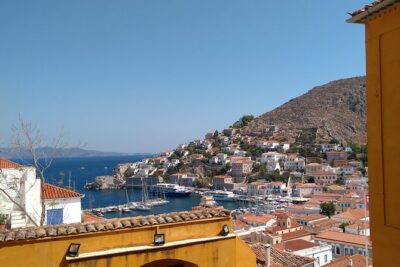
From Piraeus, the route follows the coastal road along the Saronic Gulf and the Athens Riviera. Piraeus is not just a transfer point. It is Greece’s main seaport and one of Europe’s largest passenger ports, with Athens about 12 kilometers away.
This coastal start gives you a useful contrast. The port is a working maritime center, while the Riviera brings open waterfront views and a more relaxed side of the capital. The route also reaches Mikrolimano, Passalimani, and Marina Zeas, areas tied to modern Athens and its long relationship with the sea.
At Trocadero, you may see the Averof battleship and an ancient-style trireme. The trireme was a fast warship with three banks of oars and a bronze-covered ram. It helped Athens control the Aegean in the fifth century BC. This is a fine reminder that ancient Athens was a naval power, not only a city of temples.
Seeing the Acropolis without rushing the climb

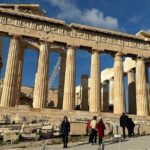
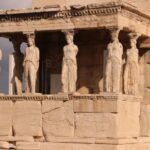
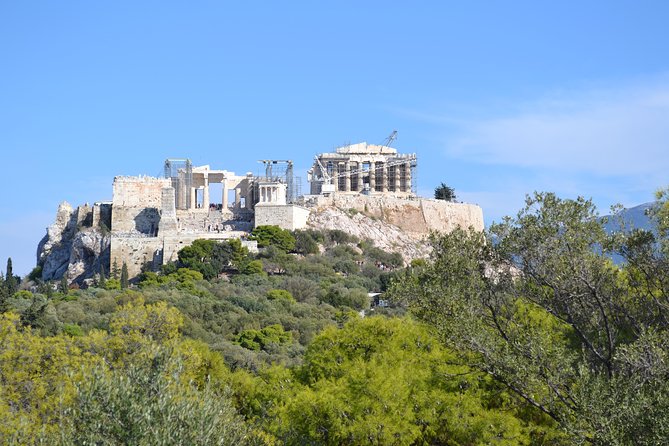
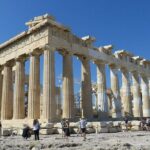
The Acropolis is the tour’s central sight. From the rocky hill, you can admire the Propylea, Temple of Athena Nike, Parthenon, and the Caryatids of the Erechtheion. Even from outside the archaeological area, the view gives you a clear sense of how the ancient sanctuary dominates modern Athens.
The Propylaea forms the grand entrance to the sacred hill. The structure visible today was begun during the building program of Pericles in 437 BC under the architect Mnesikles, though the original plan was never finished. The gateway was designed to make arrival feel ceremonial, and it still frames the approach to the monuments.
The small Temple of Athena Nike sits on a bastion at the southwestern edge of the Acropolis. Built between 426 and 421 BC, it honored Athena as a bringer of victory. Its position also gives it a strong visual presence, even though the temple is much smaller than the Parthenon.
The Parthenon was built in the mid-fifth century BC for Athena Parthenos. It was the chief sanctuary of Athens and also served as the treasury of the Delian League, the alliance led by Athens. The building’s Doric design is famous, but its larger meaning is just as important: it reflects the wealth and confidence of Athens at the height of its power.
The driver can explain the monuments and take you to the archaeological entrance. A licensed guide is not included, and the driver cannot accompany you inside the sites or museums. You can arrange a licensed guide for an additional fee, subject to availability.
For a person with limited mobility, this distinction is important. One past outing included use of the Acropolis lift, with the driver waiting while the group visited. That kind of arrangement may work well, but you should confirm current access, vehicle details, and assistance before booking. The tour vehicle has no ramp as standard, and a caregiver must accompany any disabled person.
Plaka, Monastiraki, and the old city feel
Plaka is one of the few sections where a short stop can feel like more than a photo opportunity. Built beneath the northeastern side of the Acropolis, it has narrow streets, small shops, cafes, tavernas, neoclassical buildings, and traces of ancient structures.
You may also see Anafiotika, a tiny area with whitewashed houses that suggest a Greek island village. The lanes are narrow and uneven, so your driver can help you decide how much walking makes sense. The usual stop is about 20 minutes, enough for a quick look and perhaps a coffee or shop window, but not enough for a slow neighborhood wander.
The route also passes Monastiraki, the Ancient Agora, Roman Agora, Thission, Kerameikos, and the Temple of Hephaestus, sometimes called the Temple of Vulcan. These sites help you connect Athens as a living city with Athens as an ancient center of politics, trade, worship, and daily life.
Do not expect entry to each place during this excursion. Entrance fees are not included, and the schedule is too tight for a thorough visit to all of them. The benefit is orientation. After this tour, you will know which areas deserve a longer return visit.
Syntagma Square and the modern Greek state
Syntagma Square is the center of modern Athens. The name means Constitution Square, recalling the uprising of September 3, 1843, when King Otto accepted a constitution.
The former royal palace now houses the Hellenic Parliament. Built after Athens became the capital of the modern Greek state, the building was completed as a palace for King Otto and Queen Amalia. The founding stone was laid in 1836, and Pentelic marble from the ancient quarry was used in its construction.
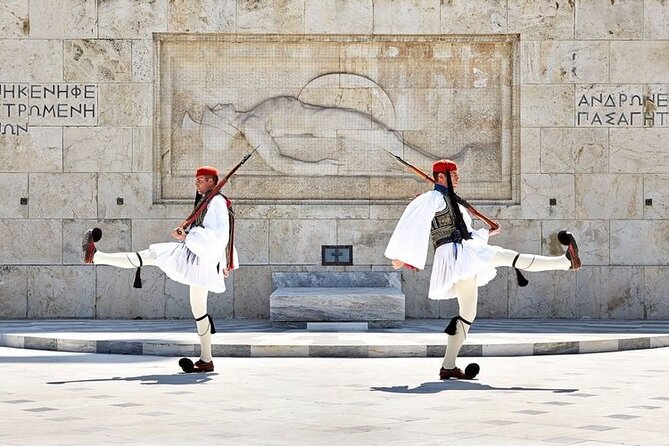
In front of Parliament, the Tomb of the Unknown Soldier honors Greek soldiers killed in war. The Evzones of the Presidential Guard protect the memorial. Depending on timing, you may see the guards in their traditional uniforms, but a formal ceremony is not promised by this tour.
The nearby National Gardens offer a green break from the stone and traffic of central Athens. Kolonaki, the city’s smart central district, adds another modern contrast before the route heads toward Lycabettus Hill.
A few more Athens tours and experiences worth a look




The neoclassical trilogy and Old Parliament
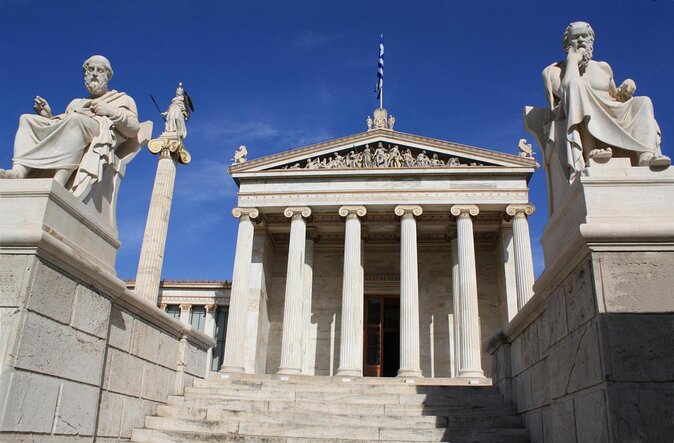
The Academy of Athens, National and Kapodistrian University, and National Library form the city’s celebrated neoclassical trilogy. Even if you only see them from the vehicle or make a brief photo stop, the buildings provide an excellent lesson in nineteenth-century Athens.
The Academy was established in 1926 as a center for sciences, humanities, and fine arts. The University, inaugurated in 1837, was the first university in the modern Greek state and the first in the Balkans and Eastern Mediterranean.
The National Library, built between 1887 and 1902, contains more than a million books and magazines along with handwritten codices dating from the ninth to the nineteenth centuries. Its broad staircase and classical design make it one of the most recognizable buildings on the route.
The tour can also pass the Old Parliament Building, now home to the National Historical Museum. The museum covers the history of modern Greece from Ottoman and Latin rule through the War of Independence, the creation of the modern state, and later political and social developments. Admission is not part of the three-hour plan, but the building itself is worth noticing.
Kallimarmaro and the Olympic connection
The Panathenaic Stadium, or Kallimarmaro, is one of Athens’s most photogenic stops. It is built entirely of marble, using Pentelic marble also seen on the Acropolis and the Temple of Zeus.
The stadium hosted the first modern Olympic Games in 1896. Its long, pale seating bowl is easy to appreciate from the outside, and the driver can explain the connection between the ancient Panathenaic contests and the modern Olympic revival.
A stop here is listed at about ten minutes. Admission is not included, so you will need to pay separately if you want to enter. For many people, an exterior view is enough during a short shore excursion. If the stadium is a personal priority, tell the driver early so you do not lose time elsewhere.
Lycabettus Hill and the final city view
The longest scheduled stop is Mount Lycabettus, the highest point in central Athens at about 277 meters. From the hill, you can look across the capital toward the coastline and see how the Acropolis sits within the modern city.
Lycabettus can be reached on foot, by funicular, or by car. This tour’s vehicle approach is useful for anyone who cannot manage a long climb. At the top is the small chapel of Saint George, along with a wide city view.
The hill provides a quieter finish after the traffic and crowds of central Athens. It also gives you a clear visual map of the places you have just passed. The stated time here is about one hour and ten minutes, though actual time can vary with traffic and your pickup schedule.
If your group has limited mobility, ask exactly where the minivan can drop you and how much walking remains. The word accessible does not mean step-free. It means the operator is trying to adapt a private vehicle and route, but the Acropolis, Plaka, Lycabettus, and other historic areas still present real access limits.
Driver commentary, comfort, and the guide question
Your English-speaking driver provides commentary on Greek history and culture during the drive and takes you to the entrances of archaeological sites and museums. Drivers named in past feedback include Andreas and Michael, but you should not assume either will lead your tour.
Andreas was specifically praised for being friendly, punctual, careful, and helpful to a person with low mobility. Michael was praised for arranging a clean car and a wheelchair for a mother with special needs. These details show what to ask for, but they do not replace written confirmation of your own requirements.
The driver is not a state-licensed guide and cannot escort you inside the archaeological sites. If you want detailed interpretation at the Parthenon or inside a museum, add a licensed guide at extra cost. This is particularly worthwhile if ancient Athens is the main reason you came.
The Mercedes vehicle is air-conditioned and has a leather interior. You can also keep luggage in the vehicle, which is useful when the tour begins at a hotel and ends at Piraeus before a cruise. Airport transfers are available on request for an additional fee.
Is $272.33 a fair price for three people?
The listed price is $272.33 per group of up to three, not per person. Split three ways, that is about $91 per person. For two people, it is about $136 each, and for one person it is the full group rate.
That is not a bargain sightseeing bus, but private transport changes the calculation. You receive hotel or cruise-port pickup, a private air-conditioned vehicle, flexible pacing, luggage storage, and a direct return to the same type of pickup point. For a short port call, those conveniences may be worth more than a lower-cost group excursion.
The value drops if you expect a fully guided archaeological tour with many interior visits. Entrance fees, food, drinks, and a licensed guide are extra. You are paying primarily for transport, access to viewpoints, driver commentary, and control over the route.
The tour makes the most financial sense for three people sharing the vehicle, for a family carrying luggage, or for a group that needs a private pace. It is harder to justify for one person who can comfortably use public transport and wants several museum entries.
Timing, pickup, and practical planning
The tour lasts about three hours, with return to the original pickup area. Cruise passengers should allow enough time to get off the ship and reach the terminal exit. Hotel guests should wait at the main entrance and tell the porter or receptionist to expect the driver.
Athens traffic can be heavy, and the route covers both the center and the coast. Tell the operator your ship departure time, mobility needs, wheelchair dimensions, and whether you need a ramp before paying. A ramp-equipped vehicle is not included as standard.
Free cancellation is available until at least 24 hours before the start time. Changes or cancellations inside that window are not accepted for a refund.
Who should book this Athens panorama tour?
I would choose this tour for a cruise passenger with only a few hours in Athens, especially if pickup at Piraeus and luggage storage simplify the day. It also suits a small family or couple who wants the Acropolis, central Athens, and the coast without changing vehicles.
It can work well for someone with limited mobility, but only after a careful conversation with the operator. The past arrangements involving an Acropolis lift and a wheelchair are encouraging, while the lack of a standard ramp means you must not treat the tour as automatically wheelchair accessible.
I would skip it if your top goal is a slow archaeological visit. Three hours cannot give the Acropolis, Agora, museums, Plaka, and stadium the attention they deserve. In that case, book a longer private tour with a licensed guide and confirmed accessible transport.
Should you book it?
Book this Athens panorama tour if you want maximum city coverage with minimum transport hassle, and if your group values a private vehicle more than long interior visits. The Acropolis views, Syntagma Square, Kallimarmaro, Piraeus, and Lycabettus Hill give you a strong introduction to the capital.
Before booking, confirm the exact vehicle, ramp arrangements, lift access, walking distances, and whether you want a licensed guide. If those details line up with your needs, the tour offers a practical way to see Athens on a tight schedule. If they do not, the price is too high for what may become three hours of mostly driving.
FAQ
Is this tour private?
Yes. Only your group participates, with a maximum of three people.
Does the tour pick up cruise passengers at Piraeus?
Yes. The driver meets cruise passengers outside the terminal exit with a sign showing the passenger’s name and returns them to the same pickup area.
Can I be picked up at an Athens hotel?
Yes. Pickup takes place at the main entrance of your hotel. You should tell the porter or receptionist that you are expecting the tour driver.
Is a licensed guide included?
No. The English-speaking driver provides commentary and takes you to site entrances, but drivers are not licensed to accompany you inside archaeological sites or museums. A licensed guide can be arranged for an extra charge, subject to availability.
Are entrance fees included?
No. Entrance fees to archaeological sites and museums are not included. Food and drinks are also not included.
Is the vehicle equipped with a wheelchair ramp?
A ramp-equipped vehicle is not available as standard on this tour. If you need one, contact the operator before booking. A disabled person must also be escorted by a caregiver.
Can I cancel for a full refund?
Yes, if you cancel at least 24 hours before the experience start time. Cancellations or changes made less than 24 hours in advance are not refunded.