REVIEW · ATHENS
Live Online Experience: Discover the heart and the soul of Athens
Book on Viator →Operated by Urban Athens Collective · Bookable on Viator
Athens comes to life through its contrasts: ancient stones beside modern street art, Ottoman traces beside neoclassical buildings, and quiet Anafiotika lanes above the busy city. This live online walk takes you from Monastiraki Square through Psiri, the central market, Plaka, and the Acropolis area while guide Eleni Gika supplies the history, myths, and local context.
I like the private format, since your group gets the guide’s attention instead of sharing the screen with a large crowd. I also like the route itself: it connects famous sights with working neighborhoods and everyday Athens, including Varvakios Market and Psiri.
The main point to check is timing. The advertised duration is about 1 hour 15 minutes, but the listed stops add up to 95 minutes. Ask Urban Athens Collective to confirm the expected length before booking, especially if you need to fit this around a class, meeting, or another tour.
In This Review
- Key points to know before booking
- What this online Athens walk is really like
- Monastiraki Square and the Flea Market
- Psiri, from working district to hip neighborhood
- Varvakios Market and everyday Athens
- Plaka and the Acropolis Hill view
- Anafiotika, a small quarter above the city
- Roman Agora, the closing link to the beginning
- Why the private online format can be worth $23.69
- Who will get the most from this experience
- Timing, time zones, and cancellation
- Should you book this Athens experience?
- FAQ
- Where does the online Athens tour begin?
- What time does the tour start?
- How long does the experience last?
- Is this a private experience?
- Which Athens areas are included?
- Who guides the experience?
- What does the tour cover?
- Can I cancel for a full refund?
Key points to know before booking
- A live private walk from home: Only your group participates, making it easier to ask questions and request more detail.
- Eleni Gika leads the experience: Her presentation is praised for its steady flow, clear historical choices, and lively interest in Athens.
- Six central Athens stops: The route covers Monastiraki, Psiri, Varvakios Market, Plaka, Anafiotika, and the Roman Agora.
- Ancient and modern Athens together: You see ruins, medieval and Ottoman remains, markets, street art, and present-day neighborhoods.
- Useful for trip planning or armchair exploration: You get an introduction to the city without airfare, hotels, or transport costs.
- Check the real duration: The stated 75 minutes differs from the stop-by-stop total of 95 minutes.
What this online Athens walk is really like

This is not a recording or a slideshow. You meet your guide online at 10:00 am Athens time, and she takes you through central Athens by live video. The guide shows you the streets, monuments, markets, ruins, and views as the walk unfolds.
That live setup matters. You can hear the story of a place while seeing the setting that gives it meaning. If a historical point catches your attention, a private group format also gives you a better chance to ask about it.
Guide Eleni Gika receives especially strong praise for her delivery. The comments describe a tour with a continuous flow, carefully chosen historical details, and a presentation that does not feel tiring. One Greek-language response also praises the way the experience helped a local resident notice parts of Athens that had previously gone unexplored.
The tone appears to blend education with entertainment. Expect mythology, legends, architecture, and contemporary city life rather than a narrow list of dates and monuments. That mix should work well for first-time visitors, students, families, and people who already know Athens but want a fresh explanation of its oldest quarters.
You can also read our reviews of more tours and experiences in Athens.



Monastiraki Square and the Flea Market
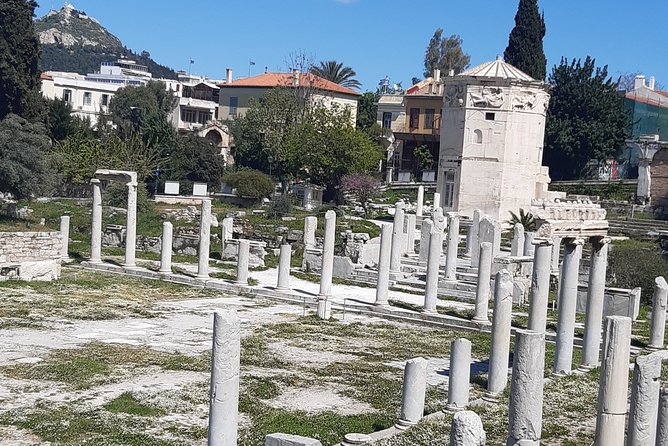
The walk begins at Monastiraki Square, one of Athens’s best-known meeting points. It is a smart starting place because several layers of the city meet here. You get a look at the architecture of different periods, the Athens Flea Market, and the Ancient Agora.
The real value is the connection between those layers. Instead of treating ancient, medieval, and Ottoman Athens as separate subjects, the guide shows how they occupy the same city. A street that feels modern can sit close to remains from a much earlier age, and the square gives you a quick visual sense of that overlap.
The stop is listed as about 15 minutes. That is enough time for orientation and a brisk introduction, but not enough for every building or historical period in detail. If you are especially interested in the Ancient Agora, use this part to note questions for the guide rather than expecting a full archaeological tour.
Because the tour is online, you will not experience the sounds, smells, or crowds of the Flea Market in person. You will, however, gain useful context before a future Athens visit, or a clearer picture of the city if you cannot go yourself.
Psiri, from working district to hip neighborhood
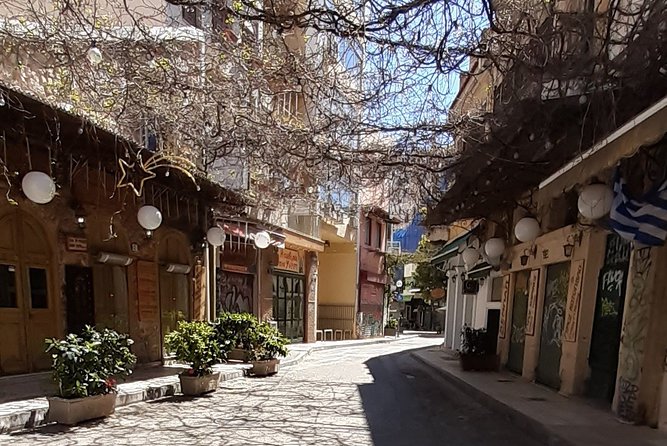
Next comes Psiri, described as a working-class district that developed in the 19th century after Athens became the capital of the Greek state. Today it is known as a hip area, so this stop gives you a useful lesson in urban change.
I like this part of the route because it moves away from the standard monument checklist. Athens is more than the Acropolis, and Psiri helps explain how a city district can shift in character over time. The guide places the modern neighborhood against the political and social changes that shaped Athens after independence and state formation.
The stop lasts about 15 minutes. Online, the guide can point out the character of the district and explain its past without asking you to keep pace on foot. That is convenient for viewers at home, though you should remember that a live video view cannot reproduce the full feel of walking through Psiri yourself.
For anyone planning a city break, this section can also help you decide how central Athens fits together. Monastiraki, Psiri, Plaka, and the Roman Agora are treated as connected parts of the historic center rather than isolated attractions.
Varvakios Market and everyday Athens
The tour then heads to the Varvakios Central Municipal Market. From home, you watch daily life continue in one of Athens’s major markets. The stop is listed at about 10 minutes, so expect a short look rather than a long market study.
This is one of the most useful choices on the route. Ancient sites tell you where Athens came from, but a market shows you how the city functions now. The guide’s aim here is to show how life goes on in Athens, giving the tour a practical, present-day counterweight to mythology and ruins.
The online format has a clear benefit at this stop. You avoid transport, crowds, and the sensory overload that can make a market visit hard to follow. The tradeoff is equally clear: you are seeing the market through a screen, not smelling the food or browsing its stalls yourself.
Still, the market helps keep the tour grounded. If you only want ancient monuments, this section may feel brief. If you want a picture of Athens beyond postcard views, it earns its place.
Plaka and the Acropolis Hill view
The longest section focuses on Plaka and the area around Acropolis Hill. The listed time is 30 minutes, making this the central portion of the experience.
Plaka is Athens’s oldest district, and the route uses it as a setting for mythology, history, legends, and modern life. The guide also points out monuments, ruins, and street art. That combination is important because Plaka is not presented as a frozen museum quarter. It is a living part of the city with layers from different eras.
The Acropolis view gives the online walk its clearest visual anchor. You cannot climb the hill through a screen, but you can see how it relates to the surrounding streets and districts. For someone preparing a future visit, that orientation can be valuable. It helps you understand where Plaka sits and how the Acropolis area connects to the rest of central Athens.
The guide also refers to the hidden island of Athens, meaning Anafiotika, which appears as the next stop. Street art and ruins share space here, so the presentation should appeal to you if you like both archaeology and present-day city culture.
Do not expect a substitute for entering the Acropolis monuments. The experience focuses on the city around the hill and the view toward it. If your main goal is detailed information about the Parthenon interior, this is not the right product. If you want a broad, story-driven look at the district, the 30-minute section is likely the strongest part of the walk.



Anafiotika, a small quarter above the city
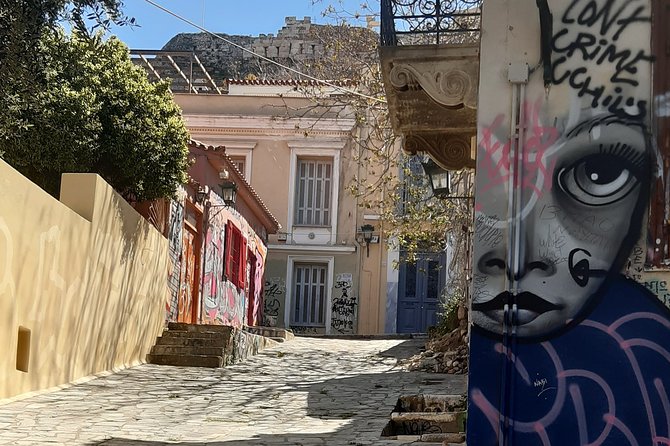
Anafiotika is presented as a hidden island within Athens, a place where time seems to have stopped. The language is poetic, but the practical point is easy to understand: this is a distinct little quarter within the capital, and it offers a sharp change from the city streets below.
The stop is listed at 15 minutes. The guide uses it to show a quieter side of Athens and to connect the neighborhood with the wider story of the Acropolis area. Its appeal comes from contrast. You move from markets, squares, and street art toward a place with a more secluded character.
An online visit works well for orientation. You can see the route and hear why the area matters without having to navigate its narrow lanes yourself. Yet this is also a place where an in-person visit has an obvious advantage. The charm depends heavily on scale and atmosphere, and a screen cannot fully convey that.
Think of Anafiotika as a preview rather than a replacement. If you later visit Athens, you will know to look for this unusual quarter. If you are joining from home, it gives you one more piece of the city’s varied character.
Roman Agora, the closing link to the beginning
The final stop is the Roman Agora, only a short distance from the starting point at Monastiraki. The listed time is 10 minutes, and the route ends back near where it began.
This circular structure makes sense for a walking tour. You start with the mixed architecture and market life of Monastiraki, then pass through Psiri, the municipal market, Plaka, and Anafiotika before returning to the Roman remains. The ending reinforces the central lesson: Athens is built in layers, and the ancient city is never far from the modern one.
A 10-minute finish will not provide a full study of the Roman Agora. Instead, it works as a final historical marker and a tidy close to the route. You should see it as part of the city’s wider story, not as a standalone archaeological lecture.
The return to the meeting point also makes the route easy to understand on a map. That is useful if you are using the experience to prepare for an actual visit.
Why the private online format can be worth $23.69
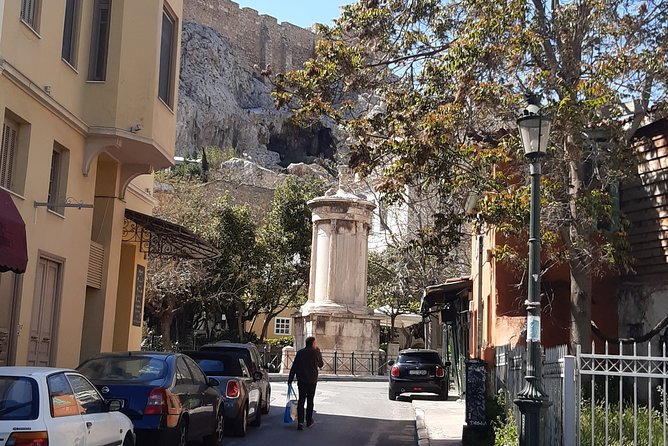
At $23.69 per person, this is not the cheapest way to see Athens, because a free online video or guidebook can provide basic facts. The price makes more sense if you value a live guide, a planned route, and the chance to participate with only your own group.
The private format is especially useful for families, school groups, friends, and small organizations. Group discounts may improve the value further, though the exact discount is not provided. You can also avoid airfare, hotels, local transport, and the time needed for a trip to Greece. For someone unable to travel, that changes the calculation.
The strongest value comes from the guide’s interpretation. Eleni Gika is praised for her clear narration and for selecting historical details that keep the experience moving. That matters in an online format, where a slow or unfocused presentation would quickly lose your attention.
The tradeoff is that the tour cannot provide the physical experience of Athens. You do not walk the stone streets, browse the market yourself, or feel the scale of the Acropolis Hill. You are paying for access to a guide and a live view, not for the full sensory experience of being there.
Who will get the most from this experience
I would recommend this online Athens walk to you if you fit one of these profiles:
- You are planning a future Athens trip and want a clear introduction to the historic center.
- You cannot travel but want a live, guided look at the city.
- You enjoy mythology and history but also want markets, street art, and modern neighborhoods.
- You are arranging an educational session for a school or private group.
- You have already visited Athens and want to see familiar areas explained through a different route.
- You prefer a private session where your group can focus on its own interests.
It may be less suitable if you want a hands-on cooking experience, museum entry, archaeological detail, or a long examination of the Acropolis monuments. It is also not ideal if you dislike screen-based sightseeing.
The tour is accessible through a mobile ticket, and most people can participate. Service animals are allowed, and the activity is near public transportation, though those points matter mainly if you later use the information to plan an in-person visit. For the online session itself, your main practical need is a reliable way to join at the correct time.
Timing, time zones, and cancellation
The start time is listed as 10:00 am in Athens. You should convert that time carefully using Timeanddate.com, since the difference can change with daylight-saving schedules.
The stated duration is approximately 1 hour 15 minutes. However, the six listed sections total 95 minutes: 15 minutes at Monastiraki, 15 in Psiri, 10 at Varvakios Market, 30 in Plaka, 15 in Anafiotika, and 10 at the Roman Agora. This may reflect rounded timings or a longer possible route, but you should confirm it with the provider before booking.
Urban Athens Collective allows free cancellation up to 24 hours before the experience begins. A cancellation made less than 24 hours before the local start time is not refundable, and late changes are not accepted.
Should you book this Athens experience?
Book it if you want a live, private introduction to central Athens with a guide who combines mythology, architecture, local life, and contemporary neighborhoods. The route is well chosen for showing how Monastiraki, Psiri, the market, Plaka, Anafiotika, and the Roman Agora fit into one city story.
At $23.69, the value is strongest for people who cannot travel, groups using it for education, and future visitors who want orientation before arriving. If you are already in Athens, walk these streets yourself and save the online fee. If you are at home, this offers a focused hour or more with Eleni Gika and a useful glimpse of the city’s past and present.
Before paying, confirm the actual length and your local start time. If those details work for you, this is a thoughtful choice for seeing Athens from your own home without reducing the city to only the Acropolis.
FAQ
Where does the online Athens tour begin?
The live experience begins online with a view of Monastiraki Square in Athens, Greece.
What time does the tour start?
The listed start time is 10:00 am Athens time. Check Timeanddate.com to convert it to your own time zone.
How long does the experience last?
The advertised duration is approximately 1 hour 15 minutes. The listed stop times add up to 95 minutes, so confirm the expected length with Urban Athens Collective before booking.
Is this a private experience?
Yes. Only your group participates in the private online tour.
Which Athens areas are included?
The route includes Monastiraki, Psiri, Varvakios Central Municipal Market, Plaka, Anafiotika, and the Roman Agora.
Who guides the experience?
The guide named in the supplied information is Eleni Gika.
What does the tour cover?
The experience includes Athens history, mythology, legends, architecture, ancient and Ottoman remains, local markets, street art, contemporary life, and views around Acropolis Hill.
Can I cancel for a full refund?
Yes, you can cancel for a full refund up to 24 hours before the experience begins. Cancellations or changes made less than 24 hours before the local start time are not accepted for a refund.