REVIEW · PELOPONNESE
Olive Facility Visit with Olive Oil Tasting Session
Book on Viator →Operated by Sparta Gourmet · Bookable on Viator
The best part of this Sparta Gourmet visit is the direct link between Greek olive trees and the bottle on your table. You walk through the factory while it is not operating, visit a small grove with several Greek olive varieties, and then sit down for a guided tasting of three extra virgin olive oils.
I like the clear tasting setup, with green apple and water to refresh your palate between samples. I also like the chance to learn about Kalamata olives, olive paste, harvesting, pressing, sorting, curing, and packaging in one short visit. The main drawback is that the factory is non-operational during the tour, so you see the facilities and learn the process rather than watch production in motion.
In This Review
- Key points to know
- Why this olive oil visit works near Sparta
- Walking through Sparta Gourmet’s factory
- A brief visit among Greek olive varieties
- Learning how to taste three extra virgin oils
- Kalamata olives and olive paste at the table
- What you receive for $29.04
- Getting to the meeting point near Sparta
- The quiet factory is the main trade-off
- Who should book this experience
- Should you book the Sparta Gourmet visit?
- FAQ
- Where does the olive oil experience take place?
- How long does the visit last?
- Is the factory operating during the tour?
- How many olive oils are included in the tasting?
- Are dietary options available?
- Is parking or EV charging available?
Key points to know
- Three olive oils are tasted: Water and green apple help clear your palate between samples.
- The factory is visited while closed to production: You receive an explanation of the process but do not watch active extraction.
- A brief olive grove visit adds context: You see several olive varieties native to Greece.
- Kalamata products are part of the tasting: Olives and olive paste are available as snacks.
- The visit lasts about 90 minutes: It begins and ends at Sparta Gourmet, about 9 kilometers from Sparta.
- Practical facilities are on site: You will find parking, restrooms, a product boutique, vending machine, and a public 300-kilowatt EV charger.
Why this olive oil visit works near Sparta
Olive oil is not a side note in the Peloponnese. It shapes local food, farming, trade, and daily cooking. This visit gives you a useful introduction without asking you to spend half a day at an agricultural site.
At Sparta Gourmet, the experience joins three pieces that make sense together: the olive grove, the production facility, and the tasting table. You first learn where the olives grow, then how they are handled, and finally how to assess the finished oil.
That order matters. A tasting can feel abstract if you only swirl oil in a glass and hear a few flavor words. Here, you get a physical sense of the work behind the product. You hear about the olive tree’s life cycle and importance to the region, then connect that information to extraction and packaging.
The visit is also a practical choice if you are staying in or passing through Sparta. It lasts about one hour and 30 minutes, and it returns you to the same meeting point. You do not need to plan a full day around it.
You can also read our reviews of more food & drink experiences in Peloponnese


Walking through Sparta Gourmet’s factory
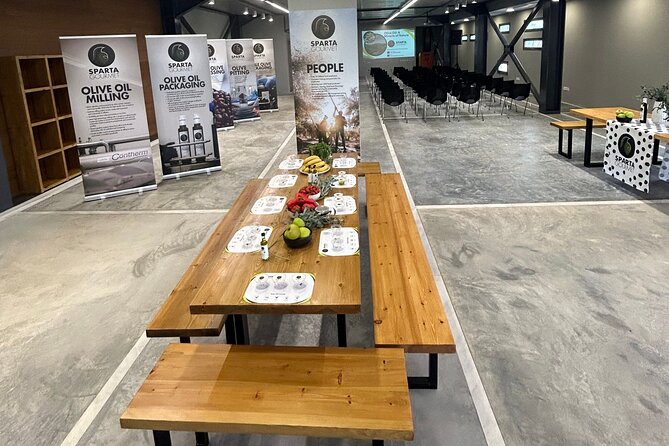
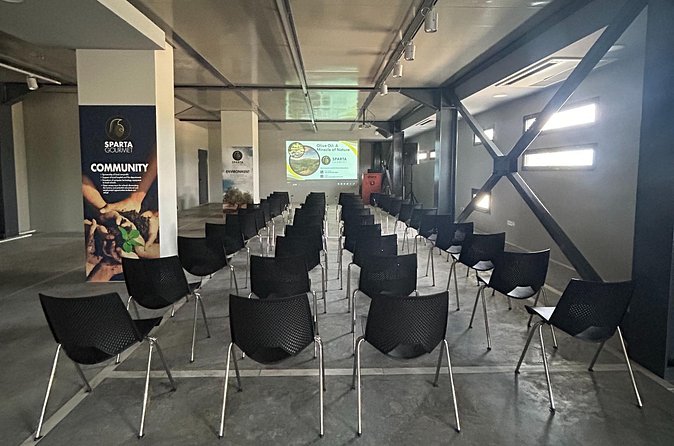
The factory tour takes place while the facility is not operating. This is the key detail to understand before booking. You will not watch fresh olives arriving, moving through machinery, or being pressed in real time.
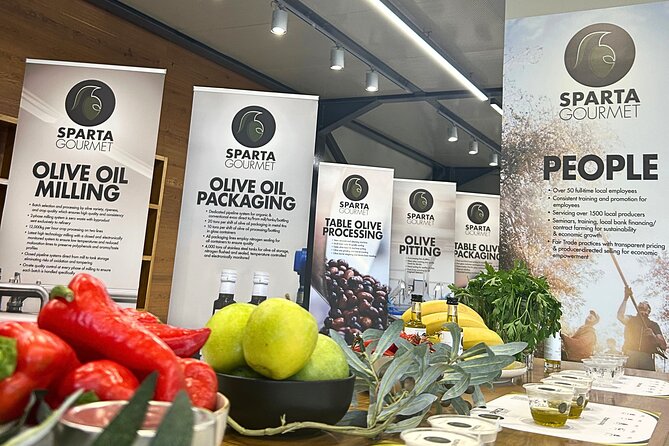
Instead, an English and Greek-speaking guide explains the stages of production as you walk through the facilities. The focus is on how olives are harvested, sorted, processed, and prepared for sale. The visit can still help you understand why extra virgin olive oil depends on careful handling, but it is more of an educational walkthrough than a working-mill demonstration.
A previous participant described seeing the extraction process and learning about pressing methods, as well as the sorting, curing, and packaging of Kalamata olives. Those subjects give the factory portion more range than a simple look at equipment. You are learning about both oil and table olives, two related but different products.
I would pay close attention to the contrast between olive oil production and Kalamata olive preparation. Oil depends on extracting and protecting the liquid from the fruit. Table olives go through sorting and curing before they reach the jar. Understanding that difference makes the tasting and product shop more interesting later.
Because the factory is quiet during the visit, you should set your expectations correctly. If your main goal is to see an active production line, this may feel limited. If you want a clear explanation of how Greek olive products move from grove to market, the slower setting gives you time to ask questions and follow the process.
A brief visit among Greek olive varieties
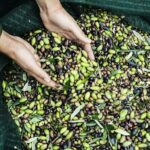
The short stop in the olive grove is one of the most useful parts of the experience. You see several varieties native to Greece and hear about the olive tree’s role in the region and its life cycle.
This adds something a factory presentation cannot provide. Olive trees are not identical, and the fruit used for oil or table olives can vary in size, character, and purpose. The grove helps you place the production story in a real agricultural setting.
The visit is brief, so do not expect a long rural walk or a full farm tour. Its value comes from context rather than distance. You get a chance to look at the trees and connect them with the oil you will taste minutes later.
For me, this is also a good reminder that olive oil is a seasonal food shaped by timing and care. The supplied details do not promise a harvest-day demonstration, so you should not book this expecting to pick olives or watch farming in action. You will receive an introduction to the trees and their importance instead.
Learning how to taste three extra virgin oils
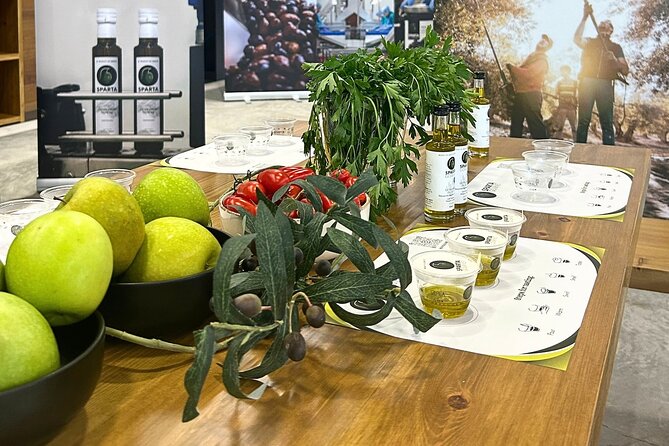
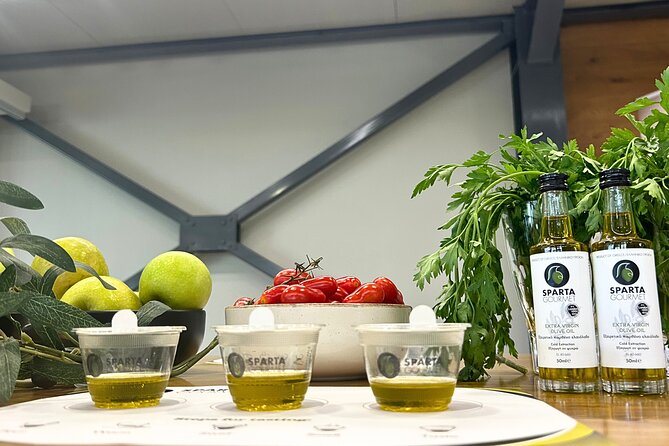
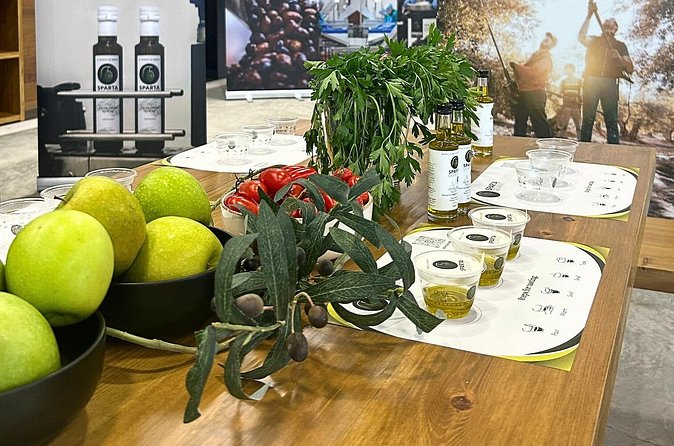
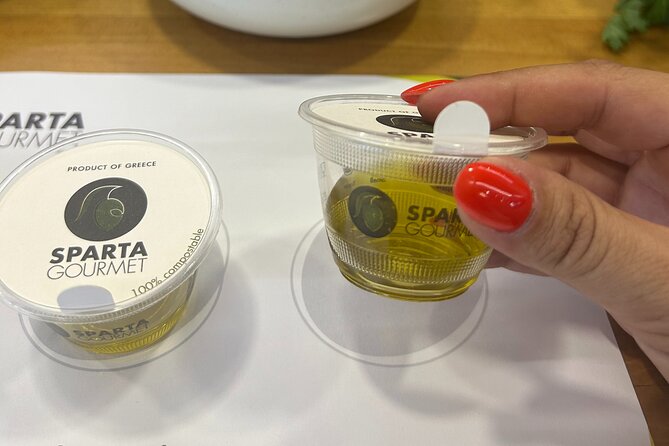
The tasting is led by an EVOO expert, who explains basic tasting tips before you sample the oils. You receive three olive oil samples, with water and green apple slices between them to cleanse your palate.
That simple arrangement makes the tasting approachable. You do not need previous experience, and you do not have to pretend to detect obscure flavors. The guide helps you focus on aroma and taste, then compare the oils rather than judging each sample in isolation.
Green apple is a useful palate cleanser because it is light and crisp. Water gives you a neutral reset. Kalamata olives and olive paste are available for snacking, which turns the session into a small food experience rather than a strictly technical exercise.
You can expect the tasting to show differences among the oils in flavor and aroma. The available information does not identify the exact oils, harvest dates, or specific tasting notes, so I would not expect a fixed menu of named bottles. The important point is the comparison of three extra virgin oils under guided conditions.
The best way to approach the session is to slow down. Smell each sample first, taste a small amount, and notice how the oils differ. You may find one greener, more peppery, smoother, or more rounded than another, but the guide’s tasting tips are there to help you form your own opinion.
This is also the moment when the factory explanation becomes practical. You are no longer hearing only about extraction and handling. You are using your senses to compare the result.
Kalamata olives and olive paste at the table
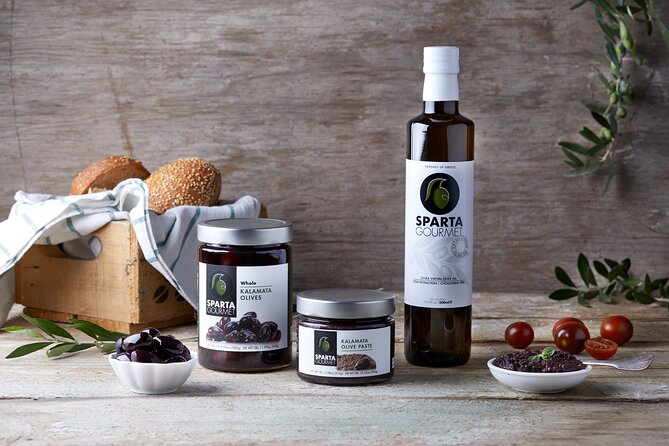
Kalamata olives are a natural part of this experience, given the region’s strong connection with the variety. You can snack on the olives and olive paste during the tasting, while also learning about sorting, curing, and packaging.
I like this inclusion because olive oil tasting alone can become a little formal. The olives give you something familiar to eat and show how the same agricultural tradition produces more than one specialty food.
Do not confuse the three oil samples with a large meal. The listed food consists of Kalamata olives and olive paste, along with water and apple slices. If you need lunch, plan another stop before or after the visit.
The tasting can be arranged for vegan and vegetarian diets. Gluten-free and dairy-free options are available upon request, which is useful if you need to state dietary requirements before arriving. The available details do not list other dietary adaptations, so ask ahead if you have needs beyond those options.


What you receive for $29.04
At $29.04 per person, I see this as a fair price for a focused 90-minute food and culture visit, especially if you are already near Sparta. You receive a guided facility walk, a grove visit, an EVOO presentation, three oil samples, and small olive-based snacks.
The value depends on what you want from the outing. If you mainly want to purchase a bottle, you can do that at the boutique without booking a tour. If you want to understand what you are buying and taste several oils side by side, the guided session makes the extra cost easier to justify.
The group limit is 20 people. That is small enough for a shared presentation without being a private lesson. Your experience may depend on the final group size, but the cap should help keep the walking tour and tasting manageable.
The visit is particularly good value for anyone interested in Greek food, regional agriculture, or cooking. It also works for families and mixed groups, since you can enjoy the grove, factory story, snacks, and shopping without needing specialist knowledge.
Getting to the meeting point near Sparta
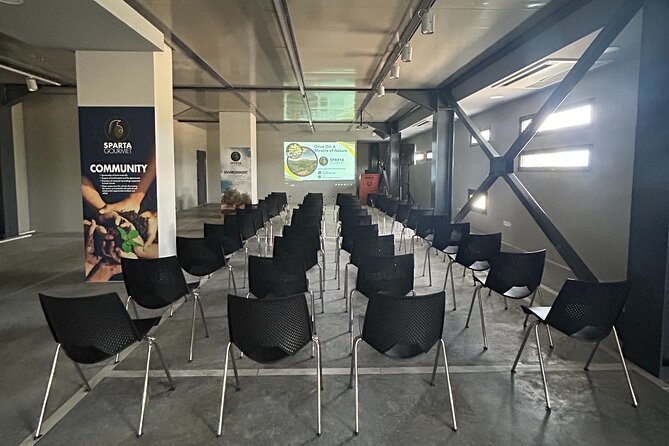
The meeting point is Sparta Gourmet S.A., at the 9th kilometer of the National Road from Sparta to Gytheio, in Sparti 231 50, Greece. The activity begins and ends there, so you need to arrange your own way to the facility.
Ample parking is available, which makes driving the simplest option. The site also has restrooms and an automated snack and beverage machine. These are small details, but they matter when you are making a stop during a road trip.
A public 300-kilowatt EV charging station is available on site. Charging is handled by the third-party company Protergia and is not included in the tour price. If you need to charge, treat it as a separate service and cost.
The boutique sells the facility’s products. I would save shopping until after the tasting, when you have a better sense of which oil or olive product suits your taste. You may also find that tasting first helps you avoid buying a bottle simply because its label looks appealing.
The activity is offered in English, with an English and Greek-speaking guide. Confirmation is provided at booking, and the experience is normally booked about 12 days ahead. That advance pattern suggests you should reserve before your Greece trip if your schedule is tight, though no minimum booking window is stated.
The quiet factory is the main trade-off
The biggest consideration is simple: production is not running during the tour. You should book this for the explanation, tasting, and agricultural context, not for the noise and movement of an active mill.
That quiet setting has one benefit. You can concentrate on the guide’s account of the production steps without machines running around you. But it also means the visit may feel less dramatic than a tour timed during harvest or pressing season.
The supplied details do not give a date-specific production schedule, so you cannot assume that booking during olive harvest will mean active processing. If watching machinery is essential to you, ask Sparta Gourmet before reserving. If you mainly want to understand the process and taste the results, the limitation may not matter much.
The factory portion also seems more instructional than theatrical. That suits me. I would rather receive a clear explanation than a rushed photo opportunity, but you may prefer a working farm or mill if you want a more hands-on outing.
Who should book this experience
I would recommend the visit to you if you are staying around Sparta and want a short, local food experience with a clear beginning and end. It fits neatly into a driving day and does not require a full-day commitment.
It is a good match for:
- People who want to learn how Greek olive oil is produced
- Anyone curious about Kalamata olives and olive paste
- Food-focused visitors who enjoy guided tastings
- Vegetarians and vegans, with suitable tasting sessions available
- Drivers who need parking or may use the EV charger
- Visitors who want to buy olive products after sampling them
I would be more cautious if you want an active factory visit, a long farm walk, a full meal, or a private tasting. None of those are promised here. You receive a compact educational visit with a three-oil tasting and light snacks.
The one-hour-30-minute duration is a strength for many schedules. You can learn something specific, taste several products, and continue exploring the Peloponnese without losing most of your day.
Should you book the Sparta Gourmet visit?
Book it if you want a practical introduction to Greek olive oil with enough explanation to make the tasting meaningful. The grove, factory walkthrough, EVOO guidance, and Kalamata snacks give you more context than a shop tasting alone.
Skip it if an operating mill is your top priority. Since the facility is non-operational during the visit, the experience will not show production in motion.
At $29.04, the visit makes the most sense when you value the story behind the food, not just the samples. I would place it on a Sparta or southern Peloponnese driving route, arrive ready to taste slowly, and leave time to browse the boutique afterward.
FAQ
Where does the olive oil experience take place?
It takes place at Sparta Gourmet S.A., at the 9th kilometer of the National Road from Sparta to Gytheio, in Sparti 231 50, Greece.
How long does the visit last?
The experience lasts approximately one hour and 30 minutes. It ends back at the same meeting point.
Is the factory operating during the tour?
No. The guided walking tour takes place while the factory is non-operational. You learn about the production process and tour the facilities, but active extraction is not promised.
How many olive oils are included in the tasting?
Three extra virgin olive oils are included. Water and green apple slices are provided between samples to cleanse your palate.
Are dietary options available?
Vegan and vegetarian tasting sessions are available. Gluten-free and dairy-free options can be provided upon request.
Is parking or EV charging available?
There is ample parking, and the site has a public 300-kilowatt EV charging station. Charging is provided separately by Protergia and is not included in the tour price.