REVIEW · THESSALONIKI
Private Half-Day Walking City Tour in Thessaloniki
Book on Viator →Operated by GreeceontheGo · Bookable on Viator
Thessaloniki’s story is written in layers, and this private walk lets you read them in order. You move from the port and the White Tower through Roman monuments, Byzantine churches, and the old civic center, ending at Aristotle Square. The route gives you a useful first look at the city without wasting time on long transfers.
I like the private format, since your group can ask questions and set the pace instead of following a large crowd. I also like the guide-led access to places such as the Rotunda, Agios Dimitrios, and the Roman Forum, where a few clear explanations make old stones and faded mosaics far easier to understand.
The main consideration is the price: $208.50 per person is a serious outlay for a four-hour walk, especially because admission fees and taxes are not included. You also need good walking shoes. One booking lasted about four and a half hours, and the route includes uneven historic areas, churches, and city streets.
In This Review
- Key points to know before you book
- Why this walk works as a first look at Thessaloniki
- White Tower: Thessaloniki’s best-known symbol
- Galerius’ Arch and the Roman city
- The Rotunda and its remarkable interior
- Hagia Sophia and the art of the Byzantine church
- Agios Dimitrios and the saint beneath the church
- The Roman Agora and the city beneath your feet
- What the four-hour pace feels like
- Is $208.50 per person a fair price?
- Who should book this experience?
- Practical details before setting out
- Should you book the Thessaloniki city walk?
- FAQ
- How long does the walking tour last?
- What language is the tour offered in?
- Is this a private tour?
- Where does the tour start?
- Where does the tour end?
- Is pickup available?
- Are admission tickets included?
- Which places are visited?
- Can service animals participate?
- What happens if bad weather cancels the tour?
Key points to know before you book
- Six major stops connect Roman, Byzantine, and modern Thessaloniki in one central walking route.
- The tour is private, so only your group participates and questions are welcome throughout.
- Several admission fees are extra, including the White Tower, Rotunda, and Roman Agora.
- Guides may include Vaso, Demetrius, Johana, or Barbara, depending on availability and assignment.
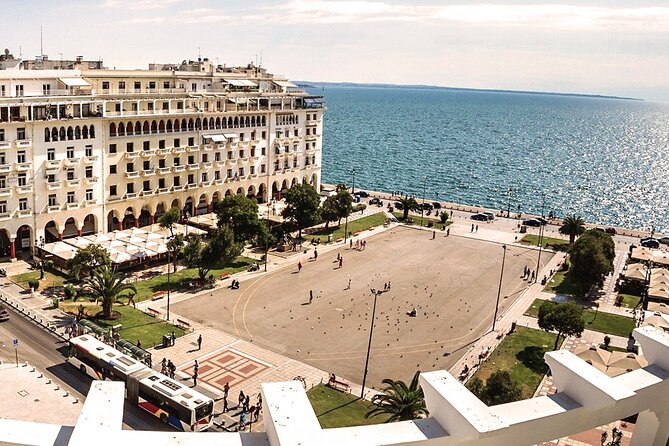
- The route ends at Aristotle Square, a handy point for continuing into the waterfront and central shopping streets.
- Pickup can be arranged, with meeting instructions sent one day before the tour.
Why this walk works as a first look at Thessaloniki
Thessaloniki can feel confusing at first. Roman ruins sit beside apartment blocks, Byzantine churches open onto busy streets, and the seafront quickly gives way to neighborhoods full of cafés and shops. This four-hour route helps you place the city’s major periods on a mental map.
You begin at the Eleftherios Venizelos Statue on Egnatia Street and finish at Aristotle Square. That direction gives the walk a natural flow from the eastern side of the central district toward the waterfront. Pickup is offered, and one booking included meeting a guide at the cruise ship, but you should wait for the provider’s exact rendezvous instructions, which arrive one day before the tour.
The experience is offered in English and includes a licensed English-speaking guide plus liability insurance. Since it is private, your group does not share the guide with strangers. That matters most at the churches, where you may want to pause, ask about religious details, or spend an extra minute looking at a mosaic.
Several guides have received especially warm praise for their style. Vaso is an archaeologist with a strong connection to Thessaloniki and has been described as generous with her time. Demetrius combines historical facts with humor. Johana has helped with practical needs as well as guiding, while Barbara has offered restaurant and activity suggestions for the rest of a visit. Your guide is not guaranteed, but these names give you an idea of the kind of personal approach associated with the experience.
You can also read our reviews of more walking tours in Thessaloniki



White Tower: Thessaloniki’s best-known symbol
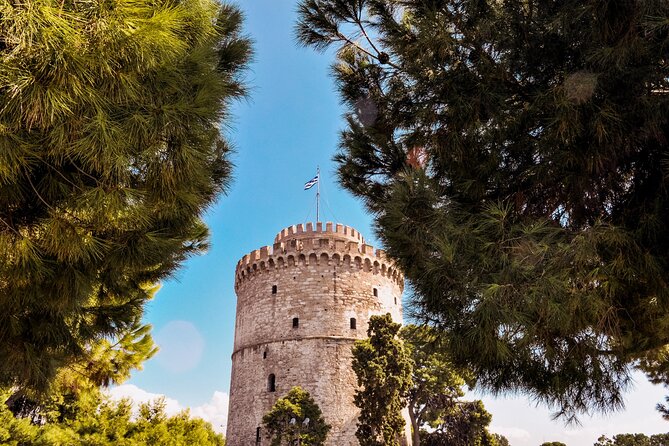
The White Tower gets about 20 minutes, enough for an exterior introduction and perhaps a visit if you choose to pay the admission fee. It dominates the port and once formed the southeastern corner of the city’s fortifications.
Its past is darker than its clean name suggests. The tower was known at different times as the Kalamaria Fortress, Janissary Tower, and Blood Tower. The last name referred to its use as a prison and execution site under the Janissaries.
The familiar white color came later. In 1890, a prisoner reportedly whitewashed the tower to gain his freedom, and the new name remained. That small detail gives the monument a human story, not just a date and architectural label.
Admission is not included, so decide before the tour whether you want to go inside. If you do, the 20-minute scheduled stop may feel short. If you stay outside, the tower still gives you an excellent orientation to the waterfront and Thessaloniki’s defensive past.
Galerius’ Arch and the Roman city
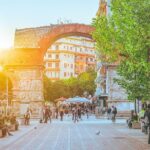
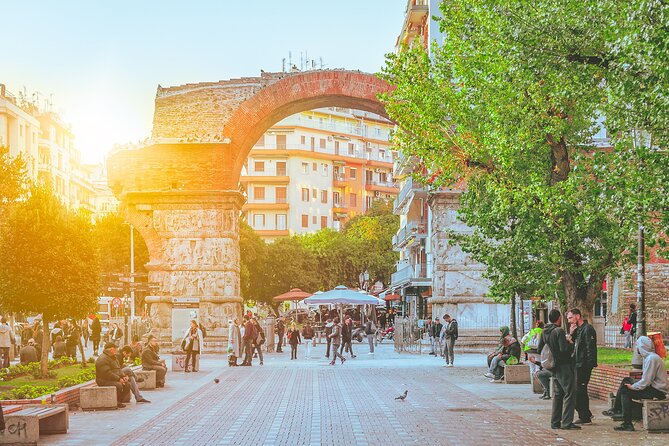
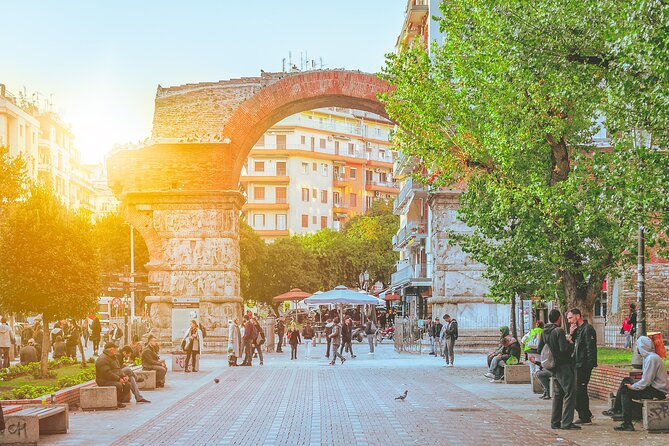
The Arch of Galerius, called Kamara by locals, is a quick but rewarding stop. It sits on Egnatia Street and functions as a popular meeting point for people heading into the center. The monument was built between 295 and 305 AD to celebrate Galerius’ victory over the Persians.
Look closely at the surviving reliefs. They show military scenes and victories, giving you a glimpse of how Roman emperors used public buildings to shape their image. The arch is not intact, and it is surrounded by modern city life, but that is part of its appeal. You are not viewing a remote ruin. You are seeing ancient imperial propaganda in the middle of a working Greek city.
The stop lasts about 20 minutes, and admission is free. Your guide can help you identify what remains and explain how the arch once related to the larger palace complex nearby.
The Rotunda and its remarkable interior
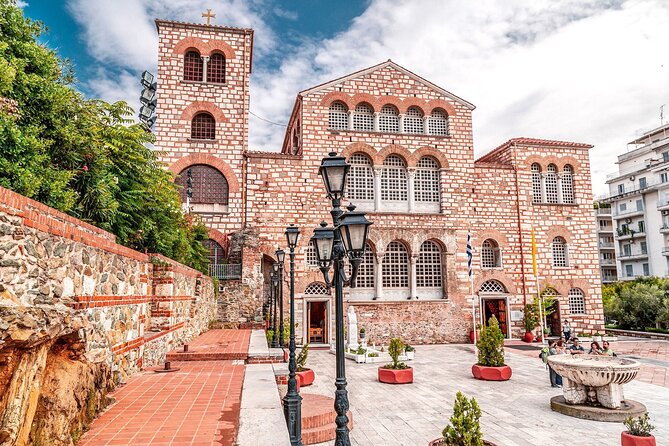
The Rotunda deserves careful attention. Built at the start of the fourth century AD, it is one of Europe’s major surviving Roman monuments. Its original purpose remains uncertain. It may have been a pagan temple or a mausoleum connected with Constantine the Great.
The building later became a Christian church and eventually a mosque. That changing use is the key to understanding it. Inside, Roman structure, Christian decoration, and later history occupy the same round space.
The mosaics are the main reason to pay the admission fee. They rise across the interior and create a powerful contrast with the plain, massive exterior. Give yourself time to look upward, since the most important details are not at eye level.
The tour allows around 20 minutes here, and admission is not included. That is enough for an introduction, but not necessarily enough for a slow architectural study. If you care strongly about Roman buildings or Byzantine art, ask your guide whether the schedule allows a little extra time.
Hagia Sophia and the art of the Byzantine church
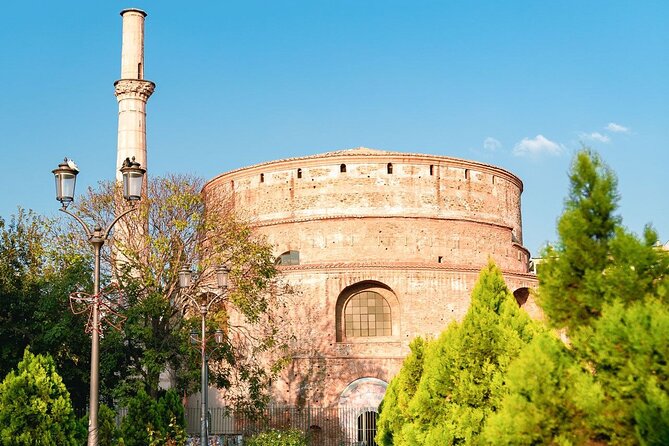
Thessaloniki’s Hagia Sophia is dedicated to the Wisdom of God and was built in the late seventh century. Its design echoes Hagia Sophia in Constantinople, though on a smaller scale. The church is a good place to see how early Christian builders adapted the cross-shaped plan to a domed structure.
The interior frescoes from the 11th century and the mosaics are the stars. They are considered major works of Byzantine art, but the church does not feel like a museum display. It remains a religious building, so respectful clothing and behavior are sensible.
The church also reflects the city’s changing rulers. During Latin rule from 1204 to 1224, it became a Latin cathedral. After Byzantine rule returned, it again served as the Orthodox cathedral until it was converted into a mosque in 1523 or 1524.
The scheduled time is about 20 minutes, and admission is free. That makes this one of the better-value stops on the route. You can see important art without paying an additional ticket, though services or other church activity could affect access.
You can also read our reviews of more city tours in Thessaloniki



Agios Dimitrios and the saint beneath the church
The Basilica of Saint Demetrius is the emotional center of the walk for many people. Agios Dimitrios is Thessaloniki’s patron saint, and the church was built near the place where tradition says he was imprisoned and killed in 303.
The first small shrine appeared in 313. The present basilica grew from that early sacred site and was built over the remains of a Roman bath. Its size and broad interior show the importance of the saint to the city.
Below the church is the Crypt, connected with the place of martyrdom. In the late Byzantine period, it became the center of washing the saint’s myrrh. This is the sort of detail that makes the visit more than a quick stop for photographs. You are seeing a place shaped by worship, memory, and centuries of local devotion.
The tour gives Agios Dimitrios about 30 minutes, longer than most other stops. Admission is free. If you have limited time in Thessaloniki, this church is one of the places I would not skip.
The Roman Agora and the city beneath your feet
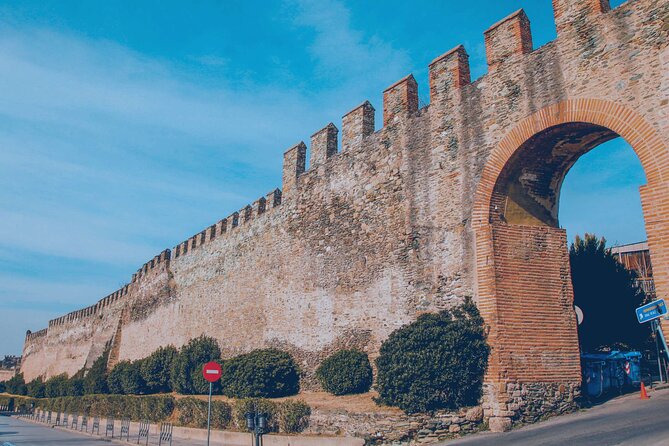
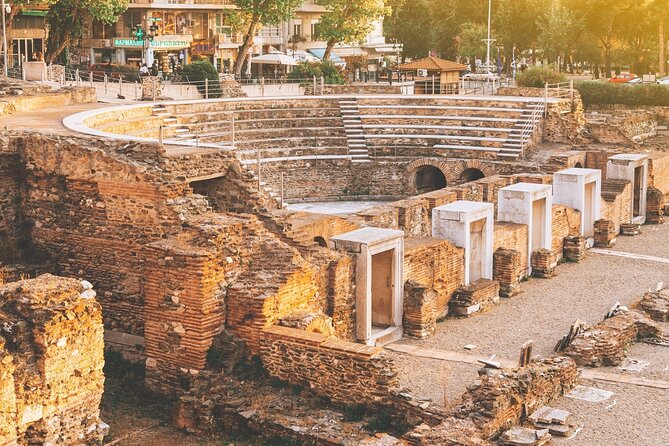
The final major historical stop is the Greek Agora and Roman Forum. The Roman Agora served as a social and religious center, and its construction took place in two main phases during the middle of the second and third centuries AD.
The archaeological site helps you picture how Roman Thessaloniki functioned. This was not simply a collection of buildings. It was a civic space where public life, religion, and administration came together.
There is also an underground museum explaining the excavations. That museum can be especially useful because the ruins alone may not show you how the whole complex once worked. One booking also included a visit to a metro station where ancient finds were uncovered during construction. That kind of stop can connect the old city to present-day Thessaloniki in a memorable way, although the exact route may vary.
South of the archaeological site are the remains known as las Incantadas. The name came from the Spanish-Jewish community that once lived in the area and called the ruins the Enchanted Ones. The scheduled stop is around 20 minutes, and admission to the Roman Agora is not included.
What the four-hour pace feels like
The timing is brisk but sensible. Most major stops receive 20 minutes, while Agios Dimitrios receives 30. You also spend time walking between sites, so the tour is not six static talks in a row.
Still, do not mistake half-day for effortless. Thessaloniki has busy streets, historic paving, and stops where you will be standing. Wear shoes with good support, especially if your booking runs closer to four and a half hours.
The private setup helps here. A guide can explain a monument while your group pauses, then move on when everyone is ready. The route is not designed for a slow photographic study of every site, but it gives you a strong framework for returning later to the places that interest you most.
The tour operates from 9:00 AM to 6:00 PM, Monday through Sunday, during the stated operating period. Since weather can cancel the experience, keep some flexibility in your plans. Poor-weather cancellations offer either another date or a full refund.
Is $208.50 per person a fair price?
At $208.50 per person, this is not a budget walking tour. The price makes the most sense for a couple, family, or small group that values a private guide and wants to cover several important sites in one morning or afternoon.
A larger private group may benefit from the group discount, though the exact reduction is not specified. Since the guide is licensed and only your group participates, you are paying for personal attention, historical interpretation, and flexible conversation rather than simply transportation or entry tickets.
The value drops if you mainly want to see the monuments from the outside. Three key paid admissions are extra: the White Tower, Rotunda, and Roman Agora. Taxes and fees are also not included, and the tour description says anything not specifically listed as included is additional.
The value improves if Thessaloniki is new to you, your time is limited, or you want help sorting Roman, Byzantine, Ottoman, and modern layers. A good guide can also suggest restaurants and further activities. Barbara, for example, has given useful ideas for continuing a stay after the walk.
Who should book this experience?
I would choose this tour if you are visiting Thessaloniki for the first time and want a clear historical introduction without joining a large group. It suits cruise passengers especially well if pickup is confirmed at the ship and you need an efficient way to see the center.
It also fits families and groups with mixed interests. The private format lets you ask for more history, more local context, or a faster pace. English is the offered language, and most people can participate. Service animals are allowed, and the meeting areas are near public transportation.
I would think twice if you dislike walking, want a slow museum visit, or are trying to keep costs low. You may prefer to see the free churches and exterior monuments independently, then pay only for the site that matters most to you.
Practical details before setting out
Your starting point is the Eleftherios Venizelos Statue at Egnatia 78. The walk finishes at Aristotle Square, a central location where you can continue exploring on foot. Pickup is offered, and detailed instructions are sent one day before the tour.
Confirmation normally arrives at booking. If you book within five days of the departure date, confirmation may take up to 48 hours and depends on availability.
Free cancellation is available up to 24 hours before the start time. Changes or cancellations inside that 24-hour window are not accepted for a refund. The cutoff uses local Thessaloniki time, so check the exact start time carefully.
Should you book the Thessaloniki city walk?
Book it if you want personal guiding across the city’s main Roman and Byzantine sights, and you are willing to pay for a private experience. The strongest reasons are the route’s historical range, the licensed English-speaking guide, and the chance to ask questions at every stop.
The price is the main hurdle, and entrance tickets add to the total. For a small group splitting the cost, or for a first visit built around limited time, the experience can be a practical way to get oriented. For a solo budget visitor, the math is harder.
Choose comfortable shoes, confirm pickup details, and decide which paid sites you want to enter. Done that way, this walk gives you both the big picture and several good reasons to return to Thessaloniki’s monuments at your own pace.
FAQ
How long does the walking tour last?
The tour lasts approximately four hours. One booking took about four and a half hours, so you should allow a little flexibility.
What language is the tour offered in?
The tour is offered in English with a licensed English-speaking guide.
Is this a private tour?
Yes. Only your group participates in the activity.
Where does the tour start?
The listed starting point is the Eleftherios Venizelos Statue at Egnatia 78, Thessaloniki 546 24, Greece.
Where does the tour end?
The tour ends at Aristotle Square, Aristotelous Square, Thessaloniki 546 24, Greece.
Is pickup available?
Pickup is offered. Detailed instructions for meeting the guide are provided one day before the scheduled tour.
Are admission tickets included?
No. Admission is not included for the White Tower, Rotunda, or Roman Agora. Hagia Sophia and Agios Dimitrios are listed with free admission, while fees and taxes are not included generally.
Which places are visited?
The route includes the White Tower, Arch of Galerius, Rotunda, Holy Cathedral Church of Hagia Sophia, Holy Church of Saint Demetrius, and the Greek Agora and Roman Forum.
Can service animals participate?
Yes. Service animals are allowed.
What happens if bad weather cancels the tour?
If poor weather causes cancellation, you are offered a different date or a full refund. You can also cancel up to 24 hours before the start time for a full refund.