REVIEW · ATHENS
Visit of the Acropolis with an official guide in Spanish
Book on Viator →Operated by Toptoursgreece · Bookable on Viator
The best thing about this Acropolis visit is its focus. In about two hours, you move through the hilltop monuments with an official guide who explains not just what you are looking at, but why it mattered to ancient Athens. The tour is conducted entirely in Spanish, a real help when mythology, architecture, and long political stories start to blur together.
I like the wireless audio system, which makes it easier to hear on a busy stone hill, and I like the guide-led approach to details that are easy to miss, from optical refinements in the Parthenon to the sacred olive tree beside the Erechtheion. Guides named in connection with this experience include Efi, Ari, Simon, and Maria, with Efi especially praised for her warmth and lively storytelling.
The main consideration is simple: your Acropolis admission ticket is not included. You must arrange entry separately, and the tour itself is on foot over uneven, sloping ground. At $44.03 per person, the guiding is reasonably priced, but your total cost will be higher once admission is added.
In This Review
- Key points at a glance
- Why a Spanish guide changes the Acropolis visit
- Meeting at 8:30 and walking uphill
- The Acropolis sets the larger story
- The Parthenon: more than perfect columns
- Propylaea and the Temple of Athena Nike
- The Erechtheion and its famous Caryatids
- The Herod Atticus Odeon and a living ancient venue
- Asclepios and the practical side of ancient belief
- The Theatre of Dionysus and the birth of drama
- What the $44.03 price really covers
- Who will get the most from this visit
- Booking timing and cancellation
- Should you book the Spanish Acropolis tour?
- FAQ
- Is the Acropolis entrance ticket included?
- Is the tour conducted in Spanish?
- How long does the tour last?
- Where does the tour start?
- What time does the tour begin?
- Where does the tour end?
- How large can the group be?
Key points at a glance
- Spanish-only guiding: The entire visit is designed for Spanish-speaking visitors, rather than being a mixed-language tour.
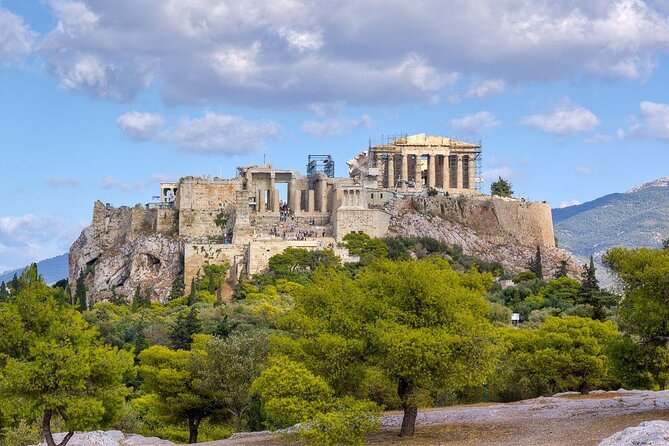
- A two-hour route: You see the Acropolis, Parthenon, Propylaea, Erechtheion, Odeon, Temple of Asclepios, and Theatre of Dionysus.
- Strong guide presence: Efi, Ari, Simon, and Maria are among the guides associated with the experience, with praise focused on passion, clarity, and care.
- Wireless audio included: You can follow the explanation without having to crowd around the guide.
- Ticket sold separately: The tour price covers the guide and equipment, not entry to the archaeological site.
- Small enough to stay personal: The maximum group size is 27 people, though this is not a private tour.
Why a Spanish guide changes the Acropolis visit
The Acropolis is easy to admire and surprisingly hard to understand on your own. You see columns, broken statues, and huge blocks of marble, but the meaning behind them is scattered across mythology, religion, warfare, politics, and restoration work.
A good guide supplies the missing links. This visit begins with the historical, mythological, and cultural setting of the hill, then connects each building to the next. That matters because the Acropolis was not a single monument built at one moment. It was a sacred center shaped by different periods, rulers, religious practices, destruction, and later changes in use.
The Spanish-only format is particularly useful if Spanish is your strongest language. You are not waiting for a second-language explanation or switching between languages. The guide can develop an idea, explain a myth, and answer questions without compressing everything into a few hurried facts.
The guide style also seems to be a major part of the appeal. Efi is repeatedly singled out for making people imagine the events of ancient Athens and for explaining mythology, anthropology, geography, and architecture in an engaging way. One family found that their children stayed attentive, even in intense heat. That gives you a useful picture of the tone: this is not meant to be a dry list of dates.
You can also read our reviews of more guided tours in Athens

Meeting at 8:30 and walking uphill
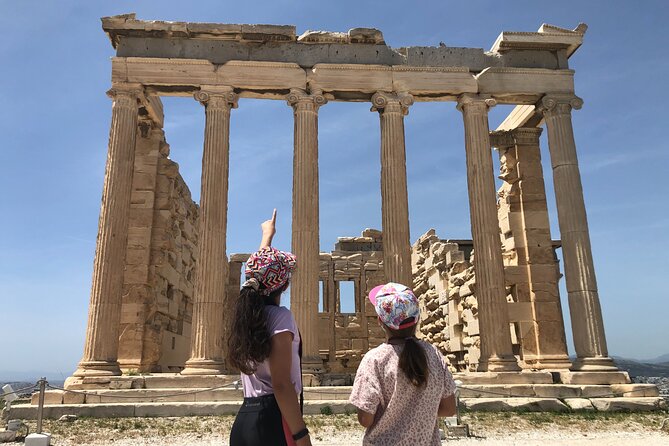
The meeting point is the Greek National Tourism Organisation Information Point at 18 Dionysiou Areopagitou Street. The start time is 8:30 a.m., and you should arrive ready to walk rather than expecting a vehicle or shuttle.
The whole visit takes place on foot. That sounds obvious, but the Acropolis is a demanding setting for anyone with limited mobility or low fitness. Expect an uphill approach, exposed sun, stone surfaces, and time spent standing while the guide speaks. The operator asks for a moderate level of physical fitness, and that is sensible advice.
The early start is helpful. The Acropolis can become hot and crowded later in the day, though the experience information does not promise a crowd-free visit. You should still bring water, wear practical shoes, and protect yourself from the sun. These are not luxury extras here. They affect how much attention you can give to the guide.
The group can include up to 27 people. That is far smaller than a large coach excursion, but it is not intimate in the way a private tour is. The audio system helps compensate, especially around the Parthenon and Propylaea, where people naturally gather.
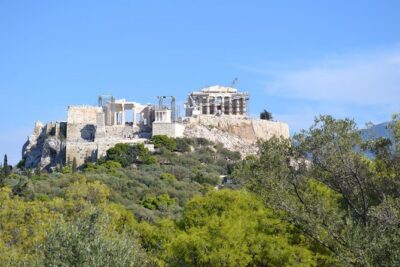
The Acropolis sets the larger story
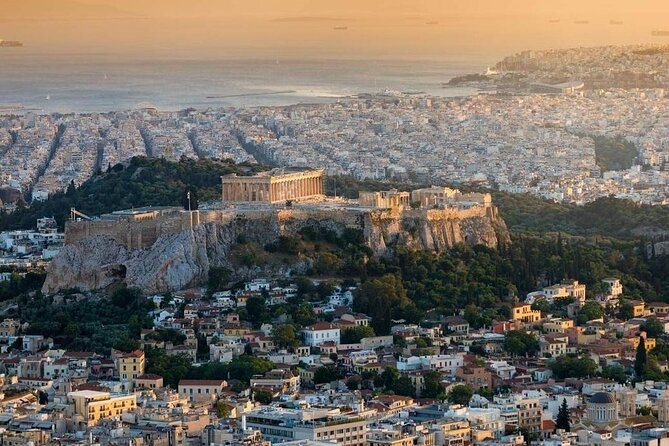
The opening portion gives you the broad context of the Acropolis before the tour narrows in on individual buildings. This is one of the experience’s strongest choices.
You learn to see the hill as a sacred and political center, not simply as a viewpoint with old ruins. The guide brings in mythology and the role of Athena, while also explaining how the site reflects the power and ambition of ancient Athens. That larger frame makes the separate monuments easier to follow.
The route includes all the named monuments within the Acropolis area. Since the tour lasts about two hours, the pace is purposeful. You get explanations at the main stops, but you should not expect a leisurely archaeological study of every fragment and foundation.
The end point is at Theorias 21, directly at the top of the Acropolis. This is useful because the formal tour ends where you can continue looking, take photographs, and enjoy free time among the monuments. You do not have to descend immediately with the group.
The Parthenon: more than perfect columns
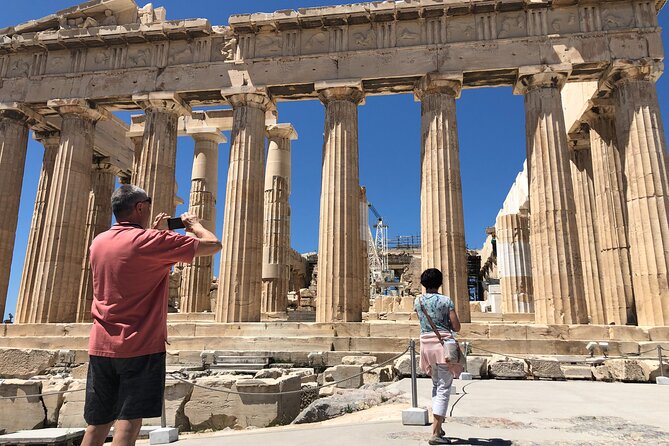
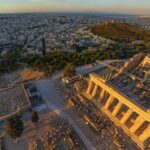
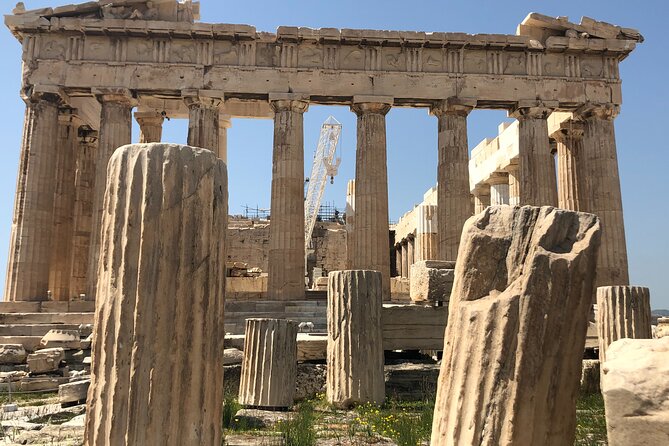
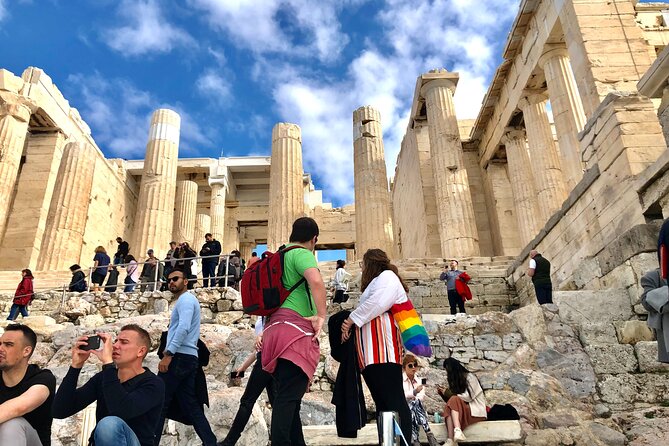
The Parthenon receives the most time, about 20 minutes, and rightly so. Built around 2,500 years ago, it is the building most people come to see, but its fame can make it easy to look without really seeing.
The guide explains its construction, decoration, later changes, and looting. You also hear how it served as a church during the Byzantine period and as a mosque during Ottoman rule. Those later chapters are important. The Parthenon was not frozen in its classical Greek identity for most of its life. It was reused, altered, damaged, and eventually placed under ongoing restoration.
A particularly worthwhile topic is the building’s optical refinement. The Parthenon’s lines and proportions were adjusted so the structure would appear balanced to the human eye. This is the kind of detail you might miss completely without help.
The guide also covers the legends surrounding the temple and the story of its decoration. You should expect the building to be an active restoration site rather than a perfectly complete ancient temple. The tour gives you a way to understand both the original design and the incomplete monument in front of you.
Propylaea and the Temple of Athena Nike
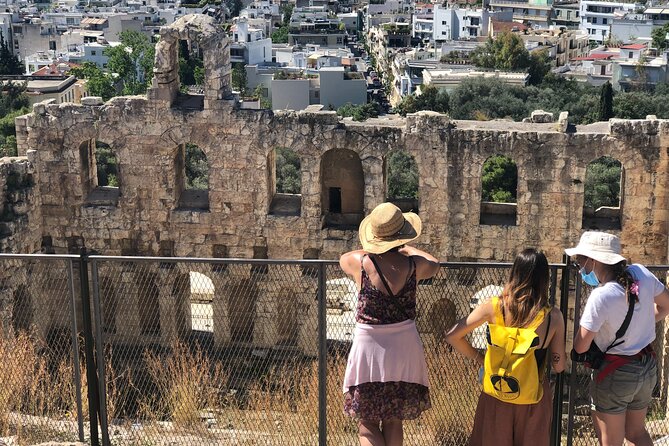
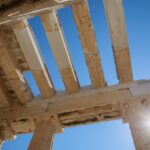
The Propylaea is the monumental marble gateway to the Acropolis. It is a brief stop, about 10 minutes, but the location does much of the work. You pass through an entrance designed to impress, and the guide explains how its position and topography helped funnel movement during wartime.
The explanation of the different column types adds architectural interest. Ancient builders were not using a single visual language throughout the entrance. The Propylaea was meant to be grand, functional, and carefully staged for those approaching the sacred hill.
The itinerary also refers to the small temple honoring Athena Nike, Athena Victorious, built after Greek victories over the Persians. This is one of those compact structures that can be overlooked beside the Parthenon. Its purpose was strongly tied to memory and victory, linking the monument to the period often called Athens’ golden age.
The source details do not give a separate stop number or duration for this temple, so you should regard it as part of the Acropolis route rather than a long standalone visit. The guide’s explanation is what makes the brief look worthwhile.
- All Day Cruise -3 Islands to Agistri,Moni, Aegina with lunch and drinks included
★ 5.0 · 4,958 reviews

The Erechtheion and its famous Caryatids
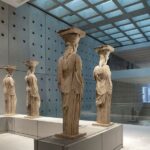
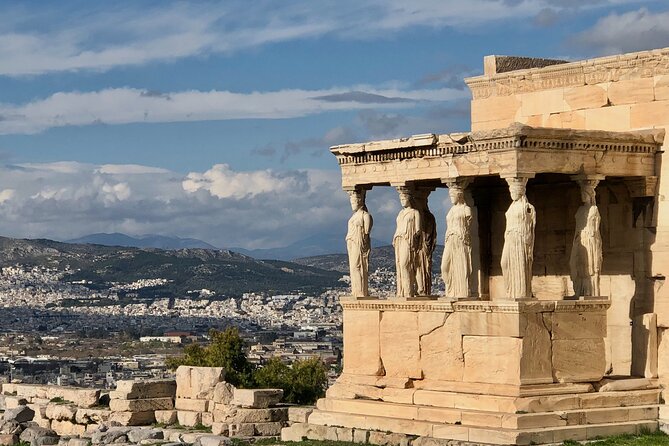
The Erechtheion is likely to be your favorite photographic stop. Its Caryatids, the female-shaped columns supporting one of its porches, give the building a distinctive look that differs sharply from the Parthenon’s regular rows of columns.
The guide explains the temple’s connection with Athena, Poseidon, and Erechtheus, the mythological first king of Athens. This is also where you hear about the sacred olive tree and why it matters to the story of Athena’s claim over the city.
The visit here lasts about 10 minutes. That is enough for the central explanation and photographs, but not enough for a slow, detailed study of every feature. The site can feel crowded around the Caryatids, so the wireless audio is useful and the guide’s advice on photo positions can save time.
The tour also helps you separate myth from physical evidence. The Acropolis is full of stories that shaped Athenian identity, and the guide places those stories beside the buildings rather than presenting them as isolated legends.
The Herod Atticus Odeon and a living ancient venue
The Odeon of Herod Atticus is a Roman-era theater built by one of the best-known Roman governors in Athens. It could hold about 5,000 spectators and was dedicated to his wife, Regilla.
The striking fact is that this is not merely a ruin. It is fully restored and still used for performances during the Athens Festival. That gives the monument a connection to present-day cultural life, even though the tour itself is not a performance experience.
You spend roughly 10 minutes here. The guide explains the building’s purpose and its modern use, while you look down into the theater from the Acropolis route. The stop is especially valuable if you enjoy seeing how ancient places continue to shape a city’s cultural life.
Do not confuse this venue with the Theatre of Dionysus lower on the slope. They belong to different periods and served different roles, and the tour makes that contrast clear.
Asclepios and the practical side of ancient belief
The Temple of Asclepios is a short, five-minute stop dedicated to the god of medicine. The focus here is less on grand architecture and more on how ancient Athenians dealt with illness.
You learn how patients were treated and what kinds of votive offerings they left to give thanks. These details bring a practical side of ancient religion into view. Worship was not only about major gods, temples, and public ceremony. It was also about people seeking help with pain and disease.
Because the stop is brief, the guide’s explanation matters more than the physical remains. If you prefer major monuments only, this may feel like a quick pause. If you like everyday human details, it adds useful balance to the grander story of the Acropolis.
The Theatre of Dionysus and the birth of drama
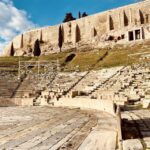
The Theatre of Dionysus Eleuthereus sits on the slope of the Acropolis and is described as one of the oldest theaters in the world built entirely of marble. Its capacity was about 17,000 spectators.
This is where the first performances of works by Euripides, Aeschylus, Sophocles, and Aristophanes took place. Even if you are not a theater specialist, that list gives the stop real weight. The setting connects the stones under your feet with the beginnings of some of the most influential dramatic forms in Western culture.
The theater’s position on the slope helped provide the acoustics the ancient audience wanted. The tour lasts about 10 minutes here, enough to explain the setting, capacity, and role in Athenian public life.
The route makes a good final chapter because it broadens your view of classical Athens. The Acropolis was not only about temples and religious devotion. It was also linked to drama, public debate, civic identity, medicine, military memory, and the city’s relationship with its gods.
What the $44.03 price really covers
At $44.03 per person, the price is for the guided experience rather than a bundled admission package. It includes the official Spanish-speaking guide, wireless audio equipment, the described monument visit, and state taxes.
The missing admission ticket is the key cost issue. You need a separate entry ticket to enter the Acropolis, and the supplied information says entry is required from 8:00 to 9:00. That wording is not fully clear as written, so I would confirm the exact ticket requirement and entry time before booking. Do not assume the $44.03 covers the gate.
The tour is a good value if you want context and prefer Spanish. A self-guided visit may cost less in guiding fees, but you would need to build the historical and architectural explanation yourself. Here, the guide organizes the site into a story and points out details that are easy to overlook.
The value is also tied to the guide you receive. Efi is associated with especially strong feedback for passion, clear explanations, and keeping both adults and children engaged. Ari, Simon, and Maria are also named as guides connected with highly praised visits. Since you cannot rely on a particular person unless the booking confirms it, choose this tour for its Spanish official-guide format rather than for one named guide alone.
Who will get the most from this visit
I would choose this experience if you want the Acropolis explained in Spanish, especially on a first visit to Athens. It suits people who enjoy mythology, architecture, ancient politics, and cultural context but do not want a full-day archaeological course.
Families may also like the storytelling approach. The guides use questions, images in the imagination, and clear explanations instead of relying only on dates. That can help children stay involved, though the heat and uneven walking surface still require patience.
It is less suitable if you want to move at your own pace, spend a long time photographing each monument, or avoid group touring altogether. The two-hour schedule keeps the route moving, and a group of up to 27 people will not provide the quiet of a private guide.
The experience is also not a transport service. You must reach the meeting point yourself, walk through the site, and make your own way onward after the formal portion. The advantage is that you finish at the top, with free time to keep taking photographs before leaving.
Booking timing and cancellation
This experience is booked an average of 25 days in advance, so I would not wait until the last minute if your dates are fixed. Confirmation is provided at the time of booking, and a mobile ticket is available.
Free cancellation applies if you cancel at least 24 hours before the local start time. Cancellations or changes made within 24 hours are not refunded or accepted. Service animals are allowed, and the meeting point is near public transportation.
Should you book the Spanish Acropolis tour?
Book it if you want a focused, well-explained Acropolis visit in Spanish and are happy to buy the entrance ticket separately. The route covers the essential monuments while adding useful context about medicine, theater, warfare, religion, restoration, and later reuse.
I especially like the combination of a two-hour structure, official guiding, and wireless audio. The strongest reason to choose it is not simply seeing the Parthenon. It is understanding why the Parthenon, Erechtheion, Propylaea, theaters, and smaller sacred spaces belong to one larger story.
Skip it if you prefer complete independence or need a very slow, accessibility-focused visit. For most Spanish-speaking first-time visitors who can manage the uphill walk, this is a practical way to make the Acropolis mean more than a beautiful photograph.
FAQ
Is the Acropolis entrance ticket included?
No. Admission to the Acropolis is not included in the $44.03 tour price. You need a separate entry ticket.
Is the tour conducted in Spanish?
Yes. The official guide conducts the visit exclusively in Spanish.
How long does the tour last?
The guided visit lasts approximately two hours.
Where does the tour start?
It starts at the Greek National Tourism Organisation Information Point, Dionysiou Areopagitou 18, Athens 117 42, Greece.
What time does the tour begin?
The stated start time is 8:30 a.m.
Where does the tour end?
The formal tour ends at Theorias 21, directly at the top of the Acropolis. You can then use your free time to photograph the monuments.
How large can the group be?
The maximum group size is 27 people.