REVIEW · ATHENS
Acropolis Guided Tour with Skip-the-Line Access
Book on Viator →Operated by Olive Sea Travel · Bookable on Viator
Athens’ Acropolis feels different in the evening. The marble catches the fading light, the city opens below you, and the great ruins become easier to study without the harsh midday sun. This roughly two-hour tour focuses on the hill’s major monuments, with a licensed guide to explain what you are seeing.
I like the 5:30 pm start, which gives you a cooler visit during hot summer weather, and the small group of no more than 15 people. The included ticket and skip-the-line access also save you from arranging the main pieces yourself. The catch is the price: at $156.20 per person, this is a costly short tour, so you need to value the guide and convenience.
In This Review
- Key points to know before you book
- Why an evening Acropolis visit works so well
- Meeting at Herodion Hotel at 5:30 pm
- Climbing the Acropolis and entering through the Propylaea
- The Temple of Athena Nike on its small bastion
- The Parthenon, Athens’ defining monument
- The Erechtheion and the Caryatid porch
- The Theatre of Dionysus below the Sacred Rock
- What the $156.20 price includes
- Who should choose this tour
- Booking details and cancellation
- Should you book the Acropolis evening tour?
- FAQ
- How long does the Acropolis guided tour last?
- What time and where does the tour begin?
- Is Acropolis admission included?
- Is a guide included, and what language is offered?
- How large is the group?
- Is hotel pickup included?
Key points to know before you book
- Evening Acropolis visit: See the Sacred Rock after the heat of the day has eased.
- Six major sights: The route covers the Propylaea, Temple of Athena Nike, Parthenon, Erechtheion, Acropolis hill, and Theatre of Dionysus.
- Licensed English-speaking guide: The guide gives the stones context instead of leaving you to identify each building on your own.
- Small group format: With a maximum of 15 people, the tour should feel more personal than a large coach-style outing.
- Admission and skip-the-line entry included: The ticket is part of the price, and you do not need to purchase Acropolis admission separately.
- Practical footwear matters: Marble and rock can be slippery, so wear walking shoes or sneakers with good grip.
Why an evening Acropolis visit works so well
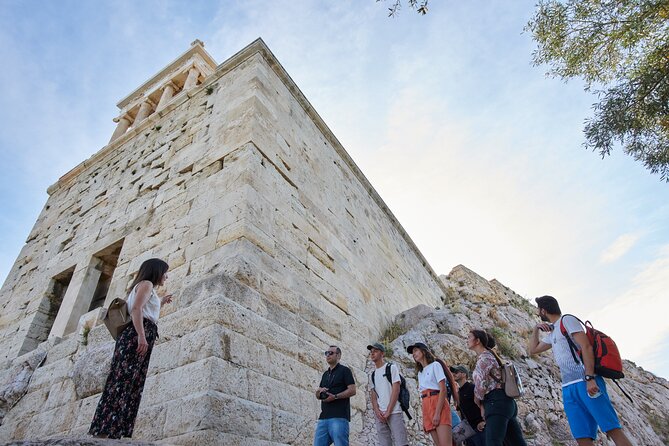
The Acropolis is Athens’ most important ancient site, but timing can shape the whole experience. A midday climb in summer can be tiring, especially on exposed stone with little shade. Starting at 5:30 pm gives you a better chance of more manageable temperatures, while still leaving enough time to see the main buildings.
You should not confuse this with a night tour. The visit begins in the evening, but the information provided does not promise that every monument will be seen after dark. Think of it as a late-day Acropolis tour, with changing light and broad views over Athens.
I also like the rhythm of the visit. The main focus is the Acropolis hill, where you spend about two hours moving among the central monuments. The planned stops are short at some buildings, but the guide can connect them into one clear story: the religious center of ancient Athens, the building program of Perikles, and the city’s lasting symbols.
The route is not a gentle city stroll. You will walk uphill and across uneven rock and marble. One useful practical point is that the incline and stairs are gradual, even if they look more intimidating from below. Good soles matter more than stylish shoes here.
You can also read our reviews of more guided tours in Athens

Meeting at Herodion Hotel at 5:30 pm
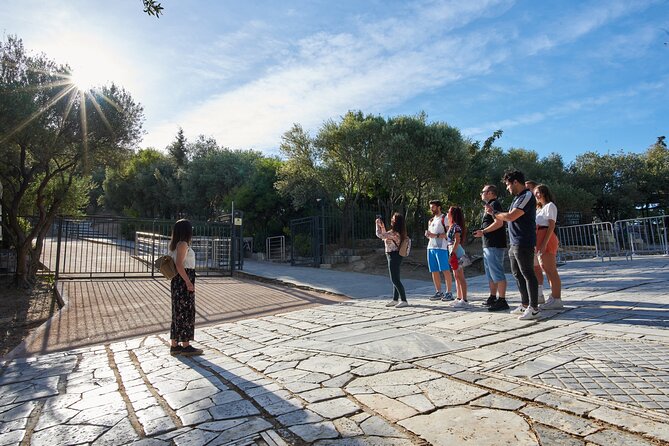
The tour begins at Herodion Hotel, at Rovertou Galli 4 in Athens. You are responsible for reaching the meeting point because hotel pickup and drop-off are not included. The location is near public transportation, which helps if you are staying elsewhere in the city.
Arrive with enough time to find the hotel and gather before the start. The tour ends back at the meeting point, so you will not be left at a different part of Athens at the end of the visit.
A mobile ticket is provided, which is handy for a short activity that does not require you to collect paper documents. Confirmation is received at booking, and the experience is offered in English.
The group limit is 15 people. That is not a private tour, but it is small enough for the guide’s explanations to be easier to hear and for questions to feel practical rather than disruptive. If you prefer complete control over pace and stops, a private visit would suit you better. If you want professional interpretation without paying for a private guide, this format is the middle ground.
Climbing the Acropolis and entering through the Propylaea
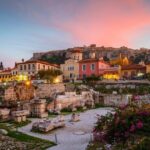
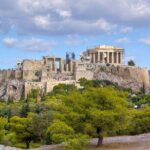
The Acropolis means edge city, and the hill remains exactly that in practical terms: a high rocky platform above Athens. Ancient builders used this commanding position for temples and sanctuaries dedicated to the city’s gods, especially Athena.
Your first important architectural stop is the Propylaea, the monumental gateway to the sacred area. Designed by Mnesicles and built with Pentelic marble, it was not merely a functional entrance. Its scale prepared worshippers for the important buildings beyond it.
The tour allows about 10 minutes for the Propylaea. That is enough for a focused explanation, but not a long architectural study. Your guide can help you notice the bold design and the way the gateway frames your movement onto the hill.
The climb and stone surfaces deserve respect. Wear sneakers or walking shoes with good grip, and avoid treating the route as a place for casual sandals. The ascent is described as gradual, but the footing can still be awkward, particularly on worn marble.
The Temple of Athena Nike on its small bastion
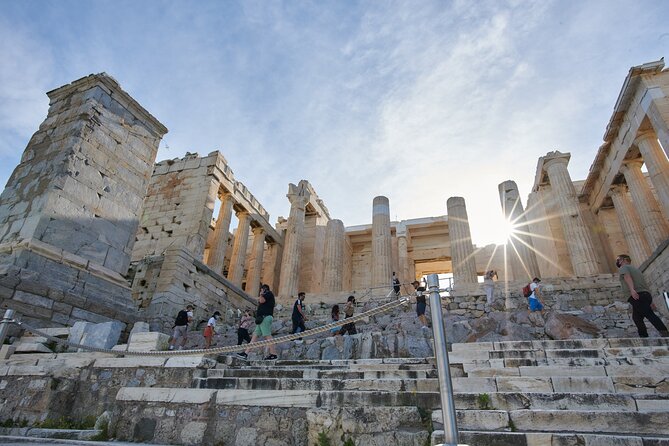
Near the Propylaea, on the southwestern edge of the entrance area, sits the Temple of Athena Nike. The position is part of its appeal. It occupies a bastion above the city, where the small Ionic temple would have been both a sacred building and a visible symbol of protection and victory.
The temple was designed by Kallikrates and built between 426 and 421 BC. Athena Nike represented victory. The name Apteros, meaning wingless, refers to the statue of Athena Nike associated with the temple.
You spend about 10 minutes here. That may sound brief, but the building is compact, and a guide’s explanation helps you understand why this small temple matters despite being overshadowed by the Parthenon nearby.
This is also a good point to take in the views. The tour description emphasizes the city views from the top, and the Temple of Athena Nike’s location makes that elevated setting easy to appreciate. Keep your attention on the ground as well as the skyline, since the stone underfoot remains uneven.
The Parthenon, Athens’ defining monument

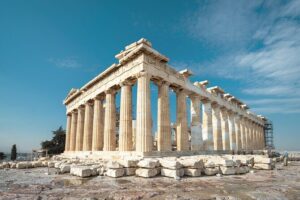
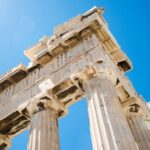
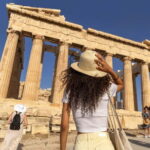
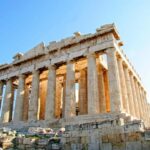
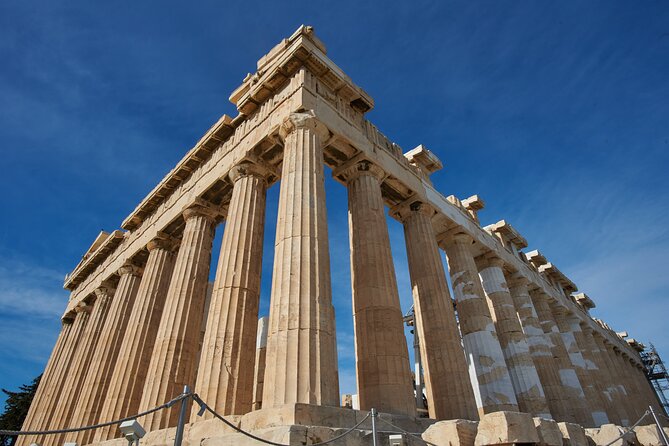
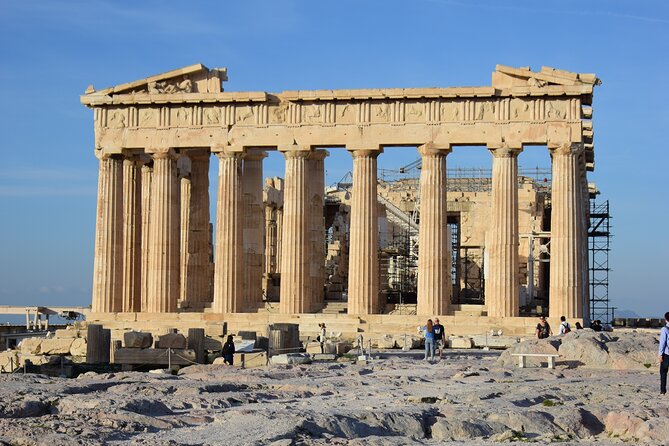
The Parthenon receives the longest dedicated stop, about 30 minutes, and rightly so. Built between 447 and 438 BC during the height of Perikles’ building program, it was dedicated to Athena Parthenos, the patron goddess of Athens.
The temple is built mainly from Pentelic marble in the Doric order. Its outer colonnade has eight columns on each short side and 17 on each long side. Even if architectural terms are not your strength, these proportions help explain why the building feels so balanced from a distance.
A good guide makes the Parthenon more than a famous pile of columns. You can learn how its sculptural decoration combined Doric metopes and triglyphs with an Ionic frieze. The carved scenes represented battles and myths, including the Gigantomachy, Amazonomachy, Centauromachy, and episodes from the Trojan War.
The evening timing is especially useful here. The Parthenon is the stop most people picture when they think of Athens, and the changing light can make its marble easier to appreciate than flat, bright sunlight. You should still expect crowds and movement around such a famous building, but the late start may feel kinder than a visit during the hottest part of the day.
Remember that this is a guided exterior visit to the monument as part of the Acropolis tour. The information provided does not include entry to the Acropolis Museum. If you want to see the original Caryatids and other museum displays, plan that separately.
A few more Athens tours and experiences worth a look



The Erechtheion and the Caryatid porch
The Erechtheion offers a different mood from the broad, powerful form of the Parthenon. Built between 421 and 406 BC, it was associated with Erechtheus, a mythical king of Athens. Its design is more irregular and elegant, shaped by the sacred traditions attached to the site.
The building used Pentelic marble, Eleusinian gray stone for the frieze, and Piraeus stone in its foundations. The mix of materials reflects the care given to the structure, even where much of the detail is easy to miss without explanation.
The site is also linked with the contest between Athena and Poseidon. A stone paving area was believed to preserve marks from Poseidon’s trident, which was said to have struck the ground and produced salt water. Your guide can place this story within the wider religious meaning of the hill.
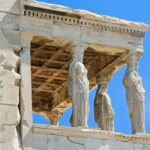
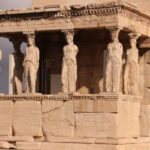
The most recognizable feature is the porch of the Caryatids, where six female figures serve as architectural supports. Five originals are in the Acropolis Museum, and one is in the British Museum. The figures on the building are casts, but the porch remains one of the clearest visual highlights of the visit.
The planned stop lasts about 15 minutes. That is enough to understand the building’s story and examine the porch, though anyone fascinated by ancient sculpture may want extra time at the museum on another visit.
The Theatre of Dionysus below the Sacred Rock
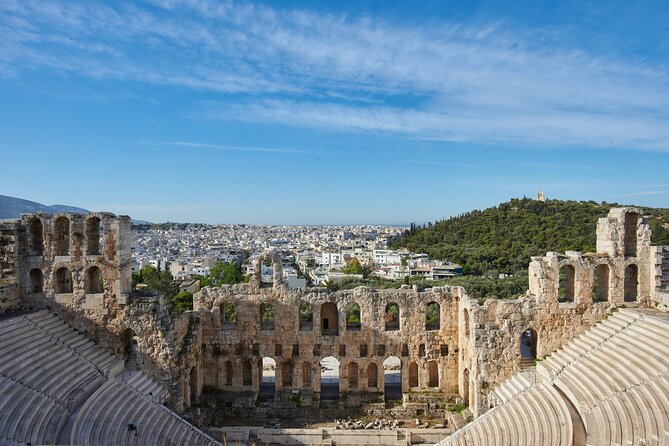
The Theatre of Dionysus sits on the southern slope of the Acropolis. It began as part of the sanctuary of Dionysus Eleuthereus, and its first orchestra terrace was built around the middle to late sixth century BC.
This is where the tour connects architecture with performance. The theatre hosted the City Dionysia, an important festival associated with drama in ancient Athens. Looking down into the seating area gives you a sense of how public performance formed part of civic and religious life.
The visit here lasts about 10 minutes. It is a shorter stop, but it rounds out the tour well. The Acropolis was not only a collection of temples at the summit. Its slopes and surrounding sanctuaries also supported festivals, performances, and public gatherings.
Because the theatre is on the south slope, this part of the route reinforces how much walking is involved. You will want comfortable shoes from the beginning, not just for the climb to the top.
What the $156.20 price includes
At $156.20 per person, this is not a budget Acropolis entry. The value depends on how much help you want with the site.
The price includes:
- A licensed tour guide
- An English-language small-group tour
- Acropolis admission
- Skip-the-line Acropolis access
- A group capped at 15 people
That package removes several tasks. You do not need to buy the ticket separately, search for a guide at the entrance, or build your own explanation of the monuments from scattered signs. For a first visit, the guide can be the difference between recognizing famous buildings and understanding why each one was built.
Still, two hours is a short window for such a major site. You are paying for a concentrated introduction, not an all-day archaeological program. The price is easier to justify if you have limited time in Athens, want an English-speaking professional, and prefer a small group.
It is harder to justify if you mainly want entry and photographs, or if you already know the Acropolis well. Independent visitors may prefer to spend longer at one building and move at their own pace. You also need to budget separately for transportation to the hotel meeting point and for any visit to the Acropolis Museum.
Who should choose this tour
I would recommend this experience to a first-time Athens visitor who wants a clear introduction to the Acropolis without handling every detail alone. The licensed guide, included ticket, and small group keep the visit simple.
It also suits you if summer heat is a concern. The 5:30 pm start avoids the most punishing part of the day, though you should still carry water and expect exposed walking.
The tour works well for people who want the major monuments rather than an exhaustive archaeological study. You see the Propylaea, Athena Nike, Parthenon, Erechtheion, and Theatre of Dionysus in one organized visit.
You may want another option if you need a fully private pace, require hotel pickup, or want substantial time inside the Acropolis Museum. The experience is described as suitable for most people, but uneven rock and marble mean that anyone with serious difficulty walking should assess the route carefully before booking.
Booking details and cancellation
The experience is offered in English and uses a mobile ticket. It is commonly booked well ahead, with an average advance booking period of 82 days, so leaving this until the last moment may be risky during a busy Athens visit.
You can cancel for a full refund if you do so at least 24 hours before the 5:30 pm start time. Cancellations or changes made less than 24 hours before the start are not accepted for a refund, and the cut-off follows local Athens time.
The provider is Olive Sea Travel. The activity has a maximum of 15 participants and ends at Herodion Hotel, the same place where you meet.
Should you book the Acropolis evening tour?
Book it if you want the main Acropolis monuments explained by a licensed guide, prefer a cooler late-day start, and value included admission with skip-the-line access. The strongest feature is the combination of timing and interpretation. You get the famous ruins, the Parthenon, the Caryatid porch, and the theatre without trying to organize the visit on your own.
Think twice if $156.20 feels high for two hours, or if you want to linger independently at each monument. For most first visits, though, the small group and focused route make this a practical way to meet Athens’ defining ancient site, especially when summer heat makes an earlier climb unpleasant.
FAQ
How long does the Acropolis guided tour last?
The tour lasts approximately two hours. The listed stops include the Acropolis hill, Propylaea, Temple of Athena Nike, Parthenon, Erechtheion, and Theatre of Dionysus.
What time and where does the tour begin?
The tour starts at 5:30 pm at Herodion Hotel, Rovertou Galli 4, Athina 117 42, Greece.
Is Acropolis admission included?
Yes. The price includes an Acropolis ticket and skip-the-line Acropolis access.
Is a guide included, and what language is offered?
A licensed tour guide is included. The experience is offered in English.
How large is the group?
The activity has a maximum of 15 participants.
Is hotel pickup included?
No. Hotel pickup and drop-off are not included. The tour begins and ends at Herodion Hotel, and the meeting point is near public transportation.