REVIEW · ATHENS
Acropolis Skip The Line Private Tour with Licensed Expert Guide
Book on Viator →Operated by WARMPENGUIN · Bookable on Viator
Skip the line, then read the stones. This private Acropolis tour is built for first-time visitors who want myths, real context, and clear direction without getting stuck in the crowd. You meet at Makrygianni Street near the Acropolis Metro stop, then your licensed expert guides you from the outer walls into the main monuments.
My favorite parts are the way the guide turns each stop into a story you can actually see, and the photo-friendly pace. At the Theatre of Dionysus you get the scale fast, and at the Parthenon you get an explanation that makes the architecture feel like something you can decode on your own.
One consideration: admission tickets are not included unless you choose the option that includes them, and the hill has lots of steps and uneven ground. If you’re heat-sensitive, plan your timing carefully, or pick the Golden-Light slot when the light softens.
In This Review
- Key highlights at a glance
- Meeting on Makrygianni Street: start fast, start calm
- Skip-the-line and tickets: what’s included and what to budget
- The main route at the Acropolis: a smart order for your first visit
- Stop 1: Acropolis meeting point and the Mycenean wall
- Stop 2: Theatre of Dionysus, one of the world’s oldest theatres
- Stop 3: Propylaea gateway and the legend of Athena’s spear
- Stop 4: Temple of Athena Nike (circa 420 BC)
- Stop 5: Parthenon—architecture, myths, and the point of it all
- Stop 6: Erechtheion and the statues you’re meant to recognize
- Stop 7: Herod Atticus Odeon—still a working theatre
- Finishing inside for views and photos
- Golden-Light option: when timing becomes part of the story
- Tailored 3-hour option: add the museum, Agora, or Plaka
- Why a private guide matters on a crowded hill
- What to wear and bring (so you enjoy it more)
- Price and value: is $188.26 per person worth it?
- Should you book this Acropolis private tour?
- FAQ
- FAQ
- How long is the Acropolis private tour?
- Where do we meet the guide?
- Where does the tour end?
- Is admission included in the price?
- What is the Golden-Light tour?
- What does the Tailored 3-hour tour include?
- Is this a private tour or a group tour?
- Are skip-the-line tickets available if admission is not included?
- Does the tour work for families and mixed ages?
- Can I cancel for a refund?
Key highlights at a glance
- Licensed guide who can enter with you so you’re not stuck explaining ruins to yourself.
- Skip-the-line options available, with admission included only under specific booking choices.
- Golden-Light timing focused on the low-light effects on the Acropolis plateau.
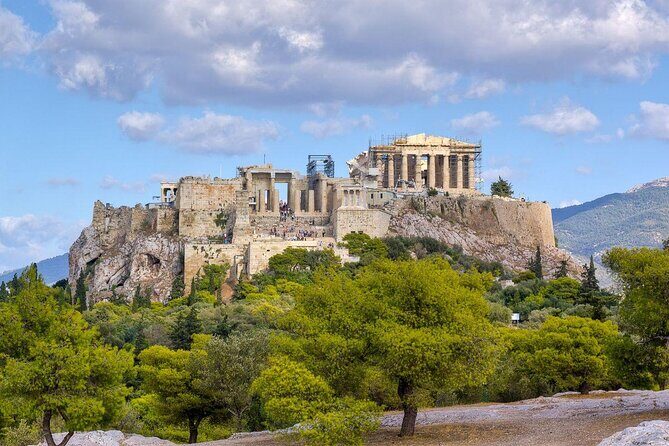
- Well-paced monument route covering Dionysus, Propylaea, Athena Nike, Parthenon, Erechtheion, and Herod Atticus Odeon.
- Private format with space for questions, breaks, and slower walking when needed.
Meeting on Makrygianni Street: start fast, start calm
The tour begins at Makrigianni 7 (Makrigianni Street), near the Acropolis Metro stop, just around the corner from the main entrance. This matters more than you’d think. When you start in the right place, you waste less time hunting, and you arrive at the first viewpoint with momentum.
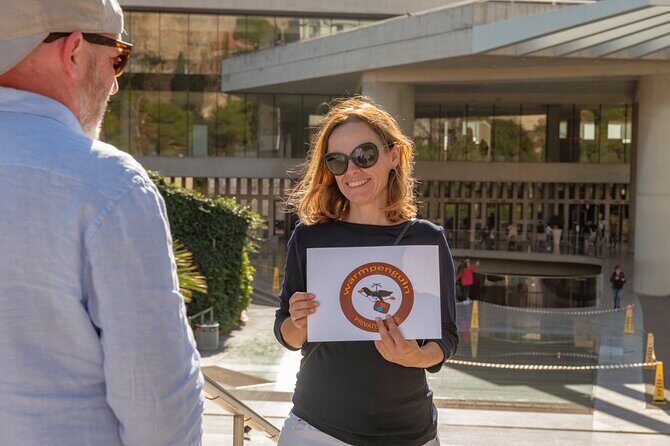
You’ll know your guide is there by a sign with your name, and you’ll get an immediate orientation. That first moment sets the tone: you look out toward the Acropolis wall built by earlier Mycenean civilization and get the big-picture role the Acropolis played in ancient Greek life.
This is also one of those small travel wins that helps later. If you start with a map in your head, the monuments feel like they belong together instead of acting like separate photo stops.
You can also read our reviews of more guided tours in Athens


Skip-the-line and tickets: what’s included and what to budget
This is a private tour, so the value isn’t only speed. It’s also interpretation plus priority access arrangements, so you spend time learning instead of standing.
Here’s the clean rule to follow:
- Admission tickets are included only if you book the Including Admission option.
- If you don’t choose admission-included, you’re still told that skip-the-line tickets can be arranged by request for an extra cost.
The cost for admission mentioned is €35.00 per person when not included. If you’re traveling as a couple or a family, it’s worth checking your exact booking option before you show up, so you’re not doing last-minute math at the gate.
Also keep in mind: a lot of people underestimate how much the Acropolis feels like an all-morning workout. Even with a short route, you’re walking uphill with steps.
The main route at the Acropolis: a smart order for your first visit
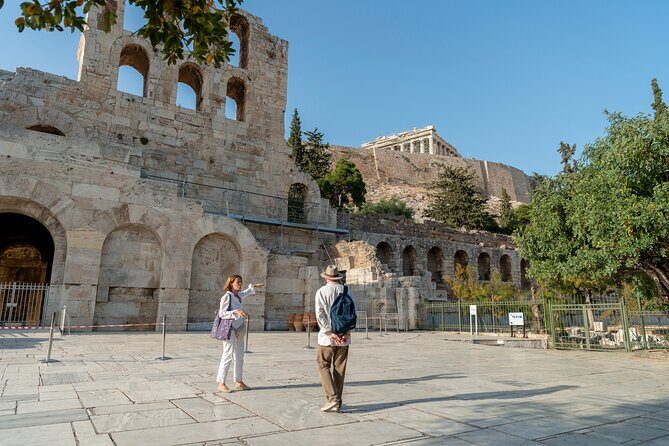
The itinerary is designed like a guided walk through a history lesson you can see with your eyes. You start at the outer viewpoint, then you work your way up toward the gateway and the key temples, finishing near the viewpoints where you can linger for photos.
Along the way, your guide builds connections between sites. That’s the difference between a checklist tour and a memorable one. At each stop you’re not only told what you’re looking at—you’re told what it meant to people then.
Stop 1: Acropolis meeting point and the Mycenean wall
Your guide meets you at Makrygianni Street, where you can get a perspective on the Acropolis wall from earlier Mycenean civilization. This is a strong opener because it frames the hill as a long-term place of power, not just a single “ancient landmark.”
Admission isn’t included at this stop, so think of it as your orientation and mental warm-up.
Stop 2: Theatre of Dionysus, one of the world’s oldest theatres
Next comes the Theatre of Dionysus, set in a natural amphitheater on the slopes of the Acropolis. It was built in the 4th and 5th century BC, and it’s described as the world’s oldest theatre.
The guide usually uses this stop to explain why so many famous Greek plays premiered here. If you care about theatre, politics, or civic life, this is often the moment where the Acropolis stops feeling like stone and starts feeling like a stage.
This stop is short on purpose (about 10 minutes), but it’s a high-impact stop.
You can also read our reviews of more private tours in Athens





Stop 3: Propylaea gateway and the legend of Athena’s spear
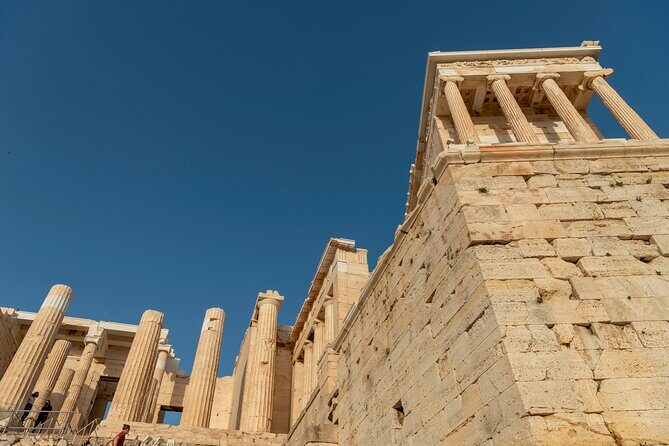
As you ascend, you reach the Propylaea, the monumental gateway into the Acropolis. From here the temples begin to “open up” visually, and your guide points out what the ancient Greeks would have seen first.
The highlight is a legend about an enormous decorated Bronze Statue of Athena. The story says the tip of her upheld spear could be seen by incoming ships in sunlight. Even if you take the legend with a grain of salt, it’s a good way to imagine how monumental and symbolic the site felt from a distance.
Stop 4: Temple of Athena Nike (circa 420 BC)
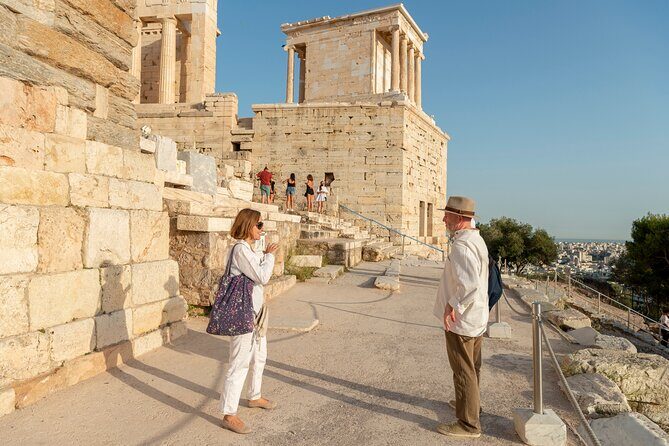
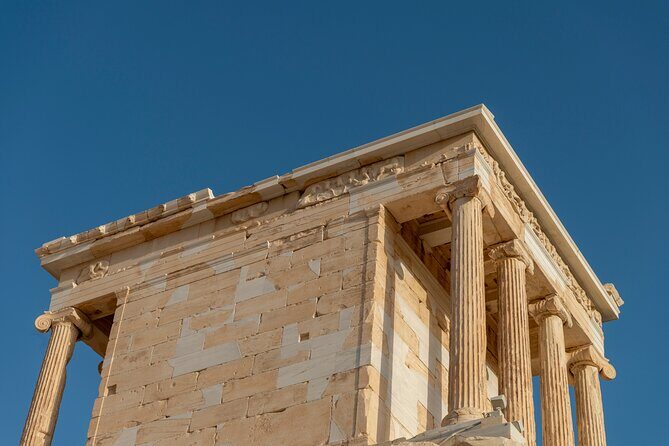
Then you move to the Temple of Athena Nike, described as one of the earliest temples of the Acropolis. Built around 420 BC, it’s a Classical Ionic temple dedicated to Athena and is largely restored.
If you like good skyline views, this is a helpful stop. It’s positioned so you can see the city below while you learn what the temple represented.
Stop 5: Parthenon—architecture, myths, and the point of it all
The Parthenon is the main event, and you’ll spend extra time here. The guide takes time at this most important temple with an overview of construction, mythology, and why it mattered historically.
Even if you’ve seen photos, this is where a guide earns their fee. The building’s details stop looking random once you understand what to notice—how the structure relates to the ceremony and worship happening around it.
Stop 6: Erechtheion and the statues you’re meant to recognize
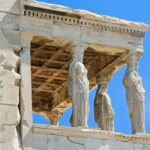
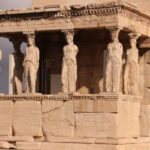
Next is the Erechtheion, dedicated to both Zeus and Athena. It’s described as the second-largest temple of the Acropolis, and it’s tied to mythology.
Your guide points out aspects of the architecture and statues, including what you can connect to what you’re seeing in the museum if you choose the museum option later. This stop is often the “I get it now” moment for people who previously felt the Acropolis was too hard to follow.
Stop 7: Herod Atticus Odeon—still a working theatre
You finish this sequence near the Herod Atticus Odeon, a marble amphitheater built in AD 161 in memory of Herodes Atticus’ wife. It’s described as continuing as a working theater to the present day.
This stop is short, but it’s a great reminder that Greek cultural spaces weren’t only ancient. A place built for public gathering still matters in the modern world.
Finishing inside for views and photos
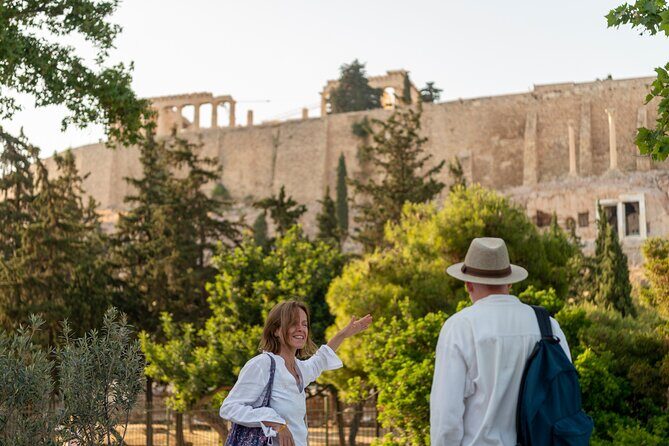
Your tour ends back at the Acropolis area, with your guide leaving you there so you can enjoy the views and take photos. If you choose a tour option that continues to a second site, you’ll stay with your guide and end at that second location instead.
This “let me breathe for a minute” approach is a big deal on the Acropolis. You don’t just get information—you get a chance to use it.
Bring a hat, and plan for bright sun. If you’re going in summer heat, it can get hard fast.
Golden-Light option: when timing becomes part of the story
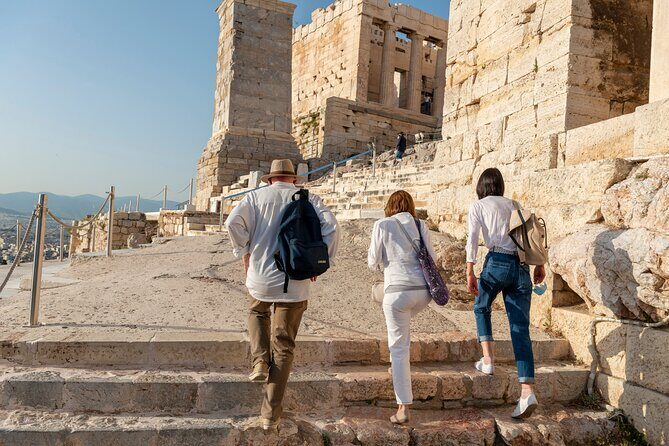
If you pick the Acropolis Golden-Light Tour, your timing shifts toward the low-light special effects on the Acropolis plateau. The description is aimed at the magical effects of the sunrise-sunset type light in the afternoon window.
This is not just a “prettier photos” add-on. Low light can make details easier to see without harsh glare. It also tends to feel less punishing than mid-day sun, especially if your group includes older adults or anyone who needs frequent shade.
From real experiences with guides in this program, the common pattern is smart pacing with shade breaks and hydration pauses. If you’re the kind of person who likes your time to feel comfortable rather than rushed, this option is often the best fit.
Tailored 3-hour option: add the museum, Agora, or Plaka
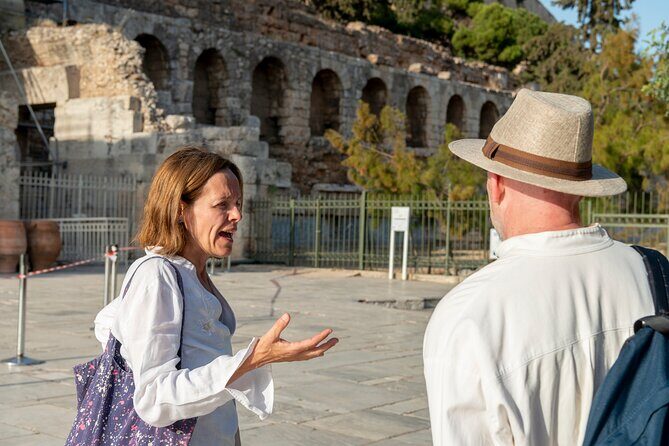
The Acropolis Tailored 3hr Tour is the version for people who hate the idea of stopping too soon. You still get the Acropolis experience, but the guide then adds a second site of your choice—such as the Acropolis Museum, Ancient Agora, or Plaka Neighborhood.
If you don’t send a preference, the default second stop is Plaka. That’s a sensible default because Plaka pairs well with the Acropolis visit. You get a change of pace right after the climb.
This option also helps if you want your photos paired with context you can keep looking at. The Acropolis Museum choice, in particular, often makes the temple stones feel more understandable because you see details up close.
One travel note: more time usually means more steps and more heat exposure. If you’re sensitive to walking uphill, consider choosing a cooler time slot or building in longer breaks.
Why a private guide matters on a crowded hill
The Acropolis is one of those places where crowds can turn a trip into a traffic jam. A private guide helps in practical ways:
- You move at your group’s pace, not a bus schedule.
- You get guidance on where to stand for views without wasting time.
- You can ask questions as you go instead of saving them for later.
In the real-world experiences tied to this tour, guides like Kalliopi (Kali), Vicky, Mondo, Katarina, Rhea, Marrissa, Nicolette, Marina, Amaryllis, and Anna have been described as finding shade, building in hydration breaks, and adjusting to slower walkers with uneven steps.
That flexibility is the biggest reason people feel it’s worth the extra cost. You’re paying to avoid friction.
One more practical thing: the tour uses a whisper communication system for groups of 6 or more. So if you’re in a larger party, you’re less likely to lose the guide’s explanations in the noise.
What to wear and bring (so you enjoy it more)
Because the Acropolis involves uphill walking, steps, and heat, your comfort directly affects your enjoyment.
I’d plan around:
- Water and a small break mindset. Even short pauses help.
- A hat and sunscreen. Light can hit hard, especially when you stop for photos.
- An umbrella if you prefer shade. It’s been specifically recommended with this kind of summer timing.
Also consider your footwear. Uneven stone steps are common, and it’s easier to stay steady if you’re in supportive shoes.
Price and value: is $188.26 per person worth it?
At $188.26 per person, this tour is not budget travel. But it is focused travel.
You’re paying for:
- A licensed official expert who can guide inside the Acropolis experience.
- A private format that saves time and reduces hassle in a chaotic area.
- A route that covers the major monuments in a logical order, so you don’t spend your precious time wandering.
If you pick the option that includes admission, you also avoid an extra ticket step in the middle of your day.
If you’re a first-time visitor, I think this is where private guides pay off most. On your own, you can absolutely see the Parthenon and take photos. But you’ll likely miss the connections between the theatre, the gateway, the temples, and the later Roman-era amphitheater.
If you’re already an archaeology nerd and you don’t need help navigating crowds, you might not feel the same value. For many people, though, the guide turns a steep, tiring walk into something that feels meaningful.
Should you book this Acropolis private tour?
Book it if:
- You’re visiting the Acropolis for the first time and want a clear story, not a pile of unrelated monuments.
- You want a guide who can keep your group moving, answering questions, and adapting to breaks.
- You like the idea of a Golden-Light timing window for better photos and more comfortable walking.
- You’re choosing the tailored 3-hour version and want to connect the hill with the Acropolis Museum, Agora, or Plaka.
Skip it if:
- You’re trying to travel as cheaply as possible and don’t mind doing a self-guided route with your own reading and navigation.
- Your group wants zero walking challenges. Even short segments involve uphill steps.
FAQ
FAQ
How long is the Acropolis private tour?
The tour is listed at about 2 hours, with Acropolis-only options also described as 90-minute guided experiences depending on the booking selection.
Where do we meet the guide?
You meet at Makrigianni 7, Athens, near the Acropolis Metro stop.
Where does the tour end?
The tour ends at the Acropolis so you can continue with photos and views. If you choose an option that goes to a second site, you’ll end there instead.
Is admission included in the price?
Admission is included only if you book the option that explicitly includes admission. For other options, admission tickets are not included.
What is the Golden-Light tour?
The Golden-Light tour is timed toward the low-light special effects on the Acropolis plateau. It’s described as a 90-minute experience focused on those lighting conditions in the afternoon window.
What does the Tailored 3-hour tour include?
It’s described as Acropolis plus another chosen site, such as the Acropolis Museum, Ancient Agora, or Plaka Neighborhood. If no preference is provided, Plaka is the default.
Is this a private tour or a group tour?
It’s private. Only your group participates.
Are skip-the-line tickets available if admission is not included?
Yes. The info states that skip-the-line tickets can still be arranged by request for an extra cost if you do not choose the admission-included option.
Does the tour work for families and mixed ages?
Yes. It’s described as family friendly, with guides experienced with different ages and the ability to adjust pace and engagement.
Can I cancel for a refund?
Yes. Free cancellation is allowed up to 24 hours in advance for a full refund. Changes inside 24 hours of the start time are not accepted.