REVIEW · ATHENS
Athens: Premium Guided E-Scooter Tour in Acropolis Area
Book on Viator →Operated by parthenons scooters and tours · Bookable on Viator
A scooter can change how fast you grasp Athens. This premium guided ride packs major Acropolis-area sights into about two hours, with small-group attention and story-led stops. Just know the route stays tight around the center, so the scooter time can feel like part sightseeing, part rolling between points.
I love that the guide doesn’t just point, they explain. On tours led by guides like Michael Angelo (and sometimes Theo or Spano), you get practical context at each stop, which makes the statues and stones start to make sense. One possible drawback: if you expect a long, uninterrupted scooter cruise, you might feel it’s more stop-and-go than a ride-only experience.
In This Review
- Key highlights you’ll actually feel
- Why an Acropolis-area e-scooter tour works in Athens
- Meet-up, timing, and that pre-ride safety briefing
- Herod Atticus Odeon: Roman theater you can almost hear
- Philopappos Hill and the views that frame the whole city
- Pnyx: where early democracy happened in open air
- National Observatory: the science story after the classics
- Dionysiou Areopagitou Street: a pedestrian spine near the Acropolis
- Temple of Olympian Zeus and Hadrian’s Gate: the grand finale
- How long you really ride: scooters vs. sightseeing
- Who this tour suits best (and who should skip it)
- Price and value: what $53.21 buys you
- Should you book this Athens e-scooter tour?
- FAQ
- How long is the e-scooter tour?
- What is the price per person?
- What language is the tour offered in?
- Where do we meet, and does the tour end nearby?
- Is there a mobile ticket?
- Do I need to pay admission fees for the stops?
- Can I participate if I cannot ride the scooter?
- What is the maximum group size?
- Are there age limits for riding?
- What happens if the weather is bad?
Key highlights you’ll actually feel
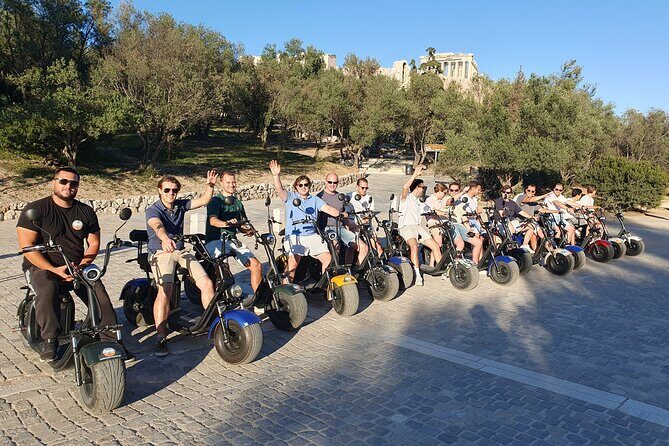
- Small group size (max 16) with a mix of drivers and passengers, so the guide can keep an eye on everyone.
- Acropolis-area focus: you see Odeon, Pnyx, Olympieion, Hadrian’s Gate, and more without crisscrossing the city.
- Stop-and-photo timing built into the route, so you can actually look, not just pass by.
- Pedestrianized street time on Dionysiou Areopagitou Street near the Acropolis.
- Brief training before departure to get you confident and safe on the scooter.
- Free admission stops listed for the sites on the itinerary.
Why an Acropolis-area e-scooter tour works in Athens
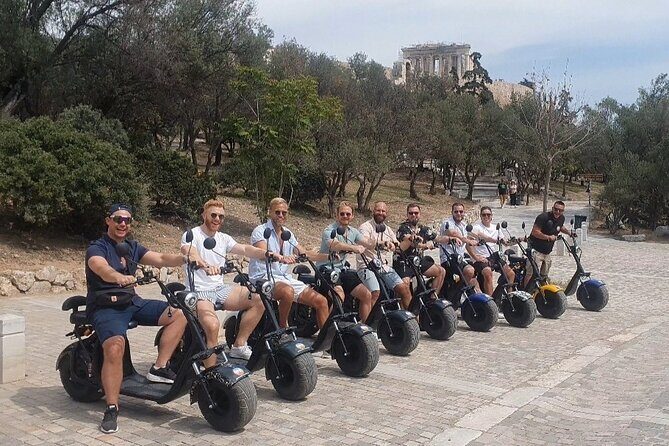
Athens is layered. You’ll see Roman theater, ancient assembly grounds, big imperial temples, and Byzantine-era Christian details all within a short radius. Walking the loop is totally doable, but it takes more time, and you’ll miss some viewpoints if your legs get tired. On an e-scooter tour like this, you get moving without the stress of navigating traffic or finding parking.
The second win is the guide’s pacing. You’re not just zipping between monuments. You stop long enough to orient yourself, take photos, and hear what matters at each place—like why the Pnyx is tied to early democratic gatherings, or what makes Herodes Atticus Odeon important even though it’s now an archaeological landmark.
The trade-off is mental: this is a concentrated, classic Acropolis crawl. It’s not trying to cover all of Athens. If your goal is maximum geographic coverage across the whole city, you may feel the “where” list is short.
You can also read our reviews of more guided tours in Athens



Meet-up, timing, and that pre-ride safety briefing
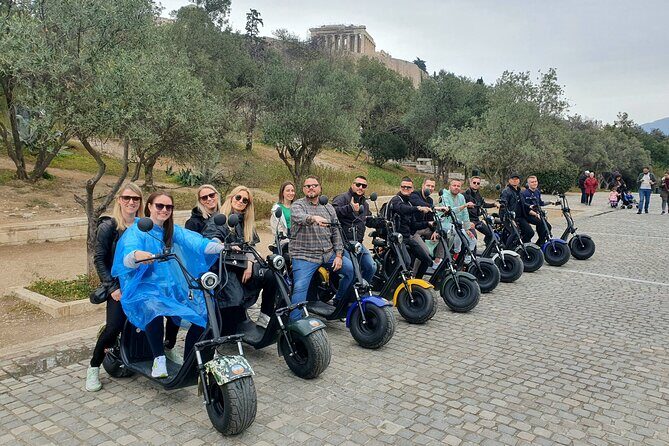
You meet at GetYourTours Athens, Kavalloti 16, Athina 117 42. The tour ends back at the same meeting point. It’s near public transportation, which is handy if you’re pairing it with other plans around Plaka or the Acropolis area.
Timeliness matters here. The group sets off promptly at the designated time, and the scooters are part of a managed flow. Before you ride, there’s a short training session. It’s not there to test you; it’s there so everyone understands the rules and can stay in formation.
If you’re a first-timer, that training is a big deal. Multiple people note the scooters feel manageable once you’re guided through it. If you’re unsure about balance or you can’t ride a bike, you’ll need to plan for the tour as a passenger option (when you’re eligible), not a self-driven ride.
Herod Atticus Odeon: Roman theater you can almost hear
Your first stop is Herod Atticus Odeon, a stone Roman theater on the southwest slope of the Acropolis. The building was completed in AD 161 and renovated in 1950. Even if you never plan to attend a performance here, it’s worth understanding the sheer scale and intention behind the place.
What makes this stop work on a scooter tour is the quick context. The Acropolis area can feel like one big pile of ruins until someone explains the “why now.” At Odeon, you’ll get the story of Roman monumental building sitting in the shadow of earlier Greek power.
This stop is about orientation and first impressions. You get around 20 minutes, with time to look and photos to capture the theater’s relationship to the Acropolis slope. The only real drawback is that if you love long, quiet museum-style time, the stop length will feel short. Here it’s about getting moving again while the information is fresh.
Philopappos Hill and the views that frame the whole city

Next up is Philopappos (Filopappou) Hill, a green promenade southwest of the Acropolis. This is one of those Athens stops where the city layout becomes part of the lesson. From here, you can see the Acropolis, the wider city, and the Aegean Sea out beyond Attica.
The other reason people like this stop: it’s a viewpoints-and-stories combo. In addition to the panorama, you’ll reach areas linked to the tradition of Socrates’ prison and Loumbardiari’s church (both mentioned as part of what you’ll encounter while you’re in this area). That mix matters because Athens isn’t only “ancient Greece.” It’s also layers of later belief and memory tied to specific spots.
On an e-scooter tour, you should expect some walking at viewpoints. It’s not an exhausting hike, but it’s enough to break up the ride and let your eyes reset. If you have mobility limits, think in terms of “short distances with frequent stops,” not continuous cruising.
Pnyx: where early democracy happened in open air

Then you’ll head to Pnyx, a hill in central Athens where citizens gathered for popular assemblies as early as 507 BC. This is one of the earliest key places tied to the creation of democracy. It’s the kind of site where the landscape itself is part of the political stage.
What I like about this stop is how it turns ruins into a concept. If you’ve only seen democracy as a word in a textbook, Pnyx helps you picture the setting: people outdoors, speaking into a shared space, with the Acropolis area as the backdrop.
The time here is about 20 minutes, which is enough to get the main idea and take a few photos from angles that help you understand the slope. If the wind is up or you’re sensitive to sun, plan for that. Hills are hills, even when the stops are short.
A few more Athens tours and experiences worth a look




National Observatory: the science story after the classics

After the political hill, the route shifts gears with a stop at the National Observatory of Athens. It’s a research institute founded in 1842, and it’s described as Greece’s oldest research foundation. It was also the first scientific research institute built after Greece became independent in 1829.
This is a smart inclusion because it reminds you that Athens didn’t stop at antiquity. A guided tour can easily stay stuck in ancient-only mode. Here, you’re given a quick “Athens keeps thinking” note—science, institutions, and the modern country building itself after independence.
This stop is also 20 minutes, so you won’t get a deep technical lecture. But you will get the historical framing that makes the city feel bigger than one era. For some people, this is the surprise highlight.
Dionysiou Areopagitou Street: a pedestrian spine near the Acropolis
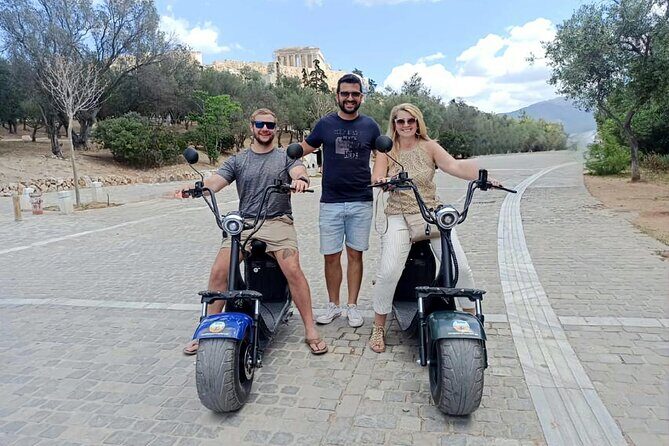
One of the most practical parts of this tour is your time on Dionysiou Areopagitou Street, a pedestrian zone adjacent to the south slope of the Acropolis in the Makrygianni district. The street runs east to west, starting near Amalias Avenue by the Arch of Hadrian, and continuing toward Philopappos Hill where it becomes Apostolou Pavlou Avenue.
This isn’t just a nice walk. It’s the kind of street where scooters fit the vibe—low-stress movement in an area meant for people. The street has a long planning story too: it was mapped in 1857 in a slightly more northern position, redesigned in 1955 by architect Dimitris Pikionis (who also designed paved paths in the archaeological site), and finally pedestrianized in 2003.
So you get two benefits: you move through the Acropolis area in a way that feels calmer, and you hear why these paths look the way they do. It also helps you connect the dots between stops instead of treating them like separate postcards.
Temple of Olympian Zeus and Hadrian’s Gate: the grand finale

You’ll finish with two big, iconic monuments: the Temple of Olympian Zeus and Hadrian’s Gate (Arch of Hadrian).
The Temple of Olympian Zeus—also called the Olympieion or the Columns of the Olympian Zeus—is a former colossal temple at the center of Athens. It was dedicated to Olympian Zeus, with the name tied to Zeus’s role as head of the Olympian gods. Even in ruins, it hits like a megaproject.
Then comes Hadrian’s Gate, a monumental gateway resembling a Roman triumphal arch. It spanned an ancient road from central Athens to the eastern complex that included the temple. It’s the kind of structure that makes you understand how roads and power networks shaped the city.
Both stops are about 20 minutes, and you’ll have time to view and photograph. The value here is that your guide can connect these final monuments to what you saw earlier—how Greeks and Romans used scale and space, and how the Acropolis neighborhood remained a focal point.
How long you really ride: scooters vs. sightseeing
The total tour time is about 2 hours. That includes training, transitions, and stops where you park the scooter, listen, and take pictures. Each listed stop is around 20 minutes, so you’ll feel the rhythm: arrive, orient, hear the story, look around, then roll to the next point.
If you want a lot of constant motion, you may find the ride time is shorter than you imagined. The scooter portion is usually what makes the experience fun, but it’s not designed as a long-distance ride through open roads. Think of it as a way to cover a tight loop efficiently.
On the other hand, that stop structure is also the reason people come away feeling like they saw more than they could on foot in the same time window. You’re not just moving fast; you’re learning fast.
Who this tour suits best (and who should skip it)
This tour works best if you’re comfortable with the idea of short walking segments and concentrated sightseeing. It’s also a good fit if you love history but you don’t want to spend a whole day hopping between sites independently.
You should also pay attention to the participation rules:
- Most travelers can participate.
- If you can’t ride, you may be able to join as a passenger, but there’s no refund for non-participation and no participation if you’re unable to ride at all.
- Children under 6 can’t participate.
- Children under 15 must sit on the backseat.
- People over 80 can’t participate.
- Those with recent surgeries or those who can’t ride a bike are listed as not able to join.
One more practical note: the tour tops out at 16 travelers, and for larger bookings it’s set up with 8 drivers and 8 passengers. That keeps the group manageable and supports safety.
If you have mobility issues, people like this format because it reduces walking. But if you’re looking for a quiet, low-stimulation walk-only experience, this may feel too structured.
Price and value: what $53.21 buys you
At $53.21 per person for about 2 hours, you’re paying for more than the scooter. You’re buying:
- a guided route with context at each monument,
- safety management (including the pre-ride training),
- time saved versus walking long distances between scattered viewpoints.
The good news is that the sites on the itinerary list free admission for the stops described. So your money mainly supports the guide and the equipment rather than entrance fees.
Value will come down to your expectations. If you want a lot of story for a limited amount of time, this price often feels reasonable. If you expected a longer ride with fewer stops, it may feel expensive for how tightly the route is managed around the Acropolis zone.
Should you book this Athens e-scooter tour?
Book it if you want a fast, guided way to understand the Acropolis neighborhood in one morning or early window, and you like being guided rather than figuring it out alone. It’s especially appealing if you want movement without the stress of navigating the area yourself.
Skip it if you’re chasing maximum coverage across all of Athens, or if you’re hoping for a long, uninterrupted scooter cruise. Also skip if you fall into the rider restrictions listed for age, recent surgeries, or inability to ride at all.
If you’re deciding between booking and holding out for a walking-only day, my advice is simple: choose this if you want both views and explanations packaged into a manageable 2-hour loop.
FAQ
How long is the e-scooter tour?
It runs about 2 hours (approximately), including training and stops.
What is the price per person?
The price is $53.21 per person.
What language is the tour offered in?
The tour is offered in English.
Where do we meet, and does the tour end nearby?
You meet at GetYourTours Athens, Kavalloti 16, Athina 117 42, Greece, and the tour ends back at the same meeting point.
Is there a mobile ticket?
Yes, you receive a mobile ticket.
Do I need to pay admission fees for the stops?
The stops listed on the itinerary show admission ticket free.
Can I participate if I cannot ride the scooter?
For those unable to ride, you can join as a passenger. Non-participation and people unable to ride at all are not eligible for refunds.
What is the maximum group size?
The maximum is 16 travelers.
Are there age limits for riding?
Children under 6 can’t participate. Children under 15 must sit on the backseat.
What happens if the weather is bad?
The experience requires good weather. If it’s canceled due to poor weather, you’ll be offered a different date or a full refund.