REVIEW · ATHENS
Corinth Canal, Corinth, Mycenae & Nafplion Argolis Tour
Book on GetYourGuide →Operated by Enjoy Greece tours · Bookable on GetYourGuide
The most striking part of this day is how much of the Peloponnese you can cover from Athens. In nine hours, you cross the Corinth Canal, walk among the ruins of Ancient Corinth, enter the royal world of Mycenae, and finish in Nafplion, Greece’s first modern capital.
I like the private format, especially for a group of up to seven, and I like the mix of major archaeological sites with time for lunch and local shopping. George, Dimitri, and Andrew have all been praised for being punctual, friendly, funny, and helpful with restaurant suggestions. The main drawback is the pace: this is a long driving day, and your driver is not permitted to enter Corinth or Acrocorinth as an official guide.
In This Review
- Key points to know
- A full Peloponnese day from Athens
- Crossing the Corinth Canal
- Ancient Corinth and the world of St. Paul
- Mycenae, the city of Agamemnon
- Nafplion, Greece’s first modern capital
- What the private driver service adds
- Is $707 good value?
- Timing, comfort, and the right expectations
- Who should book this tour?
- Should you book the Corinth and Argolis tour?
- FAQ
- How long is the tour?
- What places does the tour visit?
- Is this a private tour?
- Is hotel pickup included?
- Are entrance tickets and lunch included?
- Is the driver a licensed guide inside the archaeological sites?
Key points to know
- The Corinth Canal opens the day: Stop above the narrow waterway for photos and a short break.
- Ancient Corinth adds biblical and classical interest: See Greek and Roman remains, the museum, and the church connected with St. Paul.
- Mycenae brings the heroic age to life: Visit the Lion Gate, royal burial tombs, Cyclopean walls, and Treasury of Atreus.
- Nafplion gives the day breathing room: Walk the old streets, view Palamidi and Bourtzi, and eat at a traditional restaurant.
- Private transport keeps the group together: The vehicle, hotel pickup, drop-off, and tolls are included for up to seven people.
- Budget for extras: Food, drinks, and entrance tickets are not included, and the driver provides English commentary rather than licensed guiding inside the sites.
A full Peloponnese day from Athens
This tour is built for people who want the big Argolis sights without changing hotels. You leave Athens early, follow the coastal road toward the Peloponnese, and spend the day moving between ancient monuments and a handsome seaside town.
The route is ambitious. Nine hours sounds generous until you count the drive from Athens, stops at four separate destinations, meals, photographs, and the return trip. I would treat this as an efficient overview rather than a slow archaeological study. You get a strong first look at the region, but you will need to keep an eye on the clock.
A private vehicle makes a difference. Your group does not have to meet strangers at a central departure point, and a party of four to seven can find the $707 group price reasonable when divided among everyone. For one or two people, the cost is harder to justify unless the flexibility and private setting matter more than saving money.
You can also read our reviews of more tours and experiences in Athens.
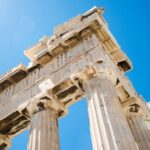

Crossing the Corinth Canal
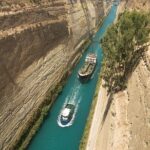
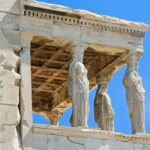
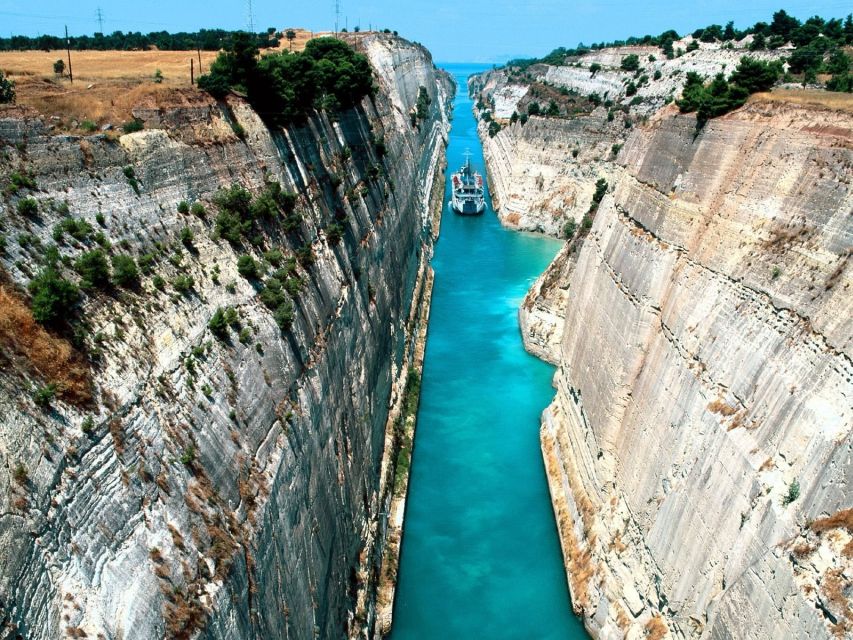
The first major stop is the Corinth Canal, cut through the Isthmus of Corinth. It links the Saronic Gulf with the Gulf of Corinth, turning a centuries-old dream into a working waterway when the canal opened in 1893.
From above, the canal is the star. The cut is narrow and dramatic, with steep sides dropping toward the water. This is a short stop, but it is well placed after the early drive. You can stretch your legs, take photographs, and get your first sense that you have left the Athens area behind.
Do not expect a long boat trip or a full canal excursion. The experience here is a scenic viewpoint and rest stop. That suits the itinerary because the day has more substantial ancient sites ahead.
Your driver can also explain the canal’s place in Greek engineering and regional trade. George has been praised for giving useful background at this stop, while Dimitri was particularly good at timing arrivals to avoid crowds. That timing can matter at popular photo points, though conditions will vary by date.
Ancient Corinth and the world of St. Paul
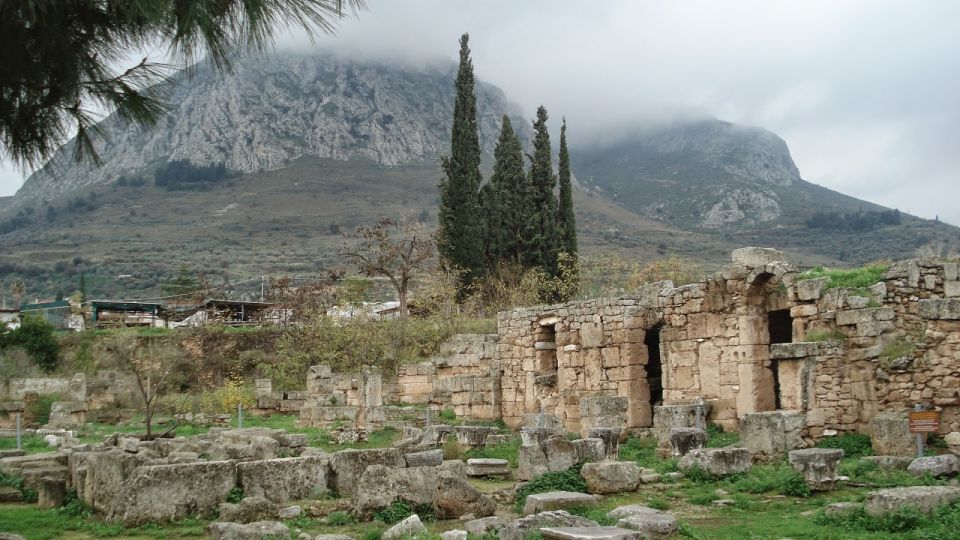
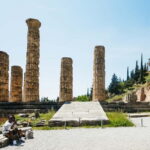
From the canal, you continue to Ancient Corinth. In antiquity, Corinth was one of the most important city-states in Greece, known for wealth, trade, and its port. The site also carries strong Christian importance because St. Paul lived and worked here for nearly two years.
The archaeological area lets you see layers of Greek and Roman Corinth in one place. You can visit the ruins and museum, and the nearby church has the First Letter to the Corinthians displayed in Greek, Arabic, French, and English. That gives the stop an accessible human connection, even if you are not an archaeology specialist.
I find Ancient Corinth valuable because it is not just a collection of broken stones. Its position helps explain why the city mattered. The canal did not exist in the ancient period, but the same narrow crossing between mainland Greece and the Peloponnese helped make Corinth an important point for movement and trade.
Allow enough time to examine the site rather than rushing straight to photographs. The ground can be uneven, and the open-air setting means you should be prepared for sun. Exact time at the ruins depends on the day’s schedule, so ask your driver how long you have before entering.
One important limitation deserves plain wording: the driver is not allowed to enter Corinth or Acrocorinth as a licensed guide. You will receive information during the drive and at the stops, but you should not expect a formal guided walk through every monument. If detailed archaeology is your main reason for coming, consider arranging a licensed guide separately.
Acrocorinth appears in the strongest advice about this area, but the stated route centers on Ancient Corinth. Confirm the exact site access and timing before booking if the hilltop fortress is essential to you.
Mycenae, the city of Agamemnon
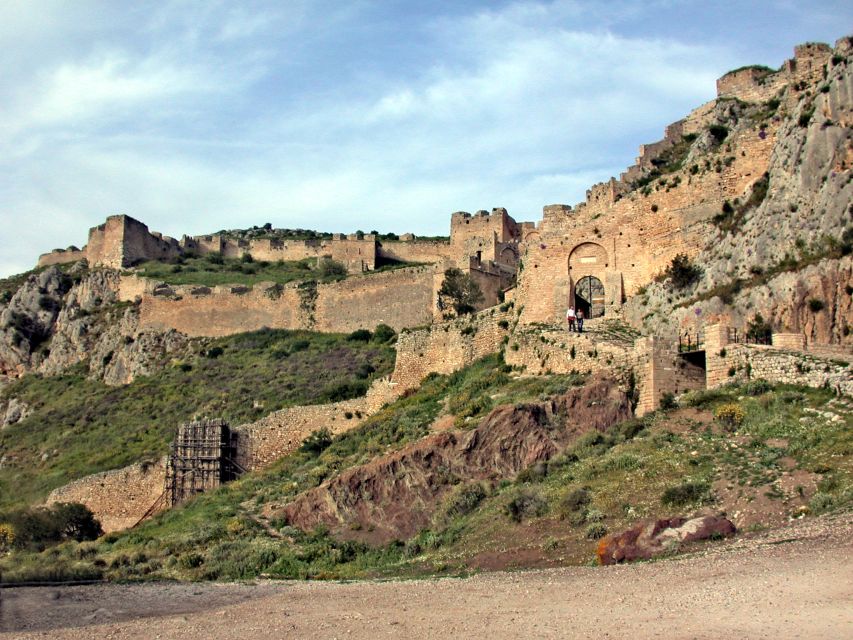
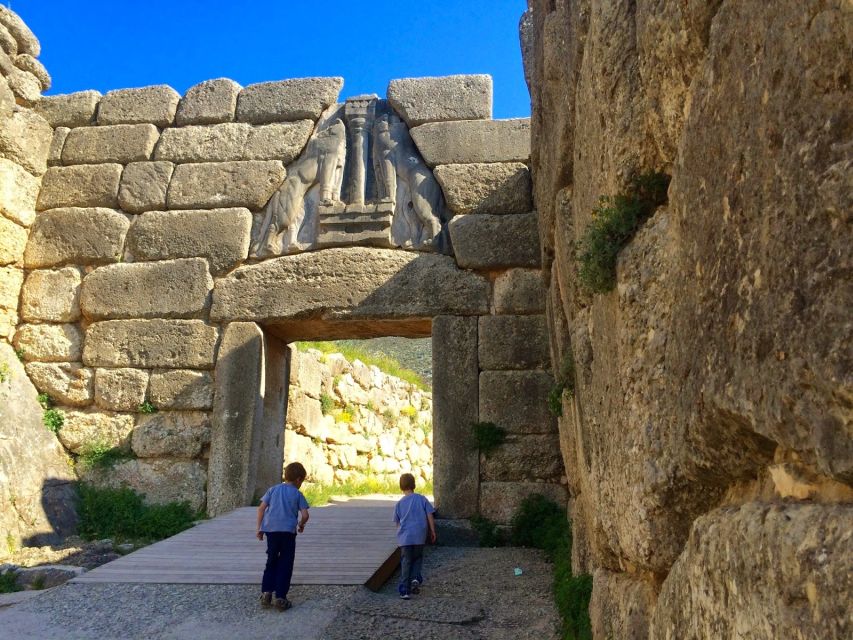
The road then leads to Mycenae, the ancient center linked with King Agamemnon and the Mycenaean civilization. Greek legend places Agamemnon at the head of the forces that fought Troy, while archaeology shows Mycenae as a powerful Bronze Age center.
The entrance is one of the most memorable sights in the Argolis: the Lion Gate, built into massive Cyclopean walls. The later name reflects the ancient masonry’s huge scale. Greek myths credited such walls to Cyclopes because ordinary people supposedly could not have moved the stones.
Inside the site, you can visit the royal burial tombs and see the remains of the citadel. The Treasury of Atreus, also called the Tomb of Agamemnon, is another key stop. Its carefully built beehive-shaped interior gives you a better sense of Mycenaean engineering than a simple look at the ruins from the road.
Mycenae is the most demanding archaeological stop on this route in terms of attention. It rewards you if you know the basic story before arriving. I suggest learning the difference between the historical Bronze Age city and the later legends around Agamemnon, then using the visit to connect the two.
The site is also exposed, and the tour schedule remains tight. You will not have endless time to wander every path. Still, Mycenae is too important to skip if you are making the long trip into the Argolis. The Lion Gate, walls, tombs, and citadel give the stop a clear shape even during a relatively short visit.
Nafplion, Greece’s first modern capital
Nafplion changes the rhythm of the day. After two major ancient sites, you reach a seaside town with old houses, local shops, harbor views, and a strong food culture. Nafplion served as the first modern capital of Greece from 1821 to 1834.
You can see Palamidi Castle above the town and Bourtzi, the island fortress that guarded the harbor. The route does not promise a full climb to Palamidi or a boat ride to Bourtzi, so think of these as sights to view rather than guaranteed interior visits.
This is the best place to slow down. Walk through the old streets, browse handmade objects and jewelry, and choose a traditional restaurant or taverna for lunch. Food and drinks are not included, so you can select what suits your budget and appetite.
A good restaurant recommendation can save time on a day like this. George directed one group to a well-regarded lunch spot, and the timing worked so well that the restaurant filled soon after they left. That is useful practical help, but you should still confirm the plan with your own driver because restaurants and crowd levels change.
Nafplion is also where you can add a little spontaneity. You might prefer a long meal, a short walk, or shopping for a small handmade item. The tradeoff is that a relaxed lunch reduces time elsewhere, and the return drive to Athens still has to happen.


What the private driver service adds
The tour includes hotel pickup and drop-off, round-trip transport, and toll fees. You avoid the work of navigating out of Athens, finding parking near several separate sites, and piecing together public transport connections across the Peloponnese.
Your driver speaks English. George has been described as humorous, hospitable, and careful with the route. Dimitri was praised for matching arrival times with quieter periods, while Andrew was noted for being accommodating and good fun. These details matter because the driver shapes the day, especially when the itinerary has several moving parts.
Still, keep the role clear. This is private transportation with historical commentary, not a full private guiding service inside every archaeological site. One past visitor specifically noted that Dimitris could not enter Acrocorinth and Corinth because he was not a guide. That is not a criticism of the transport arrangement, but it is an important expectation to set.
The private group size is up to seven people. That works well for families and friend groups who want to share the cost. It also allows the driver to keep the day more personal than a large coach tour, though the route itself remains fairly fixed because so much ground is covered.
Is $707 good value?
At $707 per group, the price is easiest to assess by group size. Seven people pay about $101 each before entrance fees, meals, and drinks. Four people pay about $177 each, while two people pay about $354 each.
For a larger group, the included vehicle, hotel transfers, tolls, and private arrangement offer solid value. You are paying for a full day of transport to places that are spread across the Argolis, not just for admission to one monument.
For a couple, the calculation is less favorable. A shared tour or public transport could cost less, but it would not provide the same private setting or direct hotel pickup. The value improves if you care about keeping your own group together, avoiding navigation, and receiving route advice from an English-speaking driver.
Remember to add entrance tickets and lunch to your budget. Since those costs are excluded, the advertised price is not the final cost of the day. The advantage is that you retain control over your meal choices rather than paying for a fixed package.
Timing, comfort, and the right expectations
The early start is necessary. Corinth, Mycenae, and Nafplion are not clustered beside Athens, and the return journey comes after a full day outside the capital. I would not book this on the same evening as an important late-night plan.
The route mixes sitting in the vehicle with outdoor walking. You get breaks at the canal, Ancient Corinth, Mycenae, and Nafplion, but this is not a restful beach day. The most relaxed stretch is likely lunch and the walk through Nafplion.
The schedule can work impressively well when the driver manages it carefully. One group described the trip as relaxing despite seeing many sights, partly because Dimitri timed stops to avoid crowds. That kind of judgment is one of the main benefits of a private departure.
At the same time, no driver can control every delay. A slow lunch, heavier traffic, or a crowded monument can shorten later stops. If you want to study each museum object or spend hours inside a castle, choose a slower multi-day plan instead.
Who should book this tour?
I would recommend it to a group that wants a broad introduction to the Peloponnese from Athens. It suits families, friends, and first-time visitors who want ancient monuments, Christian history, coastal scenery, and a pleasant town in one day.
It is also a good choice if you prefer having a driver rather than renting a car. You can watch the scenery, ask questions, and leave tolls and route planning to someone else.
I would be more cautious if you are a serious archaeology fan who wants long, detailed visits. The driver can explain the route, but site guiding is limited, and the nine-hour schedule asks you to keep moving. For that kind of trip, spend more time in Mycenae and Corinth, possibly with a licensed guide.
The cancellation policy adds useful flexibility: you can cancel up to 24 hours in advance for a full refund, and you can reserve now and pay later. Those terms are helpful, but the central decision is still the pace. You are choosing breadth and convenience over a slow examination of each place.
Should you book the Corinth and Argolis tour?
Book it if you want the best-known Argolis sights in one private day and your group can share the cost. The combination of the Corinth Canal, Ancient Corinth, Mycenae, and Nafplion is varied enough to keep the route interesting, and the drivers’ punctuality and restaurant advice can make a demanding day easier.
Skip it if you dislike long drives, need extensive time at archaeological sites, or require a licensed guide at every stop. For everyone else, this is a practical way to see far beyond Athens without managing the road yourself. Just budget for tickets and lunch, confirm the exact site timing, and treat Nafplion as your chance to slow the pace before returning to the city.
FAQ
How long is the tour?
The tour lasts nine hours, including transportation from Athens, the visits in the Argolis, and the return journey.
What places does the tour visit?
The route includes the Corinth Canal, Ancient Corinth, Mycenae, and Nafplion. At Mycenae, the planned sights include the Lion Gate, royal burial tombs, Cyclopean walls, and the Treasury of Atreus.
Is this a private tour?
Yes. It is designed for a private group of up to seven people.
Is hotel pickup included?
Yes. Hotel pickup and drop-off in Athens are included, along with round-trip transportation and toll fees.
Are entrance tickets and lunch included?
No. Entry tickets to attractions, food, and drinks are not included in the price.
Is the driver a licensed guide inside the archaeological sites?
The driver speaks English and provides information during the route, but the driver is not permitted to enter Corinth or Acrocorinth as an official guide.