REVIEW · THESSALONIKI
Full-Day Meteora Tour from Thessaloniki by Train
Book on Viator →Operated by Visit Meteora · Bookable on Viator
Meteora is the reason to take this trip: six centuries of Orthodox monasteries cling to tall gray rocks above the Thessalian plain. From Thessaloniki, this tour combines the long train ride with a Mercedes van, an English-speaking guide, and visits to three working monasteries. I especially like the chance to see Great Meteoron and Varlaam, the two largest foundations, and the quieter Badovas hermit caves. The main drawback is the schedule: you spend many hours on trains, and Greek rail connections can run late.
I also like that the route includes several kinds of Meteora scenery, from Kastraki’s village streets to sweeping views from the cliffs. Guides such as Katerina, Ava, Demetrios, and Vasilios have been praised for their personal stories and clear explanations. Bring patience for the train changes, modest clothing for the monasteries, and energy for the stairs.
In This Review
- Key points to know before booking
- Why Meteora is worth the long ride from Thessaloniki
- The train journey and the Paleofarsalos connection
- Meeting the van in Kalambaka
- Kastraki and the first views of the rocks
- Saint Nicholas of Anapafsas and Roussanou
- Great Meteoron, the largest monastery
- Varlaam and its remarkable wall paintings
- Holy Trinity and Agios Stefanos
- Badovas hermit caves and the best photo stops
- What the $59 price really covers
- Clothing, stairs, and the pace of the day
- Who should book this day trip
- Should you book the Meteora train tour?
- FAQ
- How long is the Meteora tour from Thessaloniki?
- Is train transportation included?
- Is lunch included?
- How many monasteries will I visit?
- How much do monastery entrance fees cost?
- Is the tour suitable for someone who cannot climb many stairs?
- What clothing is required?
- What happens if the train is delayed?
Key points to know before booking
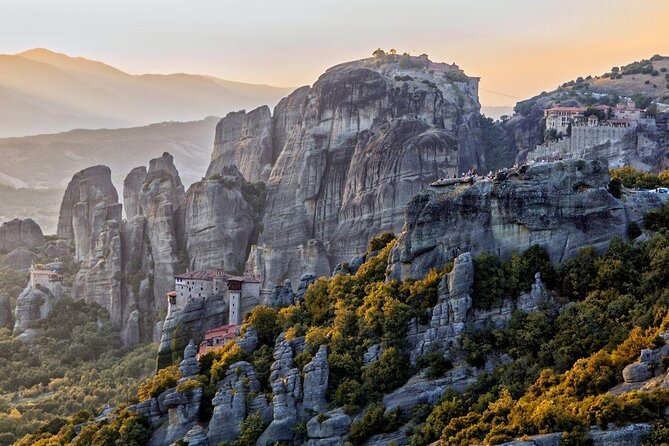
- Three active monasteries: The route can include Saint Nicholas of Anapafsas, Roussanou, Great Meteoron, Varlaam, Holy Trinity, and Agios Stefanos, with three monasteries visited during the day.
- A long rail day: You leave Thessaloniki at about 8:15 a.m., change trains at Paleofarsalos, and return in the evening.
- Strong local guiding: Guides including Katerina and Ava have been praised for monastery knowledge, personal connections, and help with photographs.
- Stairs matter: Some monasteries require long climbs, while Agios Stefanos is reached by a small bridge and is the easiest choice for limited mobility.
- Entrance costs extra: Allow €3 per monastery, or €9 if you enter three.
- The train is the weak link: Delays and confusing transfer information have affected some departures and returns, so this trip rewards flexibility.
Why Meteora is worth the long ride from Thessaloniki
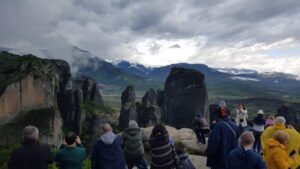
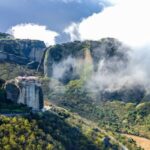
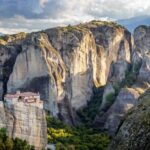
Meteora is not simply a group of old churches on hilltops. The sight of enormous stone pillars rising from a green valley, with monasteries perched above them, gives the place its power before you even step inside.
Monks first sought these cliffs for solitude and safety. In time, small hermit communities grew into organized monasteries. The name Meteora refers to something suspended in the air, a fitting description for buildings reached by ladders, stairs, ropes, and narrow paths in earlier centuries.
This day trip gives you a useful first look at that world. You see the monasteries from several angles, hear the stories behind them, and enter three of the active foundations. The experience is fast, but it covers the main essentials.
The trade-off is easy to understand. A 13-hour excursion from Thessaloniki cannot give you the same calm as staying in Kalambaka or Kastraki for several nights. You will spend roughly three hours each way on the rail journey, including a change at Paleofarsalos. Still, if your Greek itinerary has no room for an overnight stay, this is a practical way to reach Meteora.
A few more Thessaloniki tours and experiences worth a look

The train journey and the Paleofarsalos connection
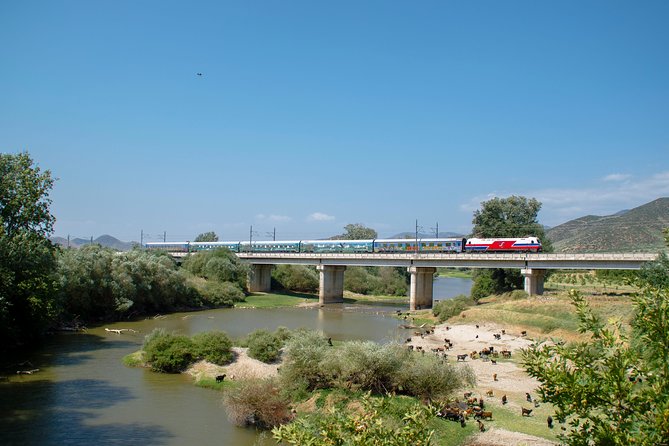
Your day begins at Thessaloniki railway station around 8:15 a.m. Train tickets are provided, so you do not need to work out the fare yourself. You can settle in and watch the Greek countryside pass by as the train heads toward Paleofarsalos.
The connection deserves your full attention. You change trains there before continuing to Kalambaka, and some passengers have found the transfer hard to follow because the ticket information is not always clear in English. Keep your ticket close, check the platform, and ask railway staff if you are unsure. Do not wander far from the train during the change.
The rail section is scenic and gives you time to rest, but it is not the polished part of the day. Several departures have run late, and delays have affected both the outward and return journeys. One return connection created a long wait on a dark platform, while another connection was caught with only a minute to spare.
That does not make the trip a bad choice, but it changes how you should plan. Avoid booking an important evening flight or fixed dinner reservation in Thessaloniki. The provider has sometimes offered private transport or a full refund when trains were unavailable, but you should still expect the rail timetable to be the least predictable part of the experience.
Meeting the van in Kalambaka
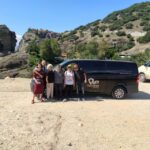
At Kalambaka station, an English-speaking driver meets you and takes you toward Meteora in an air-conditioned Mercedes Sprinter van with Wi-Fi and mineral water. The vehicle is a welcome change after the train and lets you reach the monasteries without arranging a separate taxi.
The road rises toward the rocks, with views of monasteries, stone pillars, and the valley opening below. Drivers such as Dinos and Sotos have received strong praise for handling the tight roads and stopping at useful photo points. A good driver matters here because the best views are not always beside the monastery entrance.
The group can reach up to 34 people. That is worth noting because some departures have used a small and comfortable van, while one account described a crowded vehicle of more than 30 people. The exact feel of the outing can vary. If a small group is essential to you, confirm the expected vehicle size before paying.
The guide joins you for the sightseeing portion. Katerina has been singled out for her knowledge, warmth, and personal links to the monasteries. Ava, Demetrios, and Vasilios have also been praised for explaining the sites, helping with photographs, and keeping the day moving. Guides can make a major difference here because Meteora’s buildings are striking, but their stories explain why the place matters.
Kastraki and the first views of the rocks
The village of Kastraki provides an early taste of Meteora’s local character. It sits close to the cliffs and feels more connected to the countryside than a large resort town.
You have about 30 minutes here. Use it to look up at the rock towers, take photographs, and get your bearings before the monastery visits begin. Kastraki also makes a sensible base if you decide that one day is not enough.
The short stop is pleasant, but do not expect a full village visit. The day has a tight timetable, and the monasteries are the main purpose of the excursion.
Saint Nicholas of Anapafsas and Roussanou
Saint Nicholas of Anapafsas is the first monastery encountered on the route up to Meteora. It was founded at the end of the 14th century, and its position may have made it a resting point for pilgrims heading farther into the cliffs.
The name has several explanations. One links it to a benefactor, while another connects it with the monastery’s location as a place to rest before continuing uphill. These small details help you see Meteora as a living religious route, not just a collection of scenic buildings.
Roussanou sits on a lower rock and is more approachable than some of the higher monasteries. Its main church dates from the end of the 16th century and was decorated about 30 years later. The monastery suffered serious damage during World War II and became a convent in 1988.
These two sites show useful contrasts. Saint Nicholas feels like an early stop on the climb, while Roussanou’s lower position makes it easier to reach and photograph. Depending on opening schedules and the day’s plan, your guide may include these monasteries among the three interiors you visit or show them from outside.



Great Meteoron, the largest monastery
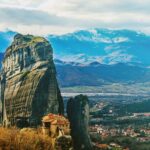
Great Meteoron is the heavyweight of the group. It is the oldest and largest monastery at Meteora, founded by Saint Athanasios the Meteorite. His work helped turn scattered religious life on the cliffs into an organized monastic community.
The monastery’s size gives you a sense of how ambitious these foundations became. It was not merely a tiny chapel for one hermit. It developed into a major religious center high above the valley, with buildings, chapels, and courtyards arranged on the rock.
The stop is especially valuable if you want historical context. Your guide can explain how the difficult setting shaped daily life and why monks chose such hard-to-reach places. You also get some of the broadest views across the surrounding plain.
Allow for climbing and uneven ground. The supplied timing lists only about 10 minutes at Great Meteoron, but the actual visit can feel more demanding because reaching the entrance and moving through the site takes effort. Wear shoes with a firm sole and save some energy for the next monastery.
Varlaam and its remarkable wall paintings
Varlaam is the second-largest monastery and sits opposite Great Meteoron. It was founded in the mid-14th century by the hermit Varlaam, then rebuilt in the 16th century by the priest-monks Theophanes and Nectarios Apsarades.
Its main church was decorated in 1548. The wall paintings are linked by style to Frago Catelano, a noted hagiographer from Thebes. You do not need to be an art specialist to appreciate the color, detail, and seriousness of the interior.
This is one of the more substantial visits, listed at about 45 minutes. Entrance costs €3 and is not included in the tour price. Carry a little cash for the three monastery admissions, which add €9 per person if all three require payment.
Varlaam also involves stairs. One account described hundreds of steps at the first monastery and about 100 at the second, though the exact count depends on the route and the sites open that day. If you have knee, heart, or balance concerns, tell your guide early so you can understand the plan.
Holy Trinity and Agios Stefanos
Holy Trinity, or Agia Triada, is one of the most dramatic monasteries to reach. The path leads first to the foot of the rock, followed by a climb of about 140 steps. Once you reach the top, the view is a fitting reward, with the valley and neighboring formations spread below.
Its organized monastic life dates to at least 1362. The setting feels more isolated than the lower monasteries, but that isolation comes with a physical cost. This is not the best choice if stairs are a serious problem.
Agios Stefanos offers the gentlest approach. Instead of a long staircase, you cross a small bridge to the entrance. It is the clearest option for anyone who cannot manage many steps but still wants to enter a real Meteora monastery.
The rock has supported monastic life since the early 12th century. Agios Stefanos includes an old 16th-century chapel, damaged during World War II and the Greek Civil War, plus an 18th-century main church dedicated to Saint Charalambos. His holy relics are kept there.
You may see Agios Stefanos as one of the three monastery visits, depending on the operating schedule. The tour route is not a promise that every named monastery will be entered. Some are viewed from outside, and the guide chooses the workable combination for the day.
Badovas hermit caves and the best photo stops
The hermit caves of Badovas add a different note to the day. The monasteries are organized institutions, but these caves recall the earlier, more solitary form of religious life that drew monks to Meteora.
You see the caves from the route rather than treating them as a separate hike. Your guide can connect them to the wider story of monks seeking quiet, protection, and distance from ordinary life.
Keep your camera ready throughout the van ride. The best images may come from a bend in the road, with a monastery high above you and the valley below. Drivers have been praised for stopping at viewpoints and helping take photographs, which is useful when you are traveling alone or as a couple.
What the $59 price really covers
At $59, this is an inexpensive way to reach Meteora from Thessaloniki. The price includes round-trip train fare, local guiding, the Kalambaka to Meteora vehicle, Wi-Fi in the air-conditioned van, and mineral water.
There is a conflict in the supplied details about lunch. The highlights describe lunch as included, but the inclusions section says lunch is not included. Treat lunch as extra unless the operator confirms otherwise before departure. The day includes about an hour of free time in Kalambaka late in the afternoon, which may be your chance to buy food.
The monastery entrance fees are also extra, at €3 per person per monastery. Add those costs to the advertised price when comparing this tour with other options.
The value is strongest for a person staying in Thessaloniki who has no spare night for Kalambaka. You receive transport across a difficult route, a local guide, and a driver who knows the narrow hill roads. The value is weaker if you dislike long train days or want time for all six monasteries.
Clothing, stairs, and the pace of the day
Monasteries require modest dress. Women should avoid short skirts and wear long sleeves. Men cannot wear shorts. Pack a light layer or suitable cover-up rather than hoping to borrow one at the entrance.
There is some walking at each stop, along with stairs at several monasteries. Most people can take part, but the day is not ideal if you cannot climb steps. Agios Stefanos is the exception, with a bridge instead of a major staircase.
The schedule moves quickly. You will have time to see three monasteries and hear their stories, but not time to linger in every courtyard or visit all six foundations. I would choose this trip for its range and convenience, not for a slow spiritual retreat.
Who should book this day trip
I would recommend it to you if you are based in Thessaloniki, want to see Meteora without renting a car, and accept that the train takes up much of the day. It is also a good fit if you value a guide who can explain the religious setting and help you make sense of what you are seeing.
It suits active visitors who can handle stairs and a full schedule. It can also work for someone with limited mobility if the guide confirms that Agios Stefanos can be included and the other stops are manageable.
I would think twice if you need reliable train timing, have an evening flight, or want a relaxed visit. Staying in Kalambaka or Kastraki gives you more time and removes the long return journey. It also lets you see more than three monasteries if opening hours allow.
Should you book the Meteora train tour?
Book it if this is your only realistic chance to see Meteora from Thessaloniki. The cliffs, monasteries, and hermit caves are extraordinary, and a strong guide can turn a fast visit into a meaningful one. Guides such as Katerina and Ava have been praised for clear explanations, personal stories, and practical help.
Skip it in favor of an overnight stay if you have the time. The train can be late, the group may be larger than expected, and the day leaves little room for quiet reflection. At $59 plus monastery admissions and lunch, it remains good value for a long-distance day trip, provided you plan for delays and arrive dressed for an Orthodox monastery.
FAQ
How long is the Meteora tour from Thessaloniki?
The full experience lasts about 13 hours. It begins around 8:15 a.m. in Thessaloniki and ends back at the same meeting point after the return train.
Is train transportation included?
Yes. The tour includes round-trip train fare between Thessaloniki and Kalambaka, with a train change at Paleofarsalos.
Is lunch included?
The supplied details conflict. One section describes lunch as included, while another says lunch is not included. Confirm this with the provider and plan to pay for lunch yourself.
How many monasteries will I visit?
You will visit three active monasteries. The possible sites include Saint Nicholas of Anapafsas, Roussanou, Great Meteoron, Varlaam, Holy Trinity, and Agios Stefanos.
How much do monastery entrance fees cost?
Entrance costs €3 per person at each monastery. Visiting three monasteries therefore costs €9 per person if fees are charged at all three sites.
Is the tour suitable for someone who cannot climb many stairs?
Agios Stefanos is the easiest monastery to reach because you cross a small bridge instead of climbing a long staircase. Other monasteries involve stairs, including about 140 steps at Holy Trinity, so discuss your needs with the guide.
What clothing is required?
Women should not wear short skirts and should have long sleeves. Men are not allowed to wear shorts. Modest clothing is required to enter the monasteries.
What happens if the train is delayed?
Train delays have occurred on both the outward and return journeys. Keep your schedule flexible, pay close attention during the Paleofarsalos change, and avoid arranging a tight evening connection after the tour.