REVIEW · ATHENS
Historic Athens Views of the City eBike Tour
Book on Viator →Operated by MTM Experiences · Bookable on Viator
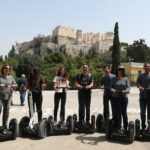
Athens is wonderfully compact around the Acropolis, but its hills, hard pavement, and hot sun can make a walking tour tiring. This three-hour e-bike ride links major sights quickly, with time to stop for photos and hear the stories behind them.
I like the easy sightseeing pace and the chance to see the Acropolis from several angles instead of only from the main entrance. I also like that guides such as George and Vagos have helped riders connect ancient monuments with the people and events behind them.
The main caution is city riding. A group of up to 12 can feel large on crowded streets, especially if some riders are new to bicycles. You should be comfortable steering and braking around pedestrians, and children must meet clear height and riding requirements.
In This Review
- Key points about the Athens e-bike tour
- Why an e-bike works well in central Athens
- Starting near Apostolou Pavlou Street
- Nymphs Hill and the first city views
- Herod Atticus Odeon and the Acropolis from below
- Dionysiou Areopagitou and the southern Acropolis view
- The Temple of Olympian Zeus and Hadrian’s Arch
- Syntagma Square and the Hellenic Parliament
- A quiet turn through the National Garden
- The Panathenaic Stadium and Olympic Athens
- Plaka, the old neighborhood below the Acropolis
- The Ancient Agora as the final history lesson
- What the $72.25 price gives you
- Group size, guides, and riding comfort
- Who should book this Athens ride
- Should you book the Historic Athens Views of the City eBike Tour?
- FAQ
- Where does the Athens e-bike tour start?
- Where does the tour end?
- How long does the tour last?
- What time does the tour start?
- Is the tour offered in English?
- What is included in the price?
- Are entrance tickets included?
- Can children ride an e-bike?
- How far in advance can I cancel for a refund?
Key points about the Athens e-bike tour
- See major Athens sights in three hours: The route covers Nymphs Hill, the Acropolis area, the Temple of Olympian Zeus, Hadrian’s Arch, Syntagma Square, the National Garden, the Panathenaic Stadium, Plaka, and the Ancient Agora.
- Save your legs for the rest of your trip: Electric assistance helps reduce the strain of Athens’ hills and long stretches between monuments.
- Enjoy several Acropolis viewpoints: The route uses Dionysiou Areopagitou pedestrian street and the Herod Atticus Odeon area for strong views of the southern side of the Acropolis.
- Learn from a live guide: Guides including George, Giorgos, Vagos, Sotos, and Neland have led tours, with particular praise for clear explanations and friendly help.
- Expect a small but not tiny group: The maximum is 12 people, so the tour stays manageable but may slow down in busy pedestrian areas.
- Bring the right riding confidence: Children over 1.50 meters may use an e-bike only if they can handle the brakes and maneuver safely through crowds.
Why an e-bike works well in central Athens
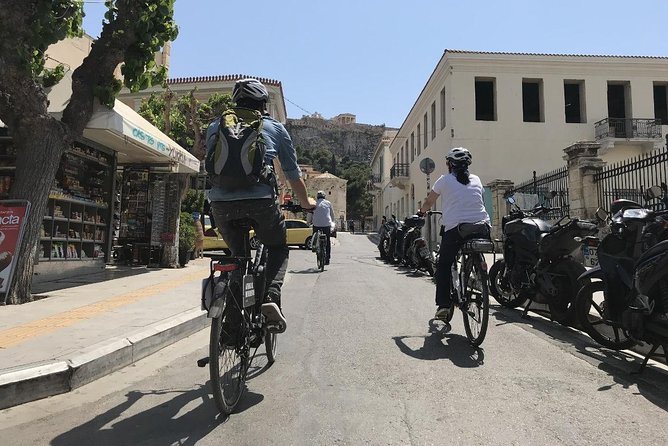
The best reason to choose this tour is simple: Athens gives you many important sights within a fairly small area, but walking between them takes energy. The Acropolis slopes, open plazas, and sunny streets can make a full day on foot feel longer than it looks on a map.
The e-bike does not turn the tour into a thrill ride. It is mainly a practical tool. You still pedal, but the motor helps with effort, so you can focus on the monuments rather than arriving at each stop tired and sweaty. If you have only one free morning or afternoon, this lets you cover a lot of ground without spending the entire time on foot.
I especially like the way the route mixes famous landmarks with views and neighborhoods. You are not simply stopping at one ticketed site, spending an hour inside, and moving on. Instead, you get a broad introduction to central Athens, then can decide which places deserve a longer visit later.
The tour lasts about three hours and uses a tour leader rather than asking you to follow a phone map. That matters in Athens, where pedestrian streets, traffic, and busy public spaces can make navigation distracting. You can listen, look around, and keep your attention on the group.
You can also read our reviews of more cycling tours in Athens


Starting near Apostolou Pavlou Street
The tour begins at Apostolou Pavlou 53 in the Thissio area, close to the Acropolis zone and near public transportation. The activity ends back at the same meeting point, which makes the morning or afternoon easier to plan.
You receive an e-bike, helmet, city map, and bottled water. Meals and entrance tickets are not included, so think of this as an outdoor orientation tour rather than a substitute for every museum or archaeological admission.
Before setting off, take the short practice period seriously. The bikes should feel comfortable, and you should know where the brakes are and how the electric assistance responds. One unpleasant experience in the tour record involved concerns about bike brakes and mechanical condition, while another family found all of their e-bikes worked well. That mixed picture makes a basic safety check sensible before you leave.
The operator has the right to refuse an e-bike to a child if it does not seem safe. That is reasonable for a route that includes pedestrians and city streets. Children who want their own e-bike must be confident riders taller than 1.50 meters, able to grip the brakes properly, and able to steer through crowds.
Nymphs Hill and the first city views
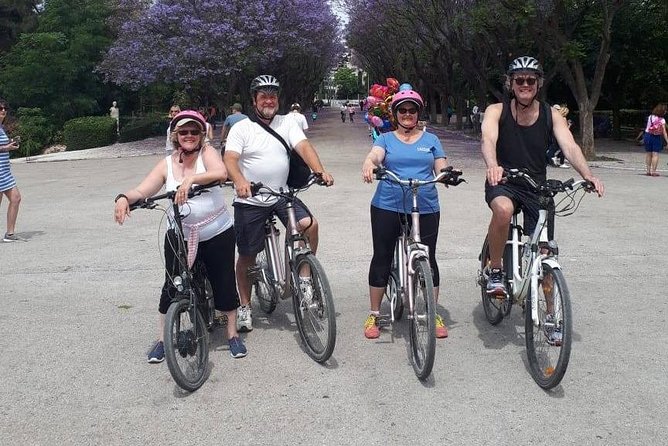
Nymphs Hill is a quieter opening stop with an unusual link to ancient belief. Its name comes from an inscription dedicated to the nymphs, figures who were worshiped in antiquity and later survived in popular stories as fairies.
You spend about 15 minutes here, with no admission fee. This is a good first pause because it gives the tour a little breathing room before the more famous monuments. You can begin to see how Athens combines open hills, ancient remains, and dense modern streets.
Do not expect a long visit or a formal archaeological presentation at this stop. Its value is atmosphere and perspective. The hill introduces a less obvious part of Athens and reminds you that ancient religion was not limited to the major gods associated with Mount Olympus.
Herod Atticus Odeon and the Acropolis from below
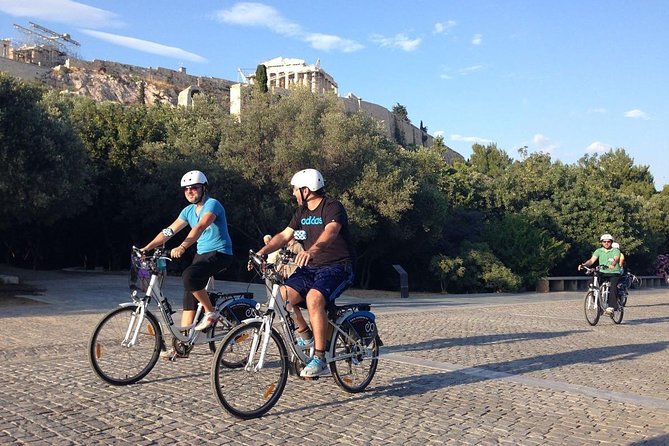
The Herod Atticus Odeon is one of the most memorable settings on the route. Built as a performance space, it has hosted music and theater on and off for roughly two thousand years. Its stone seating and curved form sit directly below the Acropolis, creating one of those Athens views that needs little decoration.
The stop lasts about 15 minutes and does not include entry. You see the monument from outside, which is enough to understand its position and dramatic setting, though you will not explore the interior or attend a performance as part of this tour.
This is also where the route benefits from a guide who can explain more than the basic name. George has been praised for clear, informative commentary, while other guides have added stories that connect the ruins with daily life and later events. The exact guide varies, but the tour depends heavily on that personal explanation.
Dionysiou Areopagitou and the southern Acropolis view
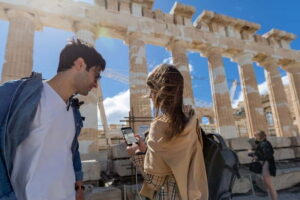
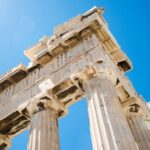
The ride continues along Dionysiou Areopagitou, a pedestrian street beside the Acropolis. It offers a broad look at the southern slope, the monuments below the Parthenon, and the great rock rising above the city.
This section is one of the strongest reasons to choose a bicycle. You move between viewpoints without wearing out your feet, and the open route gives you more than one angle on the Acropolis. You will stop for photographs, but keep your expectations practical: the tour is moving through a public area, not setting aside a long block for quiet photography.
Because this is a pedestrian zone, riding skill matters. You may need to slow down and follow the guide closely. A group of 10 was found difficult to manage in crowded areas when some riders struggled with their bicycles. The maximum group size is 12, so the ride can be smooth for confident riders but less relaxed when the streets fill up.
You can also read our reviews of more city tours in Athens



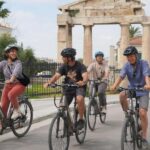
The Temple of Olympian Zeus and Hadrian’s Arch
The Temple of Olympian Zeus shows the scale of ancient ambition. Construction began in 174 BCE and was completed in 131 CE under the Roman emperor Hadrian. Its unusually tall columns once formed one of the largest temple complexes in the ancient world.
You have about 15 minutes here, with admission not included. The short stop gives you time to take in the surviving columns and hear why the project took centuries to finish. It is a useful contrast with the Acropolis, where smaller details and hilltop buildings often receive more attention.
A few minutes away, Hadrian’s Arch offers a compact but striking photo stop. The monument once marked a symbolic boundary between older Athens and the Roman city associated with Hadrian. The white Pentelic marble has weathered and suffered damage, but the arch still has a graceful outline.
The arch stop lasts about 10 minutes. It is not a place that needs a long visit, and the tour handles it well as a quick pause between larger sights.
Syntagma Square and the Hellenic Parliament
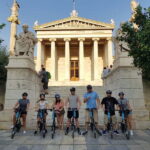
At Syntagma Square, you see the Hellenic Parliament in a neoclassical building completed in 1843. It began life as the Royal Palace of Greece, designed by the German architect Friedrich von Gärtner for King Otto.
The stop takes about 15 minutes. The building’s columned facade is easy to appreciate from the square, and the guide can provide a useful link between ancient Athens and the modern Greek state.
The tour also includes the changing of the guards as one of the sights you may see along the route. The supplied details do not promise a full ceremony viewing at a fixed time, so do not book the ride solely for that event. Still, the square adds modern civic life to a tour otherwise focused on ancient monuments.
This is one place where staying with the group matters. Central Athens can be crowded, and a bicycle group needs to keep together without blocking other people.
A quiet turn through the National Garden
The National Garden gives you a pause from stone, traffic, and open squares. Located in the center of Athens, it offers a calmer setting after the archaeological stops.
You have about 20 minutes here, the longest scheduled pause on the route. That extra time is useful. You can slow your pace, drink the included water, and let the impressions of the morning settle before the tour continues.
I like this change of mood. A good city tour should not treat every stop as another monument to photograph. The garden shows how Athens creates room for rest within its busy center, and it helps prevent the tour from becoming a nonstop chain of ruins.
The Panathenaic Stadium and Olympic Athens
The Panathenaic Stadium is built of marble and closely linked to the modern Olympic Games. Its story reaches from the revival of the Games in 1896 through the Athens Olympics in 2004. It is also connected with the Olympic Flame and the Athens Authentic Marathon.
The scheduled visit lasts about 15 minutes, and entry is not included. From outside, you can still grasp the long stadium shape and its cultural importance. If you want to walk inside, check the admission arrangements and allow extra time after the tour, since this activity does not cover entrance tickets.
This stop broadens the historical range. You begin with ancient worship at Nymphs Hill, see classical and Roman monuments, then reach a site tied directly to modern international sport. The result is a more useful picture of Athens than a tour that treats the city as a collection of ruins frozen in one age.
Plaka, the old neighborhood below the Acropolis
Plaka lies below the Acropolis and is one of Athens’ oldest neighborhoods. Its narrow, traditional layout and neoclassical houses, many dating from the 19th century, give it a different feel from the large archaeological sites.
The tour passes through Plaka rather than offering a long neighborhood walk. That is a good use of time. You get a sense of the area’s scale and character while staying on the route, then can return later for a slower wander or a meal.
Archaeological evidence suggests continuous settlement in the area since prehistoric times, which adds another layer to the neighborhood. What you see today is not a preserved ancient village, but a living part of Athens shaped by many periods.
Cycling through or near Plaka again calls for caution. Pedestrians may not expect a group of bicycles, and less confident riders can slow the whole line. Keep space between bikes and follow the leader’s instructions.
The Ancient Agora as the final history lesson
The Ancient Agora sits northwest of the Acropolis and once served as the city’s administrative and trading center. Its name means marketplace, but its role was much wider. It was a place where public business, commerce, and civic life came together.
The Agora also witnessed the Panathenaic Procession, a major celebration connected with the unity of Attica under King Theseus. That detail helps you picture the Agora as a working center of the city, not simply a field of broken stones.
The stop lasts about 15 minutes and does not include admission. You will see the setting and hear the context, but plan a separate visit if you want to explore the archaeological grounds in detail. Ending here works well because the Agora brings the route back to the civic heart of ancient Athens and close to the starting area.
What the $72.25 price gives you
At $72.25 per person, this tour is not the cheapest way to see Athens. You are paying for the e-bike, helmet, water, map, a leader, and a planned route that links many sights without requiring you to solve the city’s geography yourself.
The value improves if you have limited time, want to avoid a long walking day, or prefer explanations while moving between monuments. It also makes sense early in a trip, when a broad introduction can help you decide where to return for longer visits.
The price is less compelling if you already know central Athens well, plan to buy several archaeological admissions, or prefer to explore at your own speed. Since entrance tickets and meals are extra, budget separately for the Acropolis, Agora, Temple of Olympian Zeus, or Panathenaic Stadium if you want to go inside.
The strongest value is practical rather than luxurious. You cover a lot of ground, reduce the pressure on your knees, and gain a local route through the center.
Group size, guides, and riding comfort
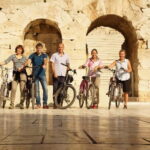
The maximum group is 12 people. That is smaller than a large coach tour, but it is still enough to create problems in busy pedestrian areas. Confident riders will likely find the pace easier to manage than beginners.
Several guides have received strong praise for their approach. George has helped first-time e-bike riders feel comfortable, including a 67-year-old rider and a 73-year-old rider. Vagos has been credited with adding useful context about the people and activities connected with each period. Sotos and Neland have also led family groups with a friendly, lively approach.
The guide assigned to your departure can vary, so treat these names as examples rather than a promise. The important point is that the experience relies on a leader who can manage both the history and the group’s pace.
A moderate fitness level is required. You do not need to be an athlete, but you should be comfortable on a bicycle and able to respond to pedestrians, turns, and stops. If you are unsteady on a bike, a walking tour may be less stressful.
Who should book this Athens ride
I would choose this tour if you want a fast, active introduction to central Athens and are comfortable riding in public spaces. It suits first-time visitors, families with capable older children, and anyone who wants major views without spending three hours on foot.
It is also a good fit for older adults who can ride confidently but want to reduce walking. The e-bike helped first-time older riders feel at ease, but that does not remove the need for balance, braking, and awareness.
I would think twice if you dislike group pacing, need long stops at every monument, or feel nervous around pedestrians. You should also check the child rules before booking. A child may use a booster seat or co-pilot bike at the child rate, but an extra e-bike costs the adult rate, and independent riders must be over 1.50 meters and able to handle the bike safely.
Free cancellation is available when you cancel at least 24 hours before the local start time. Changes or cancellations inside that window are not accepted for a refund, so keep the deadline in mind when arranging your Athens plans.
Should you book the Historic Athens Views of the City eBike Tour?
Book it if you want many central Athens highlights in one outing, with less walking and a guide to connect the sights. The Acropolis viewpoints, Herod Atticus Odeon, Olympian Zeus, Panathenaic Stadium, Plaka, and Ancient Agora make a strong first look at the city.
Go in with realistic expectations. This is an outdoor overview, not a ticketed deep visit to each monument. Check the bikes before departure, choose it only if you can ride confidently, and expect a group that may slow down in crowded streets.
For a fit, curious rider with limited time, $72.25 can be fair value. For a slow, detail-focused visit, use this as your orientation and save the rest of the day for returning to the sites that catch your eye.
FAQ
Where does the Athens e-bike tour start?
The tour starts at Apostolou Pavlou 53, Athina 118 51, Greece.
Where does the tour end?
The activity ends back at the starting meeting point.
How long does the tour last?
The tour lasts approximately three hours.
What time does the tour start?
The stated start time is 10:00 am. Morning or afternoon tour options are also available according to the tour details.
Is the tour offered in English?
Yes. The tour is offered in English.
What is included in the price?
The price includes an e-bike, helmet, city map, tour leader, and bottled water.
Are entrance tickets included?
No. Entrance tickets are not included.
Can children ride an e-bike?
Children must be confident riders taller than 1.50 meters, able to grip the brakes properly, and able to maneuver safely through pedestrian crowds. Child rates cover a booster seat or co-pilot bike. An extra e-bike is charged at the adult rate.
How far in advance can I cancel for a refund?
You can cancel at least 24 hours before the experience start time for a full refund. Cancellations or changes made less than 24 hours before the start are not accepted for a refund.