REVIEW · ATHENS
4-Day Private Tour of Classical Greece from Athens
Book on Viator →Operated by Ancient Greece Tours & Transfers · Bookable on Viator
This is a history-packed road trip through mainland Greece, linking the Oracle at Delphi, the original Olympic grounds, Mycenae, Epidaurus, and Corinth in four days. You travel by private vehicle, sleep in three different places, and let someone else handle the long drives.
I like the freedom of a private tour, especially when you want to pause for a view, a coffee, or a village meal. I also like the route’s range: mythology, religion, sport, theater, engineering, and modern Greek independence all appear along the way. The main caution is the pace. This is a lot of Greece in a short time, and the $1,529.22 price does not include hotels, meals, or about $135 in site admission fees.
In This Review
- The quick facts you need before booking
- Why this route works for history lovers
- Thermopylae and the road to Delphi
- Delphi, where the Greeks placed the center of the world
- Olympia, the birthplace of the Olympic Games
- Nafplio, a graceful break from ruins
- Epidaurus and the sound of ancient theater
- Mycenae and the world of Agamemnon
- Acrocorinth and Ancient Corinth
- The Corinth Canal and the return to Athens
- Is the $1,529.22 price good value?
- Who should book this private Greece tour?
- Final verdict: a strong route with a demanding pace
- FAQ
- Is this tour private?
- Does the tour include hotel pickup and drop-off?
- Are hotels included in the price?
- Are entrance fees included?
- Is a licensed guide included at the archaeological sites?
- What is included in the vehicle?
The quick facts you need before booking
- Four days from Athens: The route returns you to your Athens hotel, Airbnb, or apartment on the final day.
- Private transportation: Only your party takes part, using a private luxury vehicle with Wi-Fi, bottled water, refreshing wipes, and handmade Greek biscuits.
- Major ancient sites: Delphi, Olympia, Epidaurus, Mycenae, Ancient Corinth, and Acrocorinth are the core attractions.
- Three overnight stops: You stay in Delphi, Olympia, and Nafplio, or in the Corinth and Loutraki area on the final night.
- Driver rather than included site guide: Professional drivers provide historical knowledge, but a licensed guide inside the archaeological sites and museums costs extra.
- Extra costs matter: Accommodation, food, drinks, entrance fees, and airport transfers are not included.
Why this route works for history lovers
The tour connects places that are often split into separate day trips from Athens. Instead of returning to the capital each evening, you move through Central Greece and the Peloponnese, spending the night near the next major site.
That saves road time, though it does not make the itinerary light. The listed drives include roughly four hours from Delphi to Olympia, two hours from Olympia to Nafplio, about two hours from Mycenae to Ancient Corinth, and two hours from the Corinth area back to Athens. Add sightseeing, meals, and hotel check-ins, and you can expect full days.
A private car helps. You are not waiting for a large group, and hotel pickup means you do not need to reach a bus station with luggage. The vehicle’s Wi-Fi is useful during long stretches of road, while water and small Greek biscuits are modest but welcome touches.
The tour is offered in English. Your driver is expected to explain Greek history during the journey, but the service does not include a licensed guide walking through each museum and excavation. If detailed interpretation is central to your trip, ask about adding one.
You can also read our reviews of more private tours in Athens


Thermopylae and the road to Delphi
The first stop is Thermopylae, the narrow passage linked with the 480 BC battle between the Greek alliance led by Leonidas of Sparta and the Persian army of Xerxes. The ancient shoreline has changed, so the power of the place comes from its story and its monuments rather than from a perfectly preserved battlefield.
The King Leonidas monument, erected in 1955, shows the Spartan ruler with spear and shield. Nearby, the Thermopylae museum presents the battle with modern displays. You also have the chance to see the hot sulfur springs, which gave the area its ancient name, Gates of Fire. The springs are associated with healing baths and hydrotherapy facilities, although the tour description does not promise a bathing session.
This is a worthwhile opening stop because it puts Greek military history into place before the tour turns toward religion and mythology. Keep your expectations measured: Thermopylae is primarily a brief historical visit, not a large archaeological complex.
After the drive to Delphi, you check into your chosen hotel. The route then turns to one of Greece’s most impressive ancient settings.
Delphi, where the Greeks placed the center of the world
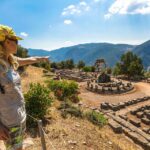
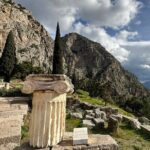
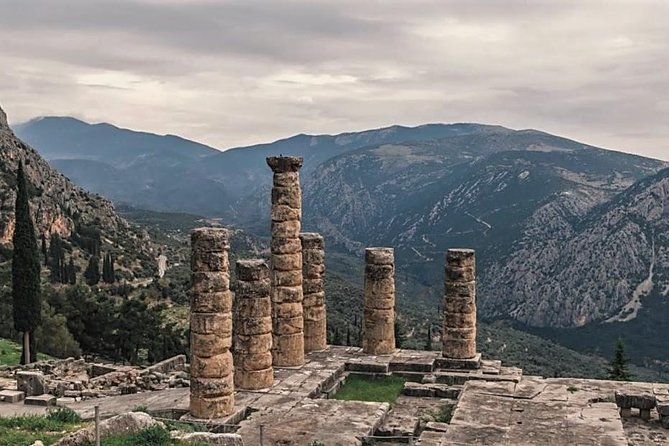
Delphi was home to Pythia, the oracle consulted by rulers and cities across the Greek world. Ancient Greeks treated the sanctuary as the center of the earth, marked by the Omphalos stone.
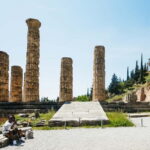
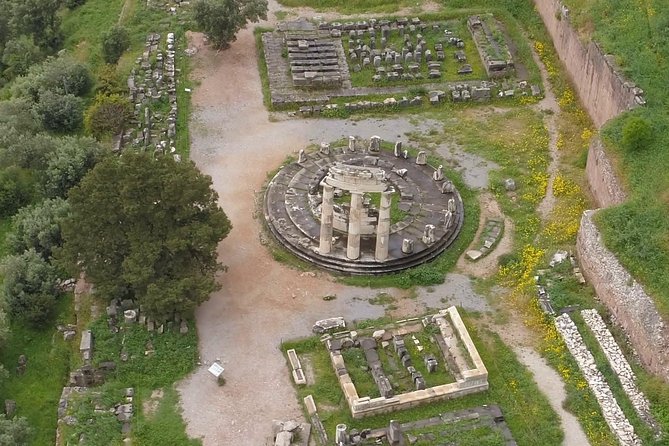
The archaeological site climbs along a hillside, so comfortable shoes matter. You see the Temple of Apollo, the ancient theater, the stadium, the Athenian Treasury, and the Sanctuary of Athena Pronaia. The Pythian Games also took place here, giving Delphi an athletic and cultural role beyond its religious function.
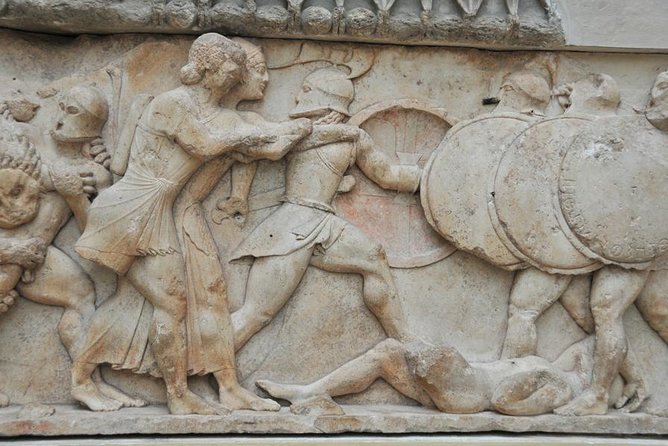
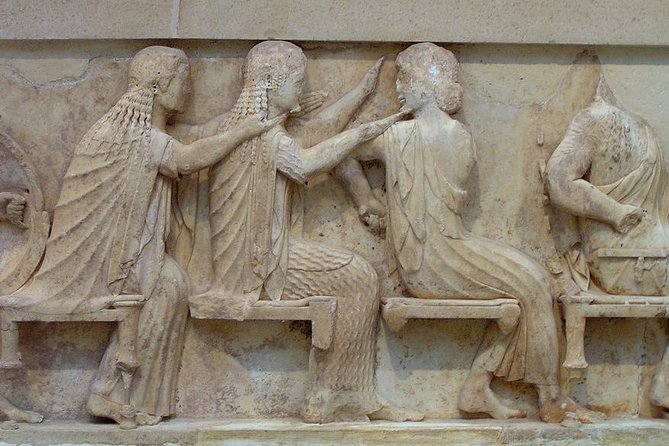
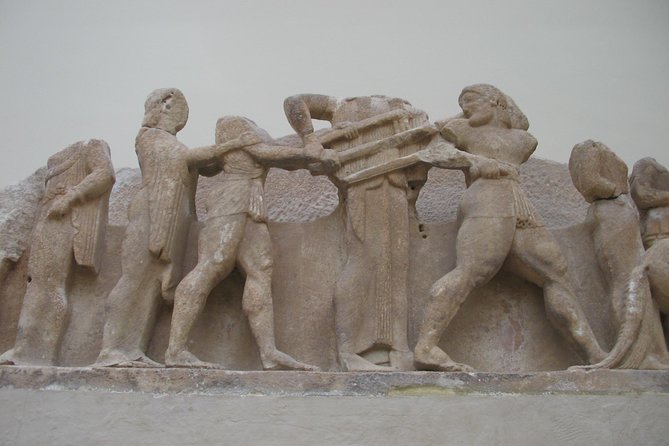
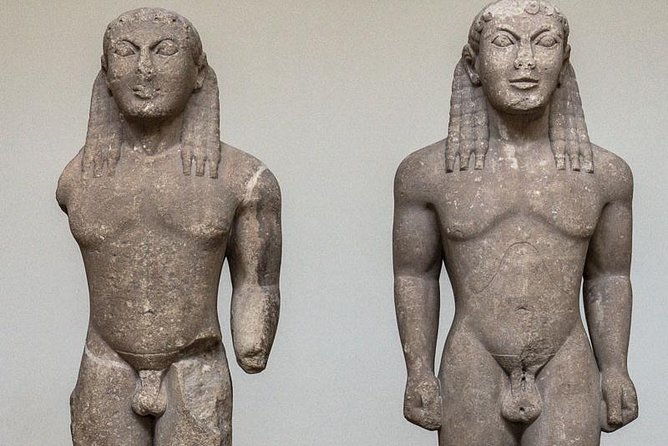
The museum makes the site easier to understand. Important pieces include the Naxian Sphinx, dated to about 560 BC, the statues of Kleobis and Biton, the Omphalos, and the famous Charioteer of Delphi. The Frieze of the Treasury of Sifnians and the metopes from the Athenian Treasury show mythological scenes in carved stone.
The Charioteer is especially memorable for its calm, controlled expression. It once formed part of a larger chariot group with four horses and another male figure. The statue of Antinoos, associated with Emperor Hadrian, offers a later example of ancient Greek artistic ideals revived in the second century AD.
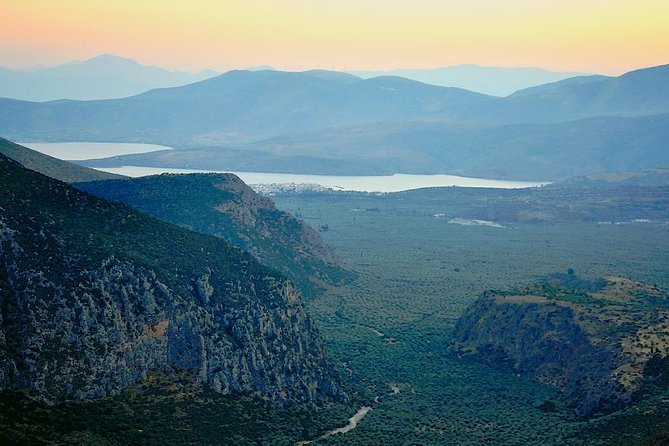
You also get time in Delphi village, which has hotels, guesthouses, tavernas, bars, coffee stops, and shops. Lunch is planned on the caldera, with views over Itea and Amfissa. This is one of the route’s pleasant pauses, but shopping and coffee take time from the archaeological visit, so tell your driver if Delphi’s ruins and museum are your top priority.
The timing deserves attention. Delphi alone can fill most of a day, and the onward drive to Olympia is listed at about four hours. A private tour gives you some control, but you still need to balance the village stop against the long road south.
Olympia, the birthplace of the Olympic Games
Olympia hosted the original Olympic Games, traditionally beginning in the eighth century BC. The sanctuary sits in the Alpheios River valley, and its setting feels quieter than the grand scale of the site might suggest.
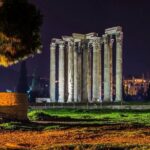
The archaeological grounds include the Temple of Zeus, the Temple of Hera, the Philippeion, the stadium, the palaestra, the gymnasium area, and the workshop of Pheidias. The Temple of Zeus was built in the fifth century BC and became a model of the mature Doric temple. The Temple of Hera is also important because the modern Olympic flame is lit there during the ceremony that begins each Olympic cycle.
At the stadium, you can picture foot races and public ceremonies. The palaestra was used for boxing, wrestling, and jumping. The workshop of Pheidias connects the ruins to the enormous gold-and-ivory Zeus statue once counted among the Seven Wonders of the ancient world.
Plan enough time for both the site and the museums. The Archaeological Museum of Olympia houses finds from the sanctuary, while the Museum of the History of the Olympic Games in Antiquity explains the contests and their place in Greek life.
A separate Archimedes museum in Olympia displays working replicas of inventions linked to the ancient mathematician and scientist. It offers a change of pace after columns, foundations, and sculpture. You can look at ancient engineering through hands-on examples rather than only through display cases.
Olympia village provides shops, meals, and a calm overnight base. The suggested meal at La Belle Helene features handmade Greek food and home cooking. Since food is not included, you pay separately, but this kind of local taverna stop may feel more personal than eating beside a major monument.
The next drive is about two hours to Nafplio. That is manageable, but the second day still combines a major archaeological site, two museums, meals, shopping, and a transfer.
Nafplio, a graceful break from ruins
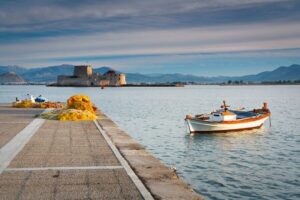
Nafplio gives the tour a welcome change of rhythm. This seaport town has a waterfront, cobbled streets, historic buildings, and a long connection with modern Greek independence. It served as the first capital of the modern Hellenic Republic after the 1821 War of Independence.
The Palamidi fortress sits on a 216-meter hill above town. The famous approach has 999 steps, though you can also reach the fortress by vehicle. From the top, views extend across the Argolic Gulf. The fortress is a serious climb, so do not treat it as a casual stroll if heat or mobility is a concern.
At water level, Bourtzi fortress occupies a small harbor island. You also pass Constitution Square, the former mosque that housed the first Hellenic Parliament from 1825 to 1826, and St. Spyridon Church, associated with the 1831 assassination of Ioannis Kapodistrias, Greece’s first governor.
Nafplio is also the place for a gelato stop at Antica Gelateria di Roma or loukoumades at Pergamonto. These honey or chocolate-covered dough balls make a fine afternoon treat. The town’s shops offer handmade souvenirs, though shopping is optional and can be skipped for more time at the historic sites.
A few more Athens tours and experiences worth a look

Epidaurus and the sound of ancient theater
From Nafplio, the route heads to Epidaurus, one of the most celebrated ancient theaters in Greece. The theater is known for its precise construction and acoustics. A small sound test from the stage can be heard high in the seats, showing how carefully the space was designed.
The theater is part of the Sanctuary of Asclepius, an ancient medical center dedicated to the demi-god of healing. The site included treatment spaces, religious buildings, and facilities connected with health and recovery. The archaeological museum displays architectural elements and inscriptions, including reconstructions of temples.
Epidaurus is a place where architecture does the explaining. You do not need a long lecture to understand the theater’s appeal once you hear sound carry across the stone seats. Still, a licensed guide would help explain the sanctuary’s medical practices and the role of drama in ancient Greek religious festivals.
The stop is listed at about an hour and a half, including the drive from Nafplio. That is enough for the theater and a look at the sanctuary, but it may feel short if you want a slow museum visit.
Mycenae and the world of Agamemnon
Mycenae brings you back to the Bronze Age, centuries before the classical temples of Delphi and Olympia. Homer’s stories connect the site with Agamemnon, while archaeology shows a powerful center that flourished roughly between 1600 and 1100 BC.
The Lion Gate is the famous entrance, built in the 13th century BC. Its huge limestone walls are called Cyclopean because later Greeks could not imagine ordinary people moving such massive blocks.
Inside, you see the royal palace area, Grave Circles A and B, and the remains of the citadel. The nearby Treasury of Atreus is a large beehive-shaped tholos tomb built around 1250 BC. The Tomb of Clytemnestra is another monumental Mycenaean tomb, named for Agamemnon’s wife.
The museum displays gold grave goods, masks, jewelry, weapons, religious figures, and frescoes. It helps you connect the bare stones outside with the wealth and ritual life of the people who built the citadel.
Mycenae can be hot and exposed, with uneven ground. Bring water, wear practical shoes, and expect the visit to involve walking over ancient surfaces rather than paved paths. The drive onward to Ancient Corinth takes about two hours, followed by a late lunch or early dinner at a taverna overlooking the Temple of Apollo.
Acrocorinth and Ancient Corinth
The final morning begins at Acrocorinth, the fortified acropolis above Ancient Corinth. This is a different kind of ancient site: instead of one sanctuary, you get layers of Greek, Roman, Byzantine, Frankish, and Ottoman use spread across a large rocky summit.
The approach passes through three lines of defensive walls and gates. Inside are the Peirene Spring, traces of the Temple of Aphrodite, a Frankish tower, and remains of churches, mosques, houses, fountains, and cisterns. The views toward Geraneia Mountain, the Corinthian Gulf, and the southwestern Peloponnese are a major part of the visit.
Acrocorinth requires walking on steep and uneven ground. If you prefer easier sightseeing, the lower site at Ancient Corinth may suit you better, though the upper fortress is the more dramatic stop.
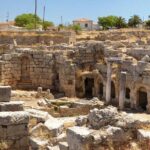
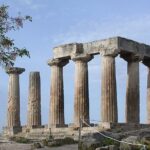
Ancient Corinth includes the Temple of Apollo, one of the earliest Doric temples on the Greek mainland, with unusual monolithic columns. The broad Agora contains shops, small temples, an altar, and the Bema, the platform associated with Apostle Paul’s address to the Corinthians in AD 52.
You also see the theater, Odeon, Asklepieion, Roman buildings, the Lechaion Road, and Hadgimoustafa Spring from the Ottoman period. The local museum holds artifacts from Corinth and nearby sites.
St. Paul’s Church adds a Christian chapter to the visit. Its mosaic mural depicts Saul’s vision of Christ while traveling to Damascus. That connection gives Ancient Corinth a wider historical reach than its classical ruins alone.
The Corinth Canal and the return to Athens
The Corinth Canal is a short but striking final stop. Built in the 19th century, it cuts through the Isthmus and links the Corinthian and Saronic gulfs. The canal is a major engineering project, and its narrow waterway looks very different from the broad ancient spaces visited earlier.
The route continues to Kechries Port, associated with the journeys of St. Paul, then to the village of the Baths of Helen of Troy for lunch beside the Saronic Sea. The final return to Athens takes about two hours, followed by drop-off at your chosen hotel, Airbnb, or apartment.
The exact road sequence can feel busy on paper, with Corinth, the canal, Kechries, lunch, and Athens all placed into one day. The private format helps you manage the pace, but you should not expect a leisurely final morning.
Is the $1,529.22 price good value?
The headline price is high because this is a private four-day service, not a basic bus tour. You are paying for a dedicated vehicle, driver, hotel pickup and return, multiple overnight transfers, and a route that would be awkward to arrange by public transport.
But the advertised price is not the full trip cost. You need to add:
- Three nights of accommodation
- Food and drinks
- About $135 per person in entrance fees for Delphi, Olympia, Mycenae, Epidaurus, and Ancient Corinth
- Airport pickup and drop-off, if needed
- A licensed guide, if you want one inside the sites and museums
Group discounts may improve the per-person value for families or friends sharing the vehicle. Solo visitors will feel the cost more sharply. The tour makes the most financial sense when your group values privacy, door-to-door service, and time saved on planning.
The cancellation terms are fairly clear but firm. You can receive a full refund when canceling at least six full days before the start time. A cancellation two to six days ahead receives 50 percent back, while cancellations under two days are nonrefundable.
Who should book this private Greece tour?
I would choose this trip if you want to cover the major Classical Greece sites without renting a car or changing buses. It suits couples, families, and small groups who prefer a private vehicle and want a driver who can discuss Greek history along the road.
It is also a good match if you want variety. You get battle history at Thermopylae, religion at Delphi, sport at Olympia, theater and medicine at Epidaurus, Bronze Age archaeology at Mycenae, and Greek, Roman, Christian, Frankish, and Ottoman layers at Corinth.
I would hesitate if you want long, quiet visits at each site, slow mornings, or several nights in one town. The schedule is ambitious. I would also budget for a licensed guide if museums and ruins matter more to you than simple transportation and broad historical orientation.
One named guide, Taz, receives particular praise for being caring, approachable, thorough, and passionate about Greek history. That personal quality may shape your experience, but driver assignments can vary, so confirm who will accompany your group.
Final verdict: a strong route with a demanding pace
Book this tour if your priority is seeing a large share of mainland Greece in four days with private transport and hotel service. The route is thoughtfully packed with major sites, and the overnight stops in Delphi, Olympia, Nafplio, and the Corinth area let you experience more than a string of Athens day trips.
Do not book it expecting a slow retreat or an all-inclusive price. Add the hotels, admissions, meals, and possible guide fee before deciding. For a history-focused group that values comfort and a personal driver, this is a practical way to connect Greece’s most important ancient places in one concentrated journey.
FAQ
Is this tour private?
Yes. Only your group participates, and transportation is provided in a private luxury vehicle.
Does the tour include hotel pickup and drop-off?
Yes. Pickup and return service are provided at your Athens hotel, Airbnb, or apartment. Airport and port transfers are available for an additional cost.
Are hotels included in the price?
No. Three nights of accommodation are not included, though hotel reservations can be arranged upon request.
Are entrance fees included?
No. Admission fees for Delphi, Ancient Olympia, Mycenae, Epidaurus, and Ancient Corinth are listed at about €135 per person.
Is a licensed guide included at the archaeological sites?
No. Professional drivers provide historical information, but a licensed guide accompanying you inside sites and museums costs extra.
What is included in the vehicle?
The private vehicle includes onboard Wi-Fi, bottled water, refreshing wipes, and fresh handmade Greek biscuits.