REVIEW · ATHENS
Visit Delphi & Meteora Monasteries Luxury Private Tour FromAthens
Book on Viator →Operated by Yomadic.Tours & Transfers · Bookable on Viator
The remarkable promise here is simple: Delphi and Meteora in one very long day. You’ll move from Apollo’s mountain sanctuary to the cliff-top monasteries of central Greece, with Arachova, Kalabaka, and Thermopylae adding useful breaks and historical context.
I like the private setup, especially the door-to-door pickup and the freedom to adjust the pace. I also like the mix of ancient Greek religion, Byzantine Christianity, mountain scenery, and local food in Arachova. The tradeoff is serious: 13 hours and 20 minutes is a demanding schedule, with roughly six hours of driving.
In This Review
- Key points to know before booking
- Why this private day from Athens is so ambitious
- Arachova and Mount Parnassus set the scene
- Delphi begins with the Tholos of Athena Pronaia
- Delphi’s museum gives the ruins a human face
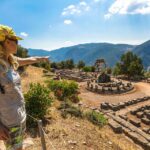
- Apollo’s sanctuary explains Delphi’s power
- The Sacred Way leads to the Athenian Treasury
- The long road to Kalabaka and Meteora
- Varlaam Monastery requires time and attention
- Roussanou adds a different Meteora viewpoint
- Thermopylae brings the day back to ancient Greece
- What the private vehicle and driver really add
- Is the $606.87 price good value?
- Who should book this tour?
- Practical details before you go
- FAQ
- How long does the tour last?
- Where does pickup take place?
- What transportation is provided?
- Is the tour private?
- Is an English-speaking guide included?
- Which monasteries are visited at Meteora?
- Are admission fees and meals included?
- Can I cancel for a full refund?
- Should you book this Delphi and Meteora day?
Key points to know before booking
- Two major Greek sights in one day: Delphi and two Meteora monasteries are the main event, making this useful for a short Athens stay.
- Private transport with WiFi: Groups of one to three use a luxury sedan, while groups of four to seven travel in a minivan.
- Drivers provide commentary: Panos, Chris, Andreas, and Christos are named as friendly, helpful drivers, but they are not licensed site guides.
- The Delphi visit is broad: You see the Tholos of Athena Pronaia, museum, Temple of Apollo, Treasury of the Athenians, and the wider sanctuary.
- The road is part of the experience: Arachova, Mount Parnassus, Kalabaka, and Thermopylae give the long transfer more purpose.
- Budget for extras: Lunch, gratuities, the €6 Meteora admission fee, and the €12 Delphi Archaeological Museum fee are not included.
Why this private day from Athens is so ambitious
Most day trips from Athens focus on one major destination. This one tries to fit two of mainland Greece’s headline sights into a single outing. Delphi is about 2 hours and 30 minutes from Athens, and the onward drive to Meteora takes about two hours. Returning to Athens adds another three and a half hours.
That schedule explains both the appeal and the caution. You can see places that would otherwise require separate days, hotel changes, or a rental car. You also spend a large portion of the day seated in a vehicle, so I would choose this only if seeing both sites matters more to you than a relaxed pace.
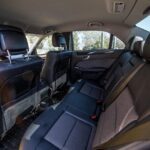
The private format makes the mileage easier. Your driver collects you at your Athens hotel, Airbnb residence, or port, then brings you back to the agreed meeting point. The vehicle has air conditioning, WiFi, and bottled water. You are not waiting for a large coach to fill up, and your group can ask for reasonable adjustments along the way.
This is best understood as a private transfer with guided commentary, not a traditional tour led inside every monument. Your English-speaking driver can explain the places, answer questions, and drop you near the entrances, but drivers do not enter the archaeological sites. A licensed guide is not included.
You can also read our reviews of more private tours in Athens


Arachova and Mount Parnassus set the scene
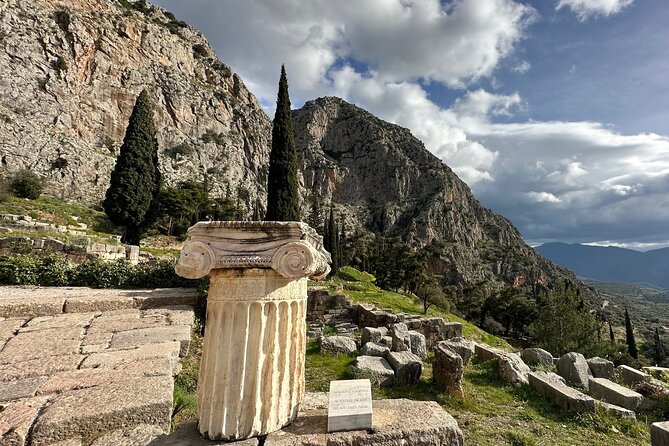
Arachova is the first named stop and a sensible place for a break before or after Delphi. The mountain town sits on the slopes of Mount Parnassus, the peak that rises above Delphi and the Gulf of Corinth. Lunch is scheduled here, but you pay for your own meal.
The value of this stop depends on your expectations. You are not getting a long village tour with a set tasting menu. Instead, Arachova gives you a chance to eat, stretch your legs, and see the mountain setting tied to Delphi. One of the drivers, Panos, was specifically praised for allowing a stop at a local restaurant, so the private format may help you turn lunch into a more personal part of the day.
Mount Parnassus also helps explain why Delphi was placed where it was. Its slopes offer broad views, olive groves, and rolling hills, while its snow feeds communities in the surrounding region. In warmer months, the mountain is used for hiking, and in winter it has ski areas. The drive is not just dead time between attractions, though the total road distance still requires patience.
Delphi begins with the Tholos of Athena Pronaia
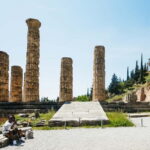
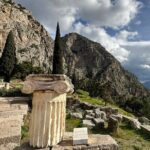
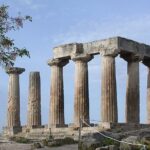
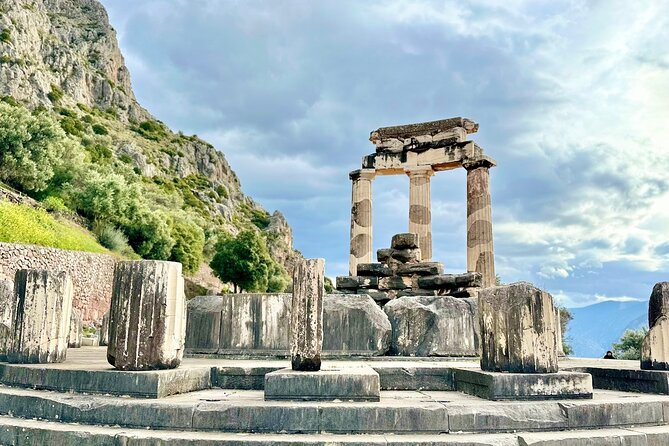
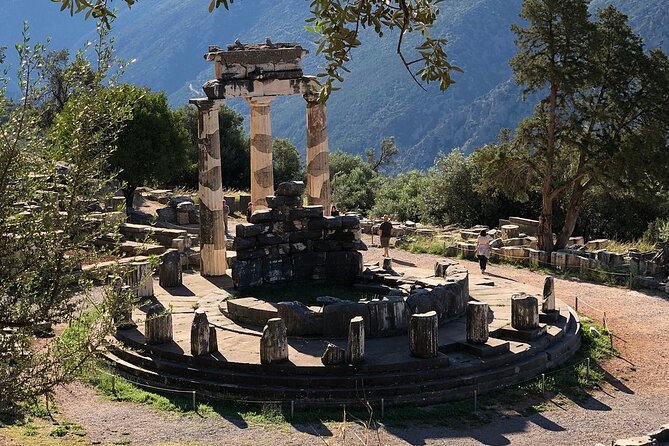
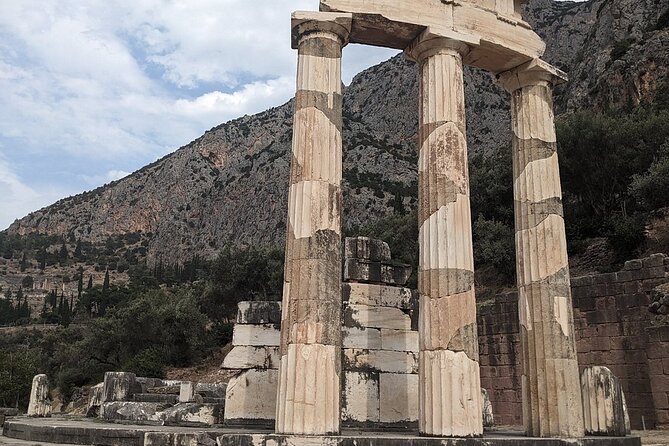
The Tholos of Athena Pronaia is one of Delphi’s most photographed monuments. Its circular design dates to the late fourth century BC, with 20 Doric columns around the outside and 10 Corinthian columns inside. Three of the outer columns have been restored, giving you a clear sense of the building’s elegant shape.
The Tholos sits about 800 meters from the main Delphi ruins. That matters because it is not simply the first stone you see before walking into the upper sanctuary. It is a separate area, and the visit includes the nearby gymnasium, where young men trained and used pools and baths.
You have about 20 minutes here, so expect a focused look rather than a long archaeological study. This is a good place to listen to your driver’s explanation and take photographs. If you want time to inspect every detail, the tight schedule may feel brisk.
Delphi’s museum gives the ruins a human face
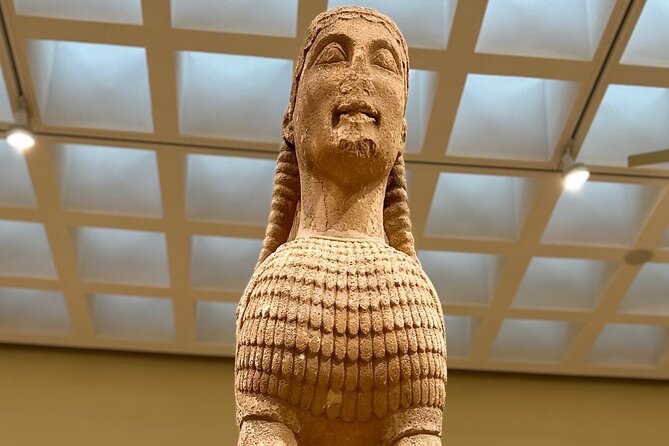
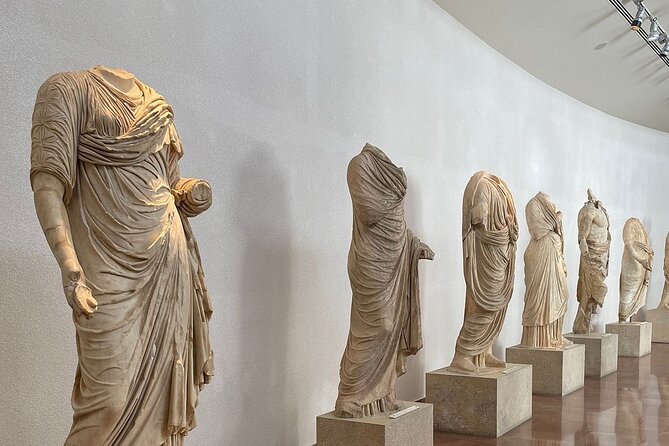
The Delphi Archaeological Museum is one of Greece’s principal museums. Its collection covers discoveries from the sanctuary, from the Late Helladic, or Mycenaean, period through the early Byzantine era.
The museum is important because the open-air ruins can be hard to read. Statues, architectural pieces, and offerings inside the museum help you picture the sanctuary as a working religious center rather than a hill of scattered stones. The planned visit lasts about an hour.
The €12 museum admission is extra. That is worth noting when you compare the advertised price with your actual cost. The museum also adds another indoor stop to a day that includes plenty of walking and road time, which can be welcome.
Apollo’s sanctuary explains Delphi’s power
The Temple of Apollo occupied the most important position in the sanctuary. The remains visible today belong to the fourth-century BC temple, the third building constructed on this spot.
This was the home of the Pythia, Delphi’s famous oracle. Ancient accounts describe a sacred chasm beneath the temple and vapors that affected the priestess. The Pythia’s utterances were then interpreted by priests, often in deliberately unclear language. That ambiguity helped preserve the oracle’s authority, since almost any outcome could later be linked to the prophecy.
You have about 15 minutes at the Temple of Apollo, so listen closely to the explanation and focus on the main view. You will not have the time of a specialist archaeological visit, but the location makes the site memorable. From here, the arrangement of the sanctuary and the slope of Parnassus help you understand why Delphi carried such influence.
A few more Athens tours and experiences worth a look




The Sacred Way leads to the Athenian Treasury
The Sacred Way climbs through the sanctuary toward the Temple of Apollo. Along the route were statues and treasuries built by Greek city-states. These small buildings held offerings to Apollo, often a tenth of the spoils from a military victory.
The restored Treasury of the Athenians is the best known. Athens built it to mark its victory at Marathon in 490 BC. Other treasuries represented places such as Siphnos and Argos, turning the sanctuary into a display of wealth, rivalry, gratitude, and political messaging.
This is one of the most useful parts of the Delphi visit because it shows that the sanctuary was not only a religious site. It was also a meeting place where city-states advertised their victories and sought the oracle’s approval. The scheduled time is about 15 minutes, and the ticket cost is not included in the tour price.
The wider Delphi visit lasts about an hour, with the Temple of Apollo and Treasury fitting into the walk through the main site. The driver does not enter with you, so ask questions before you go in or discuss what you saw afterward.
The long road to Kalabaka and Meteora
After Delphi, you travel about two hours toward Meteora and the town of Kalabaka. The town is the practical base for the monasteries and has about 12,000 residents, including roughly 8,330 people in the town proper according to the 2011 census.
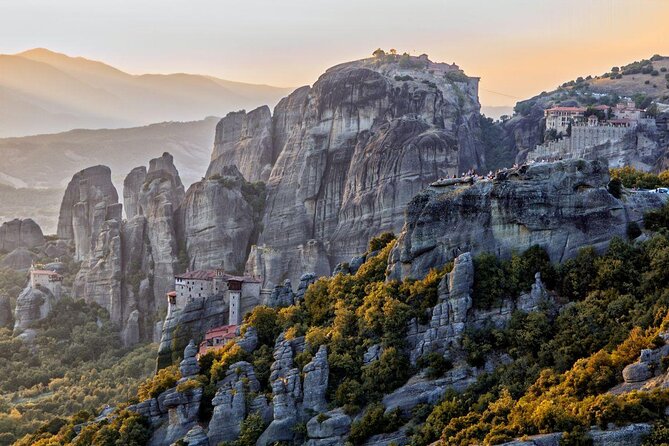
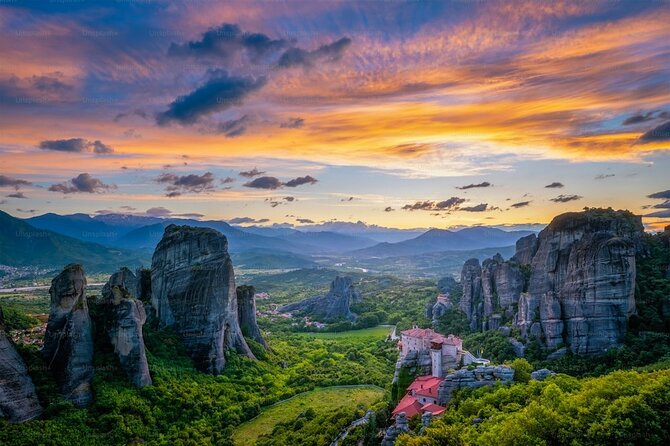
Meteora changes the character of the day. Delphi is a sanctuary shaped by mythology, politics, and classical architecture. Meteora is a Christian monastic center set among towering rock formations. The appeal comes from both the religious buildings and the striking setting around them.
You should expect a quick introduction to Kalabaka rather than a full town tour. The town is mainly a useful gateway to the monasteries, a place for orientation, and a possible point for food or a short pause.
Varlaam Monastery requires time and attention
The first monastery visit is Varlaam, with about 45 minutes scheduled for the tour. It is one of the major monasteries at Meteora and offers the chance to see how Orthodox monastic life developed in this difficult mountain setting.
The €6 Meteora admission fee is extra. The schedule allows enough time for a meaningful visit, but not for an unhurried study of every room, painting, and view. You should also plan for steps and uneven walking, since the monasteries are built in elevated positions and are reached through access routes rather than flat city streets.
Dress and entry rules can matter at Orthodox monasteries, though the supplied tour details do not specify a clothing policy. It is sensible to check current monastery requirements before departure. Your driver can bring you close to the entrance, which saves energy on a day already filled with walking.
Roussanou adds a different Meteora viewpoint
Roussanou Monastery is the second monastery, also scheduled for about 45 minutes. Visiting two monasteries gives you a better sense of Meteora than stopping for photographs alone. You can compare their position, access, religious atmosphere, and views across the rock formations.
The private vehicle is especially useful here. Rather than figuring out mountain roads and parking between monasteries, you return to a driver who knows the route and is waiting for your group. Andreas was praised for professional service and for making the day easy, including dropping the group near the entrances.
Still, two monasteries in a single afternoon is a sampling. If Byzantine art, Orthodox worship, or monastic architecture is your main interest, a longer Meteora stay would give you more time. This day works better for first contact than for detailed study.
Thermopylae brings the day back to ancient Greece
The return route includes about 30 minutes at Thermopylae, where the monument to Leonidas recalls the famous battle of 480 BC. The site is tied to the Spartan king and the ancient Greek last stand against the Persian army.
This stop is shorter and less elaborate than Delphi or Meteora, but it gives the drive home a strong historical marker. It also breaks up the three-and-a-half-hour return to Athens. You can step out, see the monument, and connect the day’s earlier stories of Greek city-states, sacred places, and political power with a famous military episode.
Do not book this tour expecting a full Thermopylae museum visit or battlefield study. The planned stop is a brief visit to the monument.
What the private vehicle and driver really add
The group size is limited to your own party. One to three people travel in a luxury sedan, while four to seven use a comfortable minivan. Every vehicle has WiFi, air conditioning, and bottled water.
The most useful benefit is control. Christos was able to adjust the day to suit particular interests, while Chris was praised for keeping the journey prompt and adding Greek mythology. Panos was described as unhurried and willing to help with a local restaurant stop. These details point to the practical advantage of a private driver: you have someone focused on your group rather than a busload of strangers.
You should keep your phone switched on so the driver can reach you. At a hotel, the driver waits in the lobby near reception. At the airport, the meeting point is the Arrivals Hall exit, with a sign showing your name. At Piraeus, the driver waits outside the cruise terminal exit.
The key limitation is the guide role. The drivers are not official site guides and will not accompany you inside the archaeological areas. If you want a licensed historian walking beside you through Delphi, this package does not provide that.
Is the $606.87 price good value?
At $606.87 per person, this is not a cheap day trip. The value improves when you divide the cost among a small private group, since the price includes private transport, pickup and drop-off, WiFi, air conditioning, water, and an English-speaking driver.
It also saves you from arranging separate transportation to two distant sites. A rental car would add driving responsibility, route planning, fuel, and parking concerns. A large coach could cost less, but it would give you less control and a less personal experience.
Your final bill will be higher than the headline price because lunch, tips, the €6 Meteora fee, and the €12 Delphi museum admission are extra. The tour also identifies additional Delphi admissions as not included, so confirm the current ticket arrangements before you go.
I see this as good value for a group that places a high price on convenience and wants both destinations immediately. For a solo visitor or couple who can spare an extra night, separate visits would likely provide a calmer and more satisfying pace.
Who should book this tour?
I would recommend it to people with limited time in Athens, especially those who strongly want to see both Delphi and Meteora. It also suits families or friends who value a private car, personal pickup, and the ability to ask for small changes during the day.
It is less suitable if you dislike long drives, need slow museum visits, or want a formal guide inside every site. The schedule is ambitious, and the sites are too important to treat as casual roadside stops. You need to accept that you are sampling two major regions rather than fully exploring either one.
The perfect attitude is see a lot, learn the main story, and return another time if one place captures you. Delphi may deserve a full day on its own. Meteora can also justify an overnight stay. But if your Greek itinerary is tight, this private service solves a real problem.
Practical details before you go
Confirmation is provided at booking, and free cancellation is available up to 24 hours before the start time. Changes made inside that 24-hour window are not accepted, and the amount paid is not refunded for a late cancellation.
The experience requires good weather. If poor conditions cause cancellation, you are offered another date or a full refund. Service animals are allowed, and most people can participate, though the monastery visits and archaeological grounds involve walking and access points that may not suit every mobility level.
The listed meeting point is Syntagma Square, but pickup is also offered from Athens hotels, Airbnb residences, and the port. Airport pickup is available at an extra cost.
FAQ
How long does the tour last?
The experience lasts approximately 13 hours and 20 minutes.
Where does pickup take place?
Pickup is offered from an Athens hotel, Airbnb residence, or port. The listed meeting point is Syntagma Square in Athens. Airport pickup is available for an additional cost.
What transportation is provided?
You travel in a modern private vehicle with air conditioning, WiFi, and bottled water. Groups of one to three use a luxury sedan, and groups of four to seven use a minivan.
Is the tour private?
Yes. Only your group participates in the activity.
Is an English-speaking guide included?
An English-speaking tour driver is included. Drivers can provide historical commentary and answer questions, but they are not licensed guides and do not enter the archaeological sites with you.
Which monasteries are visited at Meteora?
The scheduled visits are Varlaam Monastery and Roussanou Monastery. Each visit lasts about 45 minutes.
Are admission fees and meals included?
No. The €6 Meteora admission fee and €12 Delphi Archaeological Museum fee are extra. Lunch in Arachova is also not included, and gratuities are left to your discretion.
Can I cancel for a full refund?
You can cancel at least 24 hours before the experience start time for a full refund. If poor weather causes the operator to cancel, you are offered a different date or a full refund.
Should you book this Delphi and Meteora day?
Book it if you have one free day, want both Delphi and Meteora, and value a private car more than a relaxed schedule. The combination is unusually ambitious, and the drivers named for the service, including Panos, Chris, Andreas, and Christos, add a personal layer through flexible timing and historical commentary.
Skip it if you can devote separate days to these sites or if long road hours wear you down. For everyone else, this is a practical way to connect two of mainland Greece’s most important places, provided you arrive ready for a very full day.